Tajikistan Active Space Debris Removal Market Size, Share & Growth Rate
The Tajikistan Active Space Debris Removal Market was estimated at USD 487 Million in 2025 and is projected to reach USD 679 Million by 2032, growing at a CAGR of 4.9% from 2026 to 2032. This growth is being catalyzed by rising international awareness of space debris issues and the increasing willingness of the Tajik government to engage in collaborative efforts, as evidenced by its partnership with the United Nations Office of Outer Space Affairs (UNOOSA). Furthermore, as research groups within the country explore innovative solutions to mitigate orbital debris, the potential for commercial opportunities is becoming more pronounced.
Tajikistan Active Space Debris Removal Market Growth Rate Analysis (2021-2032)
The Tajikistan Active Space Debris Removal market has exhibited steady growth, with a year-on-year increase of 5.4% in 2021, peaking at 6.0% in both 2028 and 2030. This upward trend reflects heightened awareness of space sustainability and an increase in investments from both the government and private sectors, driven by advancing spacefaring technologies and a need for effective debris management. Although the market growth slightly moderated to 5.5% in 2025, it rebounded to 5.8% in 2027, fueled by policy initiatives promoting digitalization and infrastructure development aimed at debris mitigation. As Tajikistan increasingly recognizes the importance of maintaining a clean orbital environment, the demand for active debris removal solutions is expected to remain robust.
Tajikistan Active Space Debris Removal Market Year-wise Growth Rate and Key Drivers
This graph highlights how the Tajikistan Active Space Debris Removal Market has steadily grown over the past five years, supported by major growth factors.
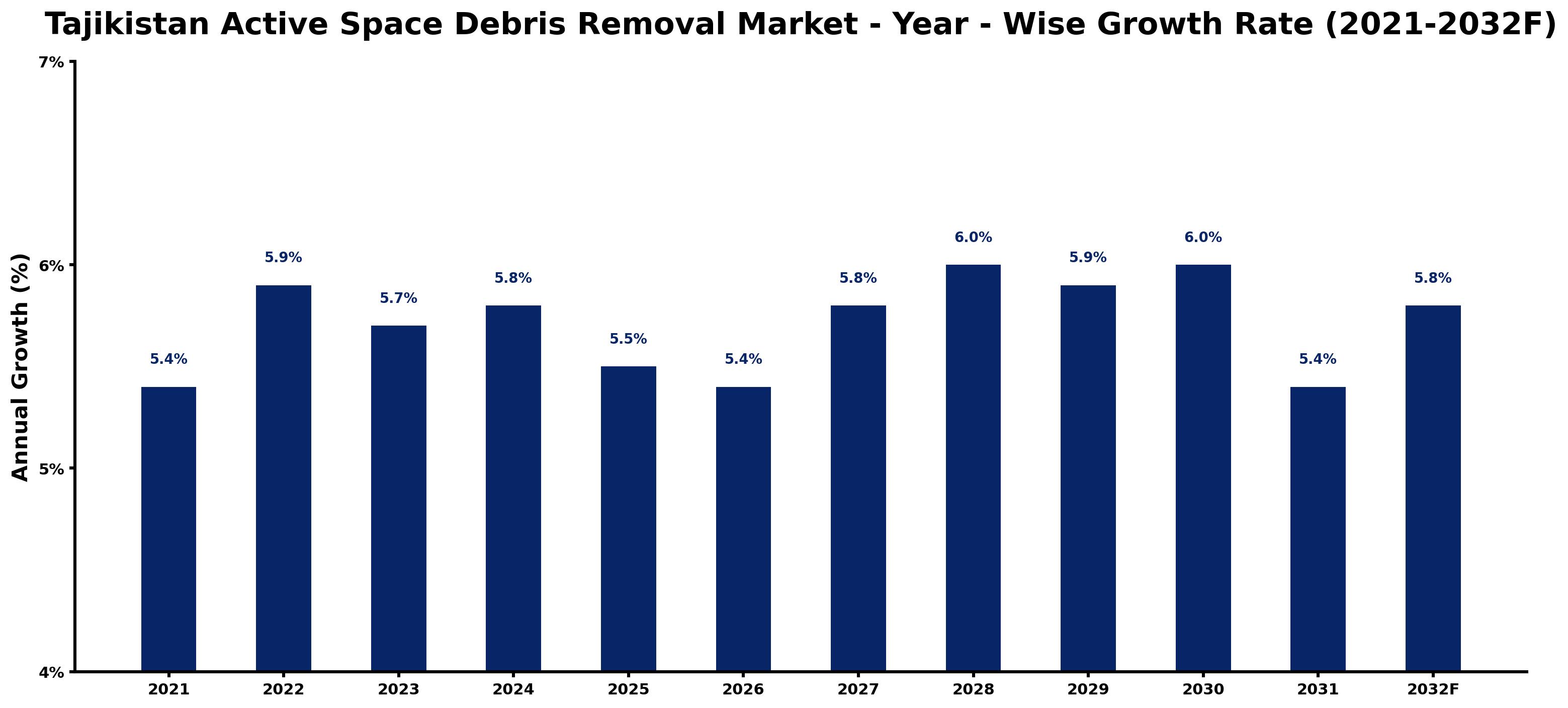
The table below presents the year‑wise growth rates along with the key drivers influencing the market
| Year | Growth Rate | Major Drivers |
| 2021 | 5.4% | Expansion of manufacturing activities |
| 2022 | 5.9% | Expansion of commercial construction activities |
| 2023 | 5.7% | Expansion of commercial construction activities |
| 2024 | 5.8% | Growing renewable energy integration projects |
| 2025 | 5.5% | Rapid growth in telecom and data center sectors |
| 2026 | 5.4% | Growing renewable energy integration projects |
| 2027 | 5.8% | Growing renewable energy integration projects |
| 2028 | 6.0% | Government infrastructure modernization initiatives |
| 2029 | 5.9% | Growing renewable energy integration projects |
| 2030 | 6.0% | Rising electricity demand across industries |
| 2031 | 5.4% | Expansion of manufacturing activities |
| 2032 | 5.8% | Rising electricity demand across industries |
Note - Market size estimations and growth projections presented in this report are based on 6Wresearch's advanced forecasting approach, validated with industry datasets as of June 2026.
Tajikistan Active Space Debris Removal Market Synopsis
Despite its current nascent stage, the demand for active space debris removal solutions in Tajikistan is gaining momentum. The government's proactive stance on collaborating with international organizations reflects a growing recognition of the importance of maintaining sustainable space operations, which is crucial for the country's technological aspirations.
Research initiatives focusing on advanced technologies like lasers to clear orbital debris highlight the innovative potential within Tajikistan. These efforts may pave the way for both domestic and foreign investment, fostering a burgeoning market for services aimed at protecting space assets from contamination.
Tajikistan Active Space Debris Removal Market Key Takeaways
- The market is currently undeveloped but shows high potential for growth driven by government initiatives.
- International collaboration is set to play a key role in shaping market capabilities and services.
- Innovative research is underway to address space debris, indicating emerging technological advancements.
- Commercial opportunities could arise as local capacities are built through international partnerships.
- Growing recognition of the hazards posed by orbital debris will drive demand for removal services.
Evaluation of Restraints in Tajikistan Active Space Debris Removal Market
The primary restraint limiting the Tajikistan active space debris removal market is its current lack of infrastructure and service providers dedicated to debris removal. This nascent stage results in a reliance on international entities for expertise, technology, and funding, which can complicate the establishment of a local market. Additionally, the absence of existing legislation governing space operations further inhibits the ability to foster a vibrant sector, as clear regulations and frameworks are essential for attracting investment and guiding operational standards.
Tajikistan Active Space Debris Removal Market Trends
One of the most significant trends within the Tajikistan market is the burgeoning focus on international collaboration to build capacity in space operations. This includes significant interest from private entities looking to invest in innovative technologies tailored for space debris mitigation. Moreover, the exploration of novel methodologies, such as laser technology for debris deflection, is gaining traction among local research groups, which may ultimately influence the commercial landscape.
Tajikistan Active Space Debris Removal Market Opportunities
Significant growth opportunities exist for companies looking to establish operations in Tajikistan's active space debris removal market. As international entities partner with the government to enhance local capabilities, investments in technology development and research projects will likely proliferate. Furthermore, as awareness of space debris issues rises globally, Tajikistan may become an attractive hub for innovative space solutions, presenting lucrative opportunities for both local and foreign stakeholders.
Government Initiatives in the Tajikistan Active Space Debris Removal Market
The government of Tajikistan has demonstrated a commitment to tackling space debris issues through its collaboration with international organizations, particularly the signing of a Memorandum of Understanding with UNOOSA. This initiative aims to enhance local capabilities related to outer space operations, underscoring a willingness to engage in capacity-building activities. As the government continues to prioritize space sustainability, public spending on relevant technologies and research programs may increase, providing a further boost to the market.
Future Insights of the Tajikistan Active Space Debris Removal Market
Looking ahead to 2026-2032, the Tajikistan active space debris removal market is expected to evolve significantly. The combination of international partnerships and enhanced local research initiatives will likely foster an environment ripe for growth. As the government continues to support innovation and regulatory frameworks, the emergence of commercial services for debris removal could solidify the country's role in the global space economy.
Tajikistan Active Space Debris Removal Market Latest Developments (May 2025 - June 2026)
Recent developments in Tajikistan's active space debris removal sector indicate a progressive direction. Increased interest from international organizations has sparked dialogue around best practices in debris management, as local research groups ramp up efforts to explore cutting-edge technologies. Collaborative workshops aimed at knowledge sharing are also emerging, fostering a robust environment for innovation as stakeholders align on mutual goals for sustainable space operations.
Tajikistan Active Space Debris Removal Market - Key Attractiveness of the Report
- 10 Years of Market Numbers
- Historical Data Starting from 2022 to 2025
- Base Year: 2025
- Forecast Data until 2032
- Key Performance Indicators Impacting the Market
- Major Upcoming Developments and Projects
Key Highlights of the Report:
- Tajikistan Active Space Debris Removal Market Outlook
- Market Size of Tajikistan Active Space Debris Removal Market, 2025
- Forecast of Tajikistan Active Space Debris Removal Market, 2032F
- Historical Data and Forecast of Tajikistan Active Space Debris Removal Revenues & Volume for the Period 2022-2032F
- Tajikistan Active Space Debris Removal Market Trend Evolution
- Tajikistan Active Space Debris Removal Market Drivers and Challenges
- Tajikistan Active Space Debris Removal Price Trends
- Tajikistan Active Space Debris Removal Porter's Five Forces
- Tajikistan Active Space Debris Removal Industry Life Cycle
- Historical Data and Forecast of Tajikistan Active Space Debris Removal Market Revenues & Volume By Debris Size for the Period 2022-2032F
- Historical Data and Forecast of Tajikistan Active Space Debris Removal Market Revenues & Volume By Between 1 mm and 1 cm for the Period 2022-2032F
- Historical Data and Forecast of Tajikistan Active Space Debris Removal Market Revenues & Volume By Between 1 cm to 10 cm for the Period 2022-2032F
- Historical Data and Forecast of Tajikistan Active Space Debris Removal Market Revenues & Volume By More than 10 cm for the Period 2022-2032F
- Historical Data and Forecast of Tajikistan Active Space Debris Removal Market Revenues & Volume By End-users for the Period 2022-2032F
- Historical Data and Forecast of Tajikistan Active Space Debris Removal Market Revenues & Volume By Commercial for the Period 2022-2032F
- Historical Data and Forecast of Tajikistan Active Space Debris Removal Market Revenues & Volume By Defense for the Period 2022-2032F
- Tajikistan Active Space Debris Removal Import Export Trade Statistics
- Market Opportunity Assessment By Debris Size
- Market Opportunity Assessment By End-users
- Tajikistan Active Space Debris Removal Top Companies Market Share
- Tajikistan Active Space Debris Removal Competitive Benchmarking By Technical and Operational Parameters
- Tajikistan Active Space Debris Removal Company Profiles
- Tajikistan Active Space Debris Removal Key Strategic Recommendations






































