Tajikistan Aerosol Market Size, Share & Growth Rate
The Tajikistan Aerosol Market was estimated at USD 158 Million in 2025 and is projected to reach USD 222 Million by 2032, growing at a CAGR of 5.0% from 2026 to 2032. This growth trajectory is primarily driven by an increasing consumer focus on personal hygiene and home care, particularly in urban areas. The rise in disposable income and a shift towards convenience-oriented products are also significant factors fostering market expansion.
Tajikistan Aerosol Market Year-wise Growth Rate and Key Drivers
This graph highlights how the Tajikistan Aerosol Market has steadily grown over the years, supported by major growth factors.
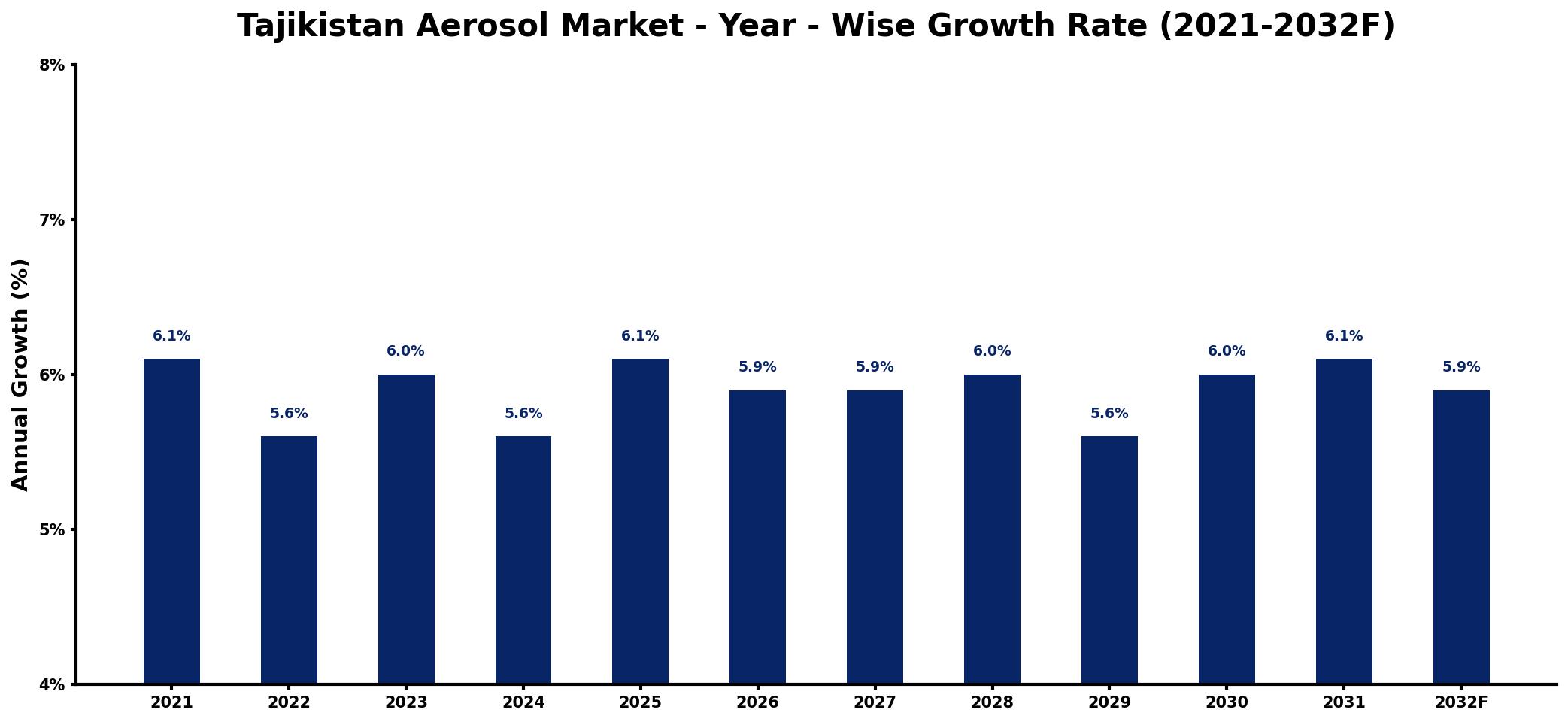
The table below presents the year‑wise growth rates along with the key drivers influencing the market
| Year | Growth Rate | Major Drivers |
| 2021 | 6.1% | rising consumer health awareness |
| 2022 | 5.6% | increased household cleaning needs |
| 2023 | 6.0% | growing demand for convenience |
| 2024 | 5.6% | expansion of retail distribution channels |
| 2025 | 6.1% | increased investment in innovation |
| 2026 | 5.9% | enhanced marketing strategies adopted |
| 2027 | 5.9% | growth in personal care sector |
| 2028 | 6.0% | increased focus on sustainability |
| 2029 | 5.6% | rising popularity of home improvement |
| 2030 | 6.0% | expanding e-commerce market presence |
| 2031 | 6.1% | enhanced product quality standards |
| 2032 | 5.9% | increased domestic production output |
Note: Market size estimations and growth projections presented in this report are based on 6Wresearch's proprietary forecasting methodology, utilizing the latest available industry data, government publications, and primary research inputs.
Tajikistan Aerosol Market Synopsis
Consumer awareness surrounding personal hygiene is the strongest force shaping the Tajikistan Aerosol Market today. As urbanization continues to rise, consumers are actively seeking effective aerosol solutions for home care and personal grooming.
The market features a diverse array of aerosol products, including air fresheners, insecticides, and personal care items. In response to growing environmental concerns, manufacturers are increasingly focusing on sustainable and eco-friendly options, aligning product development with consumer preferences.
Tajikistan Aerosol Market Key Takeaways
- Steady growth is fueled by rising disposable incomes and urbanization trends.
- Consumer preference for convenience is driving demand for aerosol personal care and cleaning products.
- Innovation in product formulations is focusing on eco-friendliness and sustainability.
- The impact of the COVID-19 pandemic has led to heightened awareness of hygiene products.
- Competitive dynamics are influenced by regulatory frameworks governing aerosol product safety.
Evaluation of Restraints in Tajikistan Aerosol Market
Despite the market's growth potential, several constraints limit its development. The limited consumer awareness and understanding of aerosol products hinder wider acceptance, leaving demand lower compared to other packaging forms. Additionally, local manufacturers often face challenges related to outdated production technologies, which make it difficult to compete with imported goods. Furthermore, high raw material costs and stringent regulatory requirements pose additional hurdles for businesses aiming to thrive in this market.
Tajikistan Aerosol Market Trends
The Tajikistan aerosol market is characterized by several emerging trends. A notable increase in demand for multi-purpose aerosol products reflects a shift towards convenience in consumer lifestyles. Moreover, the ongoing trend towards eco-friendly packaging is driving manufacturers to innovate with sustainable materials and formulations. The pandemic has accentuated the significance of hygiene, with disinfectants and sanitizers seeing a substantial uptick in consumption, which is likely to influence product development in the near future.
Tajikistan Aerosol Market Opportunities
Significant growth and investment opportunities exist across various sectors of the Tajikistan aerosol market. Areas such as personal care products and household cleaning solutions offer avenues for new entrants to innovate. With urbanization continuing to rise, the demand for efficient and user-friendly aerosol products is set to grow. Investors can benefit by introducing sustainable options that resonate with environmentally conscious consumers, while partnerships with local retailers will facilitate deeper market penetration.
Government Initiatives in the Tajikistan Aerosol Market
The Tajik government has implemented several policies aimed at ensuring the safety and environmental protection of aerosol products. Regulatory frameworks focus on the oversight of aerosol product registration to meet stringent safety standards. Furthermore, the government actively regulates the use of harmful ingredients, ensuring that public health remains a priority. These initiatives create a conducive environment for the market, promoting both consumer safety and the growth of sustainable practices.
Future Insights of the Tajikistan Aerosol Market
The Tajikistan aerosol market is poised for promising advancements between 2026 and 2032. As disposable incomes rise and consumer expectations evolve, aerosol products are increasingly seen as an essential part of daily routines. The trend towards sustainable product offerings is expected to gain momentum, influenced by consumer demand for environmentally responsible alternatives. Regulatory challenges will remain, but innovations aimed at meeting compliance can spur growth, positioning the market for success in the coming years.
Tajikistan Aerosol Market Latest Developments (2025 - 2026)
Recent developments in the Tajikistan aerosol market showcase a focus on innovative product launches and sustainability initiatives. Manufacturers are introducing new formulations that emphasize natural ingredients and reduced environmental impact. Additionally, partnerships between companies and local distributors are being forged to enhance distribution networks, improving accessibility for consumers. The growing trend towards e-commerce is also changing how aerosol products are marketed and sold, creating new avenues for growth.
Tajikistan Aerosol Market - Key Attractiveness of the Report
- 10 Years of Market Numbers
- Historical Data Starting from 2022 to 2025
- Base Year: 2025
- Forecast Data until 2032
- Key Performance Indicators Impacting the Market
- Major Upcoming Developments and Projects
Key Highlights of the Report:
- Tajikistan Aerosol Market Outlook
- Market Size of Tajikistan Aerosol Market, 2025
- Forecast of Tajikistan Aerosol Market, 2032
- Historical Data and Forecast of Tajikistan Aerosol Revenues & Volume for the Period 2022-2032F
- Tajikistan Aerosol Market Trend Evolution
- Tajikistan Aerosol Market Drivers and Challenges
- Tajikistan Aerosol Price Trends
- Tajikistan Aerosol Porter's Five Forces
- Tajikistan Aerosol Industry Life Cycle
- Historical Data and Forecast of Tajikistan Aerosol Market Revenues & Volume By Material for the Period 2022-2032F
- Historical Data and Forecast of Tajikistan Aerosol Market Revenues & Volume By Steel for the Period 2022-2032F
- Historical Data and Forecast of Tajikistan Aerosol Market Revenues & Volume By Aluminum for the Period 2022-2032F
- Historical Data and Forecast of Tajikistan Aerosol Market Revenues & Volume By Others for the Period 2022-2032F
- Historical Data and Forecast of Tajikistan Aerosol Market Revenues & Volume By Type for the Period 2022-2032F
- Historical Data and Forecast of Tajikistan Aerosol Market Revenues & Volume By Bag-In-Valve for the Period 2022-2032F
- Historical Data and Forecast of Tajikistan Aerosol Market Revenues & Volume By Standard for the Period 2022-2032F
- Historical Data and Forecast of Tajikistan Aerosol Market Revenues & Volume By Application for the Period 2022-2032F
- Historical Data and Forecast of Tajikistan Aerosol Market Revenues & Volume By Personal Care for the Period 2022-2032F
- Historical Data and Forecast of Tajikistan Aerosol Market Revenues & Volume By Household for the Period 2022-2032F
- Historical Data and Forecast of Tajikistan Aerosol Market Revenues & Volume By Automotive & Industrial for the Period 2022-2032F
- Historical Data and Forecast of Tajikistan Aerosol Market Revenues & Volume By Food for the Period 2022-2032F
- Historical Data and Forecast of Tajikistan Aerosol Market Revenues & Volume By Paints for the Period 2022-2032F
- Historical Data and Forecast of Tajikistan Aerosol Market Revenues & Volume By Medical for the Period 2022-2032F
- Historical Data and Forecast of Tajikistan Aerosol Market Revenues & Volume By Others for the Period 2022-2032F
- Tajikistan Aerosol Import Export Trade Statistics
- Market Opportunity Assessment By Material
- Market Opportunity Assessment By Type
- Market Opportunity Assessment By Application
- Tajikistan Aerosol Top Companies Market Share
- Tajikistan Aerosol Competitive Benchmarking By Technical and Operational Parameters
- Tajikistan Aerosol Company Profiles
- Tajikistan Aerosol Key Strategic Recommendations






































