Tajikistan Aircraft Cabin Interior Market Size, Share & Growth Rate
The Tajikistan Aircraft Cabin Interior Market was estimated at USD 510 Million in 2025 and is projected to reach USD 918 Million by 2032, growing at a CAGR of 8.8% from 2026 to 2032. This growth is primarily driven by the burgeoning air travel demand as regional airlines expand their fleets and services. A focus on passenger comfort and innovative design solutions is compelling manufacturers to invest in high-quality cabin interiors that cater to modern travelers' expectations.
Tajikistan Aircraft Cabin Interior Market Year-wise Growth Rate and Key Drivers
This graph highlights how the Tajikistan Aircraft Cabin Interior Market has steadily grown over the years, supported by major growth factors.
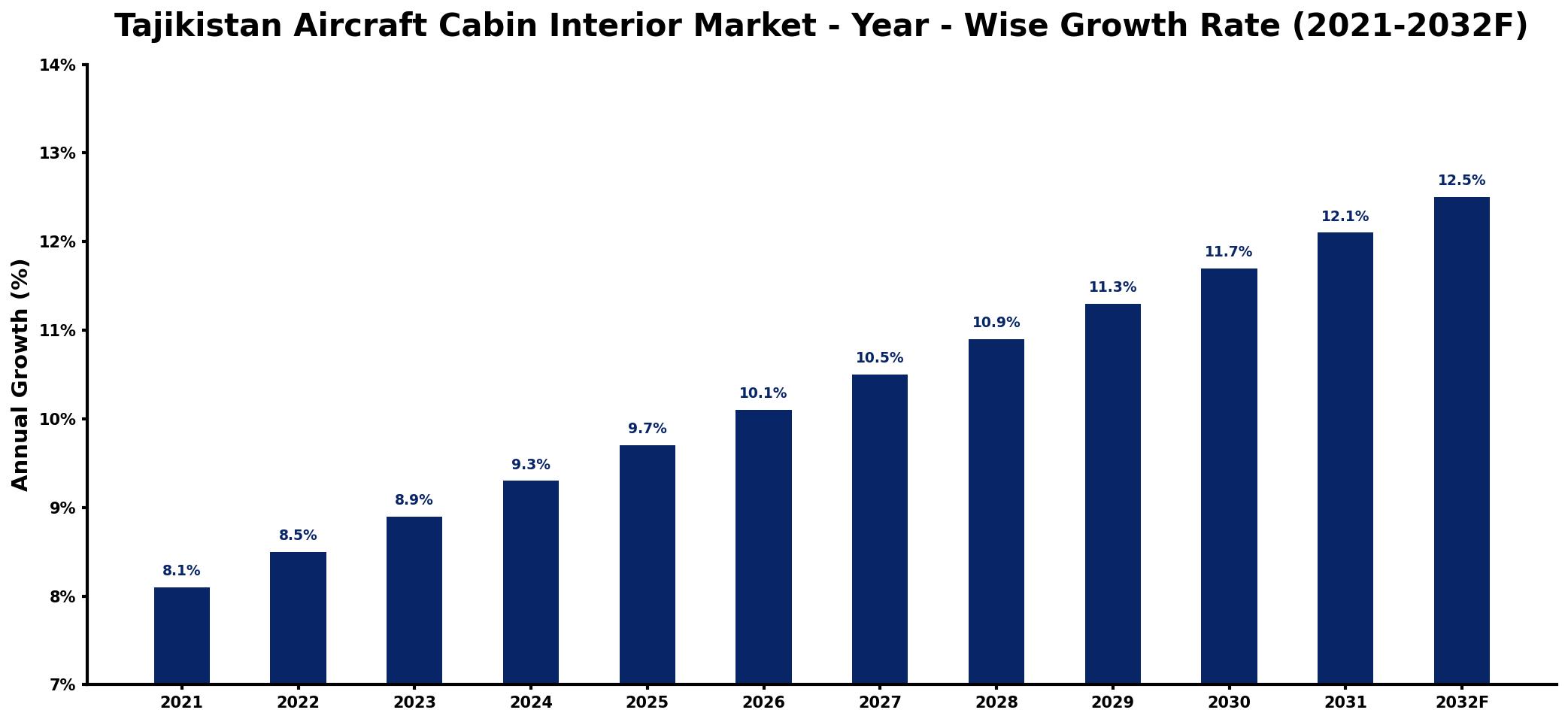
The table below presents the year‑wise growth rates along with the key drivers influencing the market
| Year | Growth Rate | Major Drivers |
| 2021 | 8.1% | Rising demand for regional travel |
| 2022 | 8.5% | Increased investments in aviation infrastructure |
| 2023 | 8.9% | Expansion of domestic airline services |
| 2024 | 9.3% | Growing tourism industry and routes |
| 2025 | 9.7% | Emerging market for business aviation |
| 2026 | 10.1% | expanding healthcare application demand |
| 2027 | 10.5% | Strengthened international trade agreements |
| 2028 | 10.9% | Enhanced passenger comfort expectations |
| 2029 | 11.3% | Government incentives for fleet upgrades |
| 2030 | 11.7% | Growing focus on sustainability practices |
| 2031 | 12.1% | Increased competition among airlines |
| 2032 | 12.5% | Rising disposable income among travelers |
Note: Market size estimations and growth projections presented in this report are based on 6Wresearch's proprietary forecasting methodology, utilizing the latest available industry data, government publications, and primary research inputs.
Tajikistan Aircraft Cabin Interior Market Synopsis
The Tajikistan Aircraft Cabin Interior Market is at a pivotal juncture, characterized by a growing recognition of the importance of passenger experience. Airlines in the region are modernizing their cabin interiors to enhance comfort and functionality, reflecting a global trend towards more luxurious and personalized flying experiences.
As the aviation landscape in Tajikistan evolves, manufacturers are responding with innovations in materials and designs. These developments not only focus on aesthetics but also prioritize sustainability and efficiency, ensuring compliance with international standards while catering to the diverse preferences of passengers.
Tajikistan Aircraft Cabin Interior Market Key Takeaways
- The market is experiencing rapid growth driven by increased demand for air travel and fleet modernization.
- Customization and personalization of cabin interiors are emerging as key differentiators among airlines.
- Investment in lightweight and sustainable materials is reshaping the design and functionality of cabin interiors.
- Collaborations between airlines and interior suppliers are rising to develop tailored cabin solutions.
- Government policies aimed at supporting the aviation sector are creating an advantageous environment for market growth.
Evaluation of Restraints in Tajikistan Aircraft Cabin Interior Market
While the Tajikistan Aircraft Cabin Interior Market holds promise, it is hindered by several constraints. Limited infrastructure for aircraft maintenance and refurbishment poses significant challenges, as does the dependency on imported materials for cabin interiors. Additionally, the lack of skilled labor in the region for design and installation further restricts market potential. These challenges necessitate concerted efforts to improve training, enhance local manufacturing capabilities, and foster partnerships to ensure a sustainable growth trajectory.
Tajikistan Aircraft Cabin Interior Market Trends
A notable trend within the Tajikistan Aircraft Cabin Interior Market is the adoption of lightweight materials that not only enhance passenger comfort but also reduce fuel consumption. The shift towards environmentally friendly and energy-efficient solutions aligns with global sustainability goals, pushing airlines to prioritize innovative upgrades. Furthermore, advanced in-flight entertainment systems and connectivity options are becoming essential in meeting the expectations of a digitally savvy traveler.
Tajikistan Aircraft Cabin Interior Market Opportunities
Investment opportunities abound in the Tajikistan Aircraft Cabin Interior Market, particularly in the retrofitting of existing aircraft. As airlines strive to elevate passenger experience, there is a burgeoning demand for modernized cabin interiors that prioritize comfort and aesthetic appeal. Collaborations with local airlines can provide a platform for companies to deliver tailored maintenance, repair, and overhaul services, tapping into a market ripe for development.
Government Initiatives in the Tajikistan Aircraft Cabin Interior Market
The Tajikistan government is actively promoting the growth of the Aircraft Cabin Interior Market through various initiatives. These include tax incentives to attract foreign investments, as well as funding for research and development focused on innovative cabin interior solutions. Regulations ensuring compliance with international safety standards further bolster the competitiveness of local products in the global arena, paving the way for improved quality and innovation.
Future Insights of the Tajikistan Aircraft Cabin Interior Market
Looking ahead to 2026-2032, the Tajikistan Aircraft Cabin Interior Market is poised for steady expansion. The anticipated recovery of the global aviation industry post-pandemic will likely fuel demand for upgraded cabin interiors. With a continual focus on passenger comfort and experience, airlines are expected to increasingly invest in cutting-edge cabin technology and design. Government support for infrastructure improvements and industry growth will play a crucial role in shaping the future landscape of this market.
Tajikistan Aircraft Cabin Interior Market Latest Developments (2025 - 2026)
Recent developments in the Tajikistan Aircraft Cabin Interior Market indicate a growing trend towards more innovative and comfortable cabin designs. Airlines are exploring partnerships with interior suppliers to introduce advanced customization options for their fleets. Efforts to improve training and development for local labor in cabin interior design and installation are also gaining momentum, reflecting a commitment to enhance regional capabilities.
Tajikistan Aircraft Cabin Interior Market - Key Attractiveness of the Report
- 10 Years of Market Numbers
- Historical Data Starting from 2022 to 2025
- Base Year: 2025
- Forecast Data until 2032
- Key Performance Indicators Impacting the Market
- Major Upcoming Developments and Projects
Key Highlights of the Report:
- Tajikistan Aircraft Cabin Interior Market Outlook
- Market Size of Tajikistan Aircraft Cabin Interior Market, 2025
- Forecast of Tajikistan Aircraft Cabin Interior Market, 2032
- Historical Data and Forecast of Tajikistan Aircraft Cabin Interior Revenues & Volume for the Period 2022-2032F
- Tajikistan Aircraft Cabin Interior Market Trend Evolution
- Tajikistan Aircraft Cabin Interior Market Drivers and Challenges
- Tajikistan Aircraft Cabin Interior Price Trends
- Tajikistan Aircraft Cabin Interior Porter's Five Forces
- Tajikistan Aircraft Cabin Interior Industry Life Cycle
- Historical Data and Forecast of Tajikistan Aircraft Cabin Interior Market Revenues & Volume By Type for the Period 2022-2032F
- Historical Data and Forecast of Tajikistan Aircraft Cabin Interior Market Revenues & Volume By Seats for the Period 2022-2032F
- Historical Data and Forecast of Tajikistan Aircraft Cabin Interior Market Revenues & Volume By Cabin Lightening for the Period 2022-2032F
- Historical Data and Forecast of Tajikistan Aircraft Cabin Interior Market Revenues & Volume By Windows and Windshields for the Period 2022-2032F
- Historical Data and Forecast of Tajikistan Aircraft Cabin Interior Market Revenues & Volume By Galley and Lavatory for the Period 2022-2032F
- Historical Data and Forecast of Tajikistan Aircraft Cabin Interior Market Revenues & Volume By In-Flight Entertainment & Connectivity for the Period 2022-2032F
- Historical Data and Forecast of Tajikistan Aircraft Cabin Interior Market Revenues & Volume By Others for the Period 2022-2032F
- Historical Data and Forecast of Tajikistan Aircraft Cabin Interior Market Revenues & Volume By Class for the Period 2022-2032F
- Historical Data and Forecast of Tajikistan Aircraft Cabin Interior Market Revenues & Volume By First Class for the Period 2022-2032F
- Historical Data and Forecast of Tajikistan Aircraft Cabin Interior Market Revenues & Volume By Business Class for the Period 2022-2032F
- Historical Data and Forecast of Tajikistan Aircraft Cabin Interior Market Revenues & Volume By Premium Economy Class for the Period 2022-2032F
- Historical Data and Forecast of Tajikistan Aircraft Cabin Interior Market Revenues & Volume By Economy Class for the Period 2022-2032F
- Historical Data and Forecast of Tajikistan Aircraft Cabin Interior Market Revenues & Volume By Aircraft Type for the Period 2022-2032F
- Historical Data and Forecast of Tajikistan Aircraft Cabin Interior Market Revenues & Volume By Narrow Body Aircraft for the Period 2022-2032F
- Historical Data and Forecast of Tajikistan Aircraft Cabin Interior Market Revenues & Volume By Wide-Body Aircraft for the Period 2022-2032F
- Historical Data and Forecast of Tajikistan Aircraft Cabin Interior Market Revenues & Volume By Business Jets for the Period 2022-2032F
- Historical Data and Forecast of Tajikistan Aircraft Cabin Interior Market Revenues & Volume By Regional Transport Aircraft for the Period 2022-2032F
- Historical Data and Forecast of Tajikistan Aircraft Cabin Interior Market Revenues & Volume By End User for the Period 2022-2032F
- Historical Data and Forecast of Tajikistan Aircraft Cabin Interior Market Revenues & Volume By OEM for the Period 2022-2032F
- Historical Data and Forecast of Tajikistan Aircraft Cabin Interior Market Revenues & Volume By Aftermarket for the Period 2022-2032F
- Tajikistan Aircraft Cabin Interior Import Export Trade Statistics
- Market Opportunity Assessment By Type
- Market Opportunity Assessment By Class
- Market Opportunity Assessment By Aircraft Type
- Market Opportunity Assessment By End User
- Tajikistan Aircraft Cabin Interior Top Companies Market Share
- Tajikistan Aircraft Cabin Interior Competitive Benchmarking By Technical and Operational Parameters
- Tajikistan Aircraft Cabin Interior Company Profiles
- Tajikistan Aircraft Cabin Interior Key Strategic Recommendations






































