Tajikistan Aircraft Engine Market Size, Share & Growth Rate
The Tajikistan Aircraft Engine Market was estimated at USD 1136 Million in 2025 and is projected to reach USD 2090 Million by 2032, growing at a CAGR of 9.1% from 2026 to 2032. This growth trajectory is primarily fueled by the increasing demand for both commercial and military aircraft, alongside government initiatives aimed at modernizing the aviation sector. As air travel expands and regional connectivity improves, the need for advanced and reliable aircraft engines is becoming more pronounced, driving investment and innovation in this market.
Tajikistan Aircraft Engine Market Year-wise Growth Rate and Key Drivers
This graph highlights how the Tajikistan Aircraft Engine Market has steadily grown over the years, supported by major growth factors.
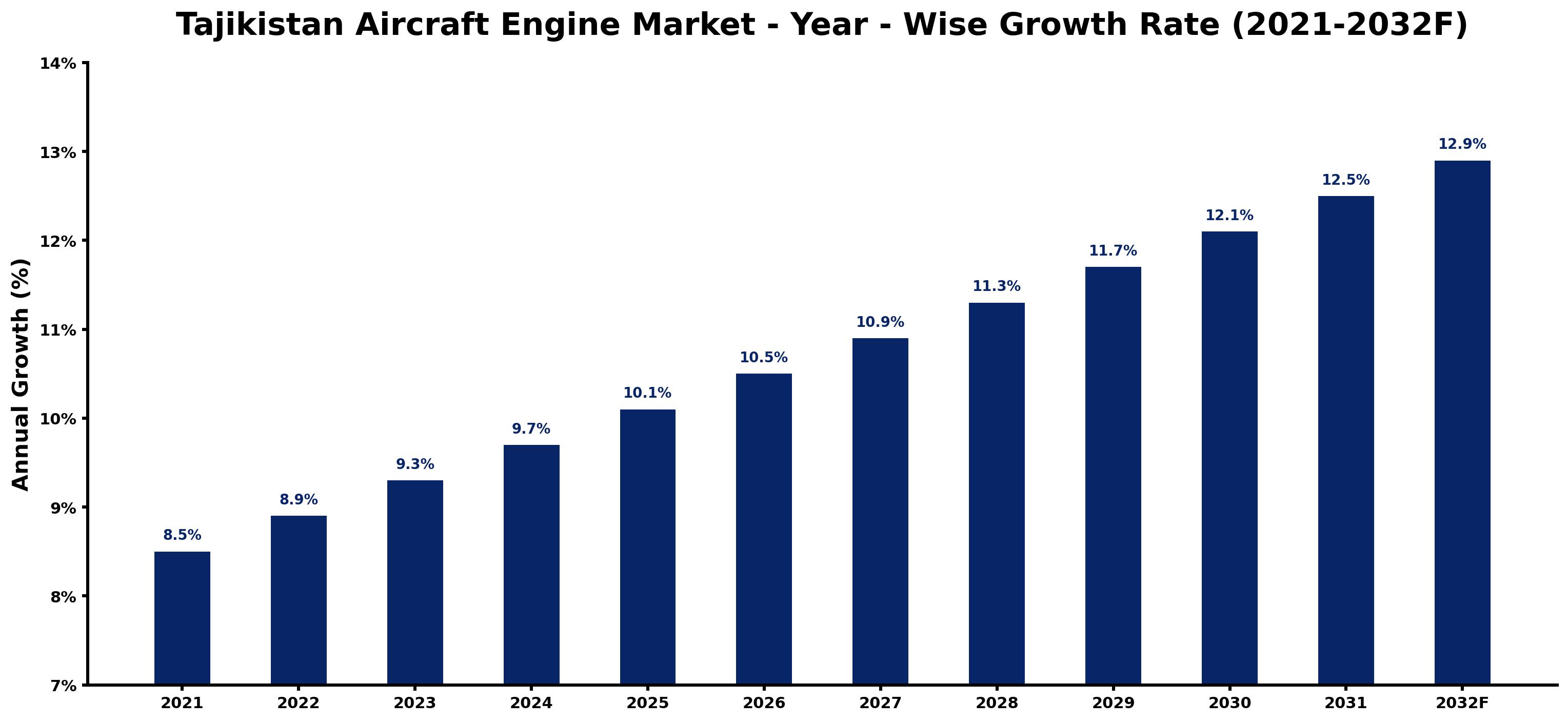
The table below presents the year‑wise growth rates along with the key drivers influencing the market
| Year | Growth Rate | Major Drivers |
| 2021 | 8.5% | Government infrastructure modernization initiatives |
| 2022 | 8.9% | Expansion of commercial construction activities |
| 2023 | 9.3% | Expansion of commercial construction activities |
| 2024 | 9.7% | Increasing adoption of advanced technologies |
| 2025 | 10.1% | Increasing smart city development projects |
| 2026 | 10.5% | Expansion of commercial construction activities |
| 2027 | 10.9% | Expansion of manufacturing activities |
| 2028 | 11.3% | Increasing industrial automation investments |
| 2029 | 11.7% | Expansion of transportation and logistics networks |
| 2030 | 12.1% | Growing urbanization and commercial development |
| 2031 | 12.5% | Expansion of manufacturing activities |
| 2032 | 12.9% | Growing renewable energy integration projects |
Note - Market size estimations and growth projections presented in this report are based on 6Wresearch’s advanced forecasting approach, validated with industry datasets as of June 2026.
Tajikistan Aircraft Engine Market Synopsis
The demand for aircraft engines in Tajikistan is significantly influenced by the government's commitment to enhancing air connectivity. With strategic plans to upgrade airports and expand aviation services, there is a notable uptick in the need for modern aircraft engines that align with global standards. This increasing demand is fostering a conducive environment for both domestic growth and international partnerships.
On the supply side, international manufacturers dominate the Tajikistan Aircraft Engine Market, providing a diverse range of engines for commercial and military applications. However, local initiatives aimed at developing maintenance and repair capabilities are gradually emerging, presenting a unique opportunity for investment and innovation in domestic engine services.
Tajikistan Aircraft Engine Market Key Takeaways
- The market is experiencing steady growth due to rising demand for aircraft in both commercial and military sectors.
- Government modernization efforts are driving investments in aviation infrastructure, including aircraft engines.
- Technological advancements focus on fuel efficiency and reduced emissions, aligning with global aviation trends.
- Challenges related to maintenance infrastructure are prompting opportunities for investment in local services.
- Future growth will hinge on government support and the ability to adapt to international aviation standards.
Evaluation of Restraints in Tajikistan Aircraft Engine Market
Despite its promising growth, the Tajikistan Aircraft Engine Market is hampered by several key restraints. Limited infrastructure for maintenance and repair of aircraft engines poses significant challenges, resulting in higher costs and longer downtimes for airlines. Furthermore, a shortage of skilled technicians exacerbates the problem, as there is insufficient domestic capability to meet the growing demand for reliable engine services. The regulatory landscape, although improving, still presents hurdles regarding compliance with international standards, impacting both import and export activities. These factors collectively inhibit the market's growth potential, necessitating focused investment and development strategies.
Tajikistan Aircraft Engine Market Trends
A notable trend in the Tajikistan Aircraft Engine Market is the shift towards adopting fuel-efficient and environmentally friendly engines. This is in response to the global aviation industry's efforts to reduce carbon emissions. Local manufacturers are increasingly prioritizing the use of advanced technologies, such as lightweight materials and efficient combustion systems, to enhance engine performance while minimizing environmental impact. Additionally, there is a growing expectation for engines that offer greater reliability and lower maintenance costs, driving demand for more sophisticated solutions.
Tajikistan Aircraft Engine Market Opportunities
The expanding aviation sector in Tajikistan presents numerous investment opportunities, particularly in the maintenance and repair services for aircraft engines. With an increasing fleet of aircraft, local operators require dependable support services, creating a niche for investors. Furthermore, partnerships with international engine manufacturers could facilitate technology transfer and enhance local capabilities. Another promising avenue lies in exploring the potential for developing domestically manufactured aircraft engines, catering to both domestic needs and export possibilities within the Central Asian region.
Government Initiatives in the Tajikistan Aircraft Engine Market
The Tajikistan government is actively fostering the growth of the aircraft engine market through various policy initiatives. These include tax incentives aimed at attracting foreign investment in the aerospace sector and financial support for research and development endeavors. Additionally, partnerships with international organizations are being leveraged to bolster local manufacturing capabilities, enhancing the overall competitiveness of the aviation industry. Regulatory frameworks are being refined to ensure compliance with international aviation standards, thereby promoting safety and operational efficiency in the market.
Future Insights of the Tajikistan Aircraft Engine Market
Looking ahead to the period from 2026 to 2032, the Tajikistan Aircraft Engine Market is poised for significant expansion. Driven by the increasing demand for air travel and ongoing governmental initiatives to upgrade air infrastructure, the market is set to witness robust growth. Investments in more fuel-efficient engines will be essential for airlines seeking to optimize operational costs while adhering to environmental regulations. However, market participants must remain vigilant about potential challenges, including fluctuating fuel prices and evolving regulatory landscapes, which could influence competitive dynamics.
Tajikistan Aircraft Engine Market Latest Developments (May 2025 - June 2026)
Recent developments in the Tajikistan Aircraft Engine Market indicate a strong push towards modernizing the existing aviation infrastructure. Initiatives aimed at enhancing maintenance capabilities are gaining traction, with both public and private sectors showing interest in upgrading facilities. Furthermore, ongoing dialogues between the government and international engine manufacturers are paving the way for potential partnerships that could streamline engine supply and support services, signaling a promising direction for the market.
Tajikistan Aircraft Engine Market - Key Attractiveness of the Report
- 10 Years of Market Numbers
- Historical Data Starting from 2022 to 2025
- Base Year: 2025
- Forecast Data until 2032
- Key Performance Indicators Impacting the Market
- Major Upcoming Developments and Projects
Key Highlights of the Report:
- Tajikistan Aircraft Engine Market Outlook
- Market Size of Tajikistan Aircraft Engine Market, 2025
- Forecast of Tajikistan Aircraft Engine Market, 2032
- Historical Data and Forecast of Tajikistan Aircraft Engine Revenues & Volume for the Period 2022-2032F
- Tajikistan Aircraft Engine Market Trend Evolution
- Tajikistan Aircraft Engine Market Drivers and Challenges
- Tajikistan Aircraft Engine Price Trends
- Tajikistan Aircraft Engine Porter's Five Forces
- Tajikistan Aircraft Engine Industry Life Cycle
- Historical Data and Forecast of Tajikistan Aircraft Engine Market Revenues & Volume By Type for the Period 2022-2032F
- Historical Data and Forecast of Tajikistan Aircraft Engine Market Revenues & Volume By Turboprop for the Period 2022-2032F
- Historical Data and Forecast of Tajikistan Aircraft Engine Market Revenues & Volume By Turbofan for the Period 2022-2032F
- Historical Data and Forecast of Tajikistan Aircraft Engine Market Revenues & Volume By Turboshaft for the Period 2022-2032F
- Historical Data and Forecast of Tajikistan Aircraft Engine Market Revenues & Volume By Piston Engine for the Period 2022-2032F
- Historical Data and Forecast of Tajikistan Aircraft Engine Market Revenues & Volume By Application for the Period 2022-2032F
- Historical Data and Forecast of Tajikistan Aircraft Engine Market Revenues & Volume By Military Aviation for the Period 2022-2032F
- Historical Data and Forecast of Tajikistan Aircraft Engine Market Revenues & Volume By Commercial Aviation for the Period 2022-2032F
- Historical Data and Forecast of Tajikistan Aircraft Engine Market Revenues & Volume By General Aviation for the Period 2022-2032F
- Historical Data and Forecast of Tajikistan Aircraft Engine Market Revenues & Volume By Platform for the Period 2022-2032F
- Historical Data and Forecast of Tajikistan Aircraft Engine Market Revenues & Volume By Fixed Wing for the Period 2022-2032F
- Historical Data and Forecast of Tajikistan Aircraft Engine Market Revenues & Volume By Rotary Wing for the Period 2022-2032F
- Tajikistan Aircraft Engine Import Export Trade Statistics
- Market Opportunity Assessment By Type
- Market Opportunity Assessment By Application
- Market Opportunity Assessment By Platform
- Tajikistan Aircraft Engine Top Companies Market Share
- Tajikistan Aircraft Engine Competitive Benchmarking By Technical and Operational Parameters
- Tajikistan Aircraft Engine Company Profiles
- Tajikistan Aircraft Engine Key Strategic Recommendations






































