Tajikistan Aircraft Seat Upholstery Market Size, Share & Growth Rate
The Tajikistan Aircraft Seat Upholstery Market was estimated at USD 1111 Million in 2025 and is projected to reach USD 2100 Million by 2032, growing at a CAGR of 9.5% from 2026 to 2032. This growth trajectory is fueled by a robust expansion of the aviation sector in Tajikistan, characterized by increasing air travel demand and the modernization of fleet interiors. As airlines strive to enhance passenger comfort, demand for high-quality, visually appealing upholstery solutions is on the rise, further driving market dynamics.
Tajikistan Aircraft Seat Upholstery Market Year-wise Growth Rate and Key Drivers
This graph highlights how the Tajikistan Aircraft Seat Upholstery Market has steadily grown over the years, supported by major growth factors.
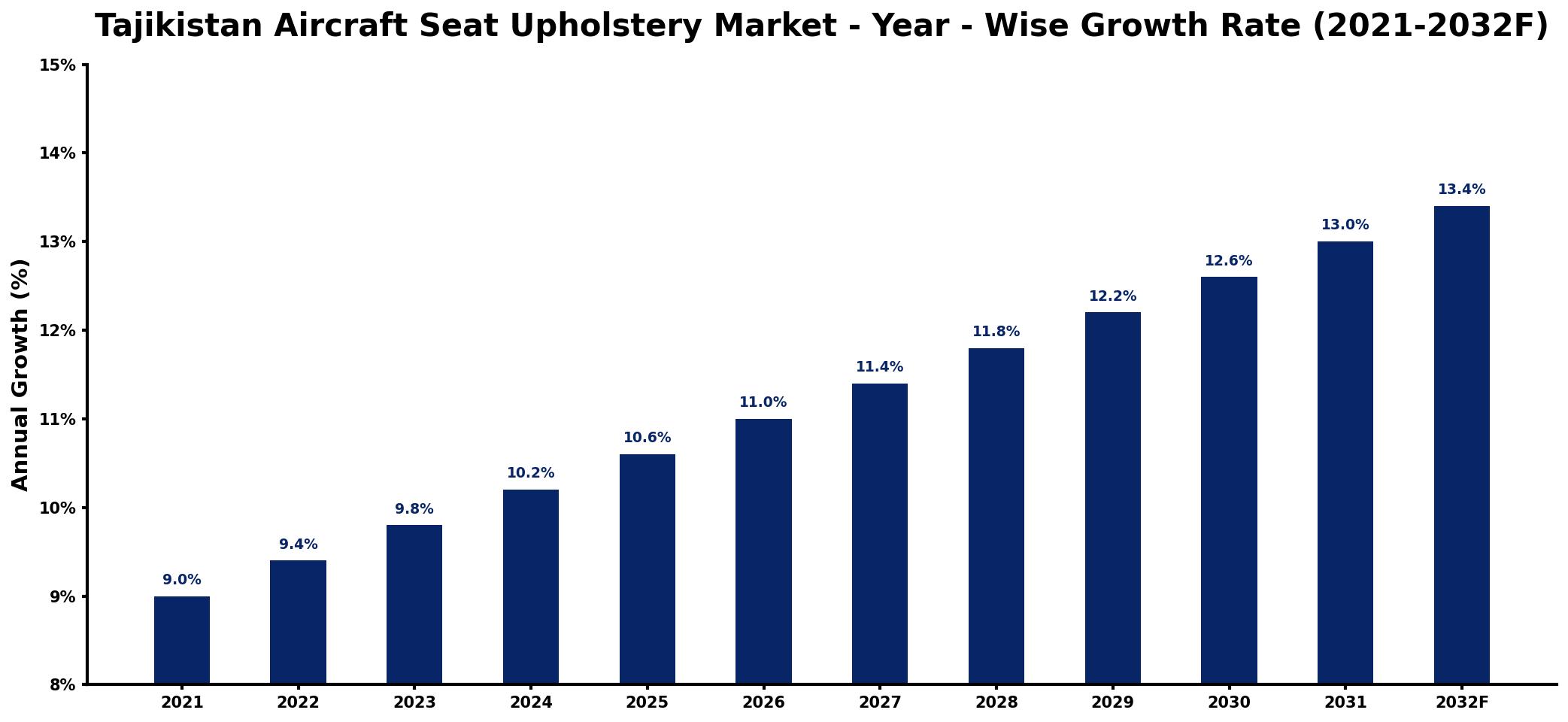
The table below presents the year‑wise growth rates along with the key drivers influencing the market
| Year | Growth Rate | Major Drivers |
| 2021 | 9.0% | Increase in domestic travel demand |
| 2022 | 9.4% | Expansion of local airlines operations |
| 2023 | 9.8% | Growing tourism sector investments |
| 2024 | 10.2% | Rising disposable income levels |
| 2025 | 10.6% | Increased focus on passenger comfort |
| 2026 | 11.0% | Investment in regional airport infrastructure |
| 2027 | 11.4% | Emergence of new airline startups |
| 2028 | 11.8% | Upgrades to existing fleet capabilities |
| 2029 | 12.2% | Growing preference for premium services |
| 2030 | 12.6% | growing emerging market penetration |
| 2031 | 13.0% | Collaborations with global suppliers |
| 2032 | 13.4% | Heightened sustainability initiatives adoption |
Note: Market size estimations and growth projections presented in this report are based on 6Wresearch's proprietary forecasting methodology, utilizing the latest available industry data, government publications, and primary research inputs.
Tajikistan Aircraft Seat Upholstery Market Synopsis
In recent years, the Tajikistan Aircraft Seat Upholstery Market has demonstrated significant momentum, aligning with the overall growth of the aviation industry. With a steady increase in the number of domestic and regional airlines, the need for superior seat upholstery has become critical to ensure both comfort and compliance with stringent safety standards.
Looking ahead, the market is poised for further evolution, with a notable emphasis on eco-friendly materials and innovative designs. This reflects a global trend towards sustainability within aviation, as well as a growing demand for customized upholstery solutions that cater to the unique branding needs of airlines operating in Tajikistan.
Tajikistan Aircraft Seat Upholstery Market Key Takeaways
- The market is anticipated to grow significantly, driven by increased airline operations and passenger expectations.
- Innovations in materials, including lightweight and sustainable options, are shaping product offerings.
- Customization is becoming a vital strategy for airlines, seeking to enhance their brand identity through upholstery designs.
- Regulatory frameworks emphasize compliance with international safety standards, influencing product development.
- The local manufacturing sector faces challenges that could impact the supply chain dynamics and pricing strategies.
Evaluation of Restraints in Tajikistan Aircraft Seat Upholstery Market
Despite the growth potential, the Tajikistan Aircraft Seat Upholstery Market grapples with certain limitations. A notable restraint is the limited domestic manufacturing capabilities, which necessitate reliance on imports for high-quality materials. Fluctuating currency exchange rates further complicate pricing structures, making it challenging for local suppliers to remain competitive. Moreover, there is a significant skills gap, stemming from the absence of specialized training programs for artisans and designers in this niche market. This dearth of skilled labor can hinder the development of innovative upholstery solutions that meet evolving industry standards.
Tajikistan Aircraft Seat Upholstery Market Trends
The market is witnessing several key trends that are reshaping demand. First, the push for lightweight materials is increasingly prevalent, as airlines aim to enhance fuel efficiency while reducing maintenance costs. Additionally, manufacturers are leaning towards integrating smart fabrics that offer features like temperature regulation and antimicrobial properties, thus prioritizing passenger comfort and safety. Sustainability remains at the forefront, with eco-friendly upholstery options gaining traction. Furthermore, the demand for customized designs reflects airlines' desires for differentiation and brand enhancement, driving innovation within the upholstery sector.
Tajikistan Aircraft Seat Upholstery Market Opportunities
Investment opportunities abound in the Tajikistan Aircraft Seat Upholstery Market, particularly as local airlines expand their fleets and service offerings. There is a growing appetite for innovative and tailored upholstery solutions that align with modern passenger expectations. Additionally, the increasing focus on sustainability opens doors for investors who can provide eco-friendly materials. Collaborations between local players and international suppliers could enhance market offerings, while technological advancements in upholstery design and manufacturing methods present significant growth avenues.
Government Initiatives in the Tajikistan Aircraft Seat Upholstery Market
Government policies are playing a crucial role in shaping the Tajikistan Aircraft Seat Upholstery Market. The government is actively promoting domestic manufacturing through import tariffs and subsidies aimed at supporting local upholstery businesses. This approach not only aims to strengthen the local industry but also encourages adherence to international quality standards. Environmental sustainability and worker safety are prioritized through regulations that govern the manufacturing process, thus fostering a responsible and competitive industry landscape.
Future Insights of the Tajikistan Aircraft Seat Upholstery Market
The future of the Tajikistan Aircraft Seat Upholstery Market appears bright, driven by anticipated increases in air travel and a commitment to enhancing passenger comfort. As airlines focus on upgrading their interiors, demand for premium upholstery solutions is expected to rise. The market is likely to benefit from ongoing technological advancements, paving the way for innovative materials and designs. Partnerships between local manufacturers and international experts could foster knowledge transfer and improve product offerings, further bolstering the market as it adapts to evolving consumer preferences.
Tajikistan Aircraft Seat Upholstery Market Latest Developments (2025 - 2026)
Recent developments within the Tajikistan Aircraft Seat Upholstery Market indicate a shift towards greater sustainability, with manufacturers increasingly exploring eco-friendly materials and practices. Additionally, there has been a noticeable increase in collaborations between local upholstery suppliers and international textile companies, aiming to enhance product quality and innovation. As airlines expand their fleets, investment in more comfortable and visually appealing upholstery is gaining traction, highlighting a clear trend towards passenger-centric design.
Tajikistan Aircraft Seat Upholstery Market - Key Attractiveness of the Report
- 10 Years of Market Numbers
- Historical Data Starting from 2022 to 2025
- Base Year: 2025
- Forecast Data until 2032
- Key Performance Indicators Impacting the Market
- Major Upcoming Developments and Projects
Key Highlights of the Report:
- Tajikistan Aircraft Seat Upholstery Market Outlook
- Market Size of Tajikistan Aircraft Seat Upholstery Market, 2025
- Forecast of Tajikistan Aircraft Seat Upholstery Market, 2032
- Historical Data and Forecast of Tajikistan Aircraft Seat Upholstery Revenues & Volume for the Period 2022-2032F
- Tajikistan Aircraft Seat Upholstery Market Trend Evolution
- Tajikistan Aircraft Seat Upholstery Market Drivers and Challenges
- Tajikistan Aircraft Seat Upholstery Price Trends
- Tajikistan Aircraft Seat Upholstery Porter's Five Forces
- Tajikistan Aircraft Seat Upholstery Industry Life Cycle
- Historical Data and Forecast of Tajikistan Aircraft Seat Upholstery Market Revenues & Volume By Material Type for the Period 2022-2032F
- Historical Data and Forecast of Tajikistan Aircraft Seat Upholstery Market Revenues & Volume By Fabric for the Period 2022-2032F
- Historical Data and Forecast of Tajikistan Aircraft Seat Upholstery Market Revenues & Volume By Leather for the Period 2022-2032F
- Historical Data and Forecast of Tajikistan Aircraft Seat Upholstery Market Revenues & Volume By Vinyl for the Period 2022-2032F
- Historical Data and Forecast of Tajikistan Aircraft Seat Upholstery Market Revenues & Volume By Seat Cover Type for the Period 2022-2032F
- Historical Data and Forecast of Tajikistan Aircraft Seat Upholstery Market Revenues & Volume By Bottom Covers for the Period 2022-2032F
- Historical Data and Forecast of Tajikistan Aircraft Seat Upholstery Market Revenues & Volume By Back Rest for the Period 2022-2032F
- Historical Data and Forecast of Tajikistan Aircraft Seat Upholstery Market Revenues & Volume By Armrests for the Period 2022-2032F
- Historical Data and Forecast of Tajikistan Aircraft Seat Upholstery Market Revenues & Volume By Headrests for the Period 2022-2032F
- Historical Data and Forecast of Tajikistan Aircraft Seat Upholstery Market Revenues & Volume By Seat Rear Pockets for the Period 2022-2032F
- Historical Data and Forecast of Tajikistan Aircraft Seat Upholstery Market Revenues & Volume By Seat Type for the Period 2022-2032F
- Historical Data and Forecast of Tajikistan Aircraft Seat Upholstery Market Revenues & Volume By First Class for the Period 2022-2032F
- Historical Data and Forecast of Tajikistan Aircraft Seat Upholstery Market Revenues & Volume By Business Class for the Period 2022-2032F
- Historical Data and Forecast of Tajikistan Aircraft Seat Upholstery Market Revenues & Volume By Premium Economy Class for the Period 2022-2032F
- Historical Data and Forecast of Tajikistan Aircraft Seat Upholstery Market Revenues & Volume By Economy Class for the Period 2022-2032F
- Historical Data and Forecast of Tajikistan Aircraft Seat Upholstery Market Revenues & Volume By Aircraft Type for the Period 2022-2032F
- Historical Data and Forecast of Tajikistan Aircraft Seat Upholstery Market Revenues & Volume By Narrow-body Aircraft for the Period 2022-2032F
- Historical Data and Forecast of Tajikistan Aircraft Seat Upholstery Market Revenues & Volume By Wide-body Aircraft for the Period 2022-2032F
- Historical Data and Forecast of Tajikistan Aircraft Seat Upholstery Market Revenues & Volume By Very Large Aircraft for the Period 2022-2032F
- Historical Data and Forecast of Tajikistan Aircraft Seat Upholstery Market Revenues & Volume By Regional Transport Aircraft for the Period 2022-2032F
- Historical Data and Forecast of Tajikistan Aircraft Seat Upholstery Market Revenues & Volume By Business Jets for the Period 2022-2032F
- Historical Data and Forecast of Tajikistan Aircraft Seat Upholstery Market Revenues & Volume By General Aviation Aircraft for the Period 2022-2032F
- Historical Data and Forecast of Tajikistan Aircraft Seat Upholstery Market Revenues & Volume By Helicopters for the Period 2022-2032F
- Tajikistan Aircraft Seat Upholstery Import Export Trade Statistics
- Market Opportunity Assessment By Material Type
- Market Opportunity Assessment By Seat Cover Type
- Market Opportunity Assessment By Seat Type
- Market Opportunity Assessment By Aircraft Type
- Tajikistan Aircraft Seat Upholstery Top Companies Market Share
- Tajikistan Aircraft Seat Upholstery Competitive Benchmarking By Technical and Operational Parameters
- Tajikistan Aircraft Seat Upholstery Company Profiles
- Tajikistan Aircraft Seat Upholstery Key Strategic Recommendations






































