Tajikistan Apparel Accessories Market Size, Share & Growth Rate
The Tajikistan Apparel Accessories Market was estimated at USD 1019 Million in 2025 and is projected to reach USD 1484 Million by 2032, growing at a CAGR of 5.5% from 2026 to 2032. This robust growth trajectory is attributed to the rising disposable incomes of consumers, a burgeoning young population with an increasing interest in personal style, and a shift towards modern and trendy accessories. As fashion trends evolve, the demand for diverse and quality accessories continues to enhance market dynamics.
Tajikistan Apparel Accessories Market Year-wise Growth Rate and Key Drivers
This graph highlights how the Tajikistan Apparel Accessories Market has steadily grown over the years, supported by major growth factors.
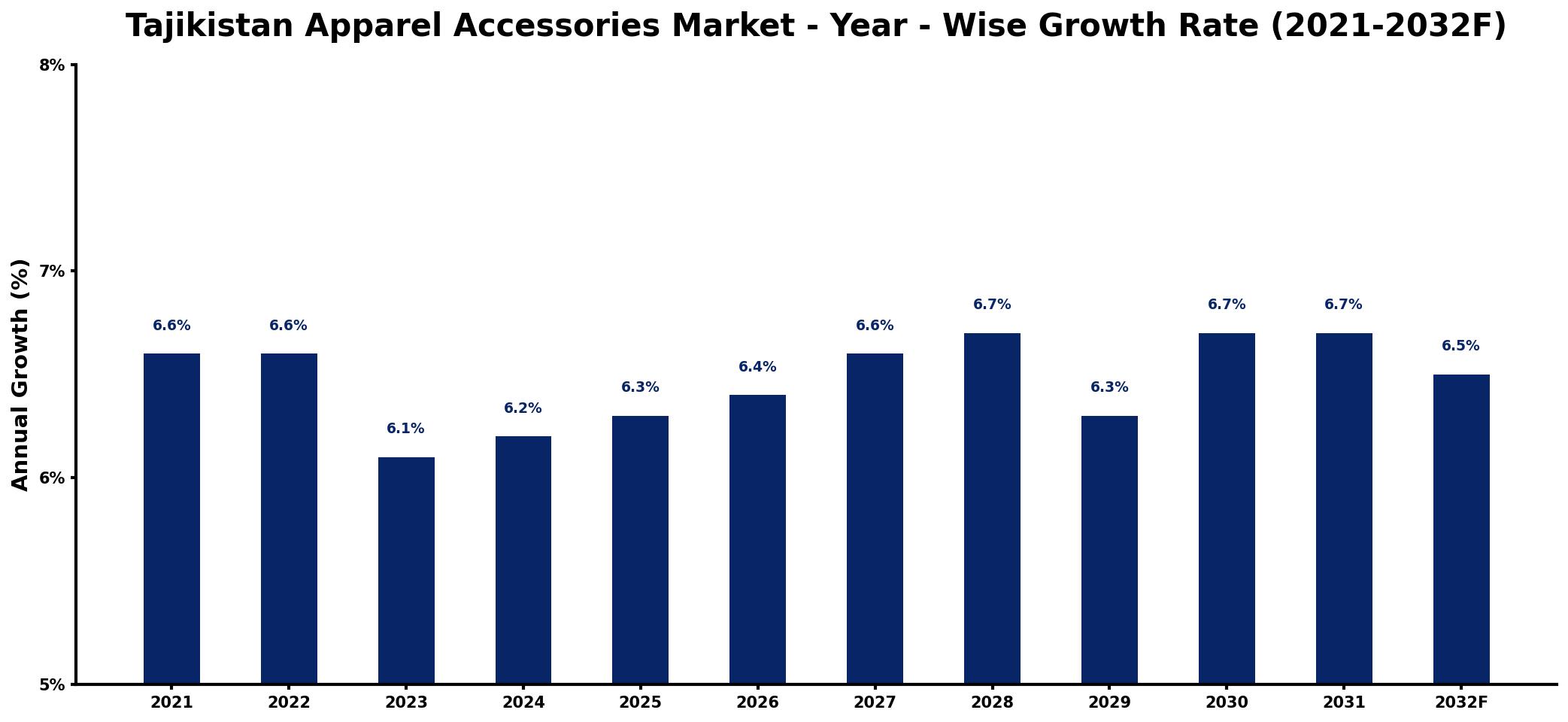
The table below presents the year‑wise growth rates along with the key drivers influencing the market
| Year | Growth Rate | Major Drivers |
| 2021 | 6.6% | Rising disposable income levels |
| 2022 | 6.6% | Increased consumer fashion awareness |
| 2023 | 6.1% | Growing online shopping trends |
| 2024 | 6.2% | Expansion of retail outlets |
| 2025 | 6.3% | Emergence of local designers |
| 2026 | 6.4% | Demand for sustainable products |
| 2027 | 6.6% | Boost in tourism activities |
| 2028 | 6.7% | Growth of social media influence |
| 2029 | 6.3% | Increase in youth population |
| 2030 | 6.7% | Rise in international brands |
| 2031 | 6.7% | Development of e-commerce platforms |
| 2032 | 6.5% | Enhancement of fashion events |
Note: Market size estimations and growth projections presented in this report are based on 6Wresearch's proprietary forecasting methodology, utilizing the latest available industry data, government publications, and primary research inputs.
Tajikistan Apparel Accessories Market Synopsis
The strongest force shaping the Tajikistan Apparel Accessories Market today is the growing demand for unique, quality accessories that reflect personal style. With a youth-centric population eager to express their individuality, there is a noticeable shift away from traditional accessories towards contemporary and fashionable designs.
In addition to this evolving fashion landscape, there is a heightened awareness of sustainability among consumers. This trend is fostering a growing interest in locally produced and eco-friendly accessories, as more people seek products that resonate with their values and cultural heritage.
Tajikistan Apparel Accessories Market Key Takeaways
- The market is driven by the rising influence of fashion trends and a young, style-conscious population.
- Local artisans are gaining traction as consumers seek unique, handmade products that reflect cultural heritage.
- Online shopping platforms are expanding access to a broader range of accessories, enhancing consumer choice.
- Sustainability and ethical practices are becoming key factors influencing purchasing decisions among consumers.
- The government supports local production and quality standards, enhancing competitiveness within the market.
Evaluation of Restraints in Tajikistan Apparel Accessories Market
Despite the promising growth, several restraints hinder the Tajikistan Apparel Accessories Market. Limited purchasing power among consumers, primarily due to economic constraints, restricts the market for premium accessories. Furthermore, local manufacturers face stiff competition from low-cost imports, which saturate the market. Infrastructure challenges, including inadequate transportation and logistics systems, further complicate distribution efforts, while a lack of skilled labor and technological advancements in manufacturing processes limits the quality and innovation of domestically produced accessories.
Tajikistan Apparel Accessories Market Trends
Current trends indicate a shift towards sustainable and eco-friendly apparel accessories. Consumers are increasingly aware of environmental issues, prompting a demand for products that meet these criteria. This awareness has not only bolstered the appeal of locally made, artisan-crafted items but also led to a growing interest in accessories that celebrate traditional Tajikistani craftsmanship, such as embroidered scarves and intricate jewelry. Additionally, the proliferation of e-commerce platforms is changing the retail landscape, making it easier for consumers to discover and purchase both local and international accessories.
Tajikistan Apparel Accessories Market Opportunities
Investment opportunities in the Tajikistan Apparel Accessories Market are multifaceted. The increasing middle-class population is poised to drive demand for affordable yet stylish accessories. Opportunities exist in importing and distributing renowned international brands, establishing local manufacturing units, and collaborating with local designers to create unique offerings that resonate with Tajik consumers. Moreover, the rise of e-commerce platforms offers a convenient channel for selling accessories, allowing businesses to reach a wider audience across the country.
Government Initiatives in the Tajikistan Apparel Accessories Market
The Tajik government is implementing policies aimed at bolstering local production within the apparel accessories market. These initiatives include tax incentives and subsidies for domestic manufacturers to stimulate growth and competitiveness. Regulations ensuring quality standards and fair labor practices are also in place to protect consumers and workers alike. Moreover, import tariffs are being enforced to safeguard local producers against overwhelming foreign competition, thus encouraging the consumption of domestically made products.
Future Insights of the Tajikistan Apparel Accessories Market
Looking ahead, the Tajikistan Apparel Accessories Market is expected to continue on its growth path through 2032. Factors such as rising disposable incomes and a vibrant youth demographic will fuel demand for stylish accessories. The increasing prevalence of online shopping will further enhance consumer access to a diverse range of products. However, businesses must remain vigilant against competition from international brands and counterfeit goods, which could pose challenges to market expansion. By adopting strategic approaches, stakeholders can tap into the significant potential of this evolving market.
Tajikistan Apparel Accessories Market Latest Developments (2025 - 2026)
Recent developments in the Tajikistan Apparel Accessories Market reflect a growing focus on quality and sustainability. Local designers are increasingly collaborating with artisans to create collections that highlight traditional craftsmanship while catering to modern aesthetics. Meanwhile, the rise of online shopping has seen a surge in localized marketing strategies as brands seek to connect with consumers on a more personal level. Overall, these trends signal a shift towards a more vibrant and diverse market landscape.
Tajikistan Apparel Accessories Market - Key Attractiveness of the Report
- 10 Years of Market Numbers
- Historical Data Starting from 2022 to 2025
- Base Year: 2025
- Forecast Data until 2032
- Key Performance Indicators Impacting the Market
- Major Upcoming Developments and Projects
Key Highlights of the Report:
- Tajikistan Apparel Accessories Market Outlook
- Market Size of Tajikistan Apparel Accessories Market, 2025
- Forecast of Tajikistan Apparel Accessories Market, 2032
- Historical Data and Forecast of Tajikistan Apparel Accessories Revenues & Volume for the Period 2022-2032F
- Tajikistan Apparel Accessories Market Trend Evolution
- Tajikistan Apparel Accessories Market Drivers and Challenges
- Tajikistan Apparel Accessories Price Trends
- Tajikistan Apparel Accessories Porter's Five Forces
- Tajikistan Apparel Accessories Industry Life Cycle
- Historical Data and Forecast of Tajikistan Apparel Accessories Market Revenues & Volume By Product for the Period 2022-2032F
- Historical Data and Forecast of Tajikistan Apparel Accessories Market Revenues & Volume By Belts for the Period 2022-2032F
- Historical Data and Forecast of Tajikistan Apparel Accessories Market Revenues & Volume By Handbags for the Period 2022-2032F
- Historical Data and Forecast of Tajikistan Apparel Accessories Market Revenues & Volume By Scarves for the Period 2022-2032F
- Historical Data and Forecast of Tajikistan Apparel Accessories Market Revenues & Volume By Eye wear for the Period 2022-2032F
- Historical Data and Forecast of Tajikistan Apparel Accessories Market Revenues & Volume By Jewelry for the Period 2022-2032F
- Historical Data and Forecast of Tajikistan Apparel Accessories Market Revenues & Volume By Neckties for the Period 2022-2032F
- Historical Data and Forecast of Tajikistan Apparel Accessories Market Revenues & Volume By Gloves for the Period 2022-2032F
- Historical Data and Forecast of Tajikistan Belts Apparel Accessories Market Revenues & Volume By Others for the Period 2022-2032F
- Historical Data and Forecast of Tajikistan Apparel Accessories Market Revenues & Volume By Demographic for the Period 2022-2032F
- Historical Data and Forecast of Tajikistan Apparel Accessories Market Revenues & Volume By Men for the Period 2022-2032F
- Historical Data and Forecast of Tajikistan Apparel Accessories Market Revenues & Volume By Women for the Period 2022-2032F
- Historical Data and Forecast of Tajikistan Apparel Accessories Market Revenues & Volume By Children for the Period 2022-2032F
- Historical Data and Forecast of Tajikistan Apparel Accessories Market Revenues & Volume By Price for the Period 2022-2032F
- Historical Data and Forecast of Tajikistan Apparel Accessories Market Revenues & Volume By Economical Apparel Accessories for the Period 2022-2032F
- Historical Data and Forecast of Tajikistan Apparel Accessories Market Revenues & Volume By Mid-range Apparel Accessories for the Period 2022-2032F
- Historical Data and Forecast of Tajikistan Apparel Accessories Market Revenues & Volume By Premium Apparel Accessories for the Period 2022-2032F
- Historical Data and Forecast of Tajikistan Apparel Accessories Market Revenues & Volume By Super-premium Apparel Accessories for the Period 2022-2032F
- Historical Data and Forecast of Tajikistan Apparel Accessories Market Revenues & Volume By Sales Channel for the Period 2022-2032F
- Historical Data and Forecast of Tajikistan Apparel Accessories Market Revenues & Volume By Apparel Accessories Sold through Modern Trade for the Period 2022-2032F
- Historical Data and Forecast of Tajikistan Apparel Accessories Market Revenues & Volume By Apparel Accessories Sold at Franchise Outlets for the Period 2022-2032F
- Historical Data and Forecast of Tajikistan Apparel Accessories Market Revenues & Volume By Apparel Accessories Sold at Specialty Stores for the Period 2022-2032F
- Historical Data and Forecast of Tajikistan Apparel Accessories Market Revenues & Volume By Others for the Period 2022-2032F
- Tajikistan Apparel Accessories Import Export Trade Statistics
- Market Opportunity Assessment By Product
- Market Opportunity Assessment By Demographic
- Market Opportunity Assessment By Price
- Market Opportunity Assessment By Sales Channel
- Tajikistan Apparel Accessories Top Companies Market Share
- Tajikistan Apparel Accessories Competitive Benchmarking By Technical and Operational Parameters
- Tajikistan Apparel Accessories Company Profiles
- Tajikistan Apparel Accessories Key Strategic Recommendations






































