Tajikistan Artificial Organs Market Size, Share & Growth Rate
The Tajikistan Artificial Organs Market was estimated at USD 342 Million in 2025 and is projected to reach USD 453 Million by 2032, growing at a CAGR of 4.1% from 2026 to 2032. This trajectory is driven by an increasing prevalence of chronic diseases, particularly among the aging population, alongside notable advancements in medical technology. The demand for innovative solutions to organ failure is compelling healthcare providers to explore artificial organ options more aggressively.
Tajikistan Artificial Organs Market Year-wise Growth Rate and Key Drivers
This graph highlights how the Tajikistan Artificial Organs Market has steadily grown over the years, supported by major growth factors.
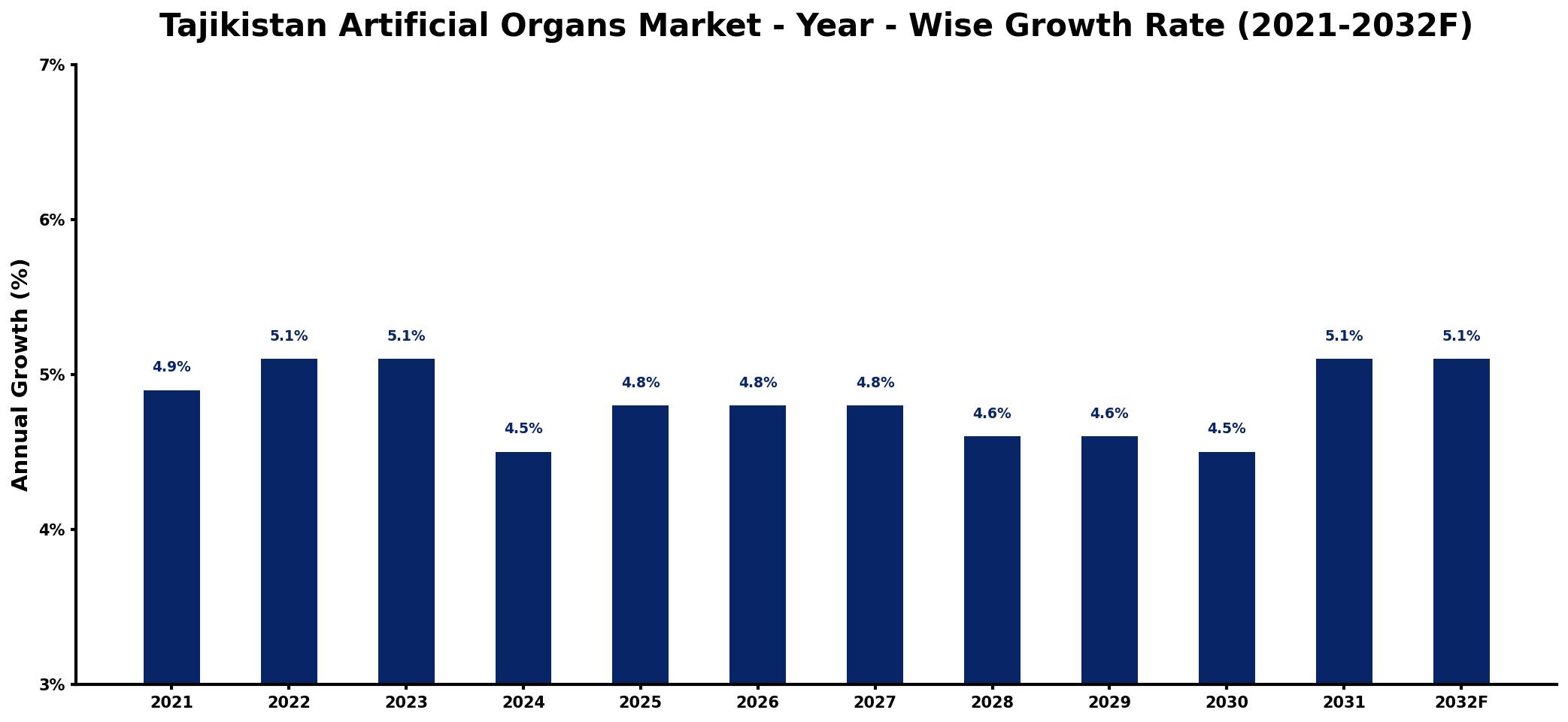
The table below presents the year‑wise growth rates along with the key drivers influencing the market
| Year | Growth Rate | Major Drivers |
| 2021 | 4.9% | increased healthcare investments nationwide |
| 2022 | 5.1% | rising patient demand for solutions |
| 2023 | 5.1% | advancements in medical technology adoption |
| 2024 | 4.5% | growing awareness of alternatives |
| 2025 | 4.8% | expanding healthcare infrastructure development |
| 2026 | 4.8% | increased funding for research initiatives |
| 2027 | 4.8% | heightened focus on patient outcomes |
| 2028 | 4.6% | growing partnerships with private sector |
| 2029 | 4.6% | emerging trends in personalized treatments |
| 2030 | 4.5% | rising number of healthcare providers |
| 2031 | 5.1% | increased international collaborations established |
| 2032 | 5.1% | growing regulatory support for innovation |
Note: Market size estimations and growth projections presented in this report are based on 6Wresearch's proprietary forecasting methodology, utilizing the latest available industry data, government publications, and primary research inputs.
Tajikistan Artificial Organs Market Synopsis
Despite the current modest scale of the Tajikistan Artificial Organs Market, there is substantial momentum building as healthcare needs evolve. The challenges of limited organ donation combined with the rise in chronic diseases have laid a foundation for market growth, signifying a crucial turning point in healthcare delivery in Tajikistan.
As technology evolves, the scope of artificial organs is expanding, offering new treatment possibilities for patients facing organ failure. The integration of advanced manufacturing processes and materials is enhancing the efficacy and accessibility of products, making them more attractive to both healthcare providers and patients.
Tajikistan Artificial Organs Market Key Takeaways
- The market is poised for steady growth due to rising chronic disease prevalence and an aging population.
- Technological advancements are driving innovation in artificial organs, improving patient outcomes.
- Awareness and acceptance of artificial organs as viable treatment options are on the rise.
- Investment in healthcare infrastructure will further enable market expansion.
- Collaborations between institutions are fostering significant advancements in artificial organ technologies.
Evaluation of Restraints in Tajikistan Artificial Organs Market
The Tajikistan Artificial Organs Market faces several barriers that could impede its growth trajectory. A significant hurdle is the limited healthcare infrastructure, which restricts access to advanced medical technologies. Additionally, the high costs associated with artificial organs can be prohibitive, especially in a country where healthcare expenditures are already constrained. Furthermore, the scarcity of skilled healthcare professionals trained to manage the complexities of artificial organ implantation remains a critical challenge. Establishing a robust regulatory framework is essential to ensure quality and safety standards, which are currently lacking.
Tajikistan Artificial Organs Market Trends
Several key trends are shaping the Tajikistan Artificial Organs Market. One significant trend is the increasing focus on biocompatible materials and smart technologies that enhance the functionality of artificial organs. Another trend is the growing collaboration among healthcare institutions and research organizations, leading to accelerated innovation in treatment methodologies. Additionally, healthcare professionals are becoming more educated and accepting of artificial organs as effective solutions, which is fostering patient trust and broadening the markets appeal.
Tajikistan Artificial Organs Market Opportunities
There are substantial opportunities for growth within the Tajikistan Artificial Organs Market as the healthcare landscape evolves. The rising demand for organ transplants, combined with limited donor availability, highlights the need for innovative artificial solutions. Investing in research and development to create more affordable artificial organs can yield significant returns. Furthermore, forming partnerships with local healthcare facilities to enhance access and distribution channels will not only improve patient access but also position companies favorably within the market.
Government Initiatives in the Tajikistan Artificial Organs Market
While the Tajikistan government has yet to implement specific policies tailored to the Artificial Organs Market, its overarching healthcare strategy aims to bolster medical services and facilities. The government's commitment to improving healthcare infrastructure, increasing access to services, and promoting medical research creates an environment conducive to the growth of the artificial organs sector. Companies must remain vigilant to any new policies that could positively influence market dynamics.
Future Insights of the Tajikistan Artificial Organs Market
Looking ahead, the Tajikistan Artificial Organs Market is set to experience notable expansion driven by a heightened awareness of organ transplantation. The ongoing rise in chronic diseases, paired with a commitment from the government to enhance healthcare delivery, sets a promising landscape for artificial organs. With the aging population increasing, the demand for innovative solutions is expected to grow significantly, offering ample opportunities for market players to innovate and expand their product offerings.
Tajikistan Artificial Organs Market Latest Developments (2025 - 2026)
Recently, there has been a noticeable shift towards the adoption of innovative technologies in artificial organ production, enhancing efficiency and patient care. Healthcare facilities are also beginning to develop specialized programs focused on educating practitioners about artificial organs, thereby improving implantation success rates. Additionally, public-private partnerships are gaining traction, which may boost funding for research and development in artificial organ technologies.
Tajikistan Artificial Organs Market - Key Attractiveness of the Report
- 10 Years of Market Numbers
- Historical Data Starting from 2022 to 2025
- Base Year: 2025
- Forecast Data until 2032
- Key Performance Indicators Impacting the Market
- Major Upcoming Developments and Projects
Key Highlights of the Report:
- Tajikistan Artificial Organs Market Outlook
- Market Size of Tajikistan Artificial Organs Market, 2025
- Forecast of Tajikistan Artificial Organs Market, 2032
- Historical Data and Forecast of Tajikistan Artificial Organs Revenues & Volume for the Period 2022-2032F
- Tajikistan Artificial Organs Market Trend Evolution
- Tajikistan Artificial Organs Market Drivers and Challenges
- Tajikistan Artificial Organs Price Trends
- Tajikistan Artificial Organs Porter's Five Forces
- Tajikistan Artificial Organs Industry Life Cycle
- Historical Data and Forecast of Tajikistan Artificial Organs Market Revenues & Volume By Product Type for the Period 2022-2032F
- Historical Data and Forecast of Tajikistan Artificial Organs Market Revenues & Volume By Artificial Kidney for the Period 2022-2032F
- Historical Data and Forecast of Tajikistan Artificial Organs Market Revenues & Volume By Artificial Heart for the Period 2022-2032F
- Historical Data and Forecast of Tajikistan Artificial Organs Market Revenues & Volume By Artificial Pancreas for the Period 2022-2032F
- Historical Data and Forecast of Tajikistan Artificial Organs Market Revenues & Volume By Cochlear Implants for the Period 2022-2032F
- Historical Data and Forecast of Tajikistan Artificial Organs Market Revenues & Volume By Others for the Period 2022-2032F
- Tajikistan Artificial Organs Import Export Trade Statistics
- Market Opportunity Assessment By Product Type
- Tajikistan Artificial Organs Top Companies Market Share
- Tajikistan Artificial Organs Competitive Benchmarking By Technical and Operational Parameters
- Tajikistan Artificial Organs Company Profiles
- Tajikistan Artificial Organs Key Strategic Recommendations






































