Tajikistan Bathroom Linen Market Size, Share & Growth Rate
The Tajikistan Bathroom Linen Market was estimated at USD 396 Million in 2025 and is projected to reach USD 546 Million by 2032, growing at a CAGR of 4.7% from 2026 to 2032. This growth trajectory is primarily driven by increasing urbanization, which is shifting consumer preferences toward modern and stylish home decor. Additionally, rising disposable incomes are enabling more consumers to invest in higher-quality bathroom linens, while an emphasis on personal hygiene and aesthetics continues to promote demand.
Tajikistan Bathroom Linen Market Year-wise Growth Rate and Key Drivers
This graph highlights how the Tajikistan Bathroom Linen Market has steadily grown over the years, supported by major growth factors.
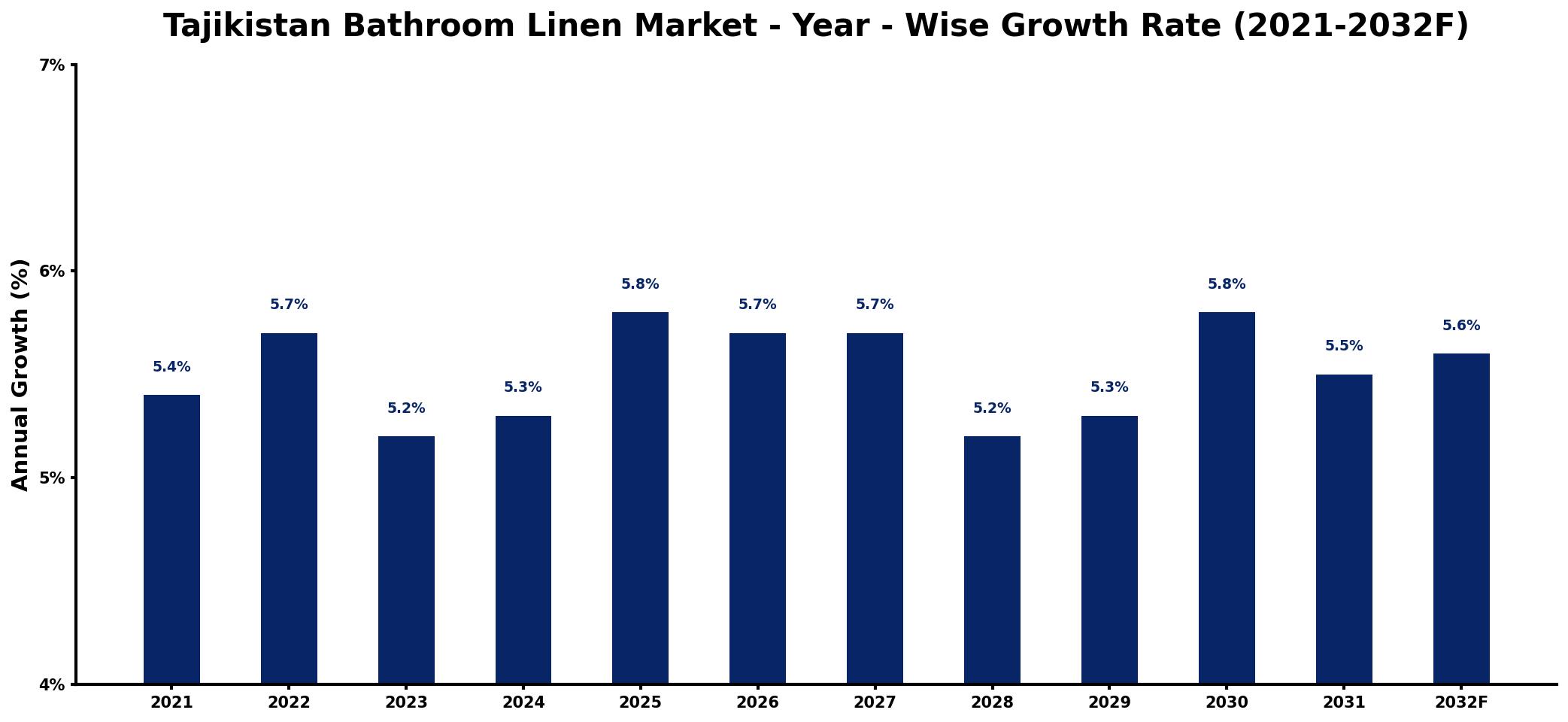
The table below presents the year‑wise growth rates along with the key drivers influencing the market
| Year | Growth Rate | Major Drivers |
| 2021 | 5.4% | Increased consumer home investments |
| 2022 | 5.7% | Expansion of retail distribution channels |
| 2023 | 5.2% | Rising disposable income levels |
| 2024 | 5.3% | Growth in online shopping platforms |
| 2025 | 5.8% | Surge in home renovation projects |
| 2026 | 5.7% | Rising demand for eco-friendly products |
| 2027 | 5.7% | Increase in tourism and hospitality |
| 2028 | 5.2% | improved processing technologies adoption |
| 2029 | 5.3% | enhanced product quality standards |
| 2030 | 5.8% | rising infrastructure development spending |
| 2031 | 5.5% | Increased focus on interior design |
| 2032 | 5.6% | rising procurement volume requirements |
Note: Market size estimations and growth projections presented in this report are based on 6Wresearch's proprietary forecasting methodology, utilizing the latest available industry data, government publications, and primary research inputs.
Tajikistan Bathroom Linen Market Synopsis
The most potent force shaping the Tajikistan Bathroom Linen Market right now is the increasing focus on home aesthetics combined with rising disposable incomes. Consumers are becoming more selective, opting for products that offer both functionality and style, particularly in urban areas where lifestyle changes are prevalent.
Local manufacturers are responding to this demand by offering a variety of bathroom linen designs that cater to evolving tastes. The market is also witnessing a growing shift towards eco-friendly materials, including organic cotton options that attract environmentally conscious consumers.
Tajikistan Bathroom Linen Market Key Takeaways
- The market is characterized by a shift toward eco-friendly and organic bathroom linen products.
- Consumers demonstrate a strong preference for soft, absorbent cotton towels and bathrobes.
- Online retail channels are rapidly gaining popularity, enhancing product accessibility.
- There is a trend towards minimalist designs in bathroom linens, with simple patterns and neutral colors.
- Investment opportunities exist in both local manufacturing and e-commerce platforms to meet rising demand.
Evaluation of Restraints in Tajikistan Bathroom Linen Market
The Tajikistan Bathroom Linen Market faces several limitations, primarily linked to the purchasing power of consumers, which can restrict access to higher-priced, premium products. Underdeveloped retail infrastructure and distribution channels further complicate market penetration for companies. Moreover, many consumers lack awareness regarding the importance of quality bathroom linens, which could be a barrier to market expansion. Counterfeit products also pose a significant risk, undermining the reputation of legitimate brands and impacting overall market growth.
Tajikistan Bathroom Linen Market Trends
The trends in the Tajikistan Bathroom Linen Market reflect a growing consumer inclination towards sustainable and high-quality products. Organic cotton items are increasingly sought after, driven by eco-conscious buyer behavior. Furthermore, luxurious bathroom linens that combine comfort with durability are becoming more popular. Aesthetic preferences are leaning towards modern, minimalist designs, characterized by simple patterns and muted color schemes, which resonate well with contemporary interior decor.
Tajikistan Bathroom Linen Market Opportunities
Significant growth and investment opportunities exist in the Tajikistan Bathroom Linen Market, particularly for companies that can produce stylish and high-quality bathroom textiles. Local manufacturers have the chance to tap into the evolving market by introducing unique, culturally inspired designs. Additionally, e-commerce platforms specializing in bathroom linens are emerging as an effective channel to reach a broader customer base, allowing businesses to engage with increasingly tech-savvy consumers.
Government Initiatives in the Tajikistan Bathroom Linen Market
While there are no specific government policies directly targeting the Bathroom Linen Market in Tajikistan, general trade regulations and policies can significantly impact market operations. The nations membership in the World Trade Organization (WTO) necessitates adherence to international trade agreements, influencing the import-export dynamics of bathroom linen products. Businesses in the market should remain vigilant regarding any changes in trade policies, taxes, or regulations that may affect operational viability.
Future Insights of the Tajikistan Bathroom Linen Market
Looking forward to the period from 2026 to 2032, the Tajikistan Bathroom Linen Market is poised for steady growth. As urbanization continues to rise, and disposable incomes grow, consumer interest in quality and aesthetically pleasing bathroom linens is likely to increase. The expanding tourism sector will further provide opportunities for hotels and accommodations to enhance guest experiences through high-quality bathroom textiles. The rise of digital platforms will also facilitate market expansion by making a diverse range of products more accessible to consumers.
Tajikistan Bathroom Linen Market Latest Developments (2025 - 2026)
In recent months, the Tajikistan Bathroom Linen Market has seen a notable increase in companies emphasizing sustainable practices, with several local manufacturers introducing eco-friendly product lines. Online retail channels are expanding, with many businesses enhancing their digital presence to cater to shifting consumer preferences. Additionally, collaborative efforts between local artisans and designers are gaining traction, focusing on culturally inspired bathroom linen products that reflect Tajikistan's rich heritage.
Tajikistan Bathroom Linen Market - Key Attractiveness of the Report
- 10 Years of Market Numbers
- Historical Data Starting from 2022 to 2025
- Base Year: 2025
- Forecast Data until 2032
- Key Performance Indicators Impacting the Market
- Major Upcoming Developments and Projects
Key Highlights of the Report:
- Tajikistan Bathroom Linen Market Outlook
- Market Size of Tajikistan Bathroom Linen Market, 2025
- Forecast of Tajikistan Bathroom Linen Market, 2032
- Historical Data and Forecast of Tajikistan Bathroom Linen Revenues & Volume for the Period 2022-2032F
- Tajikistan Bathroom Linen Market Trend Evolution
- Tajikistan Bathroom Linen Market Drivers and Challenges
- Tajikistan Bathroom Linen Price Trends
- Tajikistan Bathroom Linen Porter's Five Forces
- Tajikistan Bathroom Linen Industry Life Cycle
- Historical Data and Forecast of Tajikistan Bathroom Linen Market Revenues & Volume By Product for the Period 2022-2032F
- Historical Data and Forecast of Tajikistan Bathroom Linen Market Revenues & Volume By Bath Towels for the Period 2022-2032F
- Historical Data and Forecast of Tajikistan Bathroom Linen Market Revenues & Volume By Bathrobes for the Period 2022-2032F
- Historical Data and Forecast of Tajikistan Bathroom Linen Market Revenues & Volume By Others for the Period 2022-2032F
- Tajikistan Bathroom Linen Import Export Trade Statistics
- Market Opportunity Assessment By Product
- Tajikistan Bathroom Linen Top Companies Market Share
- Tajikistan Bathroom Linen Competitive Benchmarking By Technical and Operational Parameters
- Tajikistan Bathroom Linen Company Profiles
- Tajikistan Bathroom Linen Key Strategic Recommendations






































