Tajikistan Bathroom Products Market Summary
The tajikistan bathroom products market was estimated at USD 433 Million in 2025 and is projected to reach USD 601 Million by 2032, growing at a CAGR of 5.4% from 2026 to 2032.
Tajikistan Bathroom Products Market Year-wise Growth Rate and Key Drivers
This graph highlights how the Tajikistan Bathroom Products Market has steadily grown over the past five years, supported by major growth factors.
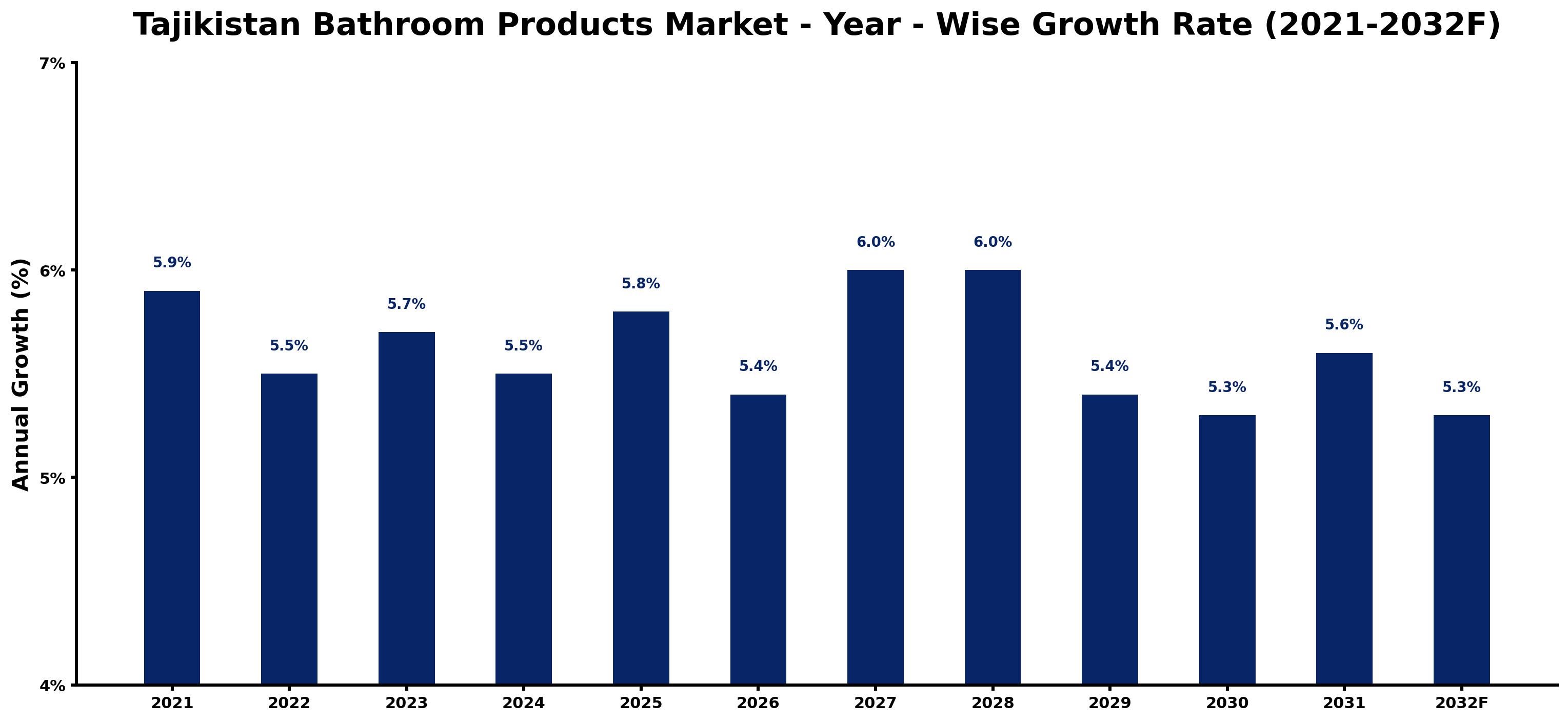
The table below presents the year wise growth rates along with the key drivers influencing the market
| Year | Growth Rate | Major Drivers |
| 2021 | 5.9% | Local manufacturers begin entering the market, enhancing product availability and variety. |
| 2022 | 5.5% | Influx of foreign investment spurs innovation in bathroom product design and technology. |
| 2023 | 5.7% | Consumer awareness campaigns highlight the importance of quality bathroom fittings and fixtures. |
| 2024 | 5.5% | Urbanization trends lead to increased demand for modern bathroom solutions in cities. |
| 2025 | 5.8% | Sustainable product lines gain popularity, reflecting changing consumer purchasing preferences. |
| 2026 | 5.4% | Regional partnerships facilitate easier access to international bathroom products and brands. |
| 2027 | 6.0% | Construction sector growth translates into rising installations of contemporary bathroom amenities. |
| 2028 | 6.0% | Technological integration in products creates smarter, more efficient bathroom environments. |
| 2029 | 5.4% | E-commerce platforms expand, providing consumers easier access to diverse bathroom products. |
| 2030 | 5.3% | Renovation projects drive demand for stylish and functional bathroom enhancements. |
| 2031 | 5.6% | Health and wellness trends influence consumer choices towards luxurious bathroom experiences. |
| 2032 | 5.3% | Government urban development plans emphasize modern infrastructure, including upgraded bathroom facilities. |
Note - Market size estimations and growth projections presented in this report are based on 6Wresearch's advanced forecasting approach, validated with industry datasets as of June 2026.
Tajikistan Bathroom Products Market Synopsis
The Tajikistan Bathroom Products Market is projected to reach 5.4% and witness significant growth during the forecast period (2026-2032). This growth is driven by a combination of increasing urbanization, rising household incomes, and a shift in consumer preferences towards modern and high-quality bathroom solutions. As the economy develops, there is a notable demand for technologically advanced, aesthetically pleasing bathroom products, which is further encouraged by the government's focus on infrastructure development.
Tajikistan Bathroom Products Market Growth Drivers
The primary growth drivers in the Tajikistan Bathroom Products Market include:
- The accelerating rate of urbanization in Tajikistan is leading to an increase in residential construction, fueling demand for various bathroom fixtures.
- With rising disposable incomes, consumers are more inclined to invest in modern, high-end bathroom products that emphasize comfort and style.
- The trend towards eco-friendliness is prompting consumers to seek out water-saving fixtures and sustainable materials, thereby enhancing market growth.
- Technological innovations, such as smart bathroom products, are transforming consumer expectations and driving demand for advanced solutions.
- The government's commitment to boosting domestic manufacturing and infrastructure projects is improving the availability and distribution of bathroom products across the country.
Tajikistan Bathroom Products Market Trends and Opportunities
Several notable trends are emerging in the Tajikistan Bathroom Products Market, presenting unique opportunities:
- Increased consumer preference for customizable bathroom solutions is indicating a shift towards personalized products that align with individual tastes.
- There is a growing demand for smart technology integration, with consumers seeking features like touchless faucets and digital shower controls to enhance usability and hygiene.
- Sustainability is becoming a priority, with consumers favoring eco-friendly products that contribute to water conservation and reduced environmental impact.
- The design aesthetic is evolving, as consumers increasingly desire luxurious finishes and modern styles, which can further elevate the bathroom experience.
- Market players are recognizing the benefit of collaborating with local manufacturers to develop cost-effective products that cater to the specific preferences of Tajik consumers.
Tajikistan Bathroom Products Market Challenges and Restraints
Despite the promising growth, the Tajikistan Bathroom Products Market faces several challenges:
- Limited purchasing power among consumers due to relatively low income levels can restrict the market for premium products, affecting overall sales.
- The distribution network remains underdeveloped in certain areas, complicating access to diverse bathroom product offerings.
- Competition from imported products could pose challenges, particularly if these imports offer greater variety and perceived quality compared to local alternatives.
- Cultural preferences can influence consumer choices, requiring companies to adapt their marketing strategies and product offerings to resonate with Tajik consumers.
- Potential infrastructure limitations may hinder the timely delivery and availability of products across the market, impacting consumer satisfaction.
Tajikistan Bathroom Products Market Government Investment and Initiatives
The government of Tajikistan is implementing various initiatives aimed at bolstering the Bathroom Products Market. These include:
- Promotion of local production through policies that encourage domestic manufacturing, reducing reliance on foreign imports.
- Financial incentives and support for small and medium-sized enterprises, which are crucial for diversifying and enhancing the product range in the bathroom products sector.
- Investment in infrastructure development to improve logistics and distribution capabilities throughout the country, facilitating easier access to bathroom products.
- Regulatory measures that include import tariffs designed to protect local manufacturers while encouraging competitive practices within the market.
- Training programs aimed at enhancing the skills of local manufacturers, ensuring they can meet the evolving demands of consumers effectively.
Tajikistan Bathroom Products Market Latest Developments (May 2025 - June 2026)
Recent developments in the Tajikistan Bathroom Products Market indicate a period of transformation driven by changing consumer preferences and technological advancements. There has been an uptick in the introduction of smart bathroom technologies, aligning with global trends towards connectivity and automation. Additionally, more manufacturers are emphasizing sustainable production practices in response to consumer demand for environmentally friendly products. The government's renewed focus on infrastructure development is also yielding benefits by enhancing supply chains and product availability in previously underserved regions.
Tajikistan Bathroom Products Market - Key Attractiveness of the Report
- 10 Years of Market Numbers
- Historical Data Starting from 2022 to 2025
- Base Year: 2025
- Forecast Data until 2032
- Key Performance Indicators Impacting the Market
- Major Upcoming Developments and Projects
Key Highlights of the Report:
- Tajikistan Bathroom Products Market Outlook
- Market Size of Tajikistan Bathroom Products Market, 2025
- Forecast of Tajikistan Bathroom Products Market, 2032F
- Historical Data and Forecast of Tajikistan Bathroom Products Revenues & Volume for the Period 2022-2032F
- Tajikistan Bathroom Products Market Trend Evolution
- Tajikistan Bathroom Products Market Drivers and Challenges
- Tajikistan Bathroom Products Price Trends
- Tajikistan Bathroom Products Porter's Five Forces
- Tajikistan Bathroom Products Industry Life Cycle
- Historical Data and Forecast of Tajikistan Bathroom Products Market Revenues & Volume By Product Type for the Period 2022-2032F
- Historical Data and Forecast of Tajikistan Bathroom Products Market Revenues & Volume By Towel Rack for the Period 2022-2032F
- Historical Data and Forecast of Tajikistan Bathroom Products Market Revenues & Volume By Shower for the Period 2022-2032F
- Historical Data and Forecast of Tajikistan Bathroom Products Market Revenues & Volume By Soap Holder for the Period 2022-2032F
- Historical Data and Forecast of Tajikistan Bathroom Products Market Revenues & Volume By Toilet Brushes and Holder for the Period 2022-2032F
- Historical Data and Forecast of Tajikistan Bathroom Products Market Revenues & Volume By Others for the Period 2022-2032F
- Historical Data and Forecast of Tajikistan Bathroom Products Market Revenues & Volume By Applications for the Period 2022-2032F
- Historical Data and Forecast of Tajikistan Bathroom Products Market Revenues & Volume By Residential for the Period 2022-2032F
- Historical Data and Forecast of Tajikistan Bathroom Products Market Revenues & Volume By Hotels for the Period 2022-2032F
- Historical Data and Forecast of Tajikistan Bathroom Products Market Revenues & Volume By Others for the Period 2022-2032F
- Historical Data and Forecast of Tajikistan Bathroom Products Market Revenues & Volume By Distribution Channel for the Period 2022-2032F
- Historical Data and Forecast of Tajikistan Bathroom Products Market Revenues & Volume By Online for the Period 2022-2032F
- Historical Data and Forecast of Tajikistan Bathroom Products Market Revenues & Volume By Offline for the Period 2022-2032F
- Tajikistan Bathroom Products Import Export Trade Statistics
- Market Opportunity Assessment By Product Type
- Market Opportunity Assessment By Applications
- Market Opportunity Assessment By Distribution Channel
- Tajikistan Bathroom Products Top Companies Market Share
- Tajikistan Bathroom Products Competitive Benchmarking By Technical and Operational Parameters
- Tajikistan Bathroom Products Company Profiles
- Tajikistan Bathroom Products Key Strategic Recommendations






































