Tajikistan Bottle Filling Machine Market Size, Share & Growth Rate
The Tajikistan Bottle Filling Machine Market was estimated at USD 1340 Million in 2025 and is projected to reach USD 1915 Million by 2032, growing at a CAGR of 5.2% from 2026 to 2032. This growth trajectory is largely fueled by the country's burgeoning food and beverage sector, which is increasingly shifting towards packaged goods, alongside a rising consumer preference for automated solutions that enhance operational efficiency. Additionally, the government's proactive initiatives aimed at stimulating industrial growth are contributing to a favorable investment landscape.
Tajikistan Bottle Filling Machine Market Year-wise Growth Rate and Key Drivers
This graph highlights how the Tajikistan Bottle Filling Machine Market has steadily grown over the years, supported by major growth factors.
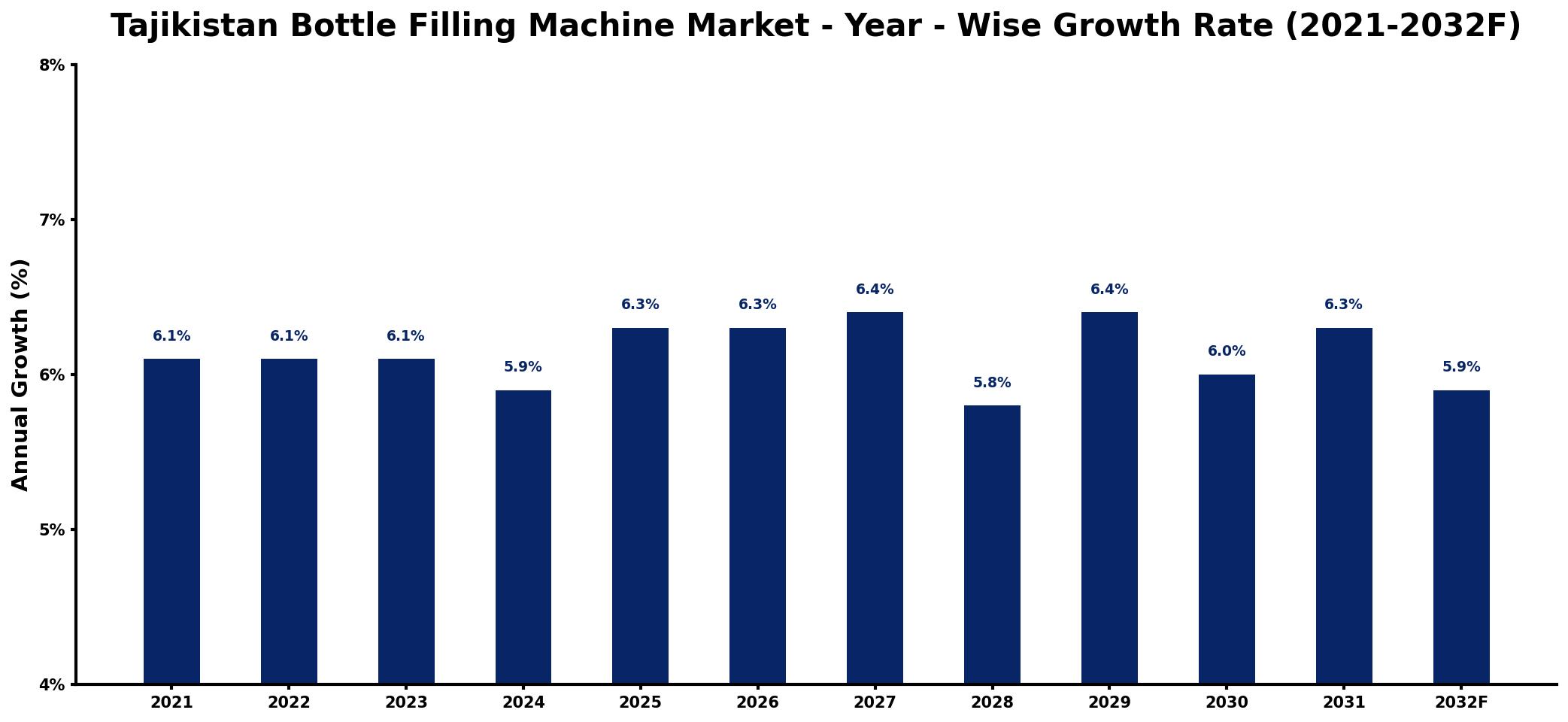
The table below presents the year‑wise growth rates along with the key drivers influencing the market
| Year | Growth Rate | Major Drivers |
| 2021 | 6.1% | Growing beverage sector investments |
| 2022 | 6.1% | Increased consumer health consciousness |
| 2023 | 6.1% | Rising demand for packaged products |
| 2024 | 5.9% | Emerging eco-friendly packaging trends |
| 2025 | 6.3% | Expansion of distribution channels |
| 2026 | 6.3% | Technological advancements in production |
| 2027 | 6.4% | Higher disposable income levels |
| 2028 | 5.8% | Increased focus on sustainability practices |
| 2029 | 6.4% | Growing export opportunities in region |
| 2030 | 6.0% | Rising urbanization and population growth |
| 2031 | 6.3% | Enhanced product quality standards |
| 2032 | 5.9% | Diversification into new markets |
Note: Market size estimations and growth projections presented in this report are based on 6Wresearch's proprietary forecasting methodology, utilizing the latest available industry data, government publications, and primary research inputs.
Tajikistan Bottle Filling Machine Market Synopsis
Currently, the Tajikistan Bottle Filling Machine Market is undergoing a significant transformation as local and international players enter the landscape to meet increasing demand. The focus is primarily on introducing advanced technologies that improve efficiency and sustainability in bottle filling processes.
With a strong emphasis on eco-friendly practices, manufacturers are now exploring solutions that reduce waste and energy consumption. This shift not only aligns with global sustainability trends but also meets local consumer expectations for environmentally responsible products.
Tajikistan Bottle Filling Machine Market Key Takeaways
- The market is poised for robust growth, driven by the expanding beverage industry and increasing demand for bottled products.
- Automation and technology advancements are becoming key differentiators for manufacturers in this sector.
- Customization of filling machines is gaining traction to cater to the specific needs of various industries.
- Government initiatives are creating a conducive environment for foreign investments and local manufacturing.
- Challenges such as technological access and skilled labor shortages remain pertinent but present opportunities for strategic investment.
Evaluation of Restraints in Tajikistan Bottle Filling Machine Market
Despite the promising growth prospects, the Tajikistan Bottle Filling Machine Market is hampered by several key constraints. Limited access to cutting-edge technology poses a significant barrier, as many local manufacturers struggle to compete with international standards. Additionally, insufficient infrastructure for manufacturing and distribution further exacerbates these challenges, leading to high import costs for necessary machinery and components. The lack of a skilled workforce capable of operating and maintaining these machines adds another layer of complexity, ultimately affecting overall production efficiency and market competitiveness.
Tajikistan Bottle Filling Machine Market Trends
The current trends in the Tajikistan Bottle Filling Machine Market showcase a clear inclination towards automation and advanced technology. Manufacturers are increasingly adopting automated filling machines that ensure precision and reduce operational costs. Furthermore, there is a rising trend toward environmentally friendly practices, with many companies prioritizing solutions that minimize waste and energy use. Customization is also becoming critical, as businesses look for tailored solutions that fit their unique production processes.
Tajikistan Bottle Filling Machine Market Opportunities
Investment opportunities abound in the Tajikistan Bottle Filling Machine Market, driven by the robust growth of the beverage sector. Local manufacturers and international companies can benefit from partnerships focused on acquiring advanced filling machine technology. Providing customized solutions tailored to the diverse needs of different beverage types also presents a lucrative avenue. Moreover, prioritizing research and development to enhance machine efficiency and sustainability can solidify market positions and possibly lead to expansion into surrounding Central Asian markets.
Government Initiatives in the Tajikistan Bottle Filling Machine Market
The Tajikistan government is actively promoting a competitive bottle filling machine market through various regulatory measures and incentives. Policies are in place to ensure quality standards for machinery, which protects both domestic producers and consumers. Additionally, the government is implementing strategies to encourage local manufacturing, including potential tax incentives for manufacturers investing in advanced technologies and infrastructure. These initiatives aim to bolster the industry while addressing the challenges faced by local players.
Future Insights of the Tajikistan Bottle Filling Machine Market
Looking ahead to 2026-2032, the Tajikistan Bottle Filling Machine Market is on track for steady expansion. The increasing consumer preference for packaged goods, alongside the growing food and beverage industry, will continue to propel demand. The ongoing push for automation and efficiency in manufacturing will be a key driver for technological advancements. However, stakeholders must navigate existing challenges, such as skill shortages and infrastructural limitations, to realize the full potential of this market.
Tajikistan Bottle Filling Machine Market Latest Developments (2025 - 2026)
In recent months, the Tajikistan Bottle Filling Machine Market has seen a notable uptick in the introduction of innovative filling technologies aimed at improving operational efficiency. Manufacturers are increasingly integrating smart technology to enhance the accuracy and speed of filling processes. Additionally, sustainability initiatives are gaining traction, with several companies exploring biodegradable materials for packaging. Industry participants are also establishing partnerships aimed at improving the training of the workforce, addressing the skills gap that has been a significant barrier to growth.
Tajikistan Bottle Filling Machine Market - Key Attractiveness of the Report
- 10 Years of Market Numbers
- Historical Data Starting from 2022 to 2025
- Base Year: 2025
- Forecast Data until 2032
- Key Performance Indicators Impacting the Market
- Major Upcoming Developments and Projects
Key Highlights of the Report:
- Tajikistan Bottle Filling Machine Market Outlook
- Market Size of Tajikistan Bottle Filling Machine Market, 2025
- Forecast of Tajikistan Bottle Filling Machine Market, 2032
- Historical Data and Forecast of Tajikistan Bottle Filling Machine Revenues & Volume for the Period 2022-2032F
- Tajikistan Bottle Filling Machine Market Trend Evolution
- Tajikistan Bottle Filling Machine Market Drivers and Challenges
- Tajikistan Bottle Filling Machine Price Trends
- Tajikistan Bottle Filling Machine Porter's Five Forces
- Tajikistan Bottle Filling Machine Industry Life Cycle
- Historical Data and Forecast of Tajikistan Bottle Filling Machine Market Revenues & Volume By Bottle Type for the Period 2022-2032F
- Historical Data and Forecast of Tajikistan Bottle Filling Machine Market Revenues & Volume By PET Bottles for the Period 2022-2032F
- Historical Data and Forecast of Tajikistan Bottle Filling Machine Market Revenues & Volume By Glass Bottles for the Period 2022-2032F
- Historical Data and Forecast of Tajikistan Bottle Filling Machine Market Revenues & Volume By Others for the Period 2022-2032F
- Historical Data and Forecast of Tajikistan Bottle Filling Machine Market Revenues & Volume By Application for the Period 2022-2032F
- Historical Data and Forecast of Tajikistan Bottle Filling Machine Market Revenues & Volume By Food Products for the Period 2022-2032F
- Historical Data and Forecast of Tajikistan Bottle Filling Machine Market Revenues & Volume By Beverages for the Period 2022-2032F
- Historical Data and Forecast of Tajikistan Bottle Filling Machine Market Revenues & Volume By Chemicals & Pharmaceuticals for the Period 2022-2032F
- Historical Data and Forecast of Tajikistan Bottle Filling Machine Market Revenues & Volume By Cosmetics for the Period 2022-2032F
- Tajikistan Bottle Filling Machine Import Export Trade Statistics
- Market Opportunity Assessment By Bottle Type
- Market Opportunity Assessment By Application
- Tajikistan Bottle Filling Machine Top Companies Market Share
- Tajikistan Bottle Filling Machine Competitive Benchmarking By Technical and Operational Parameters
- Tajikistan Bottle Filling Machine Company Profiles
- Tajikistan Bottle Filling Machine Key Strategic Recommendations






































