Tajikistan Building Construction Market Size, Share & Growth Rate
The Tajikistan Building Construction Market was estimated at USD 470 Million in 2025 and is projected to reach USD 621 Million by 2032, growing at a CAGR of 4.1% from 2026 to 2032. This growth trajectory is being propelled by increased government investment in infrastructure projects and the ongoing trend of urbanization, which is escalating demand for both residential and commercial properties. As the population continues to grow, so does the need for modern housing and public facilities, creating a robust market environment.
Tajikistan Building Construction Market Year-wise Growth Rate and Key Drivers
This graph highlights how the Tajikistan Building Construction Market has steadily grown over the years, supported by major growth factors.
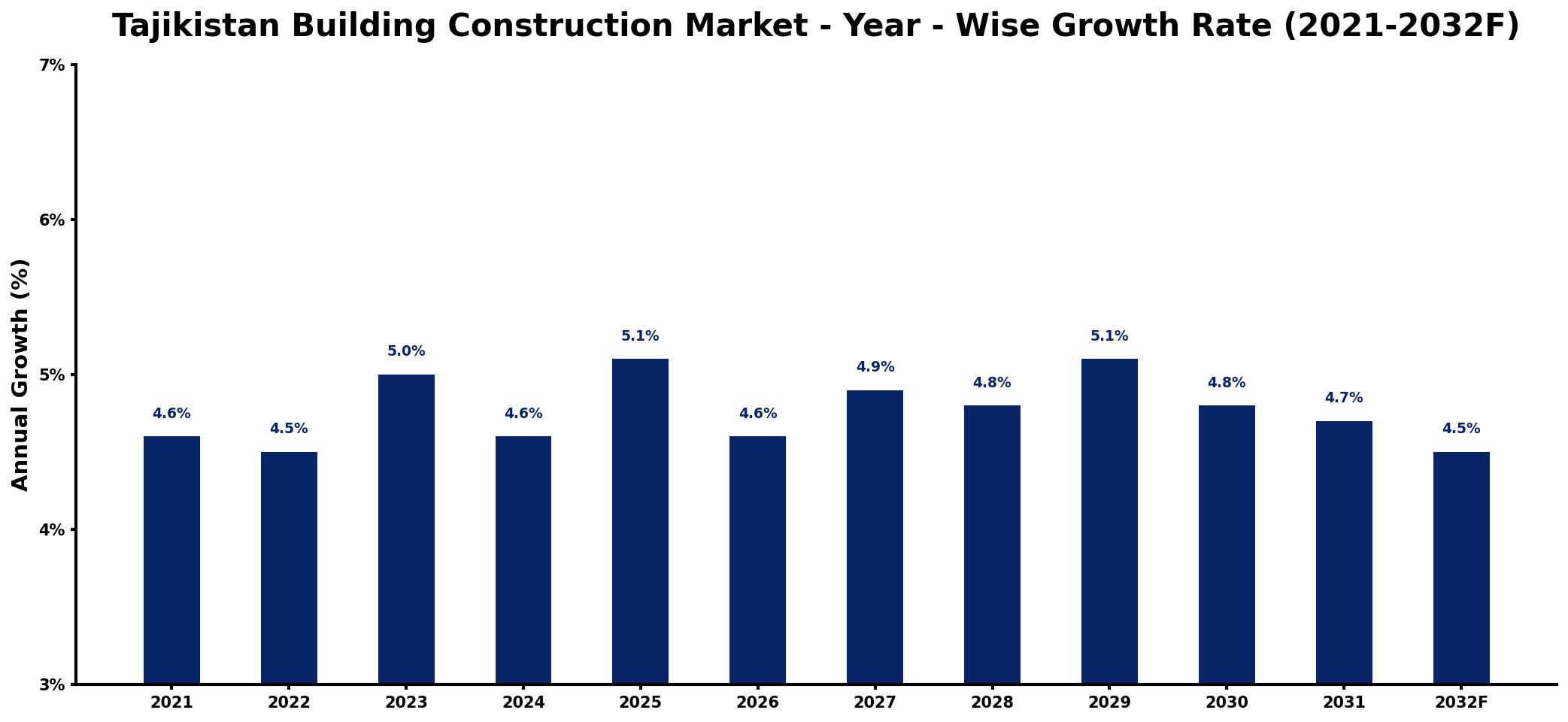
The table below presents the year‑wise growth rates along with the key drivers influencing the market
| Year | Growth Rate | Major Drivers |
| 2021 | 4.6% | increased government infrastructure investments |
| 2022 | 4.5% | rising urban population demands housing |
| 2023 | 5.0% | expansion of foreign investment projects |
| 2024 | 4.6% | growing demand for commercial spaces |
| 2025 | 5.1% | improved access to financing options |
| 2026 | 4.6% | increased public-private partnership initiatives |
| 2027 | 4.9% | surge in renewable energy projects |
| 2028 | 4.8% | enhanced transportation network development |
| 2029 | 5.1% | growing tourism sector driving demand |
| 2030 | 4.8% | rising demand for residential developments |
| 2031 | 4.7% | expanding healthcare application demand |
| 2032 | 4.5% | increased focus on sustainability initiatives |
Note: Market size estimations and growth projections presented in this report are based on 6Wresearch's proprietary forecasting methodology, utilizing the latest available industry data, government publications, and primary research inputs.
Tajikistan Building Construction Market Synopsis
In recent years, Tajikistan's building construction market has demonstrated resilience and potential for expansion. The governments commitment to infrastructure development, coupled with a surge in foreign investments, has set the stage for significant projects across the nation. This momentum is particularly visible in urban areas where the demand for commercial and residential developments is on the rise.
The construction sector is not only growing due to urbanization but also through the adoption of innovative building practices. Sustainable construction methods are gaining importance, reflecting a broader global shift towards environmentally friendly initiatives. However, several challenges remain that may impact this growth, including labor shortages and regulatory inefficiencies.
Tajikistan Building Construction Market Key Takeaways
- Government investments in infrastructure are catalyzing growth in the construction sector.
- Urbanization is driving significant demand for residential and commercial properties.
- Green building practices are increasingly being adopted, reflecting environmental considerations.
- Foreign partnerships are instrumental in enhancing local capabilities and accelerating project execution.
- Challenges such as limited skilled labor and financing access continue to pose risks to market development.
Evaluation of Restraints in Tajikistan Building Construction Market
Despite the promising growth prospects, the Tajikistan building construction market faces several constraints that inhibit its potential. A significant challenge is the limited access to financing for construction projects, which can stall development efforts. The lack of skilled labor further complicates matters, as many construction projects require specialized expertise that is in short supply. Additionally, the bureaucratic regulatory environment and inconsistent policies can hinder timely project execution and deter foreign investment, creating a need for streamlined processes and better governance to boost investor confidence.
Tajikistan Building Construction Market Trends
Currently, the market is witnessing a trend towards sustainable construction, with an emphasis on energy-efficient buildings and the integration of smart technologies. This shift is driven by a growing environmental awareness among consumers and regulators alike. In addition, modern design trends are emerging, highlighting the need for functionality combined with aesthetic appeal in urban development projects. As the government continues to enhance infrastructure, there is also a marked interest in smart city initiatives that leverage technology to improve urban living.
Tajikistan Building Construction Market Opportunities
The Tajikistan building construction market holds substantial investment opportunities, particularly in infrastructure development, residential projects, and commercial real estate. The governments ongoing initiatives to improve the housing stock and transportation networks underscore the potential for lucrative investments. Additionally, forging partnerships with local construction firms can provide foreign investors with essential insights into navigating the regulatory landscape and accessing local resources, ultimately facilitating successful project execution.
Government Initiatives in the Tajikistan Building Construction Market
The Tajik government has implemented a series of initiatives aimed at enhancing the building construction sector. Efforts to streamline the construction permitting process are in place to attract foreign investments and simplify project development. Furthermore, regulations ensuring compliance with building codes and safety standards are enforced to maintain quality across projects. Incentives are also being provided to local construction companies to bolster their capacity and competitiveness, thus fostering a more robust construction ecosystem.
Future Insights of the Tajikistan Building Construction Market
Looking ahead to the period from 2026 to 2032, the Tajikistan building construction market is poised for steady growth. The convergence of a burgeoning population, heightened urbanization, and intensified investment in infrastructure is expected to drive demand for construction projects. Moreover, the rising trend of sustainable construction practices coupled with technological advancements is likely to reshape the industry landscape, enhancing both operational efficiency and cost-effectiveness. However, it is crucial for stakeholders to navigate existing challenges, such as access to financing and regulatory complexities, to fully realize the market's potential.
Tajikistan Building Construction Market Latest Developments (2025 - 2026)
Recently, the Tajikistan building construction market has seen a surge in public-private partnerships aimed at accelerating infrastructure projects across the country. These collaborations are focusing on the modernization of existing facilities and the construction of new residential and commercial buildings. The government has also announced new initiatives to attract foreign direct investment, particularly in urban areas where the demand for construction services is most acute. Additionally, innovations in green building practices are becoming more prevalent, reflecting a growing commitment to environmental sustainability.
Tajikistan Building Construction Market - Key Attractiveness of the Report
- 10 Years of Market Numbers
- Historical Data Starting from 2022 to 2025
- Base Year: 2025
- Forecast Data until 2032
- Key Performance Indicators Impacting the Market
- Major Upcoming Developments and Projects
Key Highlights of the Report:
- Tajikistan Building Construction Market Outlook
- Market Size of Tajikistan Building Construction Market, 2025
- Forecast of Tajikistan Building Construction Market, 2032
- Historical Data and Forecast of Tajikistan Building Construction Revenues & Volume for the Period 2022-2032F
- Tajikistan Building Construction Market Trend Evolution
- Tajikistan Building Construction Market Drivers and Challenges
- Tajikistan Building Construction Price Trends
- Tajikistan Building Construction Porter's Five Forces
- Tajikistan Building Construction Industry Life Cycle
- Historical Data and Forecast of Tajikistan Building Construction Market Revenues & Volume By Type for the Period 2022-2032F
- Historical Data and Forecast of Tajikistan Building Construction Market Revenues & Volume By Residential for the Period 2022-2032F
- Historical Data and Forecast of Tajikistan Building Construction Market Revenues & Volume By Non-residential for the Period 2022-2032F
- Historical Data and Forecast of Tajikistan Building Construction Market Revenues & Volume By Construction Type for the Period 2022-2032F
- Historical Data and Forecast of Tajikistan Building Construction Market Revenues & Volume By New Construction for the Period 2022-2032F
- Historical Data and Forecast of Tajikistan Building Construction Market Revenues & Volume By Renovation for the Period 2022-2032F
- Historical Data and Forecast of Tajikistan Building Construction Market Revenues & Volume By Application for the Period 2022-2032F
- Historical Data and Forecast of Tajikistan Building Construction Market Revenues & Volume By Owned for the Period 2022-2032F
- Historical Data and Forecast of Tajikistan Building Construction Market Revenues & Volume By Rental for the Period 2022-2032F
- Historical Data and Forecast of Tajikistan Building Construction Market Revenues & Volume By End User for the Period 2022-2032F
- Historical Data and Forecast of Tajikistan Building Construction Market Revenues & Volume By Private for the Period 2022-2032F
- Historical Data and Forecast of Tajikistan Building Construction Market Revenues & Volume By Public for the Period 2022-2032F
- Tajikistan Building Construction Import Export Trade Statistics
- Market Opportunity Assessment By Type
- Market Opportunity Assessment By Construction Type
- Market Opportunity Assessment By Application
- Market Opportunity Assessment By End User
- Tajikistan Building Construction Top Companies Market Share
- Tajikistan Building Construction Competitive Benchmarking By Technical and Operational Parameters
- Tajikistan Building Construction Company Profiles
- Tajikistan Building Construction Key Strategic Recommendations






































