Tajikistan Bulletproof Glass Market Size, Share & Growth Rate
The Tajikistan Bulletproof Glass Market was estimated at USD 217 Million in 2025 and is projected to reach USD 289 Million by 2032, growing at a CAGR of 4.2% from 2026 to 2032. This growth trajectory is largely driven by escalating security concerns across various sectors, including governmental facilities, banking institutions, and upscale residences. Heightened awareness regarding personal and property safety, coupled with increasing incidences of crime, further propels the demand for advanced security solutions such as bulletproof glass.
Tajikistan Bulletproof Glass Market Year-wise Growth Rate and Key Drivers
This graph highlights how the Tajikistan Bulletproof Glass Market has steadily grown over the years, supported by major growth factors.
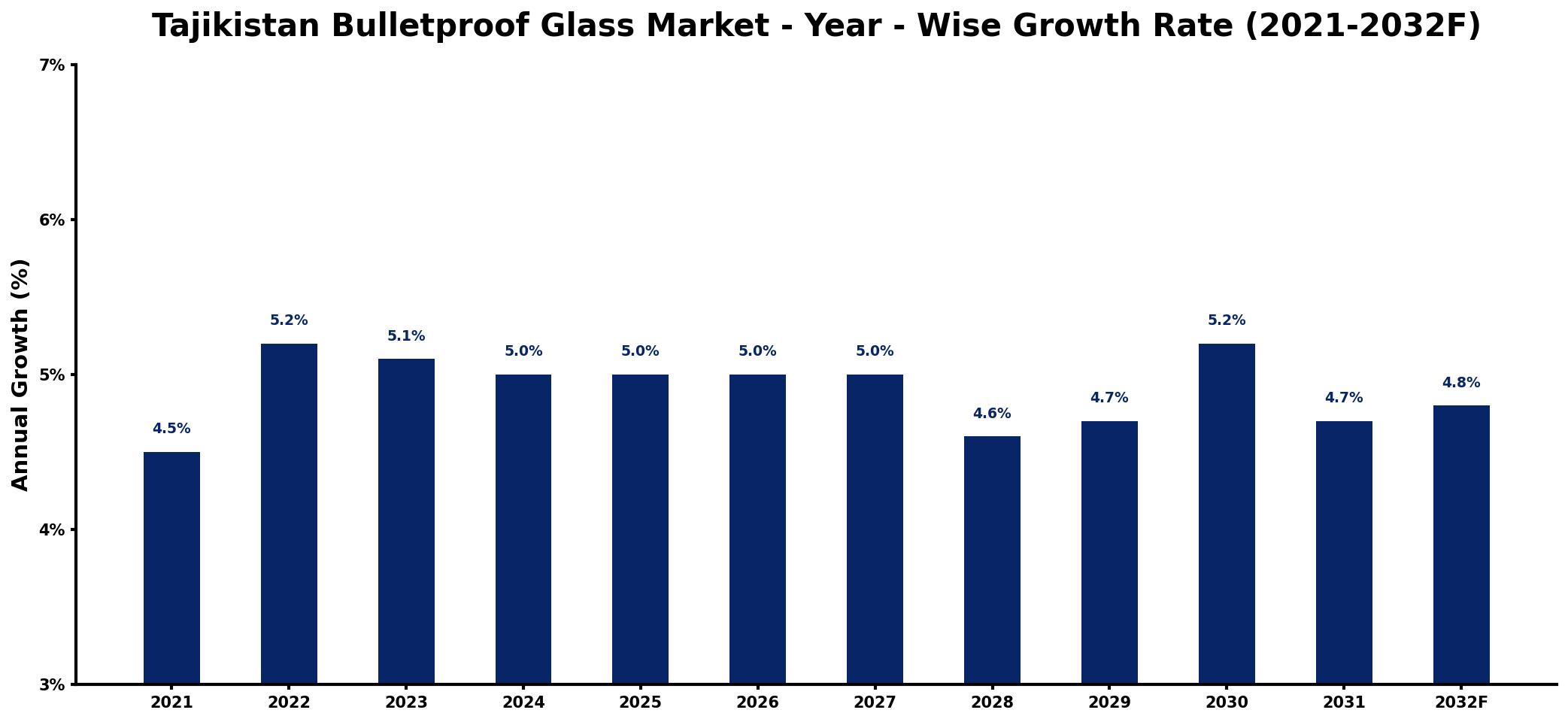
The table below presents the year‑wise growth rates along with the key drivers influencing the market
| Year | Growth Rate | Major Drivers |
| 2021 | 4.5% | increased security demand from construction |
| 2022 | 5.2% | growing investments in infrastructure projects |
| 2023 | 5.1% | rise in private security services |
| 2024 | 5.0% | expansion of automotive safety regulations |
| 2025 | 5.0% | increased awareness of personal safety |
| 2026 | 5.0% | growth in commercial property developments |
| 2027 | 5.0% | demand surge from government contracts |
| 2028 | 4.6% | increased domestic production output |
| 2029 | 4.7% | increased urbanization and development |
| 2030 | 5.2% | improved raw material availability |
| 2031 | 4.7% | rising trend in luxury vehicles |
| 2032 | 4.8% | growing demand for residential security |
Note: Market size estimations and growth projections presented in this report are based on 6Wresearch's proprietary forecasting methodology, utilizing the latest available industry data, government publications, and primary research inputs.
Tajikistan Bulletproof Glass Market Synopsis
The most significant force shaping the Tajikistan Bulletproof Glass Market today is the urgent need for enhanced security measures amidst rising political instability and crime rates. The increasing frequency of violent incidents has prompted both individuals and organizations to invest in security enhancements, elevating the demand for bulletproof glass solutions.
In parallel, ongoing infrastructure projects and renovations in existing buildings are facilitating the market's expansion. As the construction sector grows, opportunities for integrating bulletproof glass into various architectural designs are becoming more prevalent, indicating a robust future for this market.
Tajikistan Bulletproof Glass Market Key Takeaways
- The market is predominantly characterized by imported bulletproof glass products, given the local production capabilities.
- Awareness around the benefits of bulletproof glass is gradually increasing, though it remains a challenge.
- Technological advancements are leading to the development of lighter and more aesthetically appealing glass solutions.
- Investment opportunities abound for both local and international players, especially in sectors demanding enhanced security.
- The governments existing regulatory framework supports the overall safety and quality of security products, influencing market dynamics.
Evaluation of Restraints in Tajikistan Bulletproof Glass Market
Despite the growth potential, the Tajikistan Bulletproof Glass Market faces significant restraints. One of the primary challenges is the limited awareness among potential customers regarding the advantages of investing in bulletproof glass. This lack of understanding can lead to hesitation in adoption, as many view the costs as prohibitive. Additionally, economic constraints and ongoing political instability can lead to a prioritization of essential expenses over security upgrades. Furthermore, challenges in product availability and skilled installation services can inhibit market growth, necessitating strategic efforts to address these issues.
Tajikistan Bulletproof Glass Market Trends
Current trends in the Tajikistan Bulletproof Glass Market indicate a shift towards high-performance solutions that do not compromise on aesthetics. Manufacturers are innovating to create lightweight variants that are compliant with international safety standards. Moreover, there is a noticeable increase in demand from the automotive sector, as vehicles require upgraded security features to safeguard occupants. This trend of integrating security into design is indicative of the market's evolution, aligning with the broader global move towards enhanced personal safety.
Tajikistan Bulletproof Glass Market Opportunities
The growing emphasis on security within government buildings, financial institutions, and high-end residential properties offers lucrative investment opportunities in the Tajikistan Bulletproof Glass Market. Collaborating with local construction firms and security agencies to deliver customized solutions can significantly enhance market penetration. Moreover, innovations in glass technology pave the way for the development of more efficient, cost-effective products, thereby expanding market possibilities for manufacturers and investors.
Government Initiatives in the Tajikistan Bulletproof Glass Market
While there are no specific government policies exclusively addressing the bulletproof glass market, Tajikistan maintains a regulatory framework that governs the importation and utilization of security-related products. This framework aims to ensure public safety and facilitate fair market competition. Compliance with relevant safety and quality standards set forth by the government remains essential for businesses operating in this sector, reflecting a broader commitment to enhancing national security.
Future Insights of the Tajikistan Bulletproof Glass Market
Looking ahead to 2026-2032, the Tajikistan Bulletproof Glass Market is on track for continued growth. As security concerns intensify, both residential and commercial sectors are expected to increase investments in bulletproof glass solutions. The ongoing advancements in technology will likely drive innovations that cater to evolving customer needs, ensuring product offerings remain relevant and appealing. Overall, this market is poised for expansion, supported by a collective desire for improved safety across various sectors.
Tajikistan Bulletproof Glass Market Latest Developments (2025 - 2026)
Recent developments in the Tajikistan Bulletproof Glass Market reflect a growing trend toward advanced product solutions. Industry participants are increasingly focusing on creating innovative and transparent bulletproof glass options that meet consumer demands for both safety and aesthetics. Moreover, collaborations between domestic construction firms and international manufacturers are emerging, aiming to address the local market's specific security requirements effectively. This trend signals a proactive approach to enhancing security across various infrastructures.
Tajikistan Bulletproof Glass Market - Key Attractiveness of the Report
- 10 Years of Market Numbers
- Historical Data Starting from 2022 to 2025
- Base Year: 2025
- Forecast Data until 2032
- Key Performance Indicators Impacting the Market
- Major Upcoming Developments and Projects
Key Highlights of the Report:
- Tajikistan Bulletproof Glass Market Outlook
- Market Size of Tajikistan Bulletproof Glass Market, 2025
- Forecast of Tajikistan Bulletproof Glass Market, 2032
- Historical Data and Forecast of Tajikistan Bulletproof Glass Revenues & Volume for the Period 2022-2032F
- Tajikistan Bulletproof Glass Market Trend Evolution
- Tajikistan Bulletproof Glass Market Drivers and Challenges
- Tajikistan Bulletproof Glass Price Trends
- Tajikistan Bulletproof Glass Porter's Five Forces
- Tajikistan Bulletproof Glass Industry Life Cycle
- Historical Data and Forecast of Tajikistan Bulletproof Glass Market Revenues & Volume By Type for the Period 2022-2032F
- Historical Data and Forecast of Tajikistan Bulletproof Glass Market Revenues & Volume By Solid Acrylic for the Period 2022-2032F
- Historical Data and Forecast of Tajikistan Bulletproof Glass Market Revenues & Volume By Traditional Laminated for the Period 2022-2032F
- Historical Data and Forecast of Tajikistan Bulletproof Glass Market Revenues & Volume By Polycarbonate for the Period 2022-2032F
- Historical Data and Forecast of Tajikistan Bulletproof Glass Market Revenues & Volume By Glass-clad Polycarbonate for the Period 2022-2032F
- Historical Data and Forecast of Tajikistan Bulletproof Glass Market Revenues & Volume By Other Types for the Period 2022-2032F
- Historical Data and Forecast of Tajikistan Bulletproof Glass Market Revenues & Volume By End-user Industry for the Period 2022-2032F
- Historical Data and Forecast of Tajikistan Bulletproof Glass Market Revenues & Volume By Automotive for the Period 2022-2032F
- Historical Data and Forecast of Tajikistan Bulletproof Glass Market Revenues & Volume By Buildings and Construction for the Period 2022-2032F
- Historical Data and Forecast of Tajikistan Bulletproof Glass Market Revenues & Volume By Defense for the Period 2022-2032F
- Historical Data and Forecast of Tajikistan Bulletproof Glass Market Revenues & Volume By Other End-user Industries for the Period 2022-2032F
- Tajikistan Bulletproof Glass Import Export Trade Statistics
- Market Opportunity Assessment By Type
- Market Opportunity Assessment By End-user Industry
- Tajikistan Bulletproof Glass Top Companies Market Share
- Tajikistan Bulletproof Glass Competitive Benchmarking By Technical and Operational Parameters
- Tajikistan Bulletproof Glass Company Profiles
- Tajikistan Bulletproof Glass Key Strategic Recommendations






































