Tajikistan Bulletproof Vest Market Summary
The tajikistan bulletproof vest market was estimated at USD 754 Million in 2025 and is projected to reach USD 1082 Million by 2032, growing at a CAGR of 6.4% from 2026 to 2032.
Tajikistan Bulletproof Vest Market Year-wise Growth Rate and Key Drivers
This graph highlights how the Tajikistan Bulletproof Vest Market has steadily grown over the past five years, supported by major growth factors.
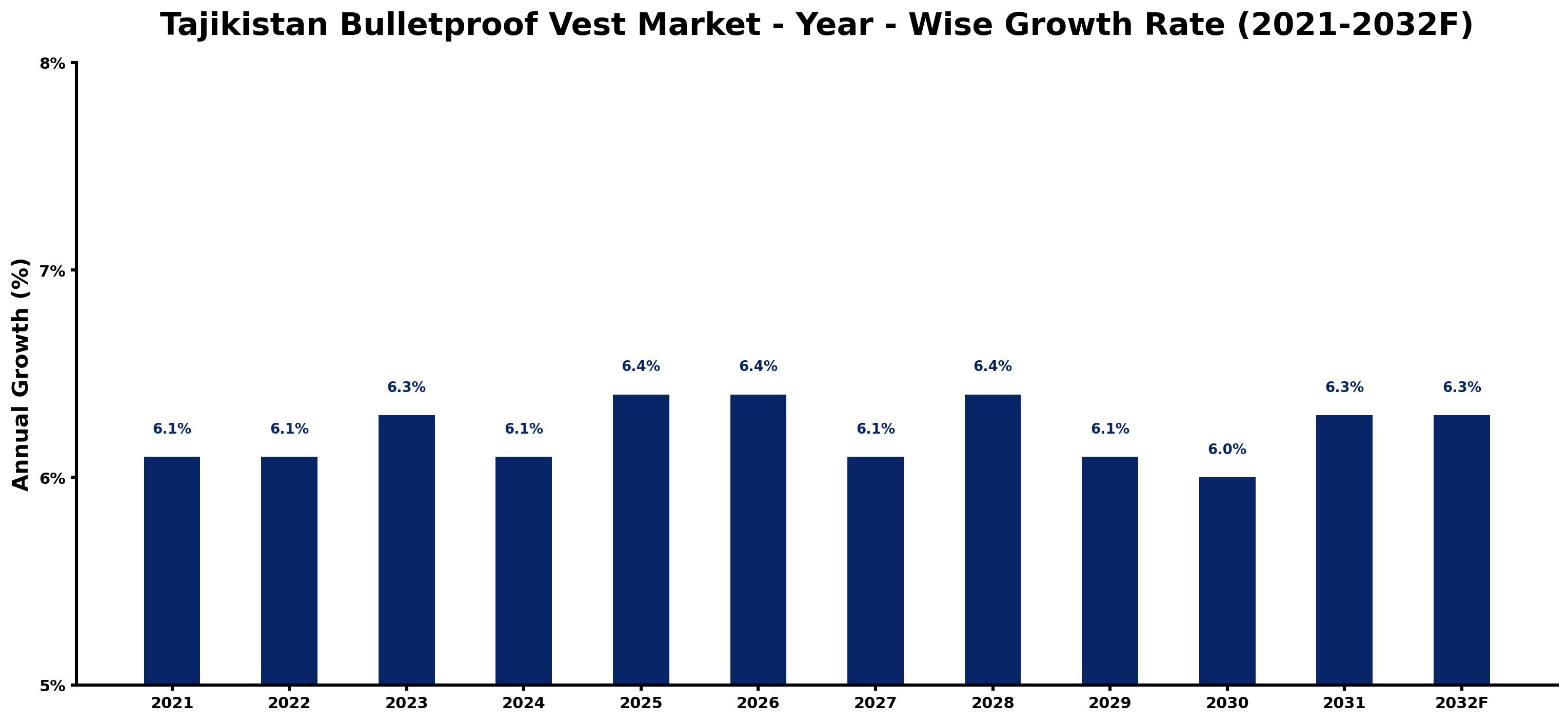
The table below presents the year wise growth rates along with the key drivers influencing the market
| Year | Growth Rate | Major Drivers |
| 2021 | 6.1% | Increased regional instability has heightened interest in personal protection equipment across sectors. |
| 2022 | 6.1% | Local manufacturers begin partnerships, reducing import reliance and enhancing market responsiveness. |
| 2023 | 6.3% | Rising awareness of personal safety spurs demand among security personnel and civilians alike. |
| 2024 | 6.1% | Economic recovery post-pandemic drives private security investments, increasing market opportunities. |
| 2025 | 6.4% | Media coverage of global conflicts influences consumer perception around personal safety gear. |
| 2026 | 6.4% | Emergence of new security threats prompts businesses to reassess safety protocols and equipment. |
| 2027 | 6.1% | Shift in government policy towards increased funding for law enforcement agencies is observed. |
| 2028 | 6.4% | Growing urbanization in Tajikistan raises the profile of personal safety concerns among residents. |
| 2029 | 6.1% | Digital marketing campaigns focused on safety gear education resonate well with potential buyers. |
| 2030 | 6.0% | International collaborations with NGOs boost awareness around protective gear in conflict-prone areas. |
| 2031 | 6.3% | Technological innovations in materials lead to better, lighter vests appealing to diverse users. |
| 2032 | 6.3% | Supply chain enhancements reduce costs, making bulletproof vests more accessible for consumers. |
Note - Market size estimations and growth projections presented in this report are based on 6Wresearch's advanced forecasting approach, validated with industry datasets as of June 2026.
Tajikistan Bulletproof Vest Market Synopsis
The Tajikistan Bulletproof Vest Market is projected to reach 6.4% and witness significant growth during the forecast period (2026-2032). The increasing demand for personal protective equipment arises primarily from the heightened security challenges, including political instability and rising threats of terrorism. The requirements from law enforcement agencies and military forces considerably influence market dynamics, driving the need for advanced protection solutions in various high-risk environments.
Tajikistan Bulletproof Vest Market Growth Drivers
Several key factors are propelling the growth of the Tajikistan Bulletproof Vest Market. First, the ongoing political climate characterized by instability has intensified the need for personal safety gear among security personnel. Furthermore, an increase in violent crime rates has compelled citizens and agencies alike to invest in protective equipment. Enhanced awareness regarding the advantages of bulletproof vests, particularly among law enforcement personnel, is another critical driver.
- The escalating threat of terrorist activities necessitates the adoption of robust protective measures.
- Government initiatives that focus on enhancing security infrastructure contribute to market demand.
- Continuing advancements in vest technology have led to the development of lighter and more comfortable products.
- Urbanization and the growth of cities have increased the need for private security services, further stimulating market growth.
- Customization options offered by manufacturers allow for tailored solutions that meet specific user needs, fostering broader acceptance of bulletproof vests.
Tajikistan Bulletproof Vest Market Trends and Opportunities
The Tajikistan Bulletproof Vest Market is currently witnessing transformative trends that significantly shape its landscape. There is a pronounced shift towards lightweight designs that provide enhanced mobility without compromising protection. The integration of advanced materials, such as Kevlar and high-performance polymers, is becoming increasingly common, as these materials offer improved protection levels while maintaining comfort. Manufacturers are also focusing on ergonomic designs that cater to users' diverse requirements.
- There is a growing trend towards the incorporation of smart technologies, including ballistic sensors and communication devices, in bulletproof vests.
- Factors like climate considerations are influencing the design of vests to ensure ventilation and adaptability in various weather conditions.
- Awareness campaigns and training programs are emerging as vital tools to educate the population on the importance of protective equipment.
- The government's increasing allocation of funds for defense and security bolsters market opportunities.
- Partnerships between local firms and international manufacturers are facilitating the introduction of innovative products, enhancing market competitiveness.
Tajikistan Bulletproof Vest Market Challenges and Restraints
Despite its growth potential, the Tajikistan Bulletproof Vest Market faces several challenges. One of the significant obstacles is the prevalent lack of awareness about the efficacy and necessity of bulletproof vests among both the general population and law enforcement agencies. This limited knowledge often results in low adoption rates and, subsequently, stunted market growth.
- Economic constraints can impede the procurement of high-quality bulletproof vests, as affordability remains a concern for many potential buyers.
- The presence of counterfeit products undermines consumer trust and poses safety risks, necessitating stricter regulations.
- Limited domestic manufacturing capabilities can hinder timely availability and increase dependency on imports.
- Understanding the appropriate usage and maintenance of bulletproof vests is essential, and the lack of education can lead to improper application.
- Overcoming stigma associated with wearing protective gear in non-military environments requires concerted awareness efforts.
Tajikistan Bulletproof Vest Market Government Investment and Initiatives
The Tajikistan government has initiated several policies to promote the secure and effective distribution of bulletproof vests. Stringent regulations are in place to ensure that imported and locally produced bulletproof vests meet specific quality standards essential for safety and reliability. The government mandates that all vendors and distributors acquire necessary licenses and certifications to operate, ensuring product integrity. Furthermore, the government actively monitors the market to prevent misuse and illegal distribution of protective gear, which is vital for public safety.
- Public spending on enhancing security measures directly impacts the procurement of protective equipment like bulletproof vests.
- Developments in the defense sector are supported by government budgets aimed at improving law enforcement capabilities.
- Investment incentives are increasingly available to local manufacturers who comply with government regulations, fostering domestic production.
- Collaborations between governmental agencies and security firms help disseminate knowledge about the importance of bulletproof vests.
- Future development plans aim at bolstering the overall security infrastructure, which will necessitate increasing demand for protective gear.
Tajikistan Bulletproof Vest Market Latest Developments (May 2025 - June 2026)
Recent developments within the Tajikistan Bulletproof Vest Market indicate a progressive shift towards the modernization of protective gear. During this period, several initiatives aimed at enhancing awareness about the significance of personal protection have gained traction. Educational campaigns led by both governmental and non-governmental organizations emphasize the importance of bulletproof vests for various professionals.
- Investments in advanced manufacturing techniques are on the rise, with an emphasis on quality control and product reliability.
- Collaborations between local suppliers and international technology firms are paving the way for innovative designs and functionalities in bulletproof vests.
- There is a noticeable increase in demand for custom-made vests tailored to specific user requirements.
- Regulatory bodies are intensifying their efforts to eradicate counterfeit products from the market, bolstering consumer confidence.
- The changing security landscape is prompting a reassessment of procurement strategies by military and law enforcement agencies to ensure the effectiveness of their protective equipment.
Tajikistan Bulletproof Vest Market - Key Attractiveness of the Report
- 10 Years of Market Numbers
- Historical Data Starting from 2022 to 2025
- Base Year: 2025
- Forecast Data until 2032
- Key Performance Indicators Impacting the Market
- Major Upcoming Developments and Projects
Key Highlights of the Report:
- Tajikistan Bulletproof Vest Market Outlook
- Market Size of Tajikistan Bulletproof Vest Market, 2025
- Forecast of Tajikistan Bulletproof Vest Market, 2032F
- Historical Data and Forecast of Tajikistan Bulletproof Vest Revenues & Volume for the Period 2022-2032F
- Tajikistan Bulletproof Vest Market Trend Evolution
- Tajikistan Bulletproof Vest Market Drivers and Challenges
- Tajikistan Bulletproof Vest Price Trends
- Tajikistan Bulletproof Vest Porter's Five Forces
- Tajikistan Bulletproof Vest Industry Life Cycle
- Historical Data and Forecast of Tajikistan Bulletproof Vest Market Revenues & Volume By Type for the Period 2022-2032F
- Historical Data and Forecast of Tajikistan Bulletproof Vest Market Revenues & Volume By Soft Vest for the Period 2022-2032F
- Historical Data and Forecast of Tajikistan Bulletproof Vest Market Revenues & Volume By Hard Vest for the Period 2022-2032F
- Historical Data and Forecast of Tajikistan Bulletproof Vest Market Revenues & Volume By Purpose for the Period 2022-2032F
- Historical Data and Forecast of Tajikistan Bulletproof Vest Market Revenues & Volume By Military for the Period 2022-2032F
- Historical Data and Forecast of Tajikistan Bulletproof Vest Market Revenues & Volume By Civilian for the Period 2022-2032F
- Tajikistan Bulletproof Vest Import Export Trade Statistics
- Market Opportunity Assessment By Type
- Market Opportunity Assessment By Purpose
- Tajikistan Bulletproof Vest Top Companies Market Share
- Tajikistan Bulletproof Vest Competitive Benchmarking By Technical and Operational Parameters
- Tajikistan Bulletproof Vest Company Profiles
- Tajikistan Bulletproof Vest Key Strategic Recommendations






































