Tajikistan Car Air Fresheners Market Size, Share & Growth Rate
The Tajikistan Car Air Fresheners Market was estimated at USD 647 Million in 2025 and is projected to reach USD 1210 Million by 2032, growing at a CAGR of 9.4% from 2026 to 2032. This robust growth is primarily fueled by the increasing car ownership rates across the nation and an evolving consumer desire for a pleasant driving ambiance. The markets expansion is further enhanced by a rising middle class with greater disposable income, enabling greater expenditure on personal vehicle care products.
Tajikistan Car Air Fresheners Market Year-wise Growth Rate and Key Drivers
This graph highlights how the Tajikistan Car Air Fresheners Market has steadily grown over the years, supported by major growth factors.
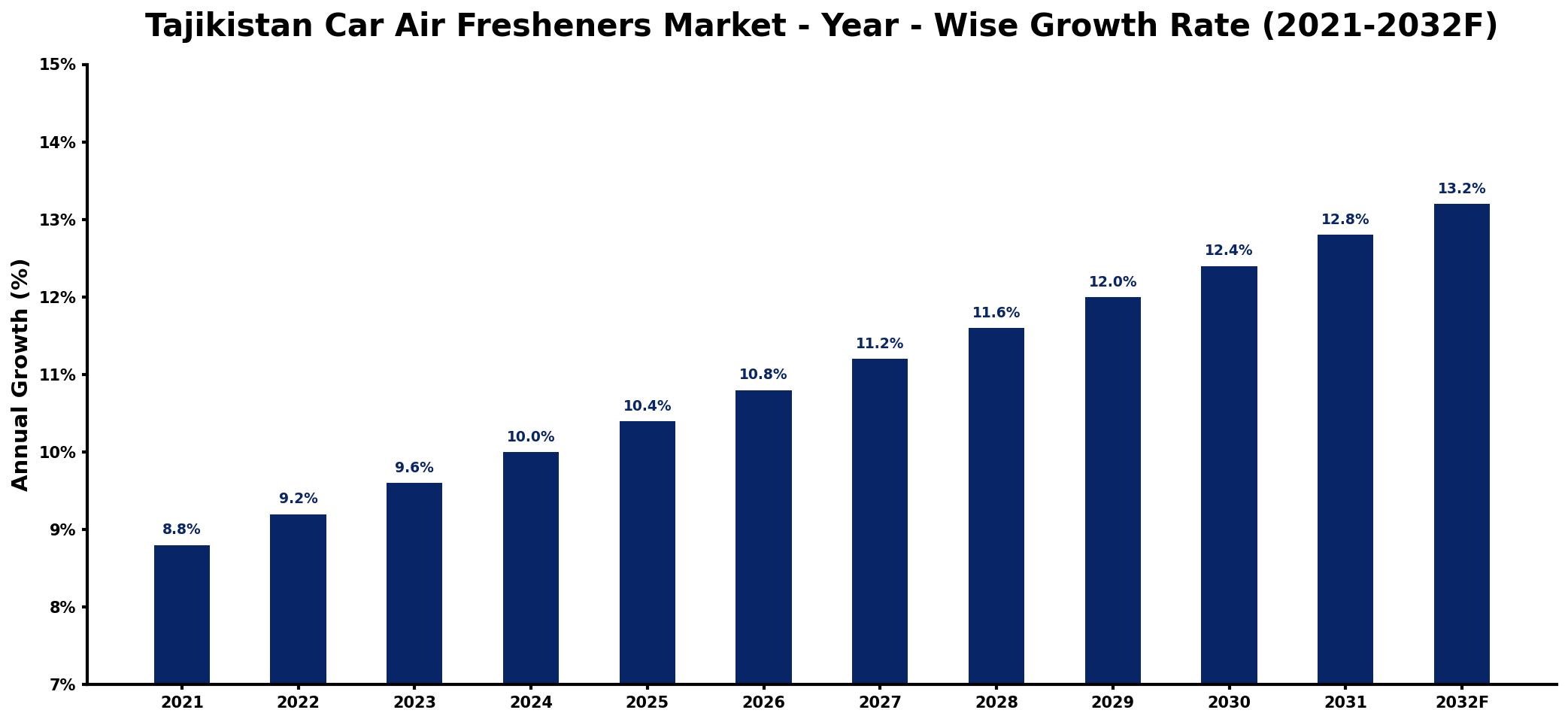
The table below presents the year‑wise growth rates along with the key drivers influencing the market
| Year | Growth Rate | Major Drivers |
| 2021 | 8.8% | Rising consumer disposable income |
| 2022 | 9.2% | Expansion of retail distribution channels |
| 2023 | 9.6% | Increasing urbanization and lifestyle changes |
| 2024 | 10.0% | Growing awareness of personal hygiene |
| 2025 | 10.4% | Innovative product offerings and varieties |
| 2026 | 10.8% | Increased focus on home decor |
| 2027 | 11.2% | increased capital investment inflows |
| 2028 | 11.6% | Rise in e-commerce shopping trends |
| 2029 | 12.0% | Growing demand for eco-friendly products |
| 2030 | 12.4% | Increased marketing and advertising efforts |
| 2031 | 12.8% | increased pharmaceutical industry usage |
| 2032 | 13.2% | Strengthening of consumer brand loyalty |
Note: Market size estimations and growth projections presented in this report are based on 6Wresearch's proprietary forecasting methodology, utilizing the latest available industry data, government publications, and primary research inputs.
Tajikistan Car Air Fresheners Market Synopsis
The foremost driver reshaping the Tajikistan Car Air Fresheners Market is the rising car ownership, as more citizens invest in personal vehicles. This surge is coupled with a growing emphasis on creating enjoyable and personalized driving environments, influencing consumer choices toward premium and long-lasting air fresheners.
Simultaneously, a trend towards eco-friendly products is gaining traction. Consumers are increasingly leaning towards air fresheners made from natural ingredients, aligning with a broader global shift towards sustainability and health consciousness. This shift is prompting manufacturers to innovate their product lines to meet evolving consumer preferences.
Tajikistan Car Air Fresheners Market Key Takeaways
- The market is expanding rapidly due to increased vehicle ownership and consumer demand for personalized car experiences.
- There is a notable preference for eco-friendly and natural air fresheners among health-conscious consumers.
- Innovations, including smart air fresheners that can be controlled via apps, are beginning to emerge.
- Distribution channels are diversifying, with a growing presence of online retailers complementing traditional automotive shops.
- Consumers are favoring premium products characterized by long-lasting scents and distinctive designs.
Evaluation of Restraints in Tajikistan Car Air Fresheners Market
Despite the promising outlook, several constraints hinder the full potential of the Tajikistan Car Air Fresheners Market. Limited consumer awareness about the benefits of modern air freshening solutions often keeps individuals reliant on traditional methods, such as sachets or natural fragrances. Additionally, the overall distribution infrastructure in Tajikistan is still underdeveloped, which restricts the availability of diverse product offerings. Economic factors, including lower purchasing power among segments of the population, also contribute to consumer hesitance to invest in non-essential products.
Tajikistan Car Air Fresheners Market Trends
The market is currently experiencing a notable shift towards sustainable and environmentally friendly products. Consumers are increasingly discerning, favoring air fresheners that not only elevate their driving experience but also resonate with their environmental values. Additionally, technological advancements are influencing the landscape, with smart air fresheners that offer convenience through mobile app controls making a debut. Customization is another emerging trend, with consumers seeking unique scents and designs that reflect personal styles.
Tajikistan Car Air Fresheners Market Opportunities
The growing number of vehicles on the road in Tajikistan presents lucrative opportunities for investors and manufacturers in the car air fresheners market. By introducing innovative products, such as organic fragrances and customized offerings, companies can capture the attention of health-conscious consumers. Moreover, developing strategic partnerships with local retailers and expanding online presence will be critical for reaching a broader customer base, ultimately leading to increased sales and market penetration.
Government Initiatives in the Tajikistan Car Air Fresheners Market
The Tajikistan government is actively involved in regulating the car air fresheners market to ensure product safety and quality. Compliance with standards regarding labeling, packaging, and ingredient transparency is mandatory for manufacturers and importers. This regulatory framework is designed to protect consumer health and promote a competitive market. Inspections and testing procedures further reinforce these standards, supporting the development of a sustainable and high-quality air fresheners industry.
Future Insights of the Tajikistan Car Air Fresheners Market
Looking ahead to the period of 2026 to 2032, the Tajikistan Car Air Fresheners Market is positioned for significant growth. Factors such as increasing disposable incomes, heightened awareness of hygiene, and a steadfast preference for pleasant driving environments will drive demand. Moreover, the market is likely to witness the introduction of innovative product variants that cater to the evolving consumer demands for sustainability. By focusing on product diversification and enhanced distribution strategies, stakeholders can effectively capitalize on these emerging opportunities.
Tajikistan Car Air Fresheners Market Latest Developments (2025 - 2026)
Recent developments in the Tajikistan Car Air Fresheners Market indicate a shift towards innovative product introductions. Companies are focusing on launching air fresheners that align with consumer preferences for eco-friendly solutions and advanced technologies. Online retailing is also gaining traction, enabling consumers to access a wider variety of products, which reflects changing shopping behaviors. Overall, the industry is adapting to meet the rising expectations for both quality and sustainability.
Tajikistan Car Air Fresheners Market - Key Attractiveness of the Report
- 10 Years of Market Numbers
- Historical Data Starting from 2022 to 2025
- Base Year: 2025
- Forecast Data until 2032
- Key Performance Indicators Impacting the Market
- Major Upcoming Developments and Projects
Key Highlights of the Report:
- Tajikistan Car Air Fresheners Market Outlook
- Market Size of Tajikistan Car Air Fresheners Market, 2025
- Forecast of Tajikistan Car Air Fresheners Market, 2032
- Historical Data and Forecast of Tajikistan Car Air Fresheners Revenues & Volume for the Period 2022-2032F
- Tajikistan Car Air Fresheners Market Trend Evolution
- Tajikistan Car Air Fresheners Market Drivers and Challenges
- Tajikistan Car Air Fresheners Price Trends
- Tajikistan Car Air Fresheners Porter's Five Forces
- Tajikistan Car Air Fresheners Industry Life Cycle
- Historical Data and Forecast of Tajikistan Car Air Fresheners Market Revenues & Volume By Product for the Period 2022-2032F
- Historical Data and Forecast of Tajikistan Car Air Fresheners Market Revenues & Volume By Gel & Cans for the Period 2022-2032F
- Historical Data and Forecast of Tajikistan Car Air Fresheners Market Revenues & Volume By Spray/Aerosol for the Period 2022-2032F
- Historical Data and Forecast of Tajikistan Car Air Fresheners Market Revenues & Volume By Paper Car Air Fresheners for the Period 2022-2032F
- Historical Data and Forecast of Tajikistan Car Air Fresheners Market Revenues & Volume By Vents & Clips for the Period 2022-2032F
- Historical Data and Forecast of Tajikistan Car Air Fresheners Market Revenues & Volume By End-User for the Period 2022-2032F
- Historical Data and Forecast of Tajikistan Car Air Fresheners Market Revenues & Volume By Sports Car for the Period 2022-2032F
- Historical Data and Forecast of Tajikistan Car Air Fresheners Market Revenues & Volume By Mid-range Car for the Period 2022-2032F
- Historical Data and Forecast of Tajikistan Car Air Fresheners Market Revenues & Volume By SUV for the Period 2022-2032F
- Historical Data and Forecast of Tajikistan Car Air Fresheners Market Revenues & Volume By Others for the Period 2022-2032F
- Historical Data and Forecast of Tajikistan Car Air Fresheners Market Revenues & Volume By Fragrance for the Period 2022-2032F
- Historical Data and Forecast of Tajikistan Car Air Fresheners Market Revenues & Volume By Scented for the Period 2022-2032F
- Historical Data and Forecast of Tajikistan Car Air Fresheners Market Revenues & Volume By UnScented for the Period 2022-2032F
- Tajikistan Car Air Fresheners Import Export Trade Statistics
- Market Opportunity Assessment By Product
- Market Opportunity Assessment By End-User
- Market Opportunity Assessment By Fragrance
- Tajikistan Car Air Fresheners Top Companies Market Share
- Tajikistan Car Air Fresheners Competitive Benchmarking By Technical and Operational Parameters
- Tajikistan Car Air Fresheners Company Profiles
- Tajikistan Car Air Fresheners Key Strategic Recommendations






































