Tajikistan Carbon Credit Market Size, Share & Growth Rate
The Tajikistan Carbon Credit Market was estimated at USD 295 Million in 2025 and is projected to reach USD 415 Million by 2032, growing at a CAGR of 5.0% from 2026 to 2032. This growth trajectory is fueled by the nation's substantial renewable energy resources, particularly in hydropower and solar energy, and a strong commitment to sustainable development. As businesses recognize the economic advantages of carbon credit trading and the global push for emissions reductions intensifies, the market is set to expand significantly.
Tajikistan Carbon Credit Market Year-wise Growth Rate and Key Drivers
This graph highlights how the Tajikistan Carbon Credit Market has steadily grown over the years, supported by major growth factors.
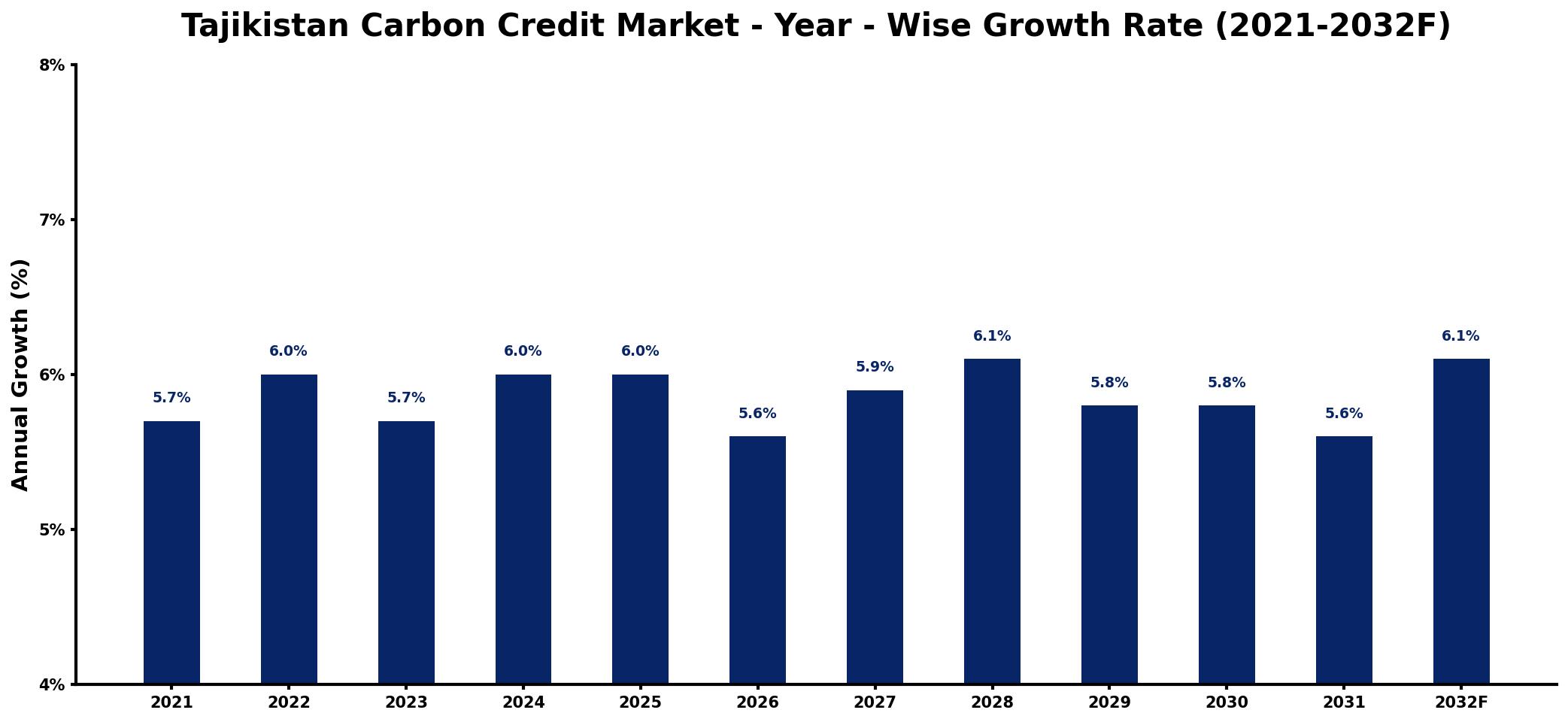
The table below presents the year‑wise growth rates along with the key drivers influencing the market
| Year | Growth Rate | Major Drivers |
| 2021 | 5.7% | Increased investment in renewable energy |
| 2022 | 6.0% | Growing awareness of sustainability practices |
| 2023 | 5.7% | Expansion of green technology initiatives |
| 2024 | 6.0% | Rising corporate responsibility commitments |
| 2025 | 6.0% | Enhanced regulatory support for initiatives |
| 2026 | 5.6% | Development of ecosystem services markets |
| 2027 | 5.9% | Increased participation from local communities |
| 2028 | 6.1% | Emergence of new funding opportunities |
| 2029 | 5.8% | Strengthened international collaboration efforts |
| 2030 | 5.8% | Growing consumer demand for sustainability |
| 2031 | 5.6% | Advancements in environmental innovation sectors |
| 2032 | 6.1% | Broadened scope of environmental policies |
Note: Market size estimations and growth projections presented in this report are based on 6Wresearch's proprietary forecasting methodology, utilizing the latest available industry data, government publications, and primary research inputs.
Tajikistan Carbon Credit Market Synopsis
The most significant force shaping the Tajikistan Carbon Credit Market is the increasing emphasis on renewable energy projects, particularly in hydropower and solar energy sectors. These initiatives not only align with global climate goals but also enhance energy security in a country rich in natural resources.
In parallel, partnerships between local businesses and international organizations are gaining momentum. This collaboration is essential for accessing carbon financing and leveraging technical expertise, thus paving the way for a more robust carbon credit market.
Tajikistan Carbon Credit Market Key Takeaways
- The market is driven by an abundance of renewable energy resources and initiatives aimed at reducing greenhouse gas emissions.
- Investment opportunities are emerging in renewable energy, energy efficiency, and reforestation projects.
- Government policies are fostering an environment conducive to carbon trading and sustainable development.
- Heightened awareness among stakeholders about the economic benefits of carbon credits is influencing market participation.
- International organizations are playing a vital role in supporting market growth through funding and expertise.
Evaluation of Restraints in Tajikistan Carbon Credit Market
Despite the promising prospects, several restraints limit the growth of the Tajikistan Carbon Credit Market. A primary concern is the lack of awareness among potential investors and project developers regarding the benefits of carbon credits. This limited understanding restricts market participation and slows project development. Additionally, regulatory frameworks remain underdeveloped, leading to uncertainties in carbon trading practices. The challenges of political instability and the effectiveness of monitoring emissions reductions add further complexities, necessitating concerted efforts toward capacity building and institutional support to realize the market's full potential.
Tajikistan Carbon Credit Market Trends
The market is witnessing a notable shift towards renewable energy investments, with hydropower projects leading the charge. Additionally, solar energy initiatives are gaining traction, driven by decreasing technology costs and increasing demand for clean energy. There's also an emerging trend of local businesses collaborating with international entities to enhance capacity and access carbon financing. Enhanced energy efficiency measures across sectors further underline the growing commitment to sustainable practices, contributing to the market's evolution.
Tajikistan Carbon Credit Market Opportunities
Tajikistan offers diverse investment opportunities, particularly in renewable energy and energy efficiency sectors. The potential for hydropower and solar projects creates a fertile ground for generating carbon credits. Investors can capitalize on initiatives that focus on energy efficiency within industrial processes and buildings, yielding cost savings while contributing to emissions reductions. Furthermore, reforestation and afforestation projects present viable avenues for generating carbon credits and enhancing biodiversity, presenting a compelling case for investment.
Government Initiatives in the Tajikistan Carbon Credit Market
The government of Tajikistan has put in place several policies aimed at nurturing the Carbon Credit Market. These initiatives include establishing a legal framework to facilitate participation in international carbon trading mechanisms, such as the Clean Development Mechanism (CDM) and the Paris Agreement. Additionally, the government has set ambitious targets for emissions reduction and energy efficiency, thereby creating avenues for project developers to generate carbon credits and contribute to the country's environmental sustainability goals.
Future Insights of the Tajikistan Carbon Credit Market
Looking ahead, the Tajikistan Carbon Credit Market is expected to flourish as the country enhances its commitment to renewable energy and sustainable practices. The increasing global demand for carbon credits, driven by international climate agreements, positions Tajikistan favorably in the carbon market landscape. As investments flow into renewable projects and regulatory frameworks strengthen, the market will likely evolve into a cornerstone of the nation's economic growth, offering substantial opportunities for businesses and investors alike.
Tajikistan Carbon Credit Market Latest Developments (2025 - 2026)
Recent developments in the Tajikistan Carbon Credit Market indicate a continued push towards renewable energy. Initiatives are underway to enhance collaboration between local firms and international organizations, facilitating access to carbon financing and expertise. Moreover, new projects are being proposed to capitalize on the country's hydropower and solar potential, further solidifying Tajikistan's position in the carbon credit landscape. The government's proactive stance in promoting clean energy solutions is also gaining traction, encouraging private sector engagement in sustainable practices.
Tajikistan Carbon Credit Market - Key Attractiveness of the Report
- 10 Years of Market Numbers
- Historical Data Starting from 2022 to 2025
- Base Year: 2025
- Forecast Data until 2032
- Key Performance Indicators Impacting the Market
- Major Upcoming Developments and Projects
Key Highlights of the Report:
- Tajikistan Carbon Credit Market Outlook
- Market Size of Tajikistan Carbon Credit Market, 2025
- Forecast of Tajikistan Carbon Credit Market, 2032
- Historical Data and Forecast of Tajikistan Carbon Credit Revenues & Volume for the Period 2022-2032F
- Tajikistan Carbon Credit Market Trend Evolution
- Tajikistan Carbon Credit Market Drivers and Challenges
- Tajikistan Carbon Credit Price Trends
- Tajikistan Carbon Credit Porter's Five Forces
- Tajikistan Carbon Credit Industry Life Cycle
- Historical Data and Forecast of Tajikistan Carbon Credit Market Revenues & Volume By Sector for the Period 2022-2032F
- Historical Data and Forecast of Tajikistan Carbon Credit Market Revenues & Volume By Energy for the Period 2022-2032F
- Historical Data and Forecast of Tajikistan Carbon Credit Market Revenues & Volume By Transportation for the Period 2022-2032F
- Historical Data and Forecast of Tajikistan Carbon Credit Market Revenues & Volume By Residential And Commercial Buildings for the Period 2022-2032F
- Historical Data and Forecast of Tajikistan Carbon Credit Market Revenues & Volume By Industry for the Period 2022-2032F
- Historical Data and Forecast of Tajikistan Carbon Credit Market Revenues & Volume By Agriculture for the Period 2022-2032F
- Historical Data and Forecast of Tajikistan Carbon Credit Market Revenues & Volume By Forestry for the Period 2022-2032F
- Historical Data and Forecast of Tajikistan Carbon Credit Market Revenues & Volume By Water And Wastewater for the Period 2022-2032F
- Tajikistan Carbon Credit Import Export Trade Statistics
- Market Opportunity Assessment By Sector
- Tajikistan Carbon Credit Top Companies Market Share
- Tajikistan Carbon Credit Competitive Benchmarking By Technical and Operational Parameters
- Tajikistan Carbon Credit Company Profiles
- Tajikistan Carbon Credit Key Strategic Recommendations






































