Tajikistan Centrifugal Industrial Dryer Market Size, Share & Growth Rate
The Tajikistan Centrifugal Industrial Dryer Market was estimated at USD 194 Million in 2025 and is projected to reach USD 213 Million by 2032, growing at a CAGR of 1.3% from 2026 to 2032. This growth trajectory is primarily driven by the escalating demand for advanced drying technologies across key sectors such as food processing, textiles, and pharmaceuticals. Enhanced efficiency and reduced energy consumption in drying processes are becoming increasingly vital as industries seek to improve productivity and product quality.
Tajikistan Centrifugal Industrial Dryer Market Year-wise Growth Rate and Key Drivers
This graph highlights how the Tajikistan Centrifugal Industrial Dryer Market has steadily grown over the years, supported by major growth factors.
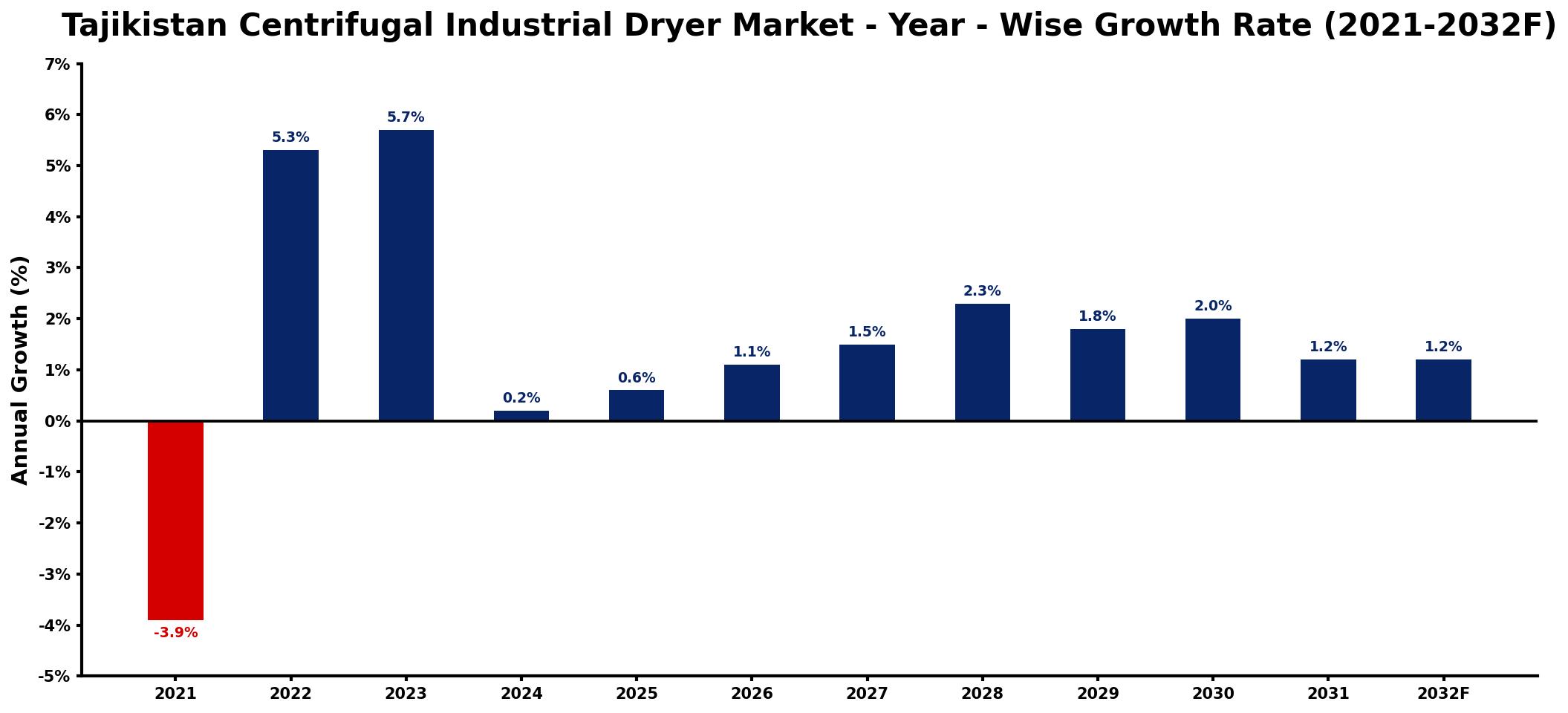
The table below presents the year‑wise growth rates along with the key drivers influencing the market
| Year | Growth Rate | Major Drivers |
| 2021 | -3.9% | decreased manufacturing output nationwide |
| 2022 | 5.3% | increased agricultural processing demand |
| 2023 | 5.7% | growing food preservation initiatives |
| 2024 | 0.2% | expansion in textile manufacturing sector |
| 2025 | 0.6% | rising energy efficiency investments |
| 2026 | 1.1% | enhanced production facility upgrades |
| 2027 | 1.5% | growing consumer product variety |
| 2028 | 2.3% | increased demand for export products |
| 2029 | 1.8% | rising investments in automation |
| 2030 | 2.0% | expanding local supply chains |
| 2031 | 1.2% | growing focus on sustainability |
| 2032 | 1.2% | increased technological innovation adoption |
Note: Market size estimations and growth projections presented in this report are based on 6Wresearch's proprietary forecasting methodology, utilizing the latest available industry data, government publications, and primary research inputs.
Tajikistan Centrifugal Industrial Dryer Market Synopsis
A rising focus on sustainability has led Tajikistani industries to embrace energy-efficient centrifugal dryers, marking a significant shift towards greener technologies. With a growing awareness of the need to minimize energy usage and environmental impact, companies are increasingly looking for dryers that meet these new standards.
Moreover, the local textile and food processing industries are expanding rapidly, which heightens the demand for high-capacity industrial dryers. This surge in demand is a reflection of broader industrial growth and modernization within the region, presenting ample opportunities for both domestic and foreign manufacturers.
Tajikistan Centrifugal Industrial Dryer Market Key Takeaways
- The market is experiencing consistent growth fueled by the need for advanced drying solutions across various sectors.
- There is a strong trend towards the adoption of energy-efficient and environmentally friendly drying technologies.
- Government initiatives are aimed at promoting industrialization and technological advancement in manufacturing.
- Investment opportunities are ripe, particularly in tailored manufacturing and distribution of industrial dryers.
- The market presents challenges related to skilled labor availability and fluctuating material costs.
Evaluation of Restraints in Tajikistan Centrifugal Industrial Dryer Market
One significant restraint in the Tajikistan Centrifugal Industrial Dryer Market is the scarcity of skilled technicians proficient in the operation and maintenance of modern dryers. This shortage can lead to increased downtimes, negatively impacting productivity and overall operational efficiency. Furthermore, limited access to advanced technologies can hinder companies from upgrading their equipment, thus affecting their competitiveness. The variability in raw material prices and energy costs also poses a financial challenge, compelling businesses to adopt stringent cost management strategies to navigate market volatility effectively.
Tajikistan Centrifugal Industrial Dryer Market Trends
Current trends indicate a pronounced shift toward energy-efficient drying solutions, with manufacturers integrating features such as heat recovery systems and moisture sensors. These technologies are not only enhancing the effectiveness of the drying processes but also lowering energy consumption significantly. Moreover, a growing trend towards automation and digitization is emerging, as smart dryers equipped with remote monitoring capabilities are gaining popularity, aligning with the broader trend of Industry 4.0.
Tajikistan Centrifugal Industrial Dryer Market Opportunities
The Tajikistan Centrifugal Industrial Dryer Market is poised for promising investment opportunities, driven by an expanding industrial sector and the burgeoning need for efficient drying technologies. Investors should focus on developing dryers that cater specifically to the requirements of local industries, particularly in agriculture and textiles. By prioritizing energy efficiency and sustainability in product development, manufacturers can tap into an increasingly eco-conscious market. Additionally, forming partnerships with local enterprises can facilitate market entry and enhance supply chain effectiveness.
Government Initiatives in the Tajikistan Centrifugal Industrial Dryer Market
The Tajikistani government is actively fostering an environment conducive to industrial growth through various initiatives aimed at enhancing manufacturing efficiency. This includes providing incentives for foreign investments, such as tax breaks and subsidies. Regulatory frameworks are being established to ensure adherence to quality standards and environmental compliance, further encouraging the adoption of advanced technologies in industrial processes. By emphasizing the importance of innovation and technology adoption, the government is working to boost the overall competitiveness of the industrial sector.
Future Insights of the Tajikistan Centrifugal Industrial Dryer Market
Looking ahead to 2026-2032, the Tajikistan Centrifugal Industrial Dryer Market is anticipated to grow steadily, driven by the relentless pace of industrialization and a continuous demand for efficient drying solutions. As technological advancements enhance dryer performance and industries recognize the advantages of centrifugal drying methods, market expansion is expected to gain momentum. The focus on energy efficiency and reduced drying times will further propel this growth. Nonetheless, businesses will need to remain vigilant of market fluctuations, particularly in raw materials and energy prices.
Tajikistan Centrifugal Industrial Dryer Market Latest Developments (2025 - 2026)
Recent trends in the Tajikistan Centrifugal Industrial Dryer Market indicate a growing interest in automation and digitization among manufacturers. Companies are increasingly incorporating advanced technologies to improve the efficiency and user-friendliness of their drying equipment. Additionally, there is a noticeable uptick in collaborations between local manufacturers and foreign investors, aimed at enhancing the technological capabilities and overall market offerings within the region.
Tajikistan Centrifugal Industrial Dryer Market - Key Attractiveness of the Report
- 10 Years of Market Numbers
- Historical Data Starting from 2022 to 2025
- Base Year: 2025
- Forecast Data until 2032
- Key Performance Indicators Impacting the Market
- Major Upcoming Developments and Projects
Key Highlights of the Report:
- Tajikistan Centrifugal Industrial Dryer Market Outlook
- Market Size of Tajikistan Centrifugal Industrial Dryer Market, 2025
- Forecast of Tajikistan Centrifugal Industrial Dryer Market, 2032
- Historical Data and Forecast of Tajikistan Centrifugal Industrial Dryer Revenues & Volume for the Period 2022-2032F
- Tajikistan Centrifugal Industrial Dryer Market Trend Evolution
- Tajikistan Centrifugal Industrial Dryer Market Drivers and Challenges
- Tajikistan Centrifugal Industrial Dryer Price Trends
- Tajikistan Centrifugal Industrial Dryer Porter's Five Forces
- Tajikistan Centrifugal Industrial Dryer Industry Life Cycle
- Historical Data and Forecast of Tajikistan Centrifugal Industrial Dryer Market Revenues & Volume By Application for the Period 2022-2032F
- Historical Data and Forecast of Tajikistan Centrifugal Industrial Dryer Market Revenues & Volume By Metal Finishing for the Period 2022-2032F
- Historical Data and Forecast of Tajikistan Centrifugal Industrial Dryer Market Revenues & Volume By Food Processing for the Period 2022-2032F
- Historical Data and Forecast of Tajikistan Centrifugal Industrial Dryer Market Revenues & Volume By Plastic Recycling for the Period 2022-2032F
- Historical Data and Forecast of Tajikistan Centrifugal Industrial Dryer Market Revenues & Volume By Chemical for the Period 2022-2032F
- Historical Data and Forecast of Tajikistan Centrifugal Industrial Dryer Market Revenues & Volume By Pharmaceutical for the Period 2022-2032F
- Historical Data and Forecast of Tajikistan Centrifugal Industrial Dryer Market Revenues & Volume By Type for the Period 2022-2032F
- Historical Data and Forecast of Tajikistan Centrifugal Industrial Dryer Market Revenues & Volume By Direct for the Period 2022-2032F
- Historical Data and Forecast of Tajikistan Centrifugal Industrial Dryer Market Revenues & Volume By Indirect for the Period 2022-2032F
- Tajikistan Centrifugal Industrial Dryer Import Export Trade Statistics
- Market Opportunity Assessment By Application
- Market Opportunity Assessment By Type
- Tajikistan Centrifugal Industrial Dryer Top Companies Market Share
- Tajikistan Centrifugal Industrial Dryer Competitive Benchmarking By Technical and Operational Parameters
- Tajikistan Centrifugal Industrial Dryer Company Profiles
- Tajikistan Centrifugal Industrial Dryer Key Strategic Recommendations






































