Tajikistan Chlorine Dioxide Market Size, Share & Growth Rate
The Tajikistan Chlorine Dioxide Market was estimated at USD 453 Million in 2025 and is projected to reach USD 633 Million by 2032, growing at a CAGR of 4.9% from 2026 to 2032. This steady growth is primarily fueled by the increasing demand for water treatment solutions, driven by both public health initiatives and regulatory pressures for cleaner water standards. The rise in infrastructure investments further supports this trajectory as both the government and private sector recognize the critical need for effective disinfection methods in various industries.
Tajikistan Chlorine Dioxide Market Year-wise Growth Rate and Key Drivers
This graph highlights how the Tajikistan Chlorine Dioxide Market has steadily grown over the years, supported by major growth factors.
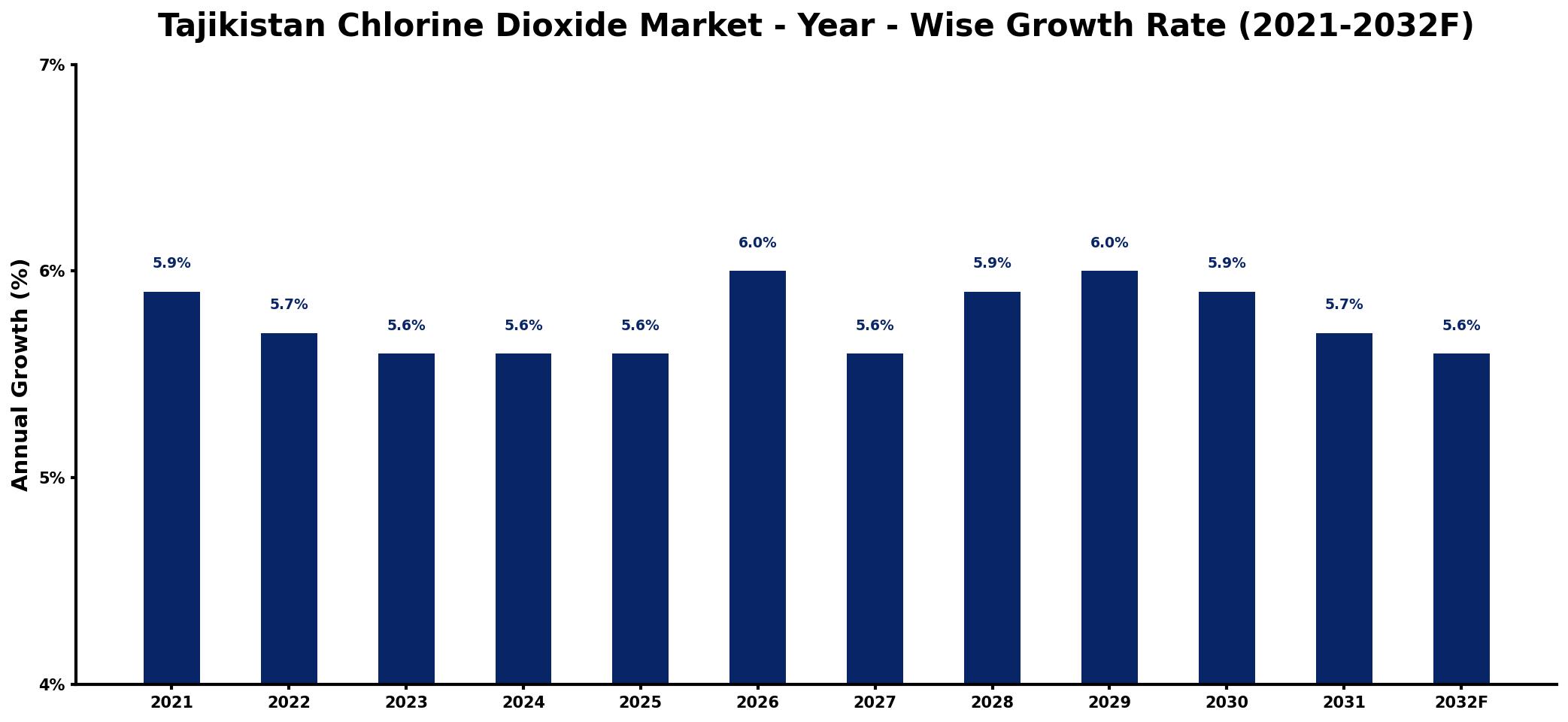
The table below presents the year‑wise growth rates along with the key drivers influencing the market
| Year | Growth Rate | Major Drivers |
| 2021 | 5.9% | Rising water treatment requirements |
| 2022 | 5.7% | Increasing industrial applications demand |
| 2023 | 5.6% | Growing focus on sanitation standards |
| 2024 | 5.6% | Expansion of healthcare facility networks |
| 2025 | 5.6% | Investment in environmental compliance initiatives |
| 2026 | 6.0% | Emergence of new market players |
| 2027 | 5.6% | Strengthening public health regulations |
| 2028 | 5.9% | Surge in agricultural sector needs |
| 2029 | 6.0% | Technological advancements in applications |
| 2030 | 5.9% | Heightened awareness of health benefits |
| 2031 | 5.7% | Development of regional distribution channels |
| 2032 | 5.6% | Enhancement of waste management practices |
Note: Market size estimations and growth projections presented in this report are based on 6Wresearch's proprietary forecasting methodology, utilizing the latest available industry data, government publications, and primary research inputs.
Tajikistan Chlorine Dioxide Market Synopsis
Currently, the Tajikistan Chlorine Dioxide Market is witnessing a notable surge in demand, particularly in water treatment facilities aimed at improving public health. The effectiveness of chlorine dioxide in eliminating a wide array of harmful pathogens has made it a preferred choice for water disinfection across multiple sectors, including healthcare and food processing.
In addition to the heightened awareness of water safety, stricter regulations regarding water quality standards are propelling the market forward. As the government invests in enhancing the country's water treatment infrastructure, chlorine dioxide emerges as a reliable solution, essential for meeting these evolving requirements.
Tajikistan Chlorine Dioxide Market Key Takeaways
- The market is driven by a heightened focus on water quality and safety among consumers and industries.
- Increased investment in water treatment infrastructure is catalyzing market growth.
- Chlorine dioxide's effectiveness against various pathogens is enhancing its adoption across sectors.
- Ongoing regulatory changes are shaping the landscape of water treatment practices in Tajikistan.
- There is a need for educational initiatives to boost awareness and understanding of chlorine dioxide's benefits.
Evaluation of Restraints in Tajikistan Chlorine Dioxide Market
Despite the positive outlook, the Tajikistan Chlorine Dioxide Market faces several limitations that could hinder its growth. One major restraint is the general lack of awareness about chlorine dioxide's applications and benefits among potential users. This knowledge gap contributes to slower adoption rates, especially when compared to alternative disinfection technologies. Moreover, the presence of more affordable disinfection methods poses a competitive challenge, making it essential for chlorine dioxide manufacturers to better communicate their products advantages. Finally, the fluctuating political and economic landscape in Tajikistan adds an element of uncertainty for both current operators and potential investors, which could impact market dynamics.
Tajikistan Chlorine Dioxide Market Trends
In recent years, the Tajikistan Chlorine Dioxide Market has witnessed emerging trends that signal significant changes in demand and technology. The growing focus on sustainable and eco-friendly water treatment solutions has placed chlorine dioxide in the spotlight due to its effective disinfection properties without the harmful by-products associated with traditional chlorination methods. Additionally, the rising investments in digital technologies for monitoring and optimizing water treatment processes are paving the way for greater efficiency and performance.
Tajikistan Chlorine Dioxide Market Opportunities
The market presents lucrative investment opportunities, particularly in sectors dedicated to infrastructure development and water treatment. As public awareness of clean water's importance increases, opportunities for companies that manufacture or distribute chlorine dioxide products are expanding. Furthermore, with potential for expansion into neighboring Central Asian markets, the overall attractiveness of investment in this sector is heightened. Focused strategies that promote the health benefits of chlorine dioxide and educate stakeholders can unlock even greater market potential.
Government Initiatives in the Tajikistan Chlorine Dioxide Market
The Tajik government has enacted various policies aimed at regulating the use of chlorine dioxide to ensure public health and environmental safety. This includes setting guidelines for safe handling, storage, and disposal of chlorine dioxide. Moreover, the government supports initiatives aimed at upgrading water treatment facilities, which enhances compliance with national and international water quality standards. Through these initiatives, the government aims to create a more robust regulatory framework that safeguards both public health and environmental integrity.
Future Insights of the Tajikistan Chlorine Dioxide Market
Looking ahead to the period from 2026 to 2032, the Tajikistan Chlorine Dioxide Market is anticipated to maintain a growth trajectory bolstered by increasing industrial demands and a continued focus on improving water quality. The governmental emphasis on developing infrastructure and implementing stringent regulations will act as a catalyst for market expansion. As awareness about the advantages of chlorine dioxide grows, particularly in sectors such as healthcare and food processing, the market is well-positioned for sustained progress. Nevertheless, players must remain vigilant in navigating regulatory complexities and pricing pressures to effectively seize emerging opportunities.
Tajikistan Chlorine Dioxide Market Latest Developments (2025 - 2026)
Recent developments indicate a growing alignment between private sector initiatives and governmental programs aimed at enhancing water quality through innovative treatment solutions. Industry stakeholders are increasingly collaborating on projects aimed at improving disinfection processes using chlorine dioxide. Furthermore, advancements in application technology are contributing to more efficient use of chlorine dioxide, enhancing its role in diverse sectors. These changes mark a significant step toward achieving the countrys broader public health goals and improving overall water management.
Tajikistan Chlorine Dioxide Market - Key Attractiveness of the Report
- 10 Years of Market Numbers
- Historical Data Starting from 2022 to 2025
- Base Year: 2025
- Forecast Data until 2032
- Key Performance Indicators Impacting the Market
- Major Upcoming Developments and Projects
Key Highlights of the Report:
- Tajikistan Chlorine Dioxide Market Outlook
- Market Size of Tajikistan Chlorine Dioxide Market, 2025
- Forecast of Tajikistan Chlorine Dioxide Market, 2032
- Historical Data and Forecast of Tajikistan Chlorine Dioxide Revenues & Volume for the Period 2022-2032F
- Tajikistan Chlorine Dioxide Market Trend Evolution
- Tajikistan Chlorine Dioxide Market Drivers and Challenges
- Tajikistan Chlorine Dioxide Price Trends
- Tajikistan Chlorine Dioxide Porter's Five Forces
- Tajikistan Chlorine Dioxide Industry Life Cycle
- Historical Data and Forecast of Tajikistan Chlorine Dioxide Market Revenues & Volume By Application for the Period 2022-2032F
- Historical Data and Forecast of Tajikistan Chlorine Dioxide Market Revenues & Volume By Industrial Water Treatment for the Period 2022-2032F
- Historical Data and Forecast of Tajikistan Chlorine Dioxide Market Revenues & Volume By Pulp & Paper Processing for the Period 2022-2032F
- Historical Data and Forecast of Tajikistan Chlorine Dioxide Market Revenues & Volume By Oil & Gas for the Period 2022-2032F
- Historical Data and Forecast of Tajikistan Chlorine Dioxide Market Revenues & Volume By Medical for the Period 2022-2032F
- Historical Data and Forecast of Tajikistan Chlorine Dioxide Market Revenues & Volume By Food & Beverages for the Period 2022-2032F
- Historical Data and Forecast of Tajikistan Chlorine Dioxide Market Revenues & Volume By Others for the Period 2022-2032F
- Tajikistan Chlorine Dioxide Import Export Trade Statistics
- Market Opportunity Assessment By Application
- Tajikistan Chlorine Dioxide Top Companies Market Share
- Tajikistan Chlorine Dioxide Competitive Benchmarking By Technical and Operational Parameters
- Tajikistan Chlorine Dioxide Company Profiles
- Tajikistan Chlorine Dioxide Key Strategic Recommendations






































