Tajikistan Coaxial Cables Market Summary
The tajikistan coaxial cables market was estimated at USD 1201 Million in 2025 and is projected to reach USD 1739 Million by 2032, growing at a CAGR of 6.5% from 2026 to 2032.
Tajikistan Coaxial Cables Market Year-wise Growth Rate and Key Drivers
This graph highlights how the Tajikistan Coaxial Cables Market has steadily grown over the past five years, supported by major growth factors.
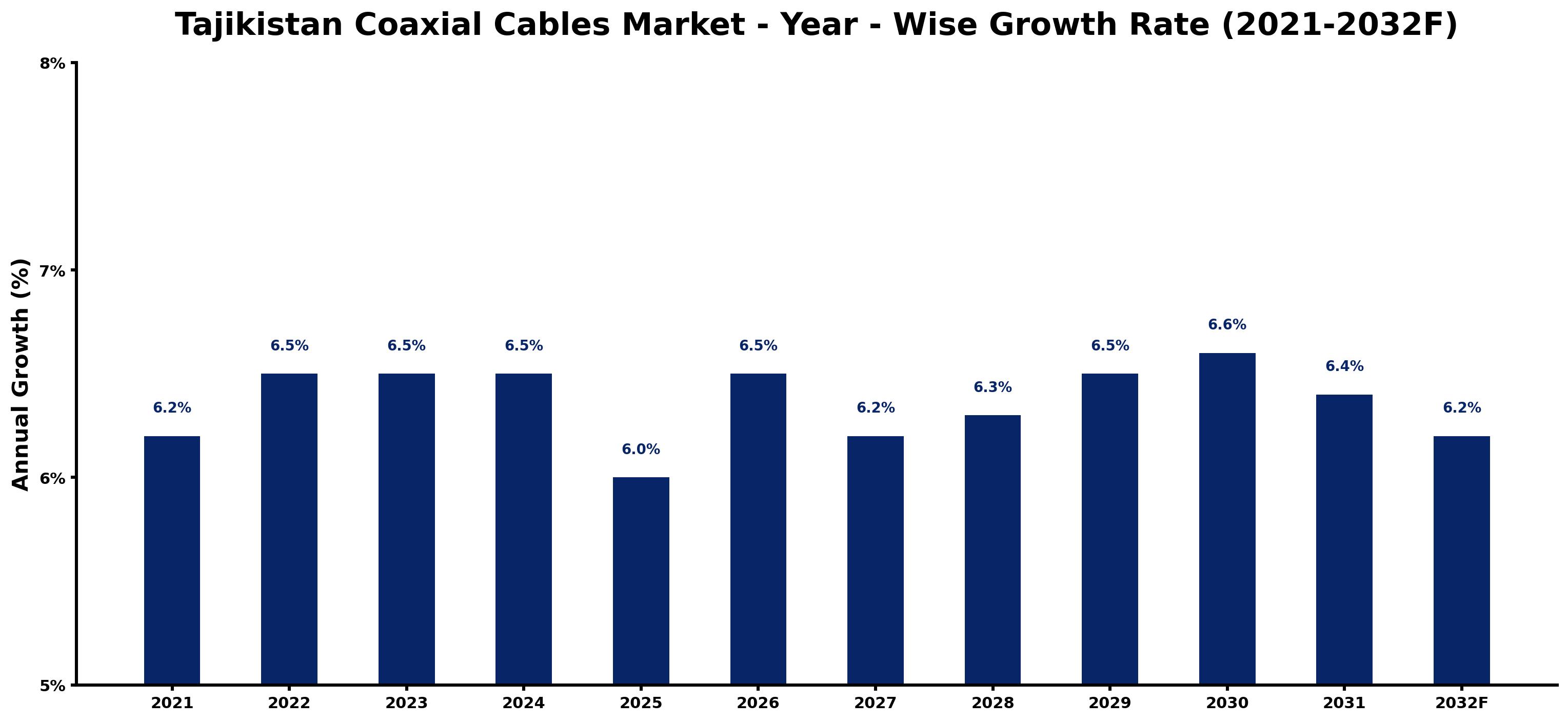
The table below presents the year wise growth rates along with the key drivers influencing the market
| Year | Growth Rate | Major Drivers |
| 2021 | 6.2% | Investment in telecommunications infrastructure highlights the importance of coaxial cables. |
| 2022 | 6.5% | Local demand for high-speed internet continues to encourage coaxial cable deployment. |
| 2023 | 6.5% | Rural electrification projects create opportunities for coaxial cable installations nationwide. |
| 2024 | 6.5% | Partnerships with foreign firms enhance local manufacturing capabilities for coaxial cables. |
| 2025 | 6.0% | Urban infrastructure projects necessitate reliable wiring solutions and quality coaxial products. |
| 2026 | 6.5% | Emerging tech startups are fueling demand for advanced communications and networking solutions. |
| 2027 | 6.2% | Infrastructure upgrades motivate telecommunications companies to modernize coaxial cable networks. |
| 2028 | 6.3% | Increased internet penetration drives competition, resulting in quality cable offerings. |
| 2029 | 6.5% | Growth in the entertainment sector boosts demand for high-performance coaxial cables. |
| 2030 | 6.6% | Expansion of educational institutions leads to increased connectivity requirements for reliable networks. |
| 2031 | 6.4% | Regional trade agreements facilitate smoother import processes for coaxial cable products. |
| 2032 | 6.2% | Consumer electronics sector growth propels demand for robust coaxial cable applications. |
Note - Market size estimations and growth projections presented in this report are based on 6Wresearch's advanced forecasting approach, validated with industry datasets as of June 2026.
Tajikistan Coaxial Cables Market Synopsis
The Tajikistan Coaxial Cables Market is projected to reach 6.5% and witness significant growth during the forecast period (2026-2032). This growth is principally driven by the expanding telecommunications and broadcasting sectors, which are undergoing rapid advancements due to increased digitalization efforts and infrastructure development within the country. As Tajikistan aims to enhance its communication networks, the necessity for high-quality coaxial cables for data transmission and connectivity is becoming increasingly evident.
Tajikistan Coaxial Cables Market Growth Drivers
Several factors are propelling the growth of the Tajikistan Coaxial Cables Market. Firstly, the significant investments made in telecommunications infrastructure are enhancing the demand for advanced cables. Secondly, the ongoing construction activities across various sectors require coaxial cables for applications such as security systems and building automation. Thirdly, the technological advancements, particularly the emergence of 5G networks, necessitate the use of high-quality coaxial cables that can support increased data transmission rates.
Moreover, government initiatives focusing on improving connectivity are further stimulating the market. Additionally, the rising demand for high-speed internet services among the population contributes significantly to market growth. The evolving consumer preferences towards enhanced connectivity also play a crucial role in driving the demand for coaxial cables within both residential and commercial spaces.
Tajikistan Coaxial Cables Market Trends and Opportunities
The Tajikistan Coaxial Cables Market is currently witnessing several notable trends. A pronounced trend is the increasing adoption of environmentally friendly and energy-efficient coaxial cables, which align with global sustainability goals. Manufacturers are prioritizing product innovation to meet these emerging needs, thus enhancing the overall performance and longevity of their offerings.
Furthermore, as the construction industry continues to thrive, there are substantial opportunities for coaxial cable applications in new infrastructure projects. The integration of advanced technologies in various sectors is also driving demand for more sophisticated cable solutions, particularly in smart city initiatives. As Tajikistan seeks to modernize its communication networks, there is a promising outlook for investment in high-quality coaxial cables to meet the burgeoning demands of advanced telecommunications solutions.
Tajikistan Coaxial Cables Market Challenges and Restraints
Despite the favorable growth outlook of the Tajikistan Coaxial Cables Market, several challenges must be addressed. One of the primary challenges is the limited infrastructure development, which hampers the local production capabilities of high-quality coaxial cables. The country has a significant reliance on imported products, leading to vulnerabilities in supply chain management.
Additionally, fluctuating raw material prices, particularly for key components like copper and aluminum, impact production costs and pricing strategies. The presence of cheaper alternatives from neighboring countries poses a competitive threat to domestic manufacturers, making it increasingly difficult for them to maintain market share. Efforts to mitigate these challenges through strategic investments and technological advancements will be crucial for local players.
Tajikistan Coaxial Cables Market Investment Opportunities
Investment opportunities within the Tajikistan Coaxial Cables Market are abundant, particularly as the demand for high-speed internet and robust digital communication solutions grows. As the government prioritizes connectivity enhancements and the expansion of telecommunication networks, there exists a need for advanced coaxial cables capable of supporting higher bandwidth and faster data transmission.
Investors may consider opportunities in manufacturing and supplying specialized coaxial cables that cater to increasing demands. Additionally, prospects for research and development investments aimed at innovating new technologies or improving existing cable efficiency will be beneficial. Collaborating with local telecommunications entities and engaging with government initiatives directed at digital infrastructure improvement can further enhance investment potential within this market.
Tajikistan Coaxial Cables Market Government Investment and Initiatives
The government of Tajikistan is actively involved in implementing policies to promote and regulate the coaxial cables market. These initiatives include establishing quality standards to ensure the reliability and safety of coaxial cables. Incentives for local manufacturing aim to bolster domestic production capabilities and reduce import dependencies.
Moreover, the imposition of import tariffs is designed to protect local manufacturers from foreign competition, thereby fostering a more competitive environment. Licensing requirements for companies engaged in the production and distribution of coaxial cables further help regulate the market effectively. By establishing a sustainable market framework, the government is facilitating growth and encouraging investments in this vital sector.
Tajikistan Coaxial Cables Market Latest Developments (May 2025 - June 2026)
Recent developments within the Tajikistan Coaxial Cables Market from May 2025 to June 2026 indicate a steady progression towards market maturity. The industry has seen an increase in strategic partnerships aimed at enhancing production capabilities and reducing reliance on imports. Companies are focusing on improving product quality and innovating designs to meet the growing requirements of modern telecommunications.
Furthermore, ongoing discussions surrounding regulatory policies have indicated the government's commitment to fostering a conducive environment for local manufacturing. Investments in infrastructure and technology upgrades remain priorities, positioning the sector for sustained growth. Overall, the developments signal a positive trajectory for the Tajikistan Coaxial Cables Market as it adapts to the evolving landscape of telecommunications.
Tajikistan Coaxial Cables Market - Key Attractiveness of the Report
- 10 Years of Market Numbers
- Historical Data Starting from 2022 to 2025
- Base Year: 2025
- Forecast Data until 2032
- Key Performance Indicators Impacting the Market
- Major Upcoming Developments and Projects
Key Highlights of the Report:
- Tajikistan Coaxial Cables Market Outlook
- Market Size of Tajikistan Coaxial Cables Market, 2025
- Forecast of Tajikistan Coaxial Cables Market, 2032F
- Historical Data and Forecast of Tajikistan Coaxial Cables Revenues & Volume for the Period 2022-2032F
- Tajikistan Coaxial Cables Market Trend Evolution
- Tajikistan Coaxial Cables Market Drivers and Challenges
- Tajikistan Coaxial Cables Price Trends
- Tajikistan Coaxial Cables Porter's Five Forces
- Tajikistan Coaxial Cables Industry Life Cycle
- Historical Data and Forecast of Tajikistan Coaxial Cables Market Revenues & Volume By Types for the Period 2022-2032F
- Historical Data and Forecast of Tajikistan Coaxial Cables Market Revenues & Volume By Hard-line Cable for the Period 2022-2032F
- Historical Data and Forecast of Tajikistan Coaxial Cables Market Revenues & Volume By Triaxial Cable for the Period 2022-2032F
- Historical Data and Forecast of Tajikistan Coaxial Cables Market Revenues & Volume By Twin Axial Cable for the Period 2022-2032F
- Historical Data and Forecast of Tajikistan Coaxial Cables Market Revenues & Volume By Applications for the Period 2022-2032F
- Historical Data and Forecast of Tajikistan Coaxial Cables Market Revenues & Volume By Internet Data Transfer for the Period 2022-2032F
- Historical Data and Forecast of Tajikistan Coaxial Cables Market Revenues & Volume By Video Distribution for the Period 2022-2032F
- Historical Data and Forecast of Tajikistan Coaxial Cables Market Revenues & Volume By Radio Distribution Frequency Transfer for the Period 2022-2032F
- Historical Data and Forecast of Tajikistan Coaxial Cables Market Revenues & Volume By Others for the Period 2022-2032F
- Historical Data and Forecast of Tajikistan Coaxial Cables Market Revenues & Volume By End-users for the Period 2022-2032F
- Historical Data and Forecast of Tajikistan Coaxial Cables Market Revenues & Volume By Cable Television Industry for the Period 2022-2032F
- Historical Data and Forecast of Tajikistan Coaxial Cables Market Revenues & Volume By Military and Aerospace for the Period 2022-2032F
- Historical Data and Forecast of Tajikistan Coaxial Cables Market Revenues & Volume By Internet Service Providers for the Period 2022-2032F
- Historical Data and Forecast of Tajikistan Coaxial Cables Market Revenues & Volume By Telephone Network Operators for the Period 2022-2032F
- Historical Data and Forecast of Tajikistan Coaxial Cables Market Revenues & Volume By Communication Equipment Manufactures for the Period 2022-2032F
- Tajikistan Coaxial Cables Import Export Trade Statistics
- Market Opportunity Assessment By Types
- Market Opportunity Assessment By Applications
- Market Opportunity Assessment By End-users
- Tajikistan Coaxial Cables Top Companies Market Share
- Tajikistan Coaxial Cables Competitive Benchmarking By Technical and Operational Parameters
- Tajikistan Coaxial Cables Company Profiles
- Tajikistan Coaxial Cables Key Strategic Recommendations






































