Tajikistan Critical Infrastructure Protection Market Size & Growth Rate (2026-2032)
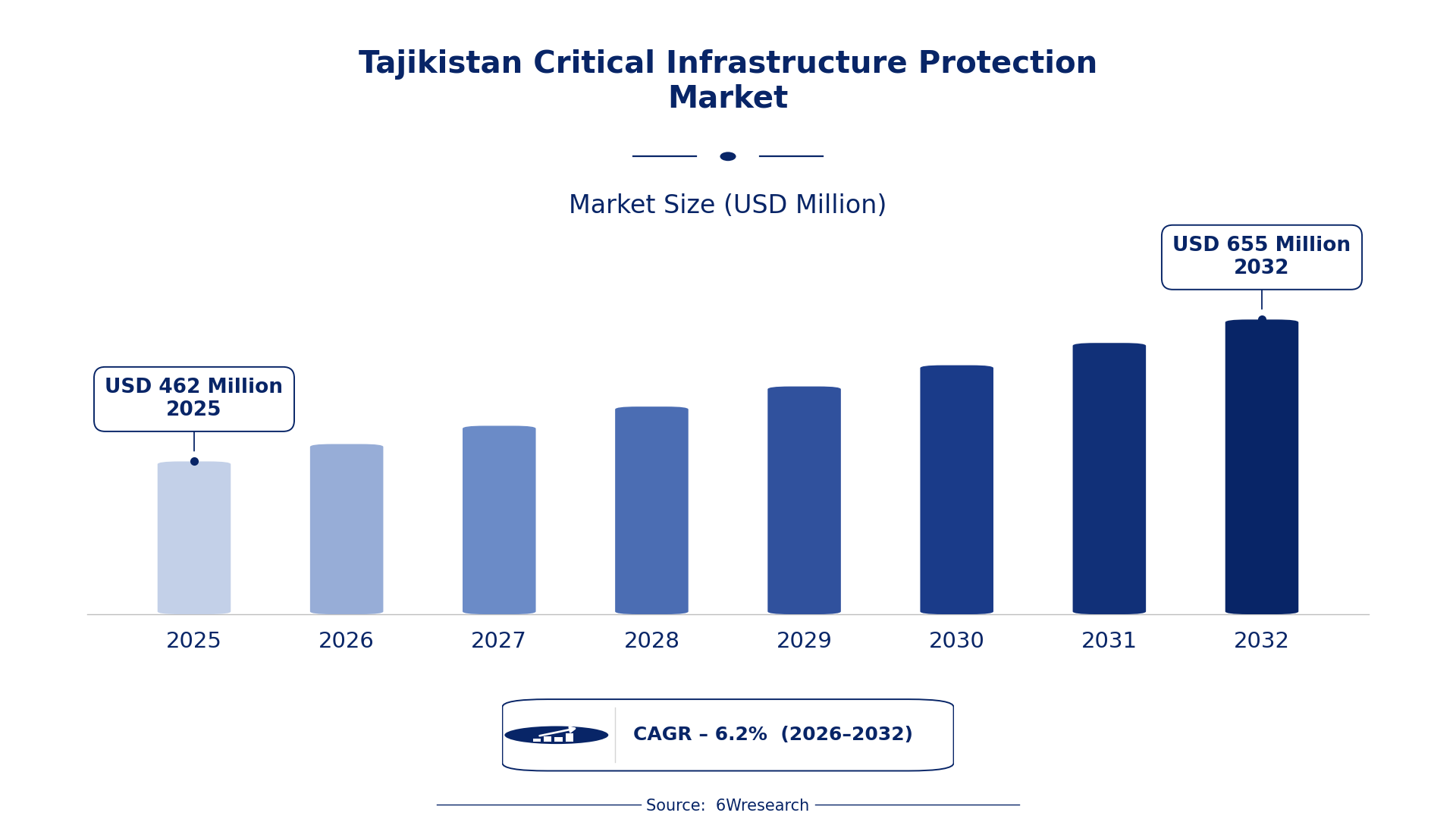
The Tajikistan Critical Infrastructure Protection Market was estimated at USD 462 Million in 2025 and is projected to reach USD 655 Million by 2032, growing at a CAGR of 6.2% from 2026 to 2032.
Tajikistan Critical Infrastructure Protection Market Synopsis
As Tajikistan accelerates efforts to modernize its infrastructure, the Critical Infrastructure Protection market is gaining traction. Recent awareness of vulnerabilities has spurred growth, emphasizing the urgent need to fortify critical assets against both physical threats and cyberattacks.
Key sectors driving this momentum include energy, transportation, and telecommunications, which have become focal points for enhanced security measures. Government initiatives aimed at attracting foreign investment further bolster the market, showcasing the dual focus on modernization and security.
Tajikistan Critical Infrastructure Protection Market Year-wise Growth Rate and Key Drivers
This graph illustrates the annual growth rates of the Tajikistan Critical Infrastructure Protection Market from 2021 to 2032, highlighting a steady upward trajectory and projected expansion over the forecast period.
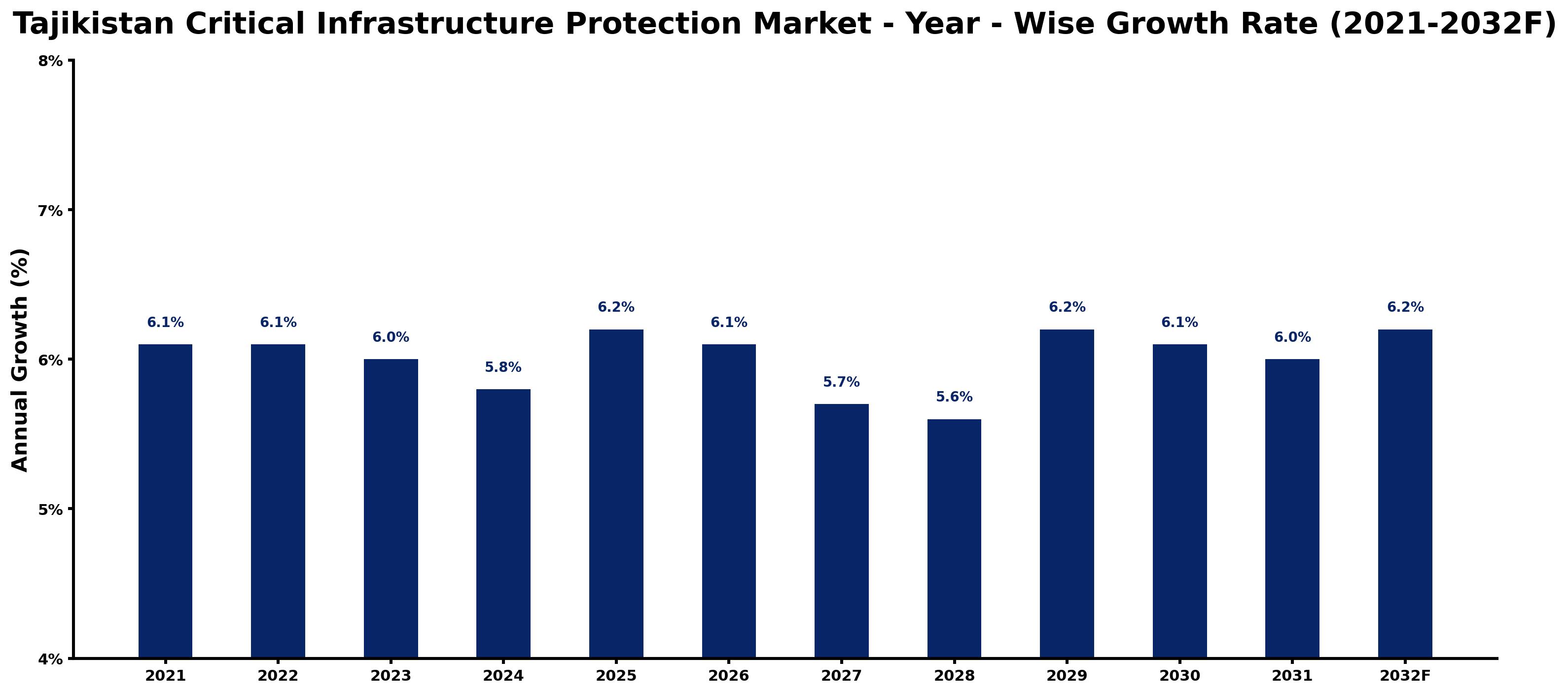
The table below presents the year‑wise growth rates along with the key drivers influencing the market
| Year | Growth Rate | Major Drivers |
| 2021 | 6.1% | Increased governmental focus on national security measures. |
| 2022 | 6.1% | Implementation of new cybersecurity regulations by the government. |
| 2023 | 6.0% | Growing infrastructure investments from international development partners. |
| 2024 | 5.8% | Heightened concerns over regional geopolitical tensions driving investments. |
| 2025 | 6.2% | National policy promoting modernization of critical infrastructure systems. |
| 2026 | 6.1% | Surge in public-private partnerships for security technology adoption. |
| 2027 | 5.7% | Demand for disaster recovery solutions due to climate change. |
| 2028 | 5.6% | Economic growth shift prioritizing national infrastructure robustness. |
| 2029 | 6.2% | Local firms expanding offerings in emergency response technology. |
| 2030 | 6.1% | Regulatory mandates for critical infrastructure risk assessments. |
| 2031 | 6.0% | Increase in urban population prompting enhanced protective measures. |
| 2032 | 6.2% | Advancements in local cybersecurity education programs boosting capabilities. |
Note: Market size estimations and growth projections presented in this report are based on 6Wresearch's proprietary forecasting methodology, utilizing the latest available industry data, government publications, and primary research inputs.
Tajikistan Critical Infrastructure Protection Market Key Takeaways
Below are some of the specific key takeaways from the market, including:
- The market is increasingly focused on adopting advanced cybersecurity measures alongside traditional physical security systems.
- Public-private partnerships are emerging as a vital strategy to address security challenges effectively.
- Investment opportunities abound in sectors such as cybersecurity solutions and emergency response technologies.
- The government's National Security Concept is shaping regulatory and operational frameworks in critical infrastructure protection.
- Ongoing investments in infrastructure development are expected to enhance market growth prospects.
Evaluation of Restraints in Tajikistan Critical Infrastructure Protection Market
The Tajikistan Critical Infrastructure Protection market is constrained by several factors. A notable challenge is the scarcity of funding and technical expertise needed to implement comprehensive security measures. Coordination among various government entities remains limited, leading to gaps in coverage and response capabilities. on top of that, the geographical intricacies of the region, characterized by remote and mountainous terrain, complicate monitoring and protection efforts. Such hurdles necessitate significant investment in training and technology to enhance resilience.
Tajikistan Critical Infrastructure Protection Market Trends
Growing demand for sophisticated security solutions is evident as sectors like energy and telecommunications prioritize risk mitigation. Technologies such as intrusion detection, access control, and video surveillance are being increasingly deployed. on top of that, a trend towards digital transformation is evident as organizations recognize the necessity for robust cybersecurity frameworks. Enhancing preparedness through training and public-private collaboration is emerging as another critical trend.
Tajikistan Critical Infrastructure Protection Market Opportunities
Numerous investment opportunities await in the Tajikistan Critical Infrastructure Protection market. Companies specializing in advanced cybersecurity systems have significant potential for growth as the digital landscape expands. Additionally, consulting services for risk assessment and security audits are in demand, aiding organizations in reinforcing their security infrastructure. Innovations in physical security systems, especially in remote monitoring solutions, present lucrative avenues for investment.
Government Initiatives in the Tajikistan Critical Infrastructure Protection Market
The Tajikistan government has taken decisive steps to bolster critical infrastructure protection through various initiatives. By establishing a robust regulatory framework, the government aims to safeguard essential sectors while fostering collaboration among public and private stakeholders. These policies are crucial for enhancing the security posture of the nation’s critical assets.
- A recently launched National Security Strategy focuses on protecting key sectors like energy and transportation against emerging threats.
- A currently ongoing effort involves the State Committee on National Security coordinating inter-agency initiatives to mitigate risks.
- Planned public-private partnerships aim to modernize telecommunications infrastructure by 2027.
- The government is developing a comprehensive cybersecurity framework to be introduced by the end of 2026.
- New guidelines for infrastructure investment incentives were released in early 2025 to attract foreign technology firms.
Future Insights of the Tajikistan Critical Infrastructure Protection Market
Looking forward to 2026-2032, the Tajikistan Critical Infrastructure Protection market is set for steady growth. Rising investment in infrastructure, alongside heightened awareness of security vulnerabilities, will drive demand for advanced protection measures. As cyber threats become increasingly sophisticated, the focus will shift towards integrating cutting-edge technologies that enhance both physical and digital security. This evolution presents vast potential for innovative solutions tailored to the unique requirements of Tajikistan’s critical sectors.
Tajikistan Critical Infrastructure Protection Market Latest Developments
In recent months, activity within the Tajikistan Critical Infrastructure Protection market has intensified, reflecting a concerted effort to enhance security frameworks. Various initiatives have emerged, focusing on both technological upgrades and policy reforms aimed at reinforcing infrastructure resilience.
- A major technology vendor initiated a rollout of an upgraded intrusion detection system across several critical sites in Q2 2025.
- An ongoing collaboration between local agencies and international partners focuses on establishing a comprehensive training program for security personnel, begun in early 2025 and continuing through 2026.
- Plans for a nationwide video surveillance network are expected to kick off in mid-2026 to bolster urban security measures.
- A regional operator successfully completed a pilot project for biometric access control systems in transportation hubs in late 2025.
- An upcoming conference planned for Q1 2027 will address strategies to combat cyber threats facing critical infrastructure.
Tajikistan Critical Infrastructure Protection Market - Key Attractiveness of the Report
- 10 Years of Market Numbers
- Historical Data Starting from 2022 to 2025
- Base Year: 2025
- Forecast Data until 2032
- Key Performance Indicators Impacting the Market
- Major Upcoming Developments and Projects
Key Highlights of the Report:
- Tajikistan Critical Infrastructure Protection Market Outlook
- Market Size of Tajikistan Critical Infrastructure Protection Market, 2025
- Forecast of Tajikistan Critical Infrastructure Protection Market, 2032
- Historical Data and Forecast of Tajikistan Critical Infrastructure Protection Revenues & Volume for the Period 2022-2032F
- Tajikistan Critical Infrastructure Protection Market Trend Evolution
- Tajikistan Critical Infrastructure Protection Market Drivers and Challenges
- Tajikistan Critical Infrastructure Protection Price Trends
- Tajikistan Critical Infrastructure Protection Porter's Five Forces
- Tajikistan Critical Infrastructure Protection Industry Life Cycle
- Historical Data and Forecast of Tajikistan Critical Infrastructure Protection Market Revenues & Volume By Solution for the Period 2022-2032F
- Historical Data and Forecast of Tajikistan Critical Infrastructure Protection Market Revenues & Volume By Physical Safety for the Period 2022-2032F
- Historical Data and Forecast of Tajikistan Critical Infrastructure Protection Market Revenues & Volume By Security Video Surveillance Systems for the Period 2022-2032F
- Historical Data and Forecast of Tajikistan Critical Infrastructure Protection Market Revenues & Volume By Screening for the Period 2022-2032F
- Historical Data and Forecast of Tajikistan Critical Infrastructure Protection Market Revenues & Volume By Scanning for the Period 2022-2032F
- Historical Data and Forecast of Tajikistan Critical Infrastructure Protection Market Revenues & Volume By Cybersecurity for the Period 2022-2032F
- Historical Data and Forecast of Tajikistan Critical Infrastructure Protection Market Revenues & Volume By Encryption for the Period 2022-2032F
- Historical Data and Forecast of Tajikistan Critical Infrastructure Protection Market Revenues & Volume By Threat Intelligence for the Period 2022-2032F
- Historical Data and Forecast of Tajikistan Critical Infrastructure Protection Market Revenues & Volume By Component for the Period 2022-2032F
- Historical Data and Forecast of Tajikistan Critical Infrastructure Protection Market Revenues & Volume By Solution for the Period 2022-2032F
- Historical Data and Forecast of Tajikistan Critical Infrastructure Protection Market Revenues & Volume By Services for the Period 2022-2032F
- Historical Data and Forecast of Tajikistan Critical Infrastructure Protection Market Revenues & Volume By Vertical for the Period 2022-2032F
- Historical Data and Forecast of Tajikistan Critical Infrastructure Protection Market Revenues & Volume By Financial Institutions for the Period 2022-2032F
- Historical Data and Forecast of Tajikistan Critical Infrastructure Protection Market Revenues & Volume By Government for the Period 2022-2032F
- Historical Data and Forecast of Tajikistan Critical Infrastructure Protection Market Revenues & Volume By Defense for the Period 2022-2032F
- Historical Data and Forecast of Tajikistan Critical Infrastructure Protection Market Revenues & Volume By Transport and Logistics for the Period 2022-2032F
- Historical Data and Forecast of Tajikistan Critical Infrastructure Protection Market Revenues & Volume By Energy and Power for the Period 2022-2032F
- Historical Data and Forecast of Tajikistan Critical Infrastructure Protection Market Revenues & Volume By Commercial Sector for the Period 2022-2032F
- Historical Data and Forecast of Tajikistan Critical Infrastructure Protection Market Revenues & Volume By Telecom for the Period 2022-2032F
- Historical Data and Forecast of Tajikistan Critical Infrastructure Protection Market Revenues & Volume By Chemicals and Manufacturing for the Period 2022-2032F
- Tajikistan Critical Infrastructure Protection Import Export Trade Statistics
- Market Opportunity Assessment By Solution
- Market Opportunity Assessment By Cybersecurity
- Market Opportunity Assessment By Component
- Market Opportunity Assessment By Vertical
- Tajikistan Critical Infrastructure Protection Top Companies Market Share
- Tajikistan Critical Infrastructure Protection Competitive Benchmarking By Technical and Operational Parameters
- Tajikistan Critical Infrastructure Protection Company Profiles
- Tajikistan Critical Infrastructure Protection Key Strategic Recommendations






































