Tajikistan Crystal Lighting Market Summary
The tajikistan crystal lighting market was estimated at USD 1382 Million in 2025 and is projected to reach USD 2003 Million by 2032, growing at a CAGR of 6.4% from 2026 to 2032.
Tajikistan Crystal Lighting Market Year-wise Growth Rate and Key Drivers
This graph highlights how the Tajikistan Crystal Lighting Market has steadily grown over the past five years, supported by major growth factors.
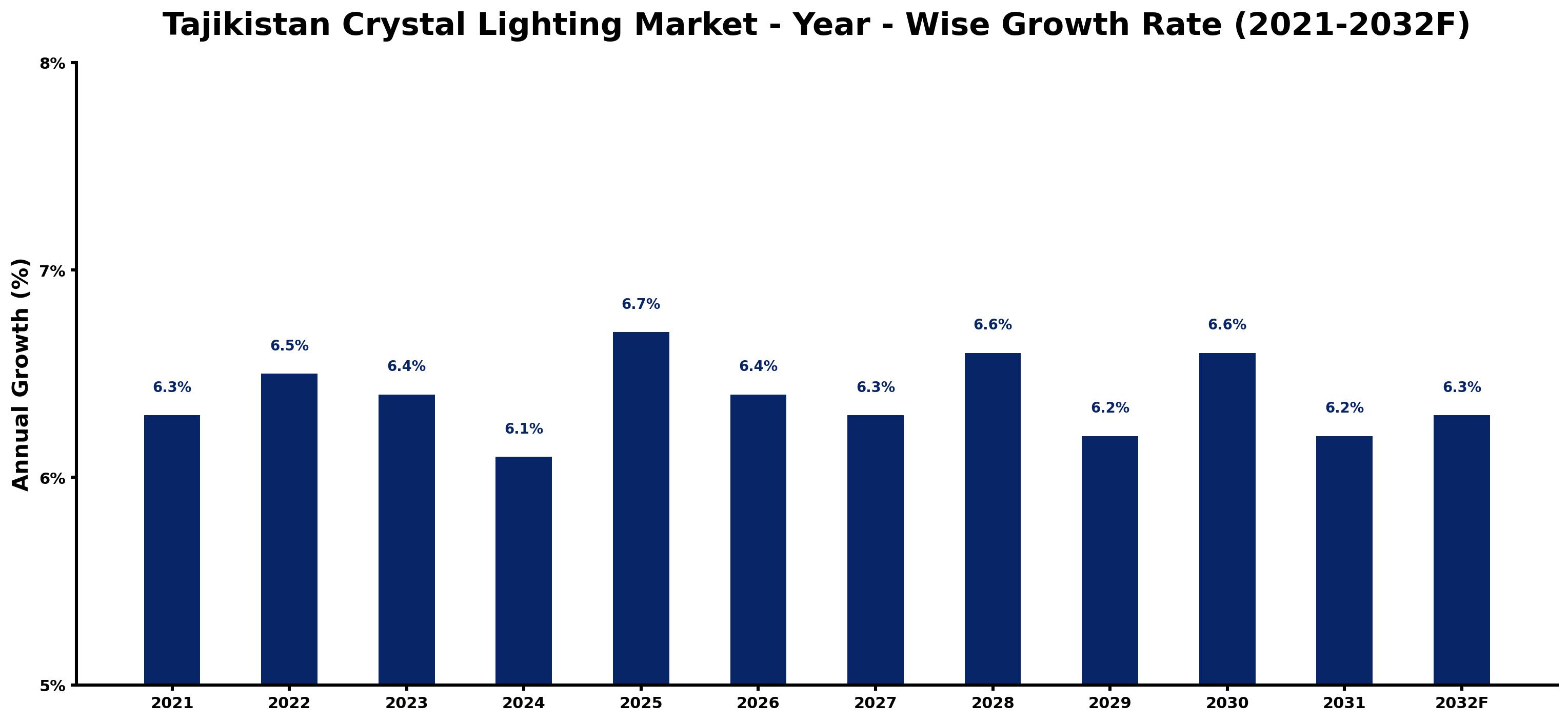
The table below presents the year wise growth rates along with the key drivers influencing the market
| Year | Growth Rate | Major Drivers |
| 2021 | 6.3% | Urban development projects initiate interest in advanced lighting solutions for infrastructure. |
| 2022 | 6.5% | Sustainable lighting technologies gain traction as energy costs influence consumer choices. |
| 2023 | 6.4% | Local businesses begin adopting crystal lighting for enhanced aesthetics and brand image. |
| 2024 | 6.1% | Improved distribution networks facilitate access to diverse lighting products across regions. |
| 2025 | 6.7% | Increased tourism boosts demand for visually appealing lighting in hospitality venues. |
| 2026 | 6.4% | Construction sector growth necessitates innovative lighting designs for residential projects. |
| 2027 | 6.3% | Technological enhancements in LED crystal lighting attract investments from regional stakeholders. |
| 2028 | 6.6% | Emerging local manufacturers create competition, driving down prices and expanding options. |
| 2029 | 6.2% | Cultural events spotlight the importance of decorative lighting, enhancing market visibility. |
| 2030 | 6.6% | Rural electrification efforts create opportunities for crystal lighting in underserved areas. |
| 2031 | 6.2% | Partnerships between local artisans and lighting companies foster unique product offerings. |
| 2032 | 6.3% | Consumer education initiatives highlight energy-efficient lighting benefits, increasing market penetration. |
Note - Market size estimations and growth projections presented in this report are based on 6Wresearch's advanced forecasting approach, validated with industry datasets as of June 2026.
Key Highlights of the Report:
- Tajikistan Crystal Lighting Market Outlook
- Market Size of Tajikistan Crystal Lighting Market, 2025
- Forecast of Tajikistan Crystal Lighting Market, 2032F
- Historical Data and Forecast of Tajikistan Crystal Lighting Revenues & Volume for the Period 2022-2032F
- Tajikistan Crystal Lighting Market Trend Evolution
- Tajikistan Crystal Lighting Market Drivers and Challenges
- Tajikistan Crystal Lighting Price Trends
- Tajikistan Crystal Lighting Porter's Five Forces
- Tajikistan Crystal Lighting Industry Life Cycle
- Historical Data and Forecast of Tajikistan Crystal Lighting Market Revenues & Volume By Product Type for the Period 2022-2032F
- Historical Data and Forecast of Tajikistan Crystal Lighting Market Revenues & Volume By Ceiling Crystal Lights for the Period 2022-2032F
- Historical Data and Forecast of Tajikistan Crystal Lighting Market Revenues & Volume By Crystal Chandeliers for the Period 2022-2032F
- Historical Data and Forecast of Tajikistan Crystal Lighting Market Revenues & Volume By Others for the Period 2022-2032F
- Historical Data and Forecast of Tajikistan Crystal Lighting Market Revenues & Volume By Applications for the Period 2022-2032F
- Historical Data and Forecast of Tajikistan Crystal Lighting Market Revenues & Volume By Commercial for the Period 2022-2032F
- Historical Data and Forecast of Tajikistan Crystal Lighting Market Revenues & Volume By Designer for the Period 2022-2032F
- Historical Data and Forecast of Tajikistan Crystal Lighting Market Revenues & Volume By Superior Residential for the Period 2022-2032F
- Tajikistan Crystal Lighting Import Export Trade Statistics
- Market Opportunity Assessment By Product Type
- Market Opportunity Assessment By Applications
- Tajikistan Crystal Lighting Top Companies Market Share
- Tajikistan Crystal Lighting Competitive Benchmarking By Technical and Operational Parameters
- Tajikistan Crystal Lighting Company Profiles
- Tajikistan Crystal Lighting Key Strategic Recommendations






































