Tajikistan Cultured Meat Market Size, Share & Growth Rate
The Tajikistan Cultured Meat Market was estimated at USD 323 Million in 2025 and is projected to reach USD 448 Million by 2032, growing at a CAGR of 4.8% from 2026 to 2032. This growth trajectory is propelled by a rising awareness among consumers regarding the environmental and ethical implications of traditional meat production. Additionally, supportive government policies aimed at promoting innovative food technologies are expected to facilitate the emergence of cultured meat as a viable alternative in the Tajik food landscape.
Tajikistan Cultured Meat Market Year-wise Growth Rate and Key Drivers
This graph highlights how the Tajikistan Cultured Meat Market has steadily grown over the years, supported by major growth factors.
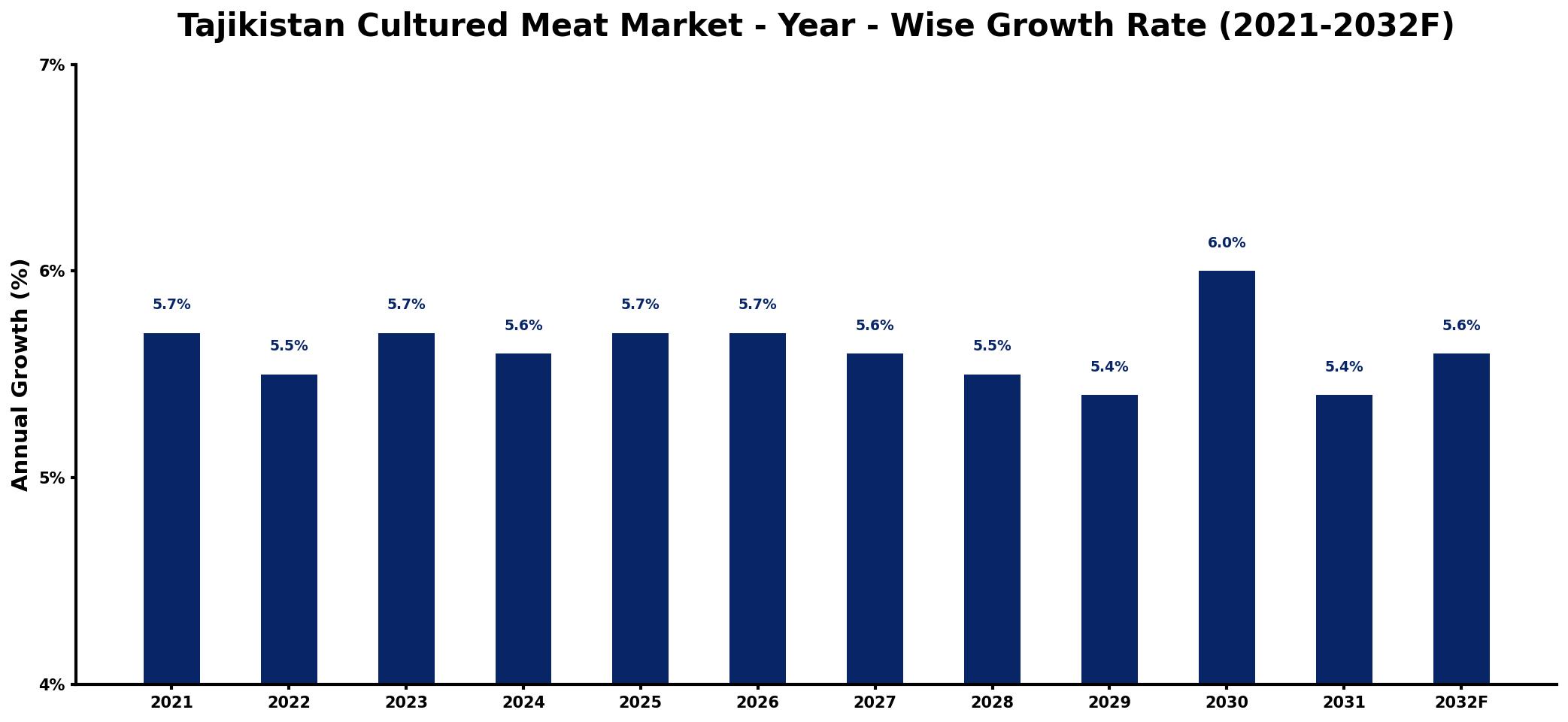
The table below presents the year‑wise growth rates along with the key drivers influencing the market
| Year | Growth Rate | Major Drivers |
| 2021 | 5.7% | increased consumer awareness nutrition |
| 2022 | 5.5% | rising investment alternative proteins |
| 2023 | 5.7% | growing interest sustainable practices |
| 2024 | 5.6% | expanding distribution channels technology |
| 2025 | 5.7% | enhanced regulatory support innovation |
| 2026 | 5.7% | emerging culinary trends preferences |
| 2027 | 5.6% | growing urban population demand |
| 2028 | 5.5% | strengthening environmental sustainability initiatives |
| 2029 | 5.4% | increased collaboration industry stakeholders |
| 2030 | 6.0% | advancements research development funding |
| 2031 | 5.4% | broader market acceptance consumer attitudes |
| 2032 | 5.6% | heightened focus health wellness trends |
Note: Market size estimations and growth projections presented in this report are based on 6Wresearch's proprietary forecasting methodology, utilizing the latest available industry data, government publications, and primary research inputs.
Tajikistan Cultured Meat Market Synopsis
In Tajikistan, the burgeoning interest in alternative protein sources reflects a shift in consumer preferences. Notably, there is an increasing demand for meat products that align with values of sustainability and animal welfare, which cultured meat directly addresses. This evolving consumer sentiment lays a solid foundation for market growth.
Furthermore, the Tajikistan Cultured Meat Market is attracting the attention of innovative startups and research institutions, which are keen on developing local solutions for protein production. However, the market's success will depend on overcoming hurdles related to regulatory frameworks and production scalability.
Tajikistan Cultured Meat Market Key Takeaways
- The cultured meat sector is gaining traction as consumer awareness of sustainability and health benefits rises.
- Investment from local startups and international firms is surging, indicating a robust interest in this emerging market.
- Government initiatives aimed at food security are likely to bolster the cultivated meat industry's development.
- Regulatory and production challenges must be addressed to facilitate wider market acceptance and expansion.
- Collaboration between local and international entities could pave the way for technological advancements in the cultured meat segment.
Evaluation of Restraints in Tajikistan Cultured Meat Market
The Tajikistan Cultured Meat Market is currently hindered by several significant constraints. First, limited consumer awareness and cultural preferences for traditional meat sources pose a challenge to acceptance. Many consumers are still unfamiliar with the benefits and viability of cultured meat. Additionally, the existing infrastructure does not adequately support the production and distribution of these innovative products, creating a barrier to entry for potential market players. Moreover, high production costs related to research and development further complicate the landscape, making it difficult for businesses to achieve scalability and effectively compete against established meat producers.
Tajikistan Cultured Meat Market Trends
Several trends are shaping the Tajikistan Cultured Meat Market as consumers increasingly seek ethical and environmentally friendly food options. There is a marked shift towards plant-based and lab-grown alternatives, driven by an awareness of climate change and animal welfare. This trend is complemented by growing health consciousness among the population, leading to an interest in meat products that promise lower fat and cholesterol levels. Moreover, technological advancements in cultured meat production are likely to enhance product quality and reduce costs, thereby attracting more consumers.
Tajikistan Cultured Meat Market Opportunities
The Tajikistan Cultured Meat Market offers lucrative investment opportunities, particularly for stakeholders focused on sustainable food production. As the middle class expands and consumer awareness rises, a demand for accessible cultured meat products is expected to grow. This trend creates potential for investments in local startups, production facilities, and distribution networks. Furthermore, collaboration with international companies experienced in cultured meat technologies can expedite the market's growth, positioning Tajikistan as a hub for alternative protein innovation in the region.
Government Initiatives in the Tajikistan Cultured Meat Market
While there are currently no specific policies governing cultured meat in Tajikistan, broader government initiatives aimed at enhancing food security and supporting innovation in the agricultural sector may indirectly benefit the industry. Policymakers are increasingly recognizing the importance of sustainable food production and are encouraged to develop regulations that align with global standards. Engaging with industry stakeholders will be essential for promoting awareness and advocating for a conducive regulatory environment that fosters the growth of cultured meat technologies.
Future Insights of the Tajikistan Cultured Meat Market
Looking ahead to the years 2026 to 2032, the Tajikistan Cultured Meat Market is poised for growth as awareness of the benefits of cultured meat continues to rise. The global shift towards sustainable food production will only amplify local interest, particularly as traditional meat sources become scrutinized for their environmental impact. Overcoming existing barriers related to consumer acceptance and regulatory challenges will be critical for market stakeholders. As technological advancements are made and investment increases, the cultured meat sector is likely to solidify its place in the food market of Tajikistan.
Tajikistan Cultured Meat Market Latest Developments (2025 - 2026)
Recent developments in the Tajikistan Cultured Meat Market reveal a growing interest from both local and foreign investors in cultivating the alternative protein sector. Collaborative initiatives are being formed between startups and research institutions, aiming to enhance production capabilities and consumer outreach. Additionally, awareness campaigns are gaining traction, emphasizing the benefits of cultured meat in terms of sustainability and health. These developments point toward a positive trajectory for the market as stakeholders work collectively to address challenges and foster growth.
Tajikistan Cultured Meat Market - Key Attractiveness of the Report
- 10 Years of Market Numbers
- Historical Data Starting from 2022 to 2025
- Base Year: 2025
- Forecast Data until 2032
- Key Performance Indicators Impacting the Market
- Major Upcoming Developments and Projects
Key Highlights of the Report:
- Tajikistan Cultured Meat Market Outlook
- Market Size of Tajikistan Cultured Meat Market, 2025
- Forecast of Tajikistan Cultured Meat Market, 2032
- Historical Data and Forecast of Tajikistan Cultured Meat Revenues & Volume for the Period 2022-2032F
- Tajikistan Cultured Meat Market Trend Evolution
- Tajikistan Cultured Meat Market Drivers and Challenges
- Tajikistan Cultured Meat Price Trends
- Tajikistan Cultured Meat Porter's Five Forces
- Tajikistan Cultured Meat Industry Life Cycle
- Historical Data and Forecast of Tajikistan Cultured Meat Market Revenues & Volume By Product Type for the Period 2022-2032F
- Historical Data and Forecast of Tajikistan Cultured Meat Market Revenues & Volume By Poultry for the Period 2022-2032F
- Historical Data and Forecast of Tajikistan Cultured Meat Market Revenues & Volume By Beef for the Period 2022-2032F
- Historical Data and Forecast of Tajikistan Cultured Meat Market Revenues & Volume By Seafood for the Period 2022-2032F
- Historical Data and Forecast of Tajikistan Cultured Meat Market Revenues & Volume By Pork for the Period 2022-2032F
- Historical Data and Forecast of Tajikistan Cultured Meat Market Revenues & Volume By Duck for the Period 2022-2032F
- Historical Data and Forecast of Tajikistan Cultured Meat Market Revenues & Volume By End-Use for the Period 2022-2032F
- Historical Data and Forecast of Tajikistan Cultured Meat Market Revenues & Volume By Nuggets for the Period 2022-2032F
- Historical Data and Forecast of Tajikistan Cultured Meat Market Revenues & Volume By Burgers for the Period 2022-2032F
- Historical Data and Forecast of Tajikistan Cultured Meat Market Revenues & Volume By Meatballs for the Period 2022-2032F
- Historical Data and Forecast of Tajikistan Cultured Meat Market Revenues & Volume By Sausage for the Period 2022-2032F
- Historical Data and Forecast of Tajikistan Cultured Meat Market Revenues & Volume By Hot dogs for the Period 2022-2032F
- Historical Data and Forecast of Tajikistan Cultured Meat Market Revenues & Volume By Others for the Period 2022-2032F
- Tajikistan Cultured Meat Import Export Trade Statistics
- Market Opportunity Assessment By Product Type
- Market Opportunity Assessment By End-Use
- Tajikistan Cultured Meat Top Companies Market Share
- Tajikistan Cultured Meat Competitive Benchmarking By Technical and Operational Parameters
- Tajikistan Cultured Meat Company Profiles
- Tajikistan Cultured Meat Key Strategic Recommendations






































