Tajikistan Curtains and Window Blinds Market Size, Share & Growth Rate
The Tajikistan Curtains and Window Blinds Market was estimated at USD 1189 Million in 2025 and is projected to reach USD 2223 Million by 2032, growing at a CAGR of 9.4% from 2026 to 2032. This growth is primarily driven by an upsurge in urbanization, with more individuals transitioning to urban lifestyles that prioritize modern home aesthetics. Rising disposable incomes and a burgeoning interest in interior design further underscore the potential for expanding consumer demand.
Tajikistan Curtains and Window Blinds Market Year-wise Growth Rate and Key Drivers
This graph highlights how the Tajikistan Curtains and Window Blinds Market has steadily grown over the years, supported by major growth factors.
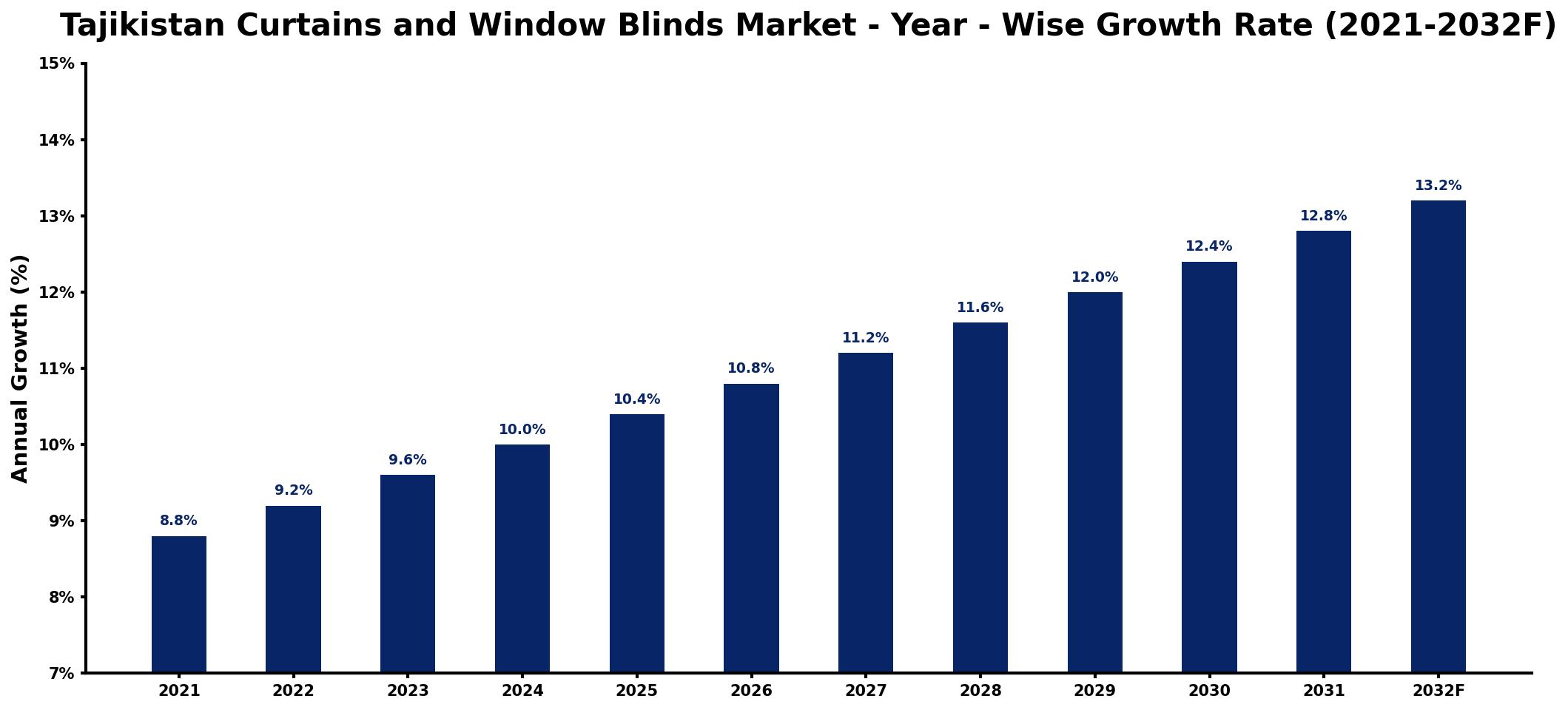
The table below presents the year‑wise growth rates along with the key drivers influencing the market
| Year | Growth Rate | Major Drivers |
| 2021 | 8.8% | Rising household disposable income |
| 2022 | 9.2% | Growing urbanization and construction |
| 2023 | 9.6% | Increasing focus on interior design |
| 2024 | 10.0% | Expansion of retail distribution networks |
| 2025 | 10.4% | Surge in home renovation projects |
| 2026 | 10.8% | Growing demand for energy efficiency |
| 2027 | 11.2% | Boost in foreign investments |
| 2028 | 11.6% | Shift towards sustainable materials |
| 2029 | 12.0% | Increase in online shopping trends |
| 2030 | 12.4% | Rising awareness of aesthetics |
| 2031 | 12.8% | Growth in hospitality sector investments |
| 2032 | 13.2% | Demand for customizable solutions |
Note: Market size estimations and growth projections presented in this report are based on 6Wresearch's proprietary forecasting methodology, utilizing the latest available industry data, government publications, and primary research inputs.
Tajikistan Curtains and Window Blinds Market Synopsis
In Tajikistan, the curtains and window blinds market is witnessing a shift towards contemporary designs, as consumers increasingly desire window treatments that blend functionality with style. Traditional fabrics remain prevalent, yet the growing appetite for eco-friendly materials reflects a significant change in consumer preferences.
This evolving market landscape is complemented by an expanding real estate sector, which fuels investments in interior enhancements. Additionally, smart technology is making inroads, offering innovative solutions that appeal to a tech-savvy consumer base looking for automated window treatments.
Tajikistan Curtains and Window Blinds Market Key Takeaways
- The market is on a robust growth trajectory, bolstered by urbanization and rising consumer incomes.
- Demand for eco-friendly and energy-efficient window treatments is increasing.
- Customization and personalization are becoming essential elements of consumer choice.
- Smart technology integration is reshaping product offerings in the window treatment sector.
- Government policies favoring local manufacturing are enhancing market competitiveness.
Evaluation of Restraints in Tajikistan Curtains and Window Blinds Market
Despite the promising growth landscape, several factors are constraining the Tajikistan curtains and window blinds market. A predominant challenge is the limited consumer awareness about modern window treatments, which often results in a preference for traditional textile products. Additionally, high import costs for quality materials can deter potential buyers from exploring diverse options. The uneven availability of specialized retail stores limits exposure to modern products, while fluctuating economic conditions, including unstable currency exchange rates, further impact consumers' purchasing power.
Tajikistan Curtains and Window Blinds Market Trends
The current trend in the Tajikistan curtains and window blinds market leans towards a blend of modern aesthetics and practical functionality. Consumers are increasingly drawn to energy-efficient solutions that offer sustainability without compromising design. Customization is becoming a key differentiator, with more homeowners seeking unique patterns and styles that reflect their personal taste. The advent of smart technology has led to an uptick in demand for motorized blinds and automated curtains, positioning these innovations at the forefront of consumer interest.
Tajikistan Curtains and Window Blinds Market Opportunities
The market presents attractive investment opportunities as the real estate sector in Tajikistan continues to flourish. With disposable incomes on the rise, there is a growing appetite for stylish window treatments that enhance interior spaces. Innovative products using sustainable materials could appeal to environmentally conscious consumers. Furthermore, government initiatives that promote local manufacturing create a conducive environment for developing production facilities, which may help reduce reliance on imports and better meet local demand.
Government Initiatives in the Tajikistan Curtains and Window Blinds Market
The Tajikistan government is actively fostering the curtains and window blinds market through policies designed to enhance local production and diminish dependency on imports. Tax incentives and subsidies are being extended to domestic manufacturers, promoting a competitive landscape. Moreover, the government has set forth quality standards to ensure product safety and performance, paving the way for a healthier market environment that not only supports local businesses but also boosts employment opportunities.
Future Insights of the Tajikistan Curtains and Window Blinds Market
Looking ahead to 2026-2032, the Tajikistan curtains and window blinds market is expected to continue its upward trajectory, driven by ongoing urbanization and a sustained focus on home décor. Consumers are likely to increasingly seek to elevate their living spaces, leading to heightened demand for innovative and aesthetically pleasing window treatments. However, market players will need to navigate challenges such as fluctuating raw material prices and competitive pressures while continuing to innovate and respond to shifting consumer preferences.
Tajikistan Curtains and Window Blinds Market Latest Developments (2025 - 2026)
Recently, the curtains and window blinds market has seen a notable shift towards sustainability, with more manufacturers exploring eco-friendly materials. Additionally, there's been increased activity in smart technology, with products featuring remote control and automated systems gaining traction among consumers. The industry is also witnessing a rise in marketing campaigns aimed at educating potential buyers about modern window treatments, which may play a crucial role in overcoming traditional preferences.
Tajikistan Curtains and Window Blinds Market - Key Attractiveness of the Report
- 10 Years of Market Numbers
- Historical Data Starting from 2022 to 2025
- Base Year: 2025
- Forecast Data until 2032
- Key Performance Indicators Impacting the Market
- Major Upcoming Developments and Projects
Key Highlights of the Report:
- Tajikistan Curtains and Window Blinds Market Outlook
- Market Size of Tajikistan Curtains and Window Blinds Market, 2025
- Forecast of Tajikistan Curtains and Window Blinds Market, 2032
- Historical Data and Forecast of Tajikistan Curtains and Window Blinds Revenues & Volume for the Period 2022-2032F
- Tajikistan Curtains and Window Blinds Market Trend Evolution
- Tajikistan Curtains and Window Blinds Market Drivers and Challenges
- Tajikistan Curtains and Window Blinds Price Trends
- Tajikistan Curtains and Window Blinds Porter's Five Forces
- Tajikistan Curtains and Window Blinds Industry Life Cycle
- Historical Data and Forecast of Tajikistan Curtains and Window Blinds Market Revenues & Volume By Materials for the Period 2022-2032F
- Historical Data and Forecast of Tajikistan Curtains and Window Blinds Market Revenues & Volume By Curtains (Cotton, Linen, Polyester) for the Period 2022-2032F
- Historical Data and Forecast of Tajikistan Curtains and Window Blinds Market Revenues & Volume By Window Blinds (Cotton, Linen, Wood, PVC, Metal) for the Period 2022-2032F
- Historical Data and Forecast of Tajikistan Curtains and Window Blinds Market Revenues & Volume By Product for the Period 2022-2032F
- Historical Data and Forecast of Tajikistan Curtains and Window Blinds Market Revenues & Volume By Curtains (Box pleat curtains, Pinch pleat curtains & drapery, Goblet pleat curtains & drapery, Eyelet curtains & drapery) for the Period 2022-2032F
- Historical Data and Forecast of Tajikistan Curtains and Window Blinds Market Revenues & Volume By Window Blinds (Window Shades,, Window Screens, Connected) for the Period 2022-2032F
- Historical Data and Forecast of Tajikistan Curtains and Window Blinds Market Revenues & Volume By Distribution Channel for the Period 2022-2032F
- Historical Data and Forecast of Tajikistan Curtains and Window Blinds Market Revenues & Volume By B2B for the Period 2022-2032F
- Historical Data and Forecast of Tajikistan Curtains and Window Blinds Market Revenues & Volume By B2C for the Period 2022-2032F
- Historical Data and Forecast of Tajikistan Curtains and Window Blinds Market Revenues & Volume By E-commerce for the Period 2022-2032F
- Historical Data and Forecast of Tajikistan Curtains and Window Blinds Market Revenues & Volume By Price Range for the Period 2022-2032F
- Historical Data and Forecast of Tajikistan Curtains and Window Blinds Market Revenues & Volume By High for the Period 2022-2032F
- Historical Data and Forecast of Tajikistan Curtains and Window Blinds Market Revenues & Volume By Medium for the Period 2022-2032F
- Historical Data and Forecast of Tajikistan Curtains and Window Blinds Market Revenues & Volume By Low for the Period 2022-2032F
- Tajikistan Curtains and Window Blinds Import Export Trade Statistics
- Market Opportunity Assessment By Materials
- Market Opportunity Assessment By Product
- Market Opportunity Assessment By Distribution Channel
- Market Opportunity Assessment By Price Range
- Tajikistan Curtains and Window Blinds Top Companies Market Share
- Tajikistan Curtains and Window Blinds Competitive Benchmarking By Technical and Operational Parameters
- Tajikistan Curtains and Window Blinds Company Profiles
- Tajikistan Curtains and Window Blinds Key Strategic Recommendations






































