Tajikistan Cutting Equipment Market Size, Share & Growth Rate
The Tajikistan Cutting Equipment Market was estimated at USD 317 Million in 2025 and is projected to reach USD 439 Million by 2032, growing at a CAGR of 4.8% from 2026 to 2032. This growth trajectory is primarily driven by the ongoing expansion of infrastructure projects across the country, which necessitates advanced cutting technologies. Additionally, the growth of the manufacturing and automotive sectors is increasing demand for high-quality cutting solutions that enhance productivity and efficiency.
Tajikistan Cutting Equipment Market Year-wise Growth Rate and Key Drivers
This graph highlights how the Tajikistan Cutting Equipment Market has steadily grown over the years, supported by major growth factors.
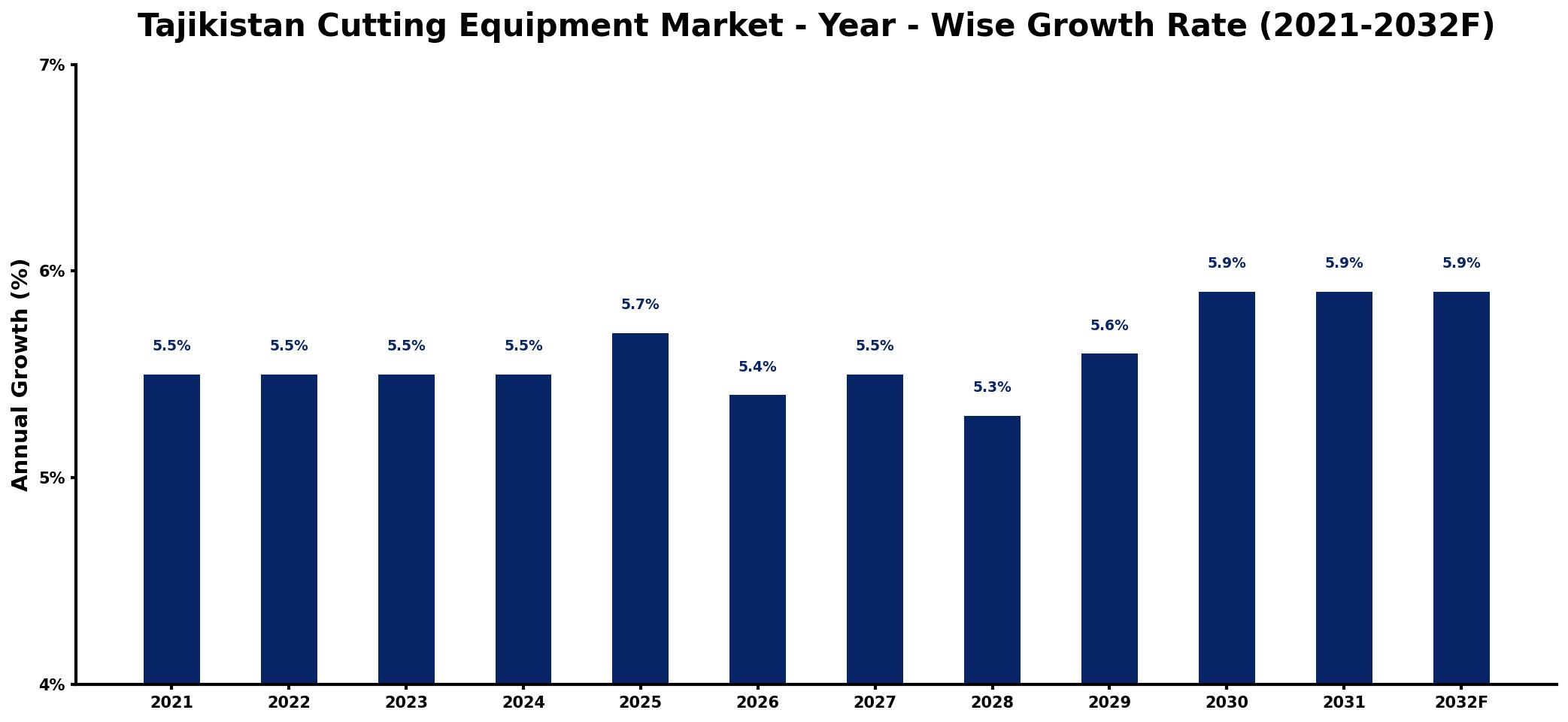
The table below presents the year‑wise growth rates along with the key drivers influencing the market
| Year | Growth Rate | Major Drivers |
| 2021 | 5.5% | Rising demand from construction sector |
| 2022 | 5.5% | Increased investments in infrastructure projects |
| 2023 | 5.5% | Growth in manufacturing activities |
| 2024 | 5.5% | Expansion of renewable energy projects |
| 2025 | 5.7% | Technological advancements in production |
| 2026 | 5.4% | Emergence of new market players |
| 2027 | 5.5% | Surge in export opportunities |
| 2028 | 5.3% | Higher consumer spending trends |
| 2029 | 5.6% | Development of urban areas |
| 2030 | 5.9% | Government support for industrial growth |
| 2031 | 5.9% | Collaborations with international firms |
| 2032 | 5.9% | Focus on sustainable production methods |
Note: Market size estimations and growth projections presented in this report are based on 6Wresearch's proprietary forecasting methodology, utilizing the latest available industry data, government publications, and primary research inputs.
Tajikistan Cutting Equipment Market Synopsis
The Tajikistan Cutting Equipment Market has shown consistent growth, buoyed by rising infrastructure investments and a dynamic manufacturing environment. As industries evolve, the demand for sophisticated cutting tools has surged, indicating a significant transition from traditional methods to modern, precision cutting technologies.
Looking ahead, the market is poised for substantial growth, catalyzed by advancements in automation and sustainability. The increasing push for environmentally friendly cutting solutions and the integration of computer numerical control (CNC) technology are set to reshape the landscape, fostering competitive advantages for early adopters.
Tajikistan Cutting Equipment Market Key Takeaways
- Strong growth forecast driven by expanding infrastructure and manufacturing sectors.
- Adoption of CNC technology for enhanced precision in cutting operations.
- Emphasis on environmentally sustainable cutting practices gaining traction.
- Investors are keenly interested in tapping into emerging automation trends.
- Government policies aimed at fostering local production and reducing import dependency.
Evaluation of Restraints in Tajikistan Cutting Equipment Market
Despite its growth potential, the Tajikistan Cutting Equipment Market faces notable restraints. Limited access to modern technologies due to geographical challenges hampers the adoption of advanced cutting equipment. Additionally, an underdeveloped infrastructure infrastructure presents difficulties in efficient distribution and access to newer machinery. The lack of a skilled workforce further complicates the transition to modern cutting solutions, requiring targeted investments in education and vocational training to build the necessary expertise.
Tajikistan Cutting Equipment Market Trends
Current trends in the Tajikistan Cutting Equipment Market reflect a clear shift towards advanced technologies such as laser and waterjet cutting systems, which offer efficient and high-quality results. Automation and robotics are increasingly integrated into cutting operations, driving productivity while simultaneously reducing labor costs. Furthermore, there is a rising focus on sustainability and environmentally friendly practices as industries respond to regulatory pressures and consumer demand.
Tajikistan Cutting Equipment Market Opportunities
The market presents compelling investment opportunities, particularly in areas like laser cutting machines and CNC cutting equipment. As Tajikistan continues to develop its infrastructure, there is a pressing need for efficient and precise cutting solutions in construction and manufacturing. Investors can capitalize on this demand by partnering with local distributors and manufacturers, thereby establishing a robust presence in the market and facilitating the adoption of advanced cutting technologies.
Government Initiatives in the Tajikistan Cutting Equipment Market
Government initiatives play a crucial role in shaping the Tajikistan Cutting Equipment Market. The administration has implemented policies designed to enhance the business environment for manufacturers, including streamlining administrative processes and offering financial incentives for investments in modern cutting technologies. Emphasis on promoting local production seeks to reduce import reliance, fostering self-sufficiency in the cutting equipment sector while supporting national economic growth.
Future Insights of the Tajikistan Cutting Equipment Market
Looking towards 2026-2032, the Tajikistan Cutting Equipment Market is set for robust growth driven by ongoing industrialization and modernization efforts. As infrastructure development remains a priority, coupled with increasing interest from international firms, the market is expected to see enhanced competition and technological advancements. This evolution will not only strengthen local industries but also position Tajikistan as a growing hub for cutting equipment in the region.
Tajikistan Cutting Equipment Market Latest Developments (2025 - 2026)
Recent developments in the Tajikistan Cutting Equipment Market have showcased an increasing interest in technological innovation, with companies exploring partnerships to bring advanced cutting technologies into the local market. Initiatives aimed at workforce training and skill development have also gained traction, aligning with the need for a more skilled labor force to operate modern cutting machinery. Furthermore, emerging discussions around sustainability in manufacturing are pushing for greater emphasis on eco-friendly cutting methods.
Tajikistan Cutting Equipment Market - Key Attractiveness of the Report
- 10 Years of Market Numbers
- Historical Data Starting from 2022 to 2025
- Base Year: 2025
- Forecast Data until 2032
- Key Performance Indicators Impacting the Market
- Major Upcoming Developments and Projects
Key Highlights of the Report:
- Tajikistan Cutting Equipment Market Outlook
- Market Size of Tajikistan Cutting Equipment Market, 2025
- Forecast of Tajikistan Cutting Equipment Market, 2032
- Historical Data and Forecast of Tajikistan Cutting Equipment Revenues & Volume for the Period 2022-2032F
- Tajikistan Cutting Equipment Market Trend Evolution
- Tajikistan Cutting Equipment Market Drivers and Challenges
- Tajikistan Cutting Equipment Price Trends
- Tajikistan Cutting Equipment Porter's Five Forces
- Tajikistan Cutting Equipment Industry Life Cycle
- Historical Data and Forecast of Tajikistan Cutting Equipment Market Revenues & Volume By Equipment Type for the Period 2022-2032F
- Historical Data and Forecast of Tajikistan Cutting Equipment Market Revenues & Volume By Manual for the Period 2022-2032F
- Historical Data and Forecast of Tajikistan Cutting Equipment Market Revenues & Volume By Mechanized for the Period 2022-2032F
- Historical Data and Forecast of Tajikistan Cutting Equipment Market Revenues & Volume By Cutting Technology for the Period 2022-2032F
- Historical Data and Forecast of Tajikistan Cutting Equipment Market Revenues & Volume By Plasma cutting for the Period 2022-2032F
- Historical Data and Forecast of Tajikistan Cutting Equipment Market Revenues & Volume By Oxy-fuel cutting for the Period 2022-2032F
- Historical Data and Forecast of Tajikistan Cutting Equipment Market Revenues & Volume By Laser cutting for the Period 2022-2032F
- Historical Data and Forecast of Tajikistan Cutting Equipment Market Revenues & Volume By Waterjet cutting for the Period 2022-2032F
- Historical Data and Forecast of Tajikistan Cutting Equipment Market Revenues & Volume By Carbon arc cutting for the Period 2022-2032F
- Historical Data and Forecast of Tajikistan Cutting Equipment Market Revenues & Volume By End Use Industry for the Period 2022-2032F
- Historical Data and Forecast of Tajikistan Cutting Equipment Market Revenues & Volume By Construction for the Period 2022-2032F
- Historical Data and Forecast of Tajikistan Cutting Equipment Market Revenues & Volume By Heavy metal fabrication for the Period 2022-2032F
- Historical Data and Forecast of Tajikistan Cutting Equipment Market Revenues & Volume By Shipbuilding & offshore for the Period 2022-2032F
- Historical Data and Forecast of Tajikistan Cutting Equipment Market Revenues & Volume By Automotive for the Period 2022-2032F
- Historical Data and Forecast of Tajikistan Cutting Equipment Market Revenues & Volume By Others for the Period 2022-2032F
- Historical Data and Forecast of Tajikistan Cutting Equipment Market Revenues & Volume By Type for the Period 2022-2032F
- Historical Data and Forecast of Tajikistan Cutting Equipment Market Revenues & Volume By Equipment for the Period 2022-2032F
- Historical Data and Forecast of Tajikistan Cutting Equipment Market Revenues & Volume By Consumables/Accessories for the Period 2022-2032F
- Tajikistan Cutting Equipment Import Export Trade Statistics
- Market Opportunity Assessment By Equipment Type
- Market Opportunity Assessment By Cutting Technology
- Market Opportunity Assessment By End Use Industry
- Market Opportunity Assessment By Type
- Tajikistan Cutting Equipment Top Companies Market Share
- Tajikistan Cutting Equipment Competitive Benchmarking By Technical and Operational Parameters
- Tajikistan Cutting Equipment Company Profiles
- Tajikistan Cutting Equipment Key Strategic Recommendations






































