Tajikistan Dairy Cream Market Size Growth Rate
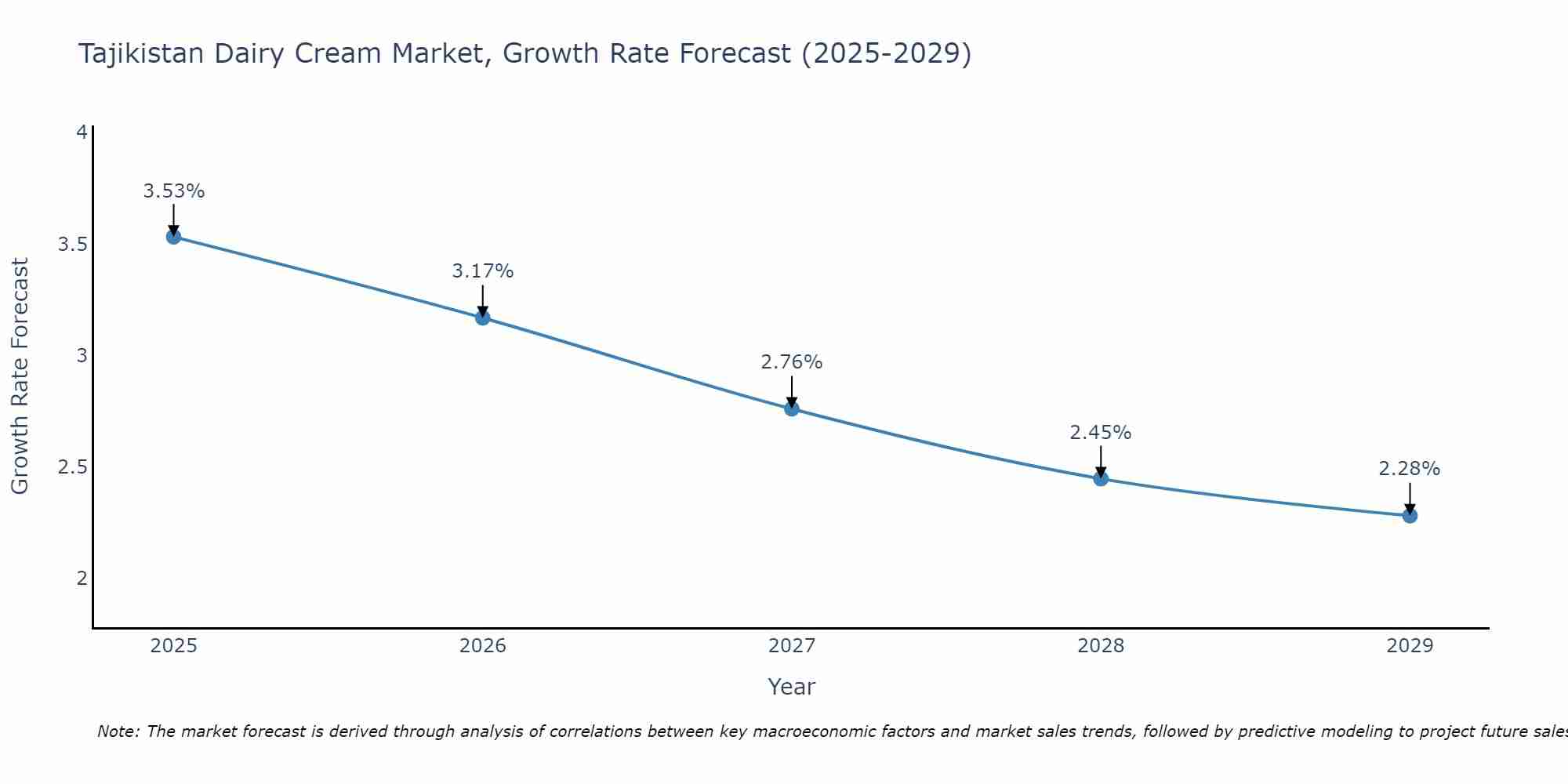
The Tajikistan Dairy Cream Market could see a tapering of growth rates over 2025 to 2029. Beginning strongly at 3.53% in 2025, growth softens to 2.28% in 2029.
Dairy Cream Market: Tajikistan vs Top 5 Major Economies in 2027 (Asia)
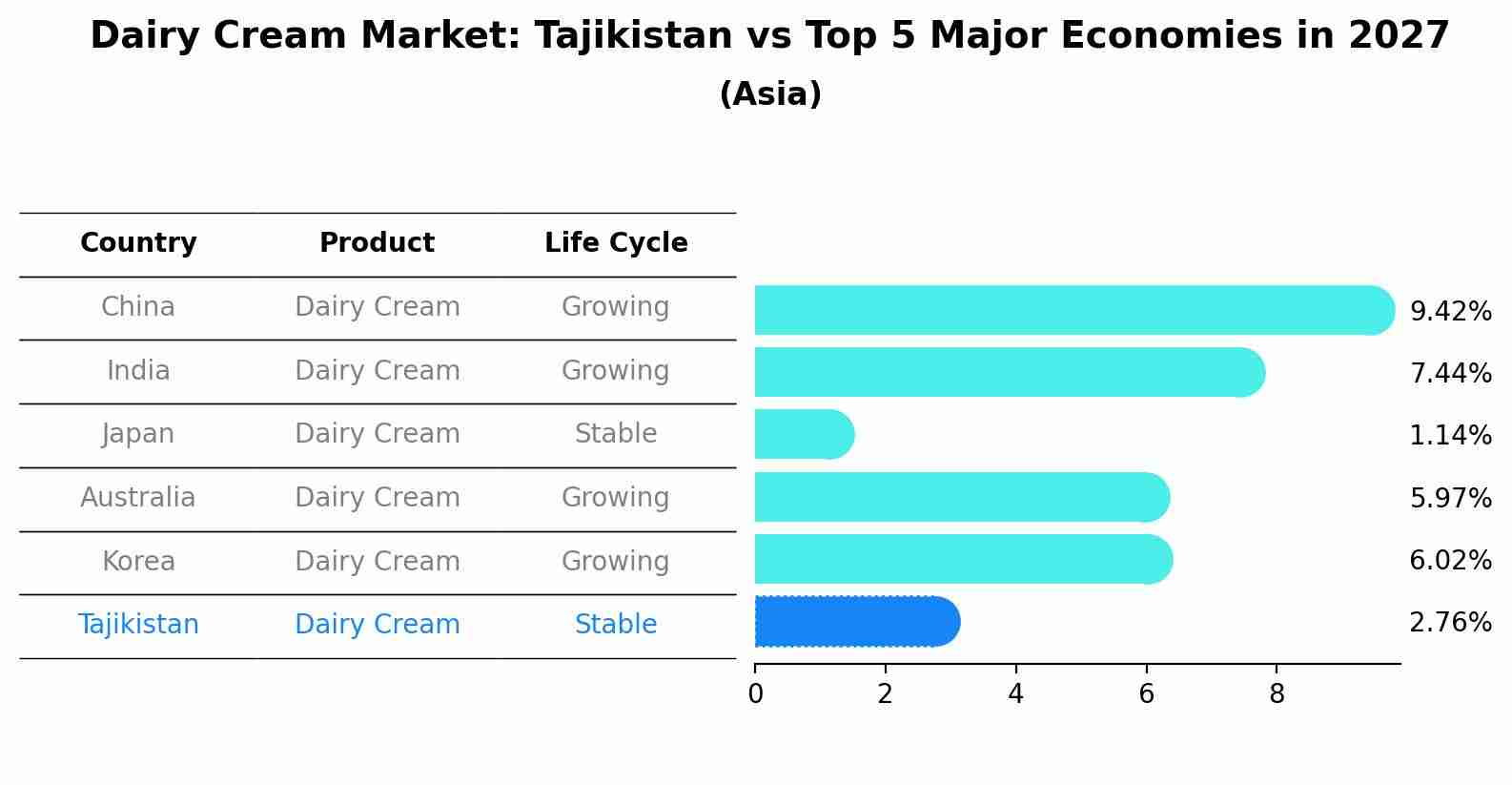
In the Asia region, the Dairy Cream market in Tajikistan is projected to expand at a stable growth rate of 2.76% by 2027. The largest economy is China, followed by India, Japan, Australia and South Korea.
Tajikistan Dairy Cream Market Overview
The Tajikistan Dairy Cream Market is experiencing steady growth driven by factors such as increasing consumer awareness of dairy products, rising disposable incomes, and changing dietary preferences. The market is characterized by a range of products including traditional cream, sour cream, and specialized cream products catering to diverse consumer needs. Key players in the market are focusing on product innovation, quality improvement, and expanding distribution channels to capitalize on the growing demand. The market is also witnessing a shift towards healthier and organic dairy cream products, driven by a rising health-conscious consumer base. Government initiatives to support dairy farming and processing industries are further expected to boost market growth in Tajikistan. Overall, the dairy cream market in Tajikistan presents opportunities for both domestic and international dairy companies to expand their presence and offerings.
Tajikistan Dairy Cream Market Trends
The Tajikistan Dairy Cream Market is experiencing a shift towards healthier and more natural products, with an increasing demand for organic and locally sourced cream. Consumers are becoming more conscious of the ingredients used in dairy products and are seeking options that are free from additives and preservatives. There is also a growing preference for non-dairy alternatives such as plant-based creams made from sources like coconut and almonds. Manufacturers in Tajikistan are responding to these trends by introducing new product offerings that cater to the changing consumer preferences, including lactose-free options and cream products with added health benefits. Overall, the market is witnessing a move towards premium, high-quality dairy cream products that align with the health and wellness priorities of Tajikistan consumers.
Tajikistan Dairy Cream Market Challenges
In the Tajikistan Dairy Cream Market, several challenges are prevalent. These include limited access to modern dairy farming techniques, resulting in lower productivity and quality of dairy products. Inadequate infrastructure for cold storage and transportation further hinders the distribution of dairy cream products, leading to spoilage and wastage. Additionally, fluctuating milk prices and lack of government support for the dairy industry create uncertainty for dairy cream producers and discourage investment in the sector. Furthermore, the competitive landscape is evolving with the entry of new players and imported products, putting pressure on local producers to improve their product offerings and marketing strategies to remain competitive in the market. Overall, addressing these challenges is essential for the sustainable growth and development of the Tajikistan Dairy Cream Market.
Tajikistan Dairy Cream Market Investment Opportunities
The Tajikistan Dairy Cream Market presents promising investment opportunities due to a growing demand for dairy products in the country. With an increasing focus on health and nutrition, there is a rising interest in high-quality dairy products such as cream. Investors can consider opportunities in dairy cream production facilities, distribution channels, and product innovation to cater to the evolving consumer preferences. Additionally, investing in modernizing dairy farming practices and improving supply chain efficiency can enhance the overall competitiveness of the market. Collaborating with local dairy farmers and leveraging technology for production and distribution can help capitalize on the potential growth in the Tajikistan Dairy Cream Market.
Tajikistan Dairy Cream Market Government Policy
The Tajikistan government has implemented various policies to support the dairy cream market in the country. These include providing subsidies and financial assistance to dairy farmers to increase milk production, improve quality, and enhance processing facilities. The government also focuses on promoting dairy products through marketing campaigns and export incentives to boost the sector`s competitiveness in the international market. Additionally, there are regulations in place to ensure food safety and quality standards are met in dairy cream production. Overall, these policies aim to stimulate growth in the Tajikistan dairy cream market, support local farmers, and enhance the country`s position as a significant player in the global dairy industry.
Tajikistan Dairy Cream Market Future Outlook
The future outlook for the Tajikistan Dairy Cream Market looks positive with steady growth expected in the coming years. Increasing consumer awareness about the health benefits of dairy products, rising disposable incomes, and a growing urban population are driving the demand for dairy cream in Tajikistan. Additionally, the government`s initiatives to support the dairy industry and the presence of international players investing in the market are expected to further boost growth. With a trend towards premium and convenience products, there is potential for new product development and market expansion. However, challenges such as price fluctuations of raw materials and competition from other dairy alternatives may impact the market dynamics. Overall, the Tajikistan Dairy Cream Market is poised for growth and opportunities for both domestic and international dairy cream manufacturers.
Key Highlights of the Report:
- Tajikistan Dairy Cream Market Outlook
- Market Size of Tajikistan Dairy Cream Market, 2024
- Forecast of Tajikistan Dairy Cream Market, 2031
- Historical Data and Forecast of Tajikistan Dairy Cream Revenues & Volume for the Period 2021 - 2031
- Tajikistan Dairy Cream Market Trend Evolution
- Tajikistan Dairy Cream Market Drivers and Challenges
- Tajikistan Dairy Cream Price Trends
- Tajikistan Dairy Cream Porter's Five Forces
- Tajikistan Dairy Cream Industry Life Cycle
- Historical Data and Forecast of Tajikistan Dairy Cream Market Revenues & Volume By Type for the Period 2021 - 2031
- Historical Data and Forecast of Tajikistan Dairy Cream Market Revenues & Volume By Fresh Cream for the Period 2021 - 2031
- Historical Data and Forecast of Tajikistan Dairy Cream Market Revenues & Volume By Thickened Cream/Heavy Cream for the Period 2021 - 2031
- Historical Data and Forecast of Tajikistan Dairy Cream Market Revenues & Volume By Whipping Cream for the Period 2021 - 2031
- Historical Data and Forecast of Tajikistan Dairy Cream Market Revenues & Volume By Sour Cream for the Period 2021 - 2031
- Historical Data and Forecast of Tajikistan Dairy Cream Market Revenues & Volume By Other Types for the Period 2021 - 2031
- Historical Data and Forecast of Tajikistan Dairy Cream Market Revenues & Volume By Distribution Channel for the Period 2021 - 2031
- Historical Data and Forecast of Tajikistan Dairy Cream Market Revenues & Volume By Supermarkets/ Hypermarkets for the Period 2021 - 2031
- Historical Data and Forecast of Tajikistan Dairy Cream Market Revenues & Volume By Convenince Stores for the Period 2021 - 2031
- Historical Data and Forecast of Tajikistan Dairy Cream Market Revenues & Volume By Online Retail Stores for the Period 2021 - 2031
- Historical Data and Forecast of Tajikistan Dairy Cream Market Revenues & Volume By Other Distribution Channels for the Period 2021 - 2031
- Tajikistan Dairy Cream Import Export Trade Statistics
- Market Opportunity Assessment By Type
- Market Opportunity Assessment By Distribution Channel
- Tajikistan Dairy Cream Top Companies Market Share
- Tajikistan Dairy Cream Competitive Benchmarking By Technical and Operational Parameters
- Tajikistan Dairy Cream Company Profiles
- Tajikistan Dairy Cream Key Strategic Recommendations






































