Tajikistan Digital Printing Market Size, Share & Growth Rate
The Tajikistan Digital Printing Market was estimated at USD 268 Million in 2025 and is projected to reach USD 367 Million by 2032, growing at a CAGR of 4.6% from 2026 to 2032. This growth trajectory is primarily fueled by the rising adoption of digital printing technology across multiple sectors, including advertising and packaging. The shift towards customized printing solutions and advancements in eco-friendly technologies are pivotal in attracting a broader customer base and increasing market participation.
Tajikistan Digital Printing Market Year-wise Growth Rate and Key Drivers
This graph highlights how the Tajikistan Digital Printing Market has steadily grown over the years, supported by major growth factors.
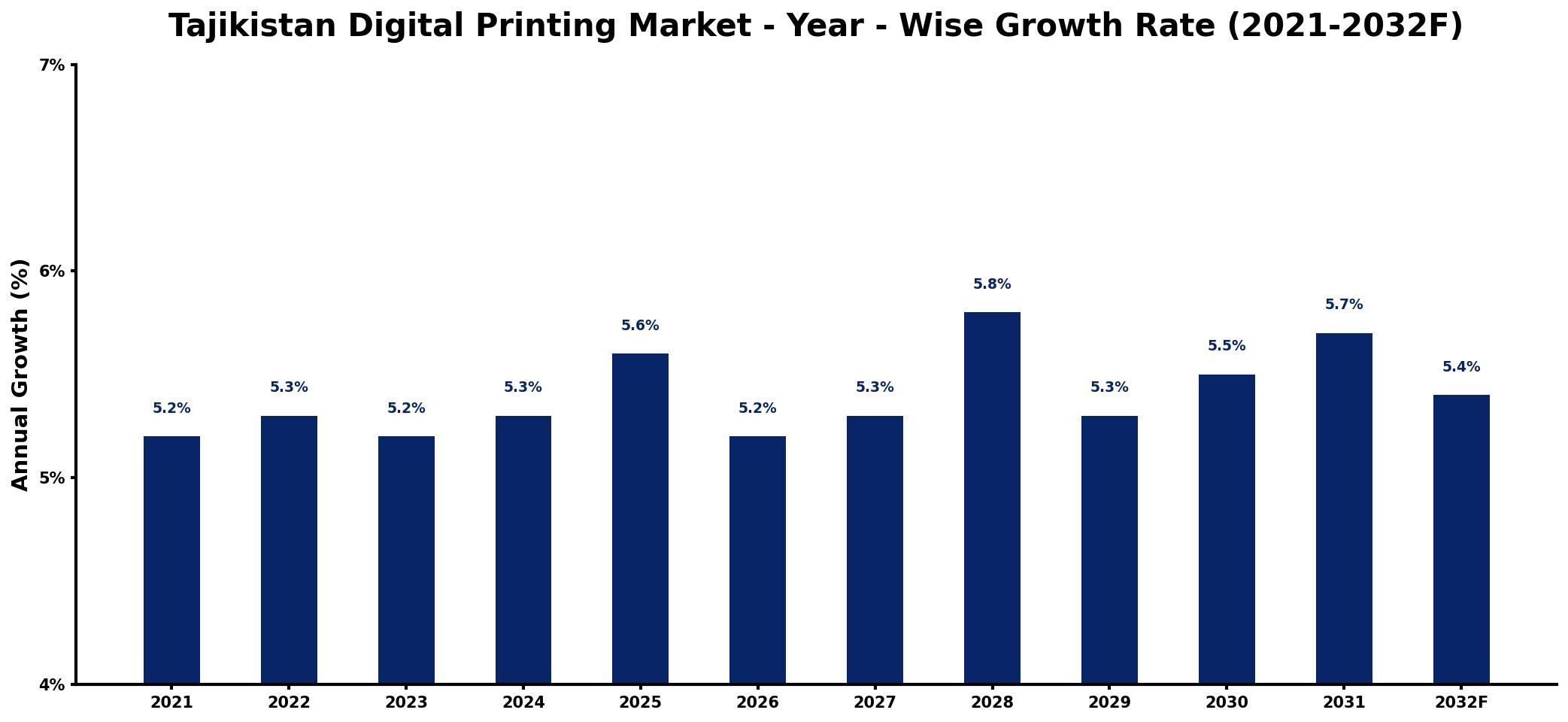
The table below presents the year‑wise growth rates along with the key drivers influencing the market
| Year | Growth Rate | Major Drivers |
| 2021 | 5.2% | Increased demand for packaging solutions |
| 2022 | 5.3% | Expansion in advertising sector growth |
| 2023 | 5.2% | Rising consumer personalization trends |
| 2024 | 5.3% | Growth in e-commerce business needs |
| 2025 | 5.6% | Investments in marketing technologies surge |
| 2026 | 5.2% | Emerging trends in sustainable solutions |
| 2027 | 5.3% | expanding manufacturing base activity |
| 2028 | 5.8% | Increase in custom merchandise demand |
| 2029 | 5.3% | Expansion of local business initiatives |
| 2030 | 5.5% | Rising interest in short runs |
| 2031 | 5.7% | stronger distribution network expansion |
| 2032 | 5.4% | improved processing technologies adoption |
Note: Market size estimations and growth projections presented in this report are based on 6Wresearch's proprietary forecasting methodology, utilizing the latest available industry data, government publications, and primary research inputs.
Tajikistan Digital Printing Market Synopsis
The strongest force currently shaping the Tajikistan Digital Printing Market is the growing demand for personalized and short-run printing materials. Industries are increasingly recognizing the advantages of digital printing, which allows for rapid production and customization, thereby enhancing marketing effectiveness and customer engagement.
In addition, the surge in eco-conscious consumerism is compelling businesses to adopt environmentally friendly printing practices. Techniques such as UV-curable and water-based inks are gaining traction, not only for their sustainability but also for their high-quality output. This combination of demand for personalization and sustainable practices is accelerating the market's evolution.
Tajikistan Digital Printing Market Key Takeaways
- The market is transitioning from traditional to digital printing methodologies due to cost efficiencies and customization.
- Government initiatives are actively promoting technological advancements in the printing sector.
- There is a notable rise in digital textile printing, propelled by demand for bespoke apparel and home textiles.
- Investment in digital printing technologies is essential for enhancing quality and operational efficiencies in printing services.
- 3D printing technology is emerging as a viable solution for prototyping and small-scale production, indicating a diversification in offerings.
Evaluation of Restraints in Tajikistan Digital Printing Market
Despite the promising growth of the Tajikistan Digital Printing Market, several restraints hinder its progress. A significant challenge is the limited access to advanced printing technologies, which is largely attributable to the country's underdeveloped infrastructure. This lack of access results in lower quality output compared to international standards. Furthermore, the industry faces a skills gap, as there is a shortage of qualified professionals familiar with modern digital printing techniques. These factors restrict the market's full potential and necessitate targeted investments and strategic partnerships.
Tajikistan Digital Printing Market Trends
The trends driving the Tajikistan Digital Printing Market are diverse and dynamic. The growing inclination towards eco-friendly printing technologies is notable, as businesses shift towards using sustainable materials. Additionally, there is an increased interest in digital textile printing, reflecting changing consumer preferences for customized apparel and home decor. Moreover, advancements in digital printing equipment and software are enhancing printing quality and operational efficiency, attracting more investments into the sector.
Tajikistan Digital Printing Market Opportunities
Significant growth and investment opportunities exist in the Tajikistan digital printing market, particularly in sectors such as advertising, packaging, and textiles. As the demand for personalized, high-quality printed materials rises, businesses can leverage digital printing technology to meet these needs cost-effectively. The government's commitment to fostering economic development creates a favorable environment for potential investors looking to establish or expand operations in this market, particularly through partnerships with local enterprises to better understand consumer preferences.
Government Initiatives in the Tajikistan Digital Printing Market
The Tajik government is actively pursuing policies to bolster the digital printing sector. This includes providing incentives for businesses to invest in advanced printing technologies and fostering an environment conducive to innovation. Additionally, the government has established regulations aimed at ensuring quality standards while promoting environmentally sustainable practices in the printing industry. By encouraging collaborations between local and international firms, the government seeks to attract advanced technologies and expertise into the Tajikistan digital printing market.
Future Insights of the Tajikistan Digital Printing Market
The future of the Tajikistan Digital Printing Market appears robust, with expected continued expansion through 2032. The increasing trend towards digitalization across various sectors will drive demand for high-quality, customizable printing solutions. Moreover, the emphasis on eco-friendly practices is likely to reshape consumer preferences, promoting sustainable printing methods. As infrastructure improves and more businesses recognize the benefits of digital printing, the market is poised for significant growth, making it an attractive arena for both local and international players.
Tajikistan Digital Printing Market Latest Developments (2025 - 2026)
Recent developments in the Tajikistan Digital Printing Market have highlighted a trend towards greater adoption of digital technologies across various sectors. This includes investments in eco-friendly printing solutions and an increasing number of collaborations aimed at enhancing printing quality. Additionally, local businesses are beginning to integrate 3D printing technologies into their operations, paving the way for innovation in prototyping and custom products.
Tajikistan Digital Printing Market - Key Attractiveness of the Report
- 10 Years of Market Numbers
- Historical Data Starting from 2022 to 2025
- Base Year: 2025
- Forecast Data until 2032
- Key Performance Indicators Impacting the Market
- Major Upcoming Developments and Projects
Key Highlights of the Report:
- Tajikistan DigitalPrinting Market Outlook
- Market Size of Tajikistan DigitalPrinting Market, 2025
- Forecast of Tajikistan DigitalPrinting Market, 2032
- Historical Data and Forecast of Tajikistan DigitalPrinting Revenues & Volume for the Period 2022-2032F
- Tajikistan DigitalPrinting Market Trend Evolution
- Tajikistan DigitalPrinting Market Drivers and Challenges
- Tajikistan DigitalPrinting Price Trends
- Tajikistan DigitalPrinting Porter's Five Forces
- Tajikistan DigitalPrinting Industry Life Cycle
- Historical Data and Forecast of Tajikistan DigitalPrinting Market Revenues & Volume By Printing Process for the Period 2022-2032F
- Historical Data and Forecast of Tajikistan DigitalPrinting Market Revenues & Volume By Electrophotography for the Period 2022-2032F
- Historical Data and Forecast of Tajikistan DigitalPrinting Market Revenues & Volume By Inkjet for the Period 2022-2032F
- Historical Data and Forecast of Tajikistan DigitalPrinting Market Revenues & Volume By Application for the Period 2022-2032F
- Historical Data and Forecast of Tajikistan DigitalPrinting Market Revenues & Volume By Books for the Period 2022-2032F
- Historical Data and Forecast of Tajikistan DigitalPrinting Market Revenues & Volume By Commercial Printing for the Period 2022-2032F
- Historical Data and Forecast of Tajikistan DigitalPrinting Market Revenues & Volume By Packaging for the Period 2022-2032F
- Historical Data and Forecast of Tajikistan DigitalPrinting Market Revenues & Volume By Labels for the Period 2022-2032F
- Historical Data and Forecast of Tajikistan DigitalPrinting Market Revenues & Volume By Corrugated Packaging for the Period 2022-2032F
- Historical Data and Forecast of Tajikistan DigitalPrinting Market Revenues & Volume By Cartons for the Period 2022-2032F
- Historical Data and Forecast of Tajikistan DigitalPrinting Market Revenues & Volume By Flexible Packaging for the Period 2022-2032F
- Historical Data and Forecast of Tajikistan DigitalPrinting Market Revenues & Volume By Rigid Plastic Packaging for the Period 2022-2032F
- Historical Data and Forecast of Tajikistan DigitalPrinting Market Revenues & Volume By Metal Packaging for the Period 2022-2032F
- Tajikistan DigitalPrinting Import Export Trade Statistics
- Market Opportunity Assessment By Printing Process
- Market Opportunity Assessment By Application
- Market Opportunity Assessment By Packaging
- Tajikistan DigitalPrinting Top Companies Market Share
- Tajikistan DigitalPrinting Competitive Benchmarking By Technical and Operational Parameters
- Tajikistan DigitalPrinting Company Profiles
- Tajikistan DigitalPrinting Key Strategic Recommendations






































