Tajikistan Dill Seed Oil Market Size, Share & Growth Rate
The Tajikistan Dill Seed Oil Market was estimated at USD 430 Million in 2025 and is projected to reach USD 560 Million by 2032, growing at a CAGR of 3.8% from 2026 to 2032. This growth trajectory is primarily fueled by increasing consumer awareness regarding natural and organic products, especially within the cosmetics and wellness sectors. As the demand for health-conscious choices continues to rise, dill seed oil's therapeutic properties and versatile applications are driving its acceptance among consumers.
Tajikistan Dill Seed Oil Market Year-wise Growth Rate and Key Drivers
This graph highlights how the Tajikistan Dill Seed Oil Market has steadily grown over the years, supported by major growth factors.
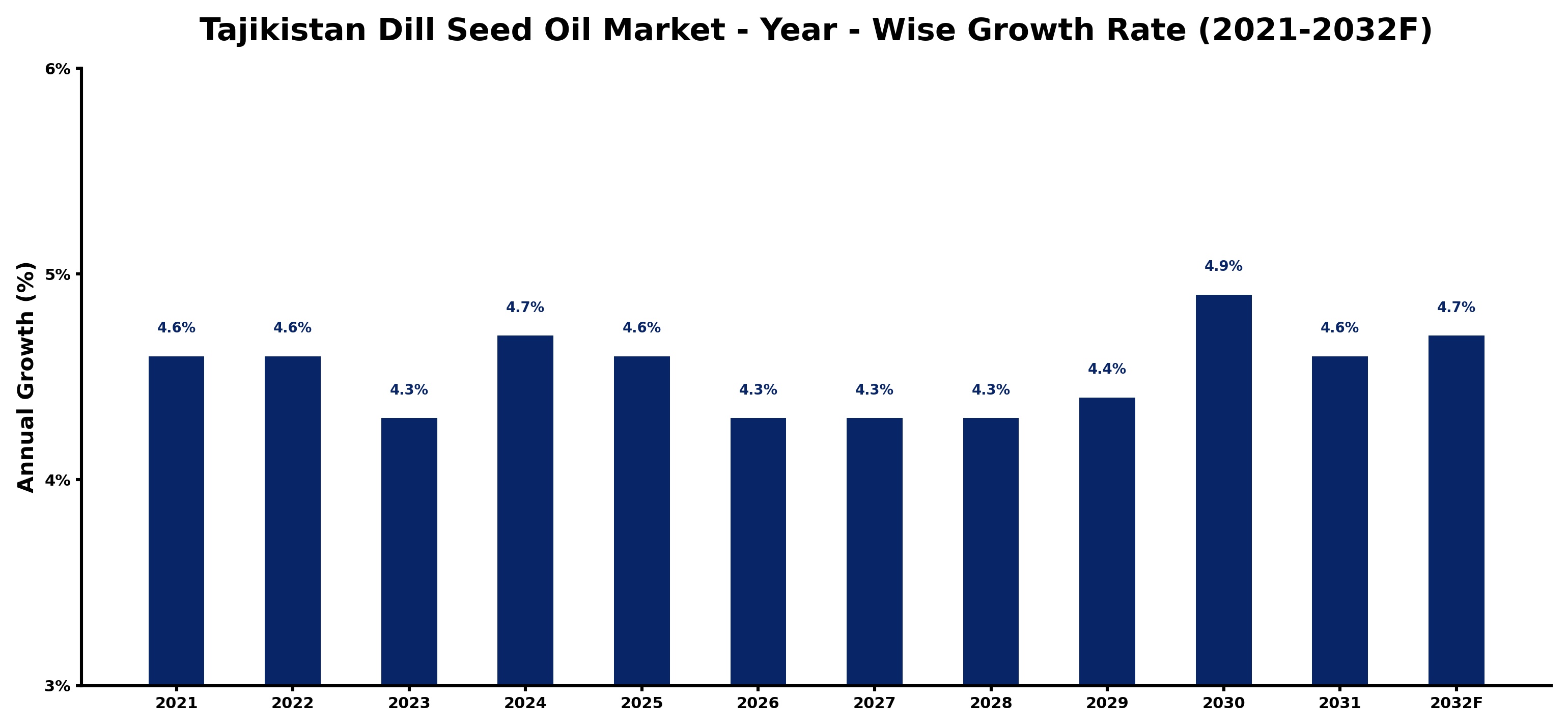
The table below presents the year‑wise growth rates along with the key drivers influencing the market
| Year | Growth Rate | Major Drivers |
| 2021 | 4.6% | Rising electricity demand across industries |
| 2022 | 4.6% | Growing urbanization and commercial development |
| 2023 | 4.3% | Expansion of commercial construction activities |
| 2024 | 4.7% | Increasing industrial infrastructure investments |
| 2025 | 4.6% | Expansion of manufacturing activities |
| 2026 | 4.3% | Expansion of transportation and logistics networks |
| 2027 | 4.3% | Increasing industrial automation investments |
| 2028 | 4.3% | Expansion of transportation and logistics networks |
| 2029 | 4.4% | Rising electricity demand across industries |
| 2030 | 4.9% | Increasing adoption of advanced technologies |
| 2031 | 4.6% | Rising electricity demand across industries |
| 2032 | 4.7% | Expansion of commercial construction activities |
Note - Market size estimations and growth projections presented in this report are based on 6Wresearch's advanced forecasting approach, validated with industry datasets as of June 2026.
Tajikistan Dill Seed Oil Market Synopsis
The Tajikistan dill seed oil market has witnessed a robust surge in demand, propelled by a growing inclination toward natural products across multiple industries. Recent consumer trends indicate a shift toward organic and health-centric options, setting a favorable stage for dill seed oil's future. However, despite this positive momentum, challenges such as infrastructure limitations and quality inconsistencies remain.
Looking ahead, the market appears well-positioned for further expansion, especially as consumer interest in holistic health and traditional remedies burgeons. With the right investments in production and education, the dill seed oil sector in Tajikistan could significantly enhance its domestic and international standing.
Tajikistan Dill Seed Oil Market Key Takeaways
- The market is on a steady growth path driven by health-conscious consumer trends.
- Increased demand for natural and organic products is shaping market dynamics.
- Infrastructure improvements are critical for enhancing production efficiency.
- Investment in quality control measures is needed to meet consumer expectations.
- Strategic partnerships and education can unlock potential market segments.
Evaluation of Restraints in Tajikistan Dill Seed Oil Market
Despite its promising growth prospects, the Tajikistan dill seed oil market faces significant restraints. A key limitation is the underdeveloped infrastructure, which affects both production capabilities and distribution efficiency. This reality leads to increased operational costs, making it challenging for local producers to compete on a global scale. Additionally, the lack of standardized quality controls results in inconsistent product offerings, which can undermine consumer trust. Furthermore, general awareness of dill seed oil's benefits remains low, limiting its market penetration. Addressing these challenges will require a multi-faceted approach, including government and private sector investment in infrastructure and consumer education initiatives.
Tajikistan Dill Seed Oil Market Trends
Current trends indicate a marked increase in consumer preference for natural and organic products, with dill seed oil being highlighted for its health benefits. As more individuals gravitate towards natural remedies, its applications in aromatherapy and skincare are gaining traction. Furthermore, there is an ongoing push for eco-friendly practices and sustainable farming methods, making it imperative for producers to align with these values to attract a conscious consumer base. The potential for product innovation—particularly in the areas of packaging and formulation—is also emerging as a key trend within this market.
Tajikistan Dill Seed Oil Market Opportunities
With the projected increase in demand for essential oils, the Tajikistan dill seed oil market presents numerous investment opportunities. Companies could explore avenues in production, processing, and distribution to meet the rising domestic and international demand. The country's favorable climatic conditions for dill cultivation further enhance the potential for investors. By forging strategic partnerships with local farmers and leveraging modern agricultural techniques, stakeholders can optimize the supply chain and meet evolving consumer expectations.
Government Initiatives in the Tajikistan Dill Seed Oil Market
While there are no specific policies directed solely at the dill seed oil market, Tajikistan's government has implemented programs aimed at bolstering the agricultural sector. These initiatives include subsidies, technical support, and access to financing for farmers, all aimed at increasing overall productivity and quality. Additionally, as a member of the Eurasian Economic Union (EAEU), Tajikistan must adhere to established agricultural regulations, which indirectly supports the dill seed oil industry's growth and its capability to meet export standards.
Future Insights of the Tajikistan Dill Seed Oil Market
Looking toward 2026-2032, the Tajikistan dill seed oil market is expected to experience continuous growth, bolstered by rising consumer awareness of health benefits and increasing demand for natural products in various sectors. The trend towards holistic health and wellness is anticipated to further accelerate market expansion. Moreover, with an emphasis on sustainable agricultural practices and local product promotion, Tajikistan has the potential to enhance its position in both domestic and international markets.
Tajikistan Dill Seed Oil Market Latest Developments (May 2025 - June 2026)
Recent developments within the Tajikistan dill seed oil market indicate a growing emphasis on product quality and innovation. There has been a noticeable shift among local producers towards enhancing their processing techniques to ensure product purity and efficacy. Furthermore, marketing campaigns aimed at increasing consumer awareness about the benefits of dill seed oil are becoming more prevalent, laying the groundwork for sustained market growth. The focus on sustainability in production practices is also gaining attention, aligning with global consumer trends.
Tajikistan Dill Seed Oil Market - Key Attractiveness of the Report
- 10 Years of Market Numbers
- Historical Data Starting from 2022 to 2025
- Base Year: 2025
- Forecast Data until 2032
- Key Performance Indicators Impacting the Market
- Major Upcoming Developments and Projects
Key Highlights of the Report:
- Tajikistan Dill Seed Oil Market Outlook
- Market Size of Tajikistan Dill Seed Oil Market, 2025
- Forecast of Tajikistan Dill Seed Oil Market, 2032
- Historical Data and Forecast of Tajikistan Dill Seed Oil Revenues & Volume for the Period 2022-2032F
- Tajikistan Dill Seed Oil Market Trend Evolution
- Tajikistan Dill Seed Oil Market Drivers and Challenges
- Tajikistan Dill Seed Oil Price Trends
- Tajikistan Dill Seed Oil Porter's Five Forces
- Tajikistan Dill Seed Oil Industry Life Cycle
- Historical Data and Forecast of Tajikistan Dill Seed Oil Market Revenues & Volume By Type for the Period 2022-2032F
- Historical Data and Forecast of Tajikistan Dill Seed Oil Market Revenues & Volume By Anethum Graveolens Seed Oil for the Period 2022-2032F
- Historical Data and Forecast of Tajikistan Dill Seed Oil Market Revenues & Volume By Anethum Sowa Seed Oil for the Period 2022-2032F
- Historical Data and Forecast of Tajikistan Dill Seed Oil Market Revenues & Volume By Application for the Period 2022-2032F
- Historical Data and Forecast of Tajikistan Dill Seed Oil Market Revenues & Volume By Flavor for the Period 2022-2032F
- Historical Data and Forecast of Tajikistan Dill Seed Oil Market Revenues & Volume By Fragrance for the Period 2022-2032F
- Historical Data and Forecast of Tajikistan Dill Seed Oil Market Revenues & Volume By Pharmaceutical for the Period 2022-2032F
- Historical Data and Forecast of Tajikistan Dill Seed Oil Market Revenues & Volume By Skincare for the Period 2022-2032F
- Historical Data and Forecast of Tajikistan Dill Seed Oil Market Revenues & Volume By Aromatherapy for the Period 2022-2032F
- Tajikistan Dill Seed Oil Import Export Trade Statistics
- Market Opportunity Assessment By Type
- Market Opportunity Assessment By Application
- Tajikistan Dill Seed Oil Top Companies Market Share
- Tajikistan Dill Seed Oil Competitive Benchmarking By Technical and Operational Parameters
- Tajikistan Dill Seed Oil Company Profiles
- Tajikistan Dill Seed Oil Key Strategic Recommendations






































