Tajikistan Edible Oil Market Size Growth Rate
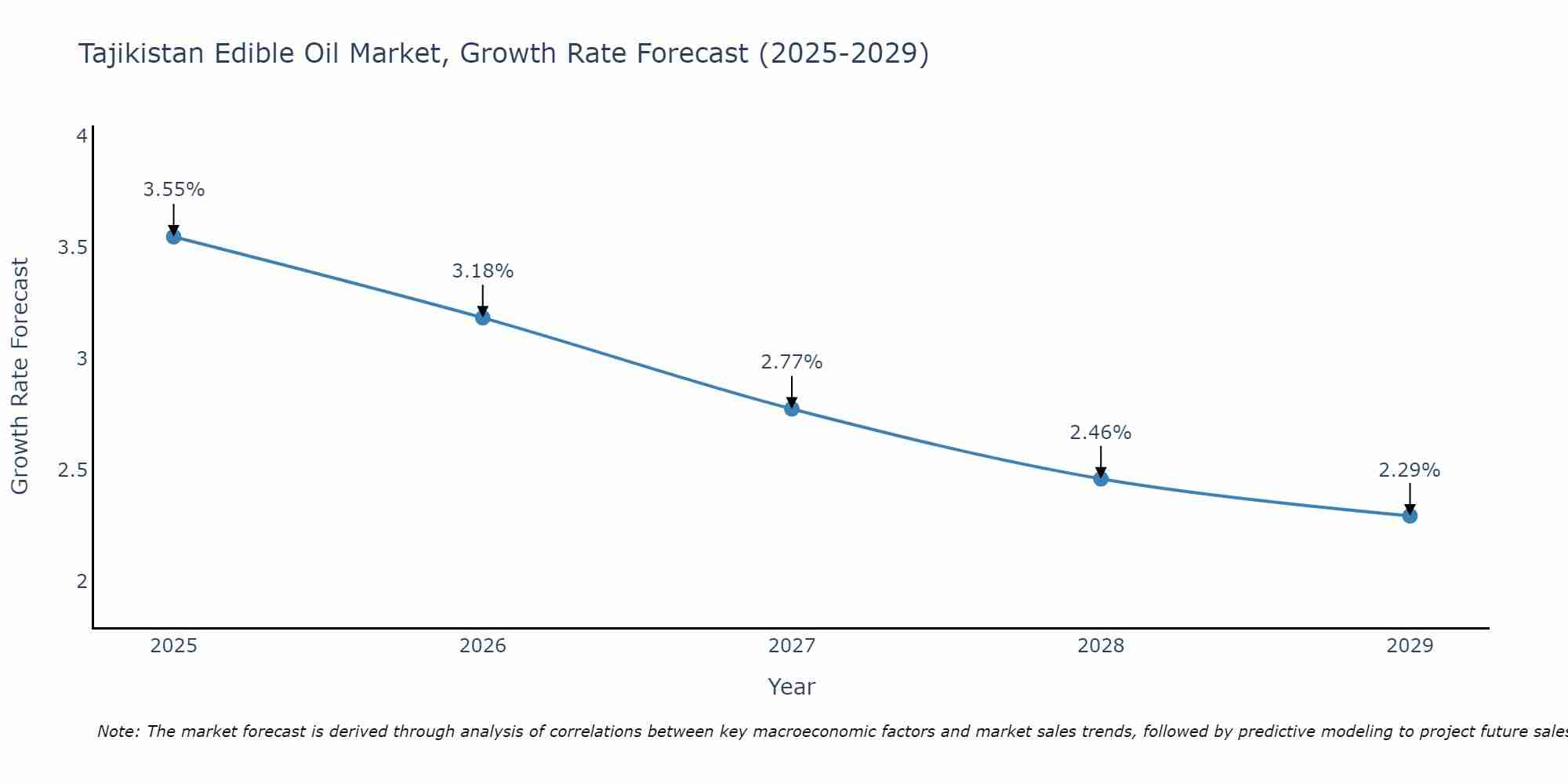
The Tajikistan Edible Oil Market could see a tapering of growth rates over 2025 to 2029. Although the growth rate starts strong at 3.55% in 2025, it steadily loses momentum, ending at 2.29% by 2029.
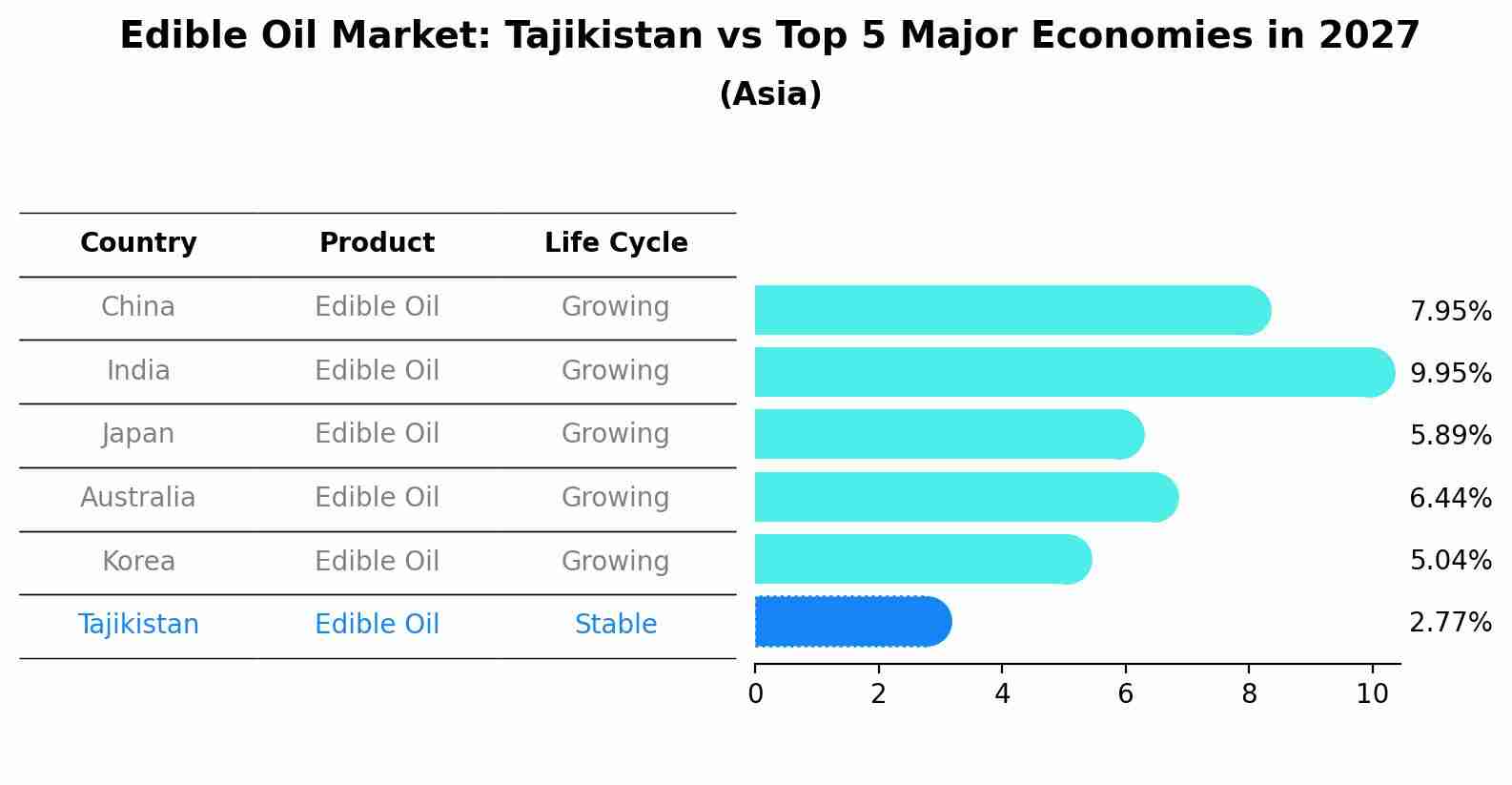
Edible Oil Market: Tajikistan vs Top 5 Major Economies in 2027 (Asia)
By 2027, Tajikistan's Edible Oil market is forecasted to achieve a stable growth rate of 2.77%, with China leading the Asia region, followed by India, Japan, Australia and South Korea.
Tajikistan Edible Oil Market Overview
The Tajikistan Edible Oil Market is experiencing steady growth driven by increasing consumer awareness regarding the health benefits of using edible oils, particularly sunflower oil which is widely consumed in the country. The market is primarily dominated by domestically produced sunflower oil, with key players including Tajik-Oil and Faroz. Due to the country`s heavy reliance on imports for other edible oils like soybean and palm oil, there is potential for market expansion through increased production or diversification of sources. The market is also influenced by factors such as changing dietary preferences, economic conditions, and government policies. Overall, the Tajikistan Edible Oil Market presents opportunities for both domestic producers and foreign investors looking to capitalize on the growing demand for healthier cooking oils in the region.
Tajikistan Edible Oil Market Trends
In Tajikistan, the edible oil market is experiencing a shift towards healthier options such as sunflower oil and olive oil, driven by increasing consumer awareness of health benefits. There is a growing demand for organic and cold-pressed oils due to their perceived purity and nutritional value. The market is also witnessing a rise in the use of locally sourced oils, as consumers are increasingly inclined towards supporting domestic producers. Additionally, there is a trend towards smaller packaging sizes to cater to the needs of single-person households and reduce wastage. Overall, the Tajikistan edible oil market is moving towards offering a wider variety of high-quality, healthier options that cater to the evolving preferences and lifestyles of consumers.
Tajikistan Edible Oil Market Challenges
In the Tajikistan Edible Oil Market, challenges such as limited domestic production capacity, dependence on imports for meeting consumption needs, fluctuating global oil prices impacting affordability, and inadequate infrastructure for storage and distribution are prevalent. Additionally, issues related to food safety standards, quality control, and competition from cheaper imported oils further compound the challenges faced by local edible oil producers in Tajikistan. The market is also susceptible to geopolitical factors and currency fluctuations, which can disrupt supply chains and impact pricing dynamics. Addressing these challenges will require strategic investments in increasing domestic production capacity, improving supply chain logistics, enhancing quality control measures, and fostering innovation in the edible oil industry to ensure sustainable growth and competitiveness in the market.
Tajikistan Edible Oil Market Investment Opportunities
The Tajikistan Edible Oil Market presents promising investment opportunities due to the country`s high demand for edible oils coupled with a growing population and increasing disposable income levels. Investors can consider opportunities in importing and distributing various types of edible oils such as sunflower oil, soybean oil, and palm oil to meet the local demand. Additionally, establishing local production facilities or partnering with existing manufacturers to enhance production capacity and cater to the domestic market can be lucrative. With the government`s focus on promoting agricultural development and increasing self-sufficiency in food production, investing in the Tajikistan Edible Oil Market offers the potential for long-term growth and profitability. However, thorough market research, understanding of local regulations, and strategic partnerships are essential for success in this market.
Tajikistan Edible Oil Market Government Policy
The Tajikistan government has implemented policies to support the development of the edible oil market in the country. This includes measures such as import tariffs on edible oils to protect local producers, subsidies for domestic oilseed production, and regulations to ensure quality standards are met. Additionally, the government has encouraged investments in the oilseed processing industry to increase domestic processing capacity and reduce reliance on imports. These policies aim to promote self-sufficiency in edible oil production, create jobs in the agricultural sector, and improve food security in Tajikistan.
Tajikistan Edible Oil Market Future Outlook
The future outlook for the Tajikistan Edible Oil Market appears promising due to factors such as the growing population, increasing urbanization, and rising disposable incomes. As consumers become more health-conscious and demand for healthier cooking oils rises, there is a shift towards oils such as olive oil and sunflower oil. Additionally, the government`s initiatives to promote domestic oilseed production and reduce reliance on imports are expected to drive growth in the market. With a focus on enhancing production efficiency and improving quality standards, the Tajikistan Edible Oil Market is likely to witness steady growth in the coming years, presenting opportunities for both domestic producers and foreign investors looking to enter the market.
Key Highlights of the Report:
- Tajikistan Edible Oil Market Outlook
- Market Size of Tajikistan Edible Oil Market, 2024
- Forecast of Tajikistan Edible Oil Market, 2031
- Historical Data and Forecast of Tajikistan Edible Oil Revenues & Volume for the Period 2021 - 2031
- Tajikistan Edible Oil Market Trend Evolution
- Tajikistan Edible Oil Market Drivers and Challenges
- Tajikistan Edible Oil Price Trends
- Tajikistan Edible Oil Porter's Five Forces
- Tajikistan Edible Oil Industry Life Cycle
- Historical Data and Forecast of Tajikistan Edible Oil Market Revenues & Volume By Type for the Period 2021 - 2031
- Historical Data and Forecast of Tajikistan Edible Oil Market Revenues & Volume By Palm Oil for the Period 2021 - 2031
- Historical Data and Forecast of Tajikistan Edible Oil Market Revenues & Volume By Soybean Oil for the Period 2021 - 2031
- Historical Data and Forecast of Tajikistan Edible Oil Market Revenues & Volume By Mustard Oil for the Period 2021 - 2031
- Historical Data and Forecast of Tajikistan Edible Oil Market Revenues & Volume By Sunflower Oil for the Period 2021 - 2031
- Historical Data and Forecast of Tajikistan Edible Oil Market Revenues & Volume By Others for the Period 2021 - 2031
- Historical Data and Forecast of Tajikistan Edible Oil Market Revenues & Volume By for the Period 2021 - 2031
- Historical Data and Forecast of Tajikistan Edible Oil Market Revenues & Volume By Packaging Type for the Period 2021 - 2031
- Historical Data and Forecast of Tajikistan Edible Oil Market Revenues & Volume By Pouches for the Period 2021 - 2031
- Historical Data and Forecast of Tajikistan Edible Oil Market Revenues & Volume By Jars for the Period 2021 - 2031
- Historical Data and Forecast of Tajikistan Edible Oil Market Revenues & Volume By Cans for the Period 2021 - 2031
- Historical Data and Forecast of Tajikistan Edible Oil Market Revenues & Volume By Bottles for the Period 2021 - 2031
- Historical Data and Forecast of Tajikistan Edible Oil Market Revenues & Volume By for the Period 2021 - 2031
- Historical Data and Forecast of Tajikistan Edible Oil Market Revenues & Volume By Pack Size for the Period 2021 - 2031
- Historical Data and Forecast of Tajikistan Edible Oil Market Revenues & Volume By Less than 1 Litres for the Period 2021 - 2031
- Historical Data and Forecast of Tajikistan Edible Oil Market Revenues & Volume By 1 Litres for the Period 2021 - 2031
- Historical Data and Forecast of Tajikistan Edible Oil Market Revenues & Volume By 1 Litres - 5 litres for the Period 2021 - 2031
- Historical Data and Forecast of Tajikistan Edible Oil Market Revenues & Volume By 5 Litres - 10 Litres for the Period 2021 - 2031
- Historical Data and Forecast of Tajikistan Edible Oil Market Revenues & Volume By 10 Litres and Above for the Period 2021 - 2031
- Historical Data and Forecast of Tajikistan Edible Oil Market Revenues & Volume By for the Period 2021 - 2031
- Historical Data and Forecast of Tajikistan Edible Oil Market Revenues & Volume By Packaging Material for the Period 2021 - 2031
- Historical Data and Forecast of Tajikistan Edible Oil Market Revenues & Volume By Metal for the Period 2021 - 2031
- Historical Data and Forecast of Tajikistan Edible Oil Market Revenues & Volume By Plastic for the Period 2021 - 2031
- Historical Data and Forecast of Tajikistan Edible Oil Market Revenues & Volume By Paper for the Period 2021 - 2031
- Historical Data and Forecast of Tajikistan Edible Oil Market Revenues & Volume By Others for the Period 2021 - 2031
- Historical Data and Forecast of Tajikistan Edible Oil Market Revenues & Volume By Application for the Period 2021 - 2031
- Historical Data and Forecast of Tajikistan Edible Oil Market Revenues & Volume By HoReCa for the Period 2021 - 2031
- Historical Data and Forecast of Tajikistan Edible Oil Market Revenues & Volume By Home Users for the Period 2021 - 2031
- Historical Data and Forecast of Tajikistan Edible Oil Market Revenues & Volume By Food Processing Industry for the Period 2021 - 2031
- Historical Data and Forecast of Tajikistan Edible Oil Market Revenues & Volume By for the Period 2021 - 2031
- Historical Data and Forecast of Tajikistan Edible Oil Market Revenues & Volume By Distribution Channel for the Period 2021 - 2031
- Historical Data and Forecast of Tajikistan Edible Oil Market Revenues & Volume By Direct/Institutional Sales for the Period 2021 - 2031
- Historical Data and Forecast of Tajikistan Edible Oil Market Revenues & Volume By Supermarkets and Hypermarkets for the Period 2021 - 2031
- Historical Data and Forecast of Tajikistan Edible Oil Market Revenues & Volume By Convenience Stores for the Period 2021 - 2031
- Historical Data and Forecast of Tajikistan Edible Oil Market Revenues & Volume By Online for the Period 2021 - 2031
- Historical Data and Forecast of Tajikistan Edible Oil Market Revenues & Volume By Others for the Period 2021 - 2031
- Tajikistan Edible Oil Import Export Trade Statistics
- Market Opportunity Assessment By Type
- Market Opportunity Assessment By Packaging Type
- Market Opportunity Assessment By Pack Size
- Market Opportunity Assessment By Packaging Material
- Market Opportunity Assessment By Application
- Market Opportunity Assessment By Distribution Channel
- Tajikistan Edible Oil Top Companies Market Share
- Tajikistan Edible Oil Competitive Benchmarking By Technical and Operational Parameters
- Tajikistan Edible Oil Company Profiles
- Tajikistan Edible Oil Key Strategic Recommendations






































