Tajikistan Electric AC Motors Market Size Growth Rate
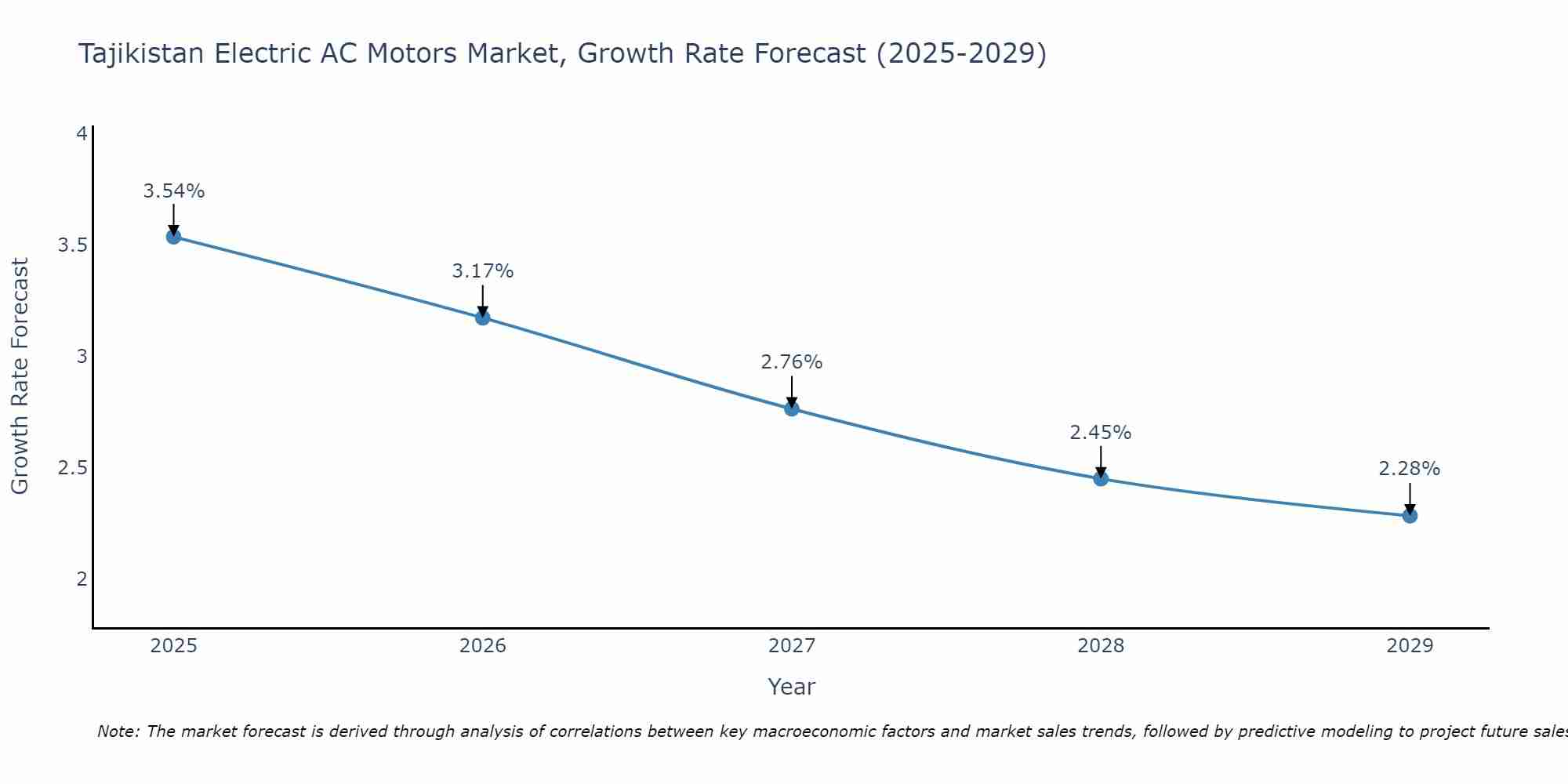
The Tajikistan Electric AC Motors Market could see a tapering of growth rates over 2025 to 2029. Starting high at 3.54% in 2025, the market steadily declines to 2.28% by 2029.
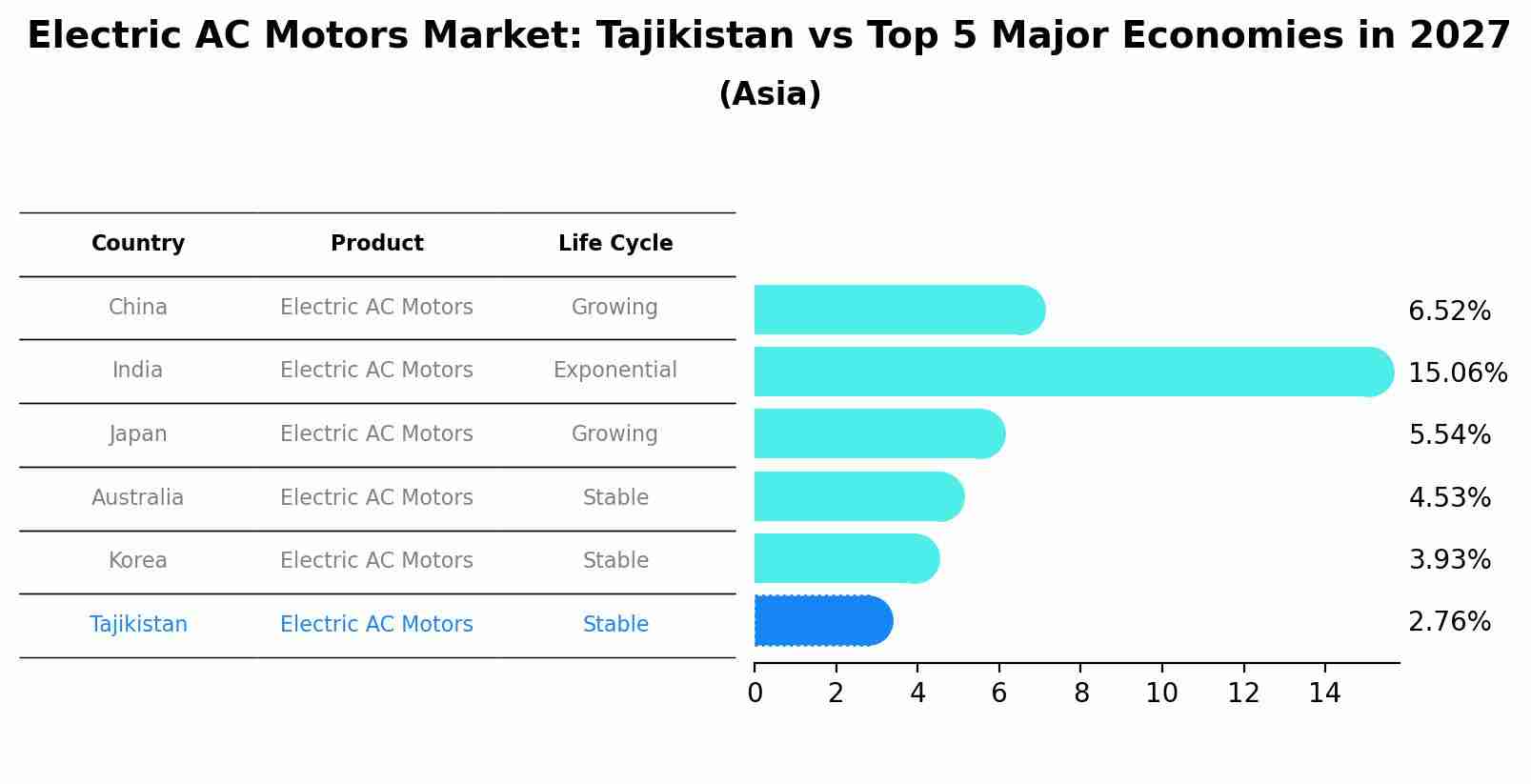
Electric AC Motors Market: Tajikistan vs Top 5 Major Economies in 2027 (Asia)
Tajikistan's Electric AC Motors market is anticipated to experience a stable growth rate of 2.76% by 2027, reflecting trends observed in the largest economy China, followed by India, Japan, Australia and South Korea.
Tajikistan Electric AC Motors Market Overview
The Tajikistan Electric AC Motors market is experiencing steady growth driven by increasing industrial activities, infrastructure development, and the adoption of energy-efficient technologies. Key players in the market include Siemens AG, ABB Ltd, and WEG Electric Corp, among others. The demand for electric AC motors in Tajikistan is primarily being fueled by sectors such as manufacturing, automotive, and construction. The government`s focus on improving energy efficiency and sustainability is also driving the market growth. However, challenges such as limited awareness about the benefits of electric AC motors and the availability of cheaper alternatives like traditional motors may hinder the market`s growth potential. Overall, the Tajikistan Electric AC Motors market presents opportunities for manufacturers to innovate and develop advanced, energy-efficient solutions to meet the evolving needs of industries in the country.
Tajikistan Electric AC Motors Market Trends
The Tajikistan Electric AC Motors Market is witnessing a shift towards energy-efficient and environmentally friendly models, in line with global sustainability goals. Increased industrialization and infrastructure development projects in the country are driving the demand for high-performance AC motors with advanced features such as variable speed drives and sensor technology. There is also a growing emphasis on the adoption of smart and IoT-enabled motors for improved operational efficiency and remote monitoring capabilities. Furthermore, the market is experiencing a rise in the integration of digital technologies like data analytics and predictive maintenance to enhance overall performance and reduce downtime. Overall, the Tajikistan Electric AC Motors Market is poised for growth as companies prioritize innovation and sustainability in their motor solutions.
Tajikistan Electric AC Motors Market Challenges
In the Tajikistan Electric AC Motors Market, several challenges are prevalent. These include limited access to advanced technology and equipment, which hinders the efficiency and performance of electric motors in various industries. Additionally, unreliable power supply and infrastructure issues in the country lead to disruptions in the operation of electric motors, impacting overall productivity. High import costs for quality electric AC motors also present a challenge for businesses operating in Tajikistan, as it increases the overall cost of production and reduces competitiveness in the market. Furthermore, the lack of skilled workforce and technical expertise in the maintenance and repair of electric motors poses a significant challenge for companies looking to utilize this technology effectively. Addressing these challenges will be crucial for the growth and development of the Tajikistan Electric AC Motors Market.
Tajikistan Electric AC Motors Market Investment Opportunities
In the Tajikistan Electric AC Motors Market, there are promising investment opportunities driven by the country`s focus on infrastructure development and industrial growth. With increasing demand for energy-efficient solutions, investing in the production and distribution of high-quality electric AC motors could be lucrative. Additionally, the government`s initiatives to enhance renewable energy sources present opportunities for electric motors used in hydroelectric power generation. Collaborating with local manufacturers or establishing a presence in the market through partnerships can also be advantageous. Understanding the specific needs of industries such as mining, agriculture, and manufacturing will be key to successfully capitalizing on the growing demand for electric AC motors in Tajikistan.
Tajikistan Electric AC Motors Market Government Policy
In Tajikistan, the government has implemented policies aimed at promoting energy efficiency and sustainability in the electric AC motors market. This includes initiatives to increase the use of energy-efficient motors, provide incentives for manufacturers to produce high-efficiency motor models, and set minimum efficiency standards for motors imported or manufactured in the country. Additionally, the government has been focusing on improving the reliability and quality of electricity supply to support the efficient operation of AC motors. These policies align with Tajikistan`s broader energy strategy to enhance energy security, reduce energy consumption, and mitigate environmental impacts. Overall, the government`s efforts in this sector aim to drive the adoption of energy-efficient technologies and contribute to the country`s sustainable development goals.
Tajikistan Electric AC Motors Market Future Outlook
The Tajikistan Electric AC Motors market is poised for steady growth in the coming years, driven by increasing industrialization, infrastructure development, and the adoption of energy-efficient technologies in the country. The demand for Electric AC Motors is expected to rise across various sectors such as manufacturing, automotive, and agriculture, as businesses seek to enhance operational efficiency and reduce energy consumption. Government initiatives promoting sustainable practices and the shift towards renewable energy sources are also likely to fuel market growth. However, challenges such as limited technological advancements and infrastructure constraints may hinder the market`s full potential. Overall, with a favorable economic outlook and increasing focus on sustainability, the Tajikistan Electric AC Motors market is anticipated to expand in the foreseeable future.
Key Highlights of the Report:
- Tajikistan Electric AC Motors Market Outlook
- Market Size of Tajikistan Electric AC Motors Market, 2024
- Forecast of Tajikistan Electric AC Motors Market, 2031
- Historical Data and Forecast of Tajikistan Electric AC Motors Revenues & Volume for the Period 2021 - 2031
- Tajikistan Electric AC Motors Market Trend Evolution
- Tajikistan Electric AC Motors Market Drivers and Challenges
- Tajikistan Electric AC Motors Price Trends
- Tajikistan Electric AC Motors Porter's Five Forces
- Tajikistan Electric AC Motors Industry Life Cycle
- Historical Data and Forecast of Tajikistan Electric AC Motors Market Revenues & Volume By Type for the Period 2021 - 2031
- Historical Data and Forecast of Tajikistan Electric AC Motors Market Revenues & Volume By Synchronous AC Motors for the Period 2021 - 2031
- Historical Data and Forecast of Tajikistan Electric AC Motors Market Revenues & Volume By Induction AC Motors for the Period 2021 - 2031
- Historical Data and Forecast of Tajikistan Electric AC Motors Market Revenues & Volume By Voltage for the Period 2021 - 2031
- Historical Data and Forecast of Tajikistan Electric AC Motors Market Revenues & Volume By Integral HP Output for the Period 2021 - 2031
- Historical Data and Forecast of Tajikistan Electric AC Motors Market Revenues & Volume By Fractional HP Output for the Period 2021 - 2031
- Historical Data and Forecast of Tajikistan Electric AC Motors Market Revenues & Volume By End-Use for the Period 2021 - 2031
- Historical Data and Forecast of Tajikistan Electric AC Motors Market Revenues & Volume By Industrial Machinery for the Period 2021 - 2031
- Historical Data and Forecast of Tajikistan Electric AC Motors Market Revenues & Volume By Motor Vehicles for the Period 2021 - 2031
- Historical Data and Forecast of Tajikistan Electric AC Motors Market Revenues & Volume By HVAC Equipment for the Period 2021 - 2031
- Historical Data and Forecast of Tajikistan Electric AC Motors Market Revenues & Volume By Aerospace & Transportation for the Period 2021 - 2031
- Historical Data and Forecast of Tajikistan Electric AC Motors Market Revenues & Volume By Household Appliances for the Period 2021 - 2031
- Historical Data and Forecast of Tajikistan Electric AC Motors Market Revenues & Volume By Others for the Period 2021 - 2031
- Tajikistan Electric AC Motors Import Export Trade Statistics
- Market Opportunity Assessment By Type
- Market Opportunity Assessment By Voltage
- Market Opportunity Assessment By End-Use
- Tajikistan Electric AC Motors Top Companies Market Share
- Tajikistan Electric AC Motors Competitive Benchmarking By Technical and Operational Parameters
- Tajikistan Electric AC Motors Company Profiles
- Tajikistan Electric AC Motors Key Strategic Recommendations






































