Tajikistan Electric Commercial Vehicle Market Size, Share & Growth Rate
The Tajikistan Electric Commercial Vehicle Market was estimated at USD 268 Million in 2025 and is projected to reach USD 364 Million by 2032, growing at a CAGR of 4.5% from 2026 to 2032. This growth trajectory is underpinned by increasing government initiatives aimed at promoting electric vehicles, coupled with a rising awareness among businesses and consumers regarding environmental sustainability. Furthermore, the push towards reducing dependence on fossil fuels is aligning well with global trends, providing a robust platform for market expansion.
Tajikistan Electric Commercial Vehicle Market Year-wise Growth Rate and Key Drivers
This graph highlights how the Tajikistan Electric Commercial Vehicle Market has steadily grown over the years, supported by major growth factors.
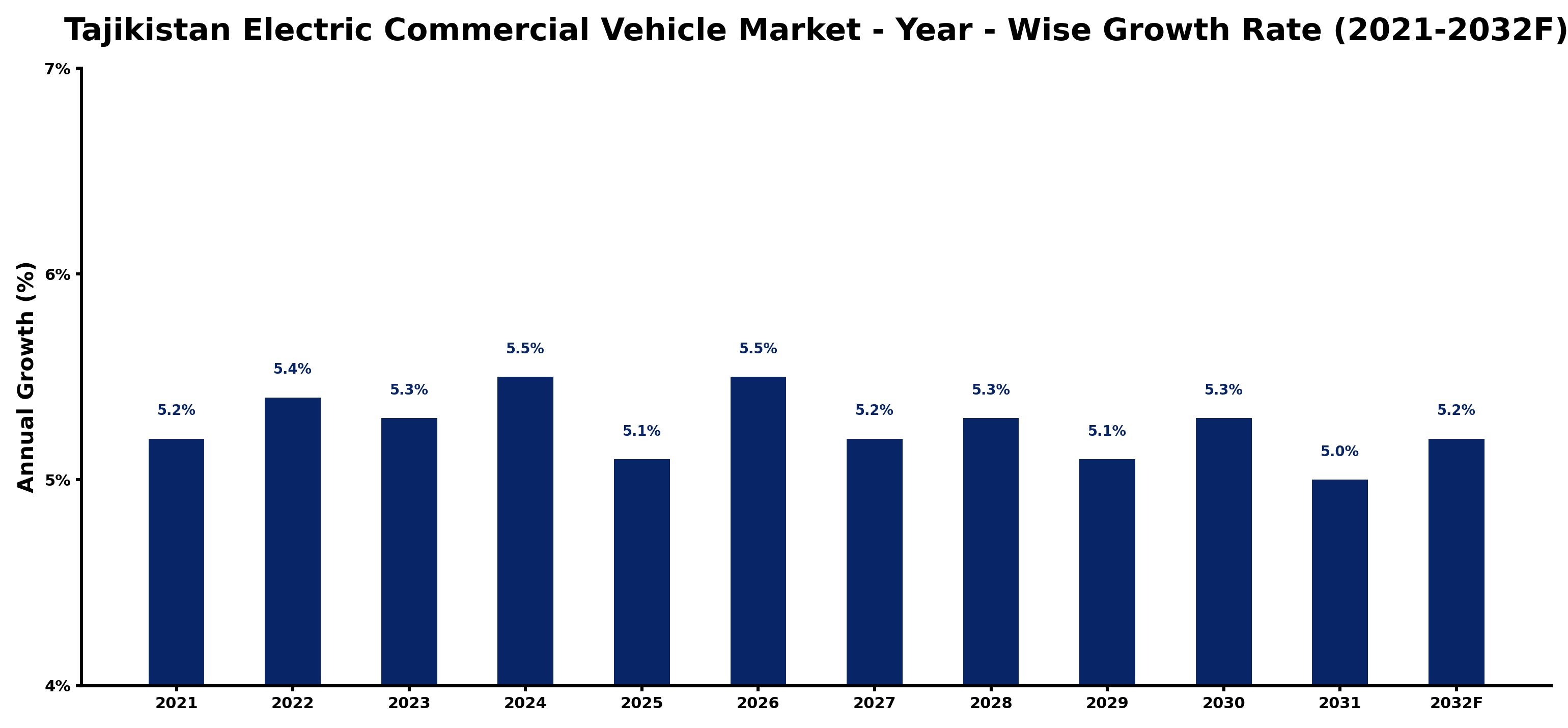
The table below presents the year‑wise growth rates along with the key drivers influencing the market
| Year | Growth Rate | Major Drivers |
| 2021 | 5.2% | Government incentives promoted adoption |
| 2022 | 5.4% | Infrastructure development enhanced charging |
| 2023 | 5.3% | Increased environmental awareness drove demand |
| 2024 | 5.5% | Technological advancements improved efficiency |
| 2025 | 5.1% | Public transportation electrification expanded |
| 2026 | 5.5% | Investment in renewable energy surged |
| 2027 | 5.2% | Corporate sustainability initiatives gained traction |
| 2028 | 5.3% | Consumer preference shifted towards electric |
| 2029 | 5.1% | Partnerships with local manufacturers strengthened |
| 2030 | 5.3% | Fleet modernization initiatives encouraged transition |
| 2031 | 5.0% | Urbanization increased electric vehicle necessity |
| 2032 | 5.2% | Logistics optimization enhanced operational efficiency |
Note - Market size estimations and growth projections presented in this report are based on 6Wresearch’s advanced forecasting approach, validated with industry datasets as of June 2026.
Tajikistan Electric Commercial Vehicle Market Synopsis
As Tajikistan embarks on its journey towards sustainable transportation, the electric commercial vehicle sector is witnessing a gradual yet meaningful transition. With governmental support and a growing commitment to environmental issues, the market is set to evolve rapidly, although still at an early stage.
Current trends suggest a pivot towards electric buses and trucks, particularly for public transport and logistics, as the country seeks to modernize its fleet. Additionally, collaborations between local and international entities are paving the way for innovation and technological advancement within the market.
Tajikistan Electric Commercial Vehicle Market Key Takeaways
- The market is in its early stages but shows significant growth potential driven by sustainability initiatives.
- Government policies are enhancing the appeal of electric vehicles through incentives and infrastructure development.
- Partnerships between local and international manufacturers are crucial for expanding the product range.
- Rising environmental awareness among consumers and businesses fuels demand for electric vehicles.
- Investment opportunities exist in manufacturing and infrastructure to support the electric vehicle ecosystem.
Evaluation of Restraints in Tajikistan Electric Commercial Vehicle Market
Despite the promising outlook for the Tajikistan Electric Commercial Vehicle Market, several constraints persist that may impede progress. A notable lack of robust charging infrastructure creates uncertainty for potential electric vehicle users, while the high upfront costs compared to traditional vehicles further complicate adoption rates. Additionally, the limited variety of commercial electric vehicles available exacerbates the situation. Awareness levels among the public and businesses regarding electric vehicles and their benefits also remain low, necessitating targeted educational efforts. The rugged terrain and harsh weather conditions in Tajikistan further challenge the performance of electric vehicles, making it essential to address these issues to realize the market's potential fully.
Tajikistan Electric Commercial Vehicle Market Trends
The market is experiencing a discernible shift towards the adoption of electric vehicles, driven by heightened environmental concerns and favorable government incentives. Innovators are increasingly focusing on enhancing battery technology and expanding charging networks to support this transition. Moreover, there is growing enthusiasm for electric buses and trucks for public transport and logistics, as businesses begin to recognize the long-term cost benefits associated with electric mobility.
Tajikistan Electric Commercial Vehicle Market Opportunities
With a strong push towards sustainability and reduced carbon emissions, the Tajikistan Electric Commercial Vehicle Market presents ample investment opportunities. The strategic location of Tajikistan along essential trade routes in Central Asia opens doors for logistics services focused on electric vehicles. Additionally, collaborating with local manufacturers or establishing partnerships with international suppliers can significantly enhance the market's technological capabilities and product diversity.
Government Initiatives in the Tajikistan Electric Commercial Vehicle Market
The Tajikistan government has launched a series of initiatives to bolster the adoption of electric commercial vehicles. These include tax incentives and subsidies aimed at encouraging businesses to transition towards electric mobility. Furthermore, public spending on the development of charging infrastructure underscores the commitment to supporting this industry. By setting ambitious targets to increase the number of electric vehicles on the road, the government is determined to reduce carbon emissions and dependency on fossil fuels, paving the way for a greener future.
Future Insights of the Tajikistan Electric Commercial Vehicle Market
Looking forward to the years 2026 to 2032, the Tajikistan Electric Commercial Vehicle Market is poised for steady growth. The convergence of rising environmental awareness, combined with government backing for cleaner technologies, is expected to solidify demand. As fuel prices rise and energy efficiency becomes a priority for businesses, electric commercial vehicles will likely become increasingly attractive options. Anticipated improvements in charging infrastructure and advancements in battery performance will further mitigate current limitations, encouraging wider adoption among consumers and enterprises alike.
Tajikistan Electric Commercial Vehicle Market Latest Developments (May 2025 - June 2026)
Recent developments indicate a concerted push towards enhancing the electric vehicle landscape in Tajikistan. Efforts are underway to improve the charging infrastructure, with new partnerships emerging to facilitate this goal. Additionally, the introduction of innovative electric vehicle models specifically designed for commercial use is gaining traction, reflecting a response to the growing demand from logistics and public transportation sectors. These movements are critical in establishing a solid foundation for the future of electric commercial vehicles in the country.
Tajikistan Electric Commercial Vehicle Market - Key Attractiveness of the Report
- 10 Years of Market Numbers
- Historical Data Starting from 2022 to 2025
- Base Year: 2025
- Forecast Data until 2032
- Key Performance Indicators Impacting the Market
- Major Upcoming Developments and Projects
Key Highlights of the Report:
- Tajikistan Electric Commercial Vehicle Market Outlook
- Market Size of Tajikistan Electric Commercial Vehicle Market, 2025
- Forecast of Tajikistan Electric Commercial Vehicle Market, 2032
- Historical Data and Forecast of Tajikistan Electric Commercial Vehicle Revenues & Volume for the Period 2022-2032F
- Tajikistan Electric Commercial Vehicle Market Trend Evolution
- Tajikistan Electric Commercial Vehicle Market Drivers and Challenges
- Tajikistan Electric Commercial Vehicle Price Trends
- Tajikistan Electric Commercial Vehicle Porter's Five Forces
- Tajikistan Electric Commercial Vehicle Industry Life Cycle
- Historical Data and Forecast of Tajikistan Electric Commercial Vehicle Market Revenues & Volume By Propulsion Type for the Period 2022-2032F
- Historical Data and Forecast of Tajikistan Electric Commercial Vehicle Market Revenues & Volume By BEV for the Period 2022-2032F
- Historical Data and Forecast of Tajikistan Electric Commercial Vehicle Market Revenues & Volume By PHEV for the Period 2022-2032F
- Historical Data and Forecast of Tajikistan Electric Commercial Vehicle Market Revenues & Volume By FCEV for the Period 2022-2032F
- Historical Data and Forecast of Tajikistan Electric Commercial Vehicle Market Revenues & Volume By Vehicle Type for the Period 2022-2032F
- Historical Data and Forecast of Tajikistan Electric Commercial Vehicle Market Revenues & Volume By Electric Bus for the Period 2022-2032F
- Historical Data and Forecast of Tajikistan Electric Commercial Vehicle Market Revenues & Volume By Electric Truck for the Period 2022-2032F
- Historical Data and Forecast of Tajikistan Electric Commercial Vehicle Market Revenues & Volume By Electric Pick-up Truck for the Period 2022-2032F
- Historical Data and Forecast of Tajikistan Electric Commercial Vehicle Market Revenues & Volume By Electric Van for the Period 2022-2032F
- Historical Data and Forecast of Tajikistan Electric Commercial Vehicle Market Revenues & Volume By Battery Type for the Period 2022-2032F
- Historical Data and Forecast of Tajikistan Electric Commercial Vehicle Market Revenues & Volume By Lithium-iron-phosphate (LFP) for the Period 2022-2032F
- Historical Data and Forecast of Tajikistan Electric Commercial Vehicle Market Revenues & Volume By Lithium-nickel-manganese-cobalt oxide (NMC) for the Period 2022-2032F
- Historical Data and Forecast of Tajikistan Electric Commercial Vehicle Market Revenues & Volume By Others for the Period 2022-2032F
- Historical Data and Forecast of Tajikistan Electric Commercial Vehicle Market Revenues & Volume By Battery Capacity for the Period 2022-2032F
- Historical Data and Forecast of Tajikistan Electric Commercial Vehicle Market Revenues & Volume By less than 50 kWh for the Period 2022-2032F
- Historical Data and Forecast of Tajikistan Electric Commercial Vehicle Market Revenues & Volume By 50??250 kWh for the Period 2022-2032F
- Historical Data and Forecast of Tajikistan Electric Commercial Vehicle Market Revenues & Volume By above 250 kWh for the Period 2022-2032F
- Historical Data and Forecast of Tajikistan Electric Commercial Vehicle Market Revenues & Volume By Power Output for the Period 2022-2032F
- Historical Data and Forecast of Tajikistan Electric Commercial Vehicle Market Revenues & Volume By less than 100 KW, for the Period 2022-2032F
- Historical Data and Forecast of Tajikistan Electric Commercial Vehicle Market Revenues & Volume By 100??250 KW for the Period 2022-2032F
- Historical Data and Forecast of Tajikistan Electric Commercial Vehicle Market Revenues & Volume By Above 250 KW for the Period 2022-2032F
- Historical Data and Forecast of Tajikistan Electric Commercial Vehicle Market Revenues & Volume By End-user for the Period 2022-2032F
- Historical Data and Forecast of Tajikistan Electric Commercial Vehicle Market Revenues & Volume By Last Mile Delivery for the Period 2022-2032F
- Historical Data and Forecast of Tajikistan Electric Commercial Vehicle Market Revenues & Volume By Distribution Service for the Period 2022-2032F
- Historical Data and Forecast of Tajikistan Electric Commercial Vehicle Market Revenues & Volume By Field Service for the Period 2022-2032F
- Historical Data and Forecast of Tajikistan Electric Commercial Vehicle Market Revenues & Volume By Refuse Service for the Period 2022-2032F
- Historical Data and Forecast of Tajikistan Electric Commercial Vehicle Market Revenues & Volume By Long Haul Transportation for the Period 2022-2032F
- Historical Data and Forecast of Tajikistan Electric Commercial Vehicle Market Revenues & Volume By Component for the Period 2022-2032F
- Historical Data and Forecast of Tajikistan Electric Commercial Vehicle Market Revenues & Volume By Electric Motor for the Period 2022-2032F
- Historical Data and Forecast of Tajikistan Electric Commercial Vehicle Market Revenues & Volume By EV Battery for the Period 2022-2032F
- Historical Data and Forecast of Tajikistan Electric Commercial Vehicle Market Revenues & Volume By Hydrogen Fuel Cell for the Period 2022-2032F
- Historical Data and Forecast of Tajikistan Electric Commercial Vehicle Market Revenues & Volume By Autonomous Vehicles for the Period 2022-2032F
- Historical Data and Forecast of Tajikistan Electric Commercial Vehicle Market Revenues & Volume By Electric Autonomous Truck for the Period 2022-2032F
- Historical Data and Forecast of Tajikistan Electric Commercial Vehicle Market Revenues & Volume By Electric Autonomous Bus for the Period 2022-2032F
- Tajikistan Electric Commercial Vehicle Import Export Trade Statistics
- Market Opportunity Assessment By Propulsion Type
- Market Opportunity Assessment By Vehicle Type
- Market Opportunity Assessment By Battery Type
- Market Opportunity Assessment By Battery Capacity
- Market Opportunity Assessment By Power Output
- Market Opportunity Assessment By End-user
- Market Opportunity Assessment By Component
- Market Opportunity Assessment By Autonomous Vehicles
- Tajikistan Electric Commercial Vehicle Top Companies Market Share
- Tajikistan Electric Commercial Vehicle Competitive Benchmarking By Technical and Operational Parameters
- Tajikistan Electric Commercial Vehicle Company Profiles
- Tajikistan Electric Commercial Vehicle Key Strategic Recommendations






































