Tajikistan Electronic Components Market Summary
The tajikistan electronic components market was estimated at USD 1455 Million in 2025 and is projected to reach USD 2126 Million by 2032, growing at a CAGR of 6.4% from 2026 to 2032.
Tajikistan Electronic Components Market Year-wise Growth Rate and Key Drivers
This graph highlights how the Tajikistan Electronic Components Market has steadily grown over the past five years, supported by major growth factors.
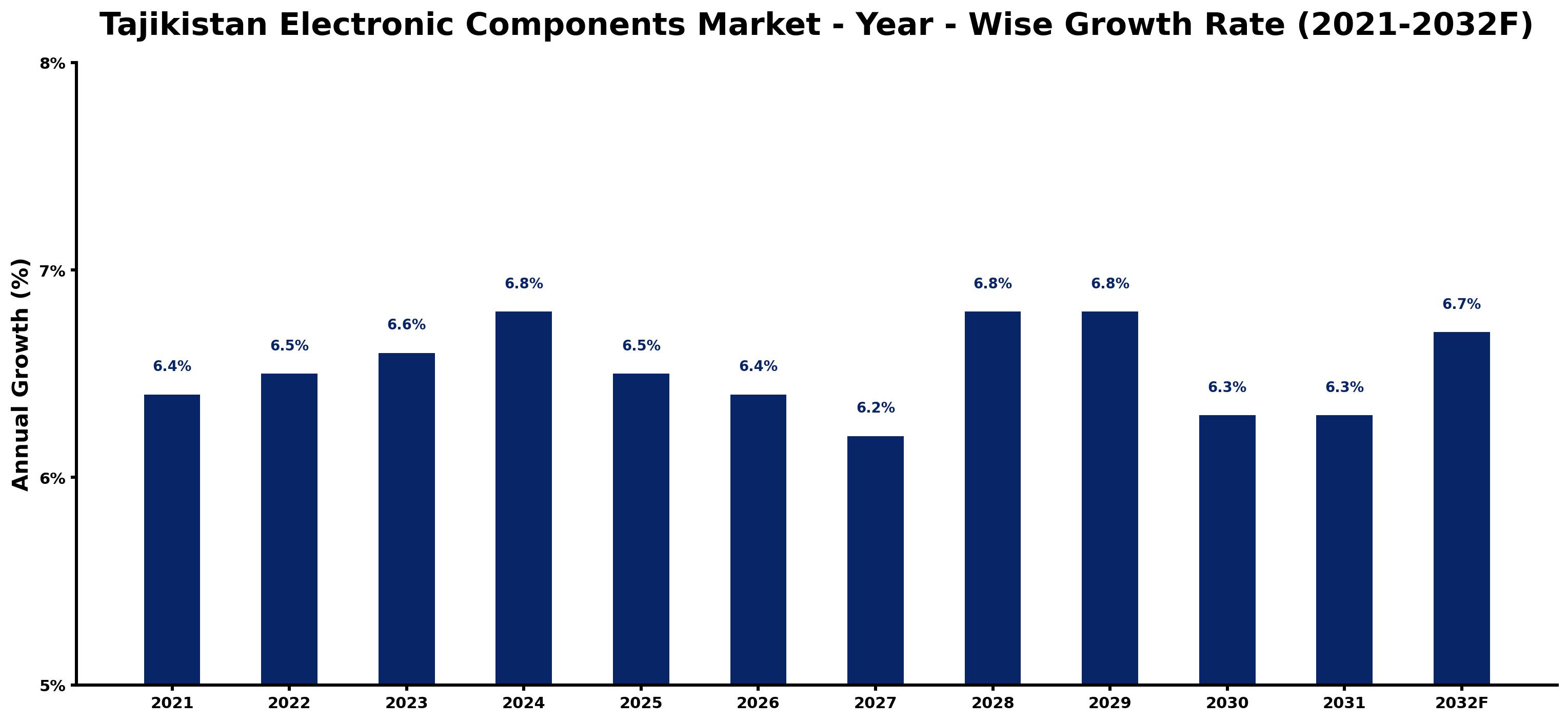
The table below presents the year wise growth rates along with the key drivers influencing the market
| Year | Growth Rate | Major Drivers |
| 2021 | 6.4% | Local manufacturers began exploring partnerships to enhance supply chains for electronic components. |
| 2022 | 6.5% | Investments in telecommunications infrastructure prompted a spike in electronic component requirements. |
| 2023 | 6.6% | Post-pandemic recovery in consumer electronics spurred demand for advanced components in Tajikistan. |
| 2024 | 6.8% | Emerging tech hubs in urban centers fostered innovation and increased component production capacity. |
| 2025 | 6.5% | Expansion of renewable energy projects increased the necessity for electronic control systems. |
| 2026 | 6.4% | Increased smartphone penetration raised demand for high-quality electronic parts and accessories. |
| 2027 | 6.2% | Rise in local startups focused on tech solutions spurred the need for varied components. |
| 2028 | 6.8% | A shift toward digitalization in education prompted investment in electronic learning tools. |
| 2029 | 6.8% | Growing automotive sector in neighboring countries influenced Tajikistan's electronics market dynamics. |
| 2030 | 6.3% | Cultural shifts toward smart consumer products accelerated component acquisition for local brands. |
| 2031 | 6.3% | Increased regional trade agreements improved access to advanced electronic components markets. |
| 2032 | 6.7% | Investment in green technology initiatives led to rising demand for eco-friendly electronic solutions. |
Note - Market size estimations and growth projections presented in this report are based on 6Wresearch's advanced forecasting approach, validated with industry datasets as of June 2026.
Tajikistan Electronic Components Market Synopsis
The Tajikistan Electronic Components Market is projected to reach 6.4% and witness significant growth during the forecast period (2026-2032). This growth is driven by a surge in consumer electronics, industrial machinery, and telecommunications equipment, reflecting the country's ongoing technological advancements. The market remains heavily reliant on imports due to limited local manufacturing capabilities, necessitating an emphasis on international suppliers and distributors who meet the diverse needs of various industries within Tajikistan.
Tajikistan Electronic Components Market Growth Drivers
The growth of the Tajikistan Electronic Components Market can be attributed to several key factors.
- The increasing demand for electronic devices, spurred by rising consumer spending and a growing middle class, is a primary driver of market expansion.
- Technological advancements across sectors are fueling the need for advanced electronic components, including semiconductors and IoT devices.
- Infrastructure development initiatives undertaken by the government are creating a conducive environment for the electronics sector, enhancing market access and logistics.
- A shift towards smart and energy-efficient technologies aligns with global sustainability trends, thereby promoting demand for innovative electronic components.
- The growth of industries such as renewable energy and electric vehicles is fostering the need for specialized components, presenting new business avenues for suppliers.
Tajikistan Electronic Components Market Trends and Opportunities
Current trends within the Tajikistan Electronic Components Market emphasize innovation and efficiency, as stakeholders focus on meeting the evolving demands of consumers and industries.
- There is a growing preference for miniaturized components, driven by the need for more compact and efficient electronic devices that cater to consumer lifestyle trends.
- Energy-efficient components are gaining traction as industries strive to meet sustainability targets and reduce operational costs associated with energy consumption.
- The rising adoption of IoT technologies necessitates a greater focus on sensors and connectivity components, propelling demand across various sectors.
- Investments in research and development are fostering innovation, leading to the emergence of customized electronic components tailored to local needs.
- The expanding market for renewable energy solutions highlights opportunities for the supply of components integral to solar power systems and energy storage technologies.
Tajikistan Electronic Components Market Challenges and Restraints
Despite the positive growth trajectory, the Tajikistan Electronic Components Market faces several challenges that could hinder its development.
- The country's limited skilled labor pool in electronics manufacturing creates difficulties for local production capabilities, contributing to reliance on imports.
- High import duties can create pricing challenges for imported components, impacting the cost competitiveness of products in the local market.
- Fluctuating currency exchange rates pose risks to the affordability and availability of imported components, affecting supply chain stability.
- Lack of robust infrastructure and technological facilities limits the ability of local producers to compete with international suppliers.
- Intellectual property protection issues may deter foreign investment, creating an uncertain business environment for potential investors.
Tajikistan Electronic Components Market Investment Opportunities
The evolving landscape of the Tajikistan Electronic Components Market presents promising avenues for investment as demand escalates across various sectors.
- Investors can explore opportunities in the supply of high-quality electronic components, addressing the increasing need for semiconductors and passive components among local manufacturers.
- Partnerships with domestic electronics firms for technology transfer can bolster local production capabilities and foster innovation.
- Establishing manufacturing facilities within Tajikistan could allow investors to produce components tailored specifically to local market demand.
- Engagement in research and development initiatives focused on creating customized solutions presents a strategic approach to tap into an emerging market.
- Investment in training programs for skilled labor within the electronics sector can enhance local manufacturing capabilities and contribute to market growth.
Tajikistan Electronic Components Market Government Investment and Initiatives
The government of Tajikistan is actively promoting the development of the electronic components market through various strategic investments and initiatives.
Policies aimed at attracting foreign investment include tax incentives and simplified regulatory processes, designed to encourage international players to enter the market. Furthermore, infrastructure improvements are underway to support the growth of the electronics sector, providing necessary logistics frameworks that can facilitate better supply chain management.
The government is also looking to enhance the competitiveness of local manufacturers through support programs and initiatives that focus on innovation and technology adoption. Import regulations are being enforced to ensure that quality standards are met, protecting both consumers and local businesses from subpar imports. These efforts reflect the government's commitment to stimulating growth in the electronic components market while fostering a sustainable business environment.
Tajikistan Electronic Components Market Latest Developments (May 2025 - June 2026)
The period from May 2025 to June 2026 has seen significant developments in the Tajikistan Electronic Components Market, marking a phase of increased interest and investment in technological advancement.
Initiatives aimed at improving local manufacturing capabilities have gained momentum, with various stakeholders focusing on establishing assembly plants and manufacturing facilities within the country. Additionally, there has been a noticeable increase in the collaboration between local firms and international technology providers, facilitating knowledge transfer and enhancing innovation capabilities.
New regulatory measures have been introduced to streamline processes for importing electronic components, ensuring that quality standards are upheld while promoting broader access to advanced technologies. There are also ongoing public discussions about enhancing educational programs to develop a skilled workforce that can adequately support the burgeoning electronics sector.
Tajikistan Electronic Components Market - Key Attractiveness of the Report
- 10 Years of Market Numbers
- Historical Data Starting from 2022 to 2025
- Base Year: 2025
- Forecast Data until 2032
- Key Performance Indicators Impacting the Market
- Major Upcoming Developments and Projects
Key Highlights of the Report:
- Tajikistan Electronic Components Market Outlook
- Market Size of Tajikistan Electronic Components Market, 2025
- Forecast of Tajikistan Electronic Components Market, 2032F
- Historical Data and Forecast of Tajikistan Electronic Components Revenues & Volume for the Period 2022-2032F
- Tajikistan Electronic Components Market Trend Evolution
- Tajikistan Electronic Components Market Drivers and Challenges
- Tajikistan Electronic Components Price Trends
- Tajikistan Electronic Components Porter's Five Forces
- Tajikistan Electronic Components Industry Life Cycle
- Historical Data and Forecast of Tajikistan Electronic Components Market Revenues & Volume By Types for the Period 2022-2032F
- Historical Data and Forecast of Tajikistan Electronic Components Market Revenues & Volume By Passive for the Period 2022-2032F
- Historical Data and Forecast of Tajikistan Electronic Components Market Revenues & Volume By Active for the Period 2022-2032F
- Historical Data and Forecast of Tajikistan Electronic Components Market Revenues & Volume By Electro Mechanic for the Period 2022-2032F
- Historical Data and Forecast of Tajikistan Electronic Components Market Revenues & Volume By Applications for the Period 2022-2032F
- Historical Data and Forecast of Tajikistan Electronic Components Market Revenues & Volume By Automotive for the Period 2022-2032F
- Historical Data and Forecast of Tajikistan Electronic Components Market Revenues & Volume By Communications for the Period 2022-2032F
- Historical Data and Forecast of Tajikistan Electronic Components Market Revenues & Volume By Industrial for the Period 2022-2032F
- Historical Data and Forecast of Tajikistan Electronic Components Market Revenues & Volume By Computing Applications for the Period 2022-2032F
- Historical Data and Forecast of Tajikistan Electronic Components Market Revenues & Volume By Others for the Period 2022-2032F
- Tajikistan Electronic Components Import Export Trade Statistics
- Market Opportunity Assessment By Types
- Market Opportunity Assessment By Applications
- Tajikistan Electronic Components Top Companies Market Share
- Tajikistan Electronic Components Competitive Benchmarking By Technical and Operational Parameters
- Tajikistan Electronic Components Company Profiles
- Tajikistan Electronic Components Key Strategic Recommendations






































