Tajikistan Enterprise AI Market Size & Growth Rate (2026-2032)
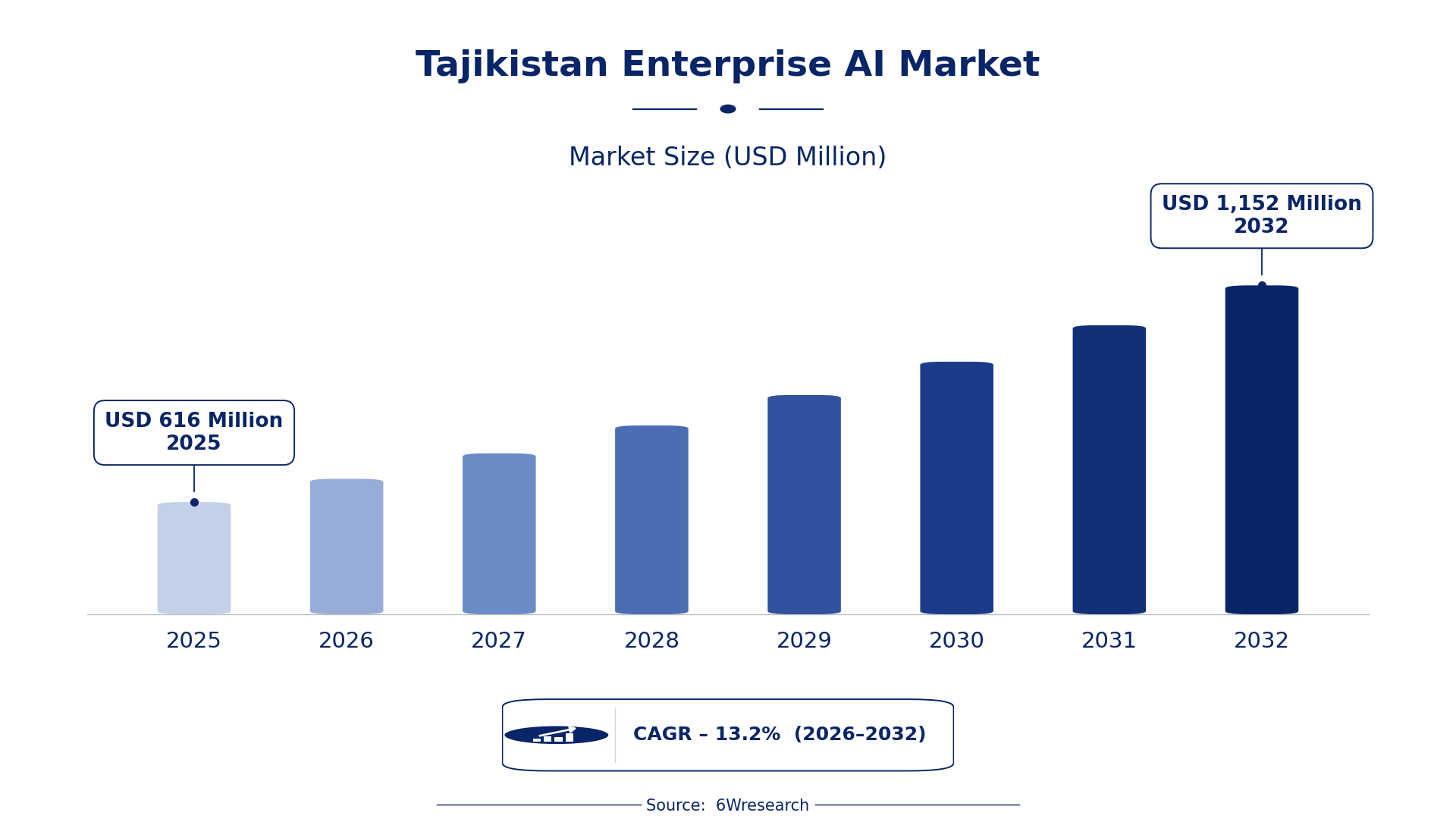
The Tajikistan Enterprise AI Market was estimated at USD 616 Million in 2025 and is projected to reach USD 1152 Million by 2032, growing at a CAGR of 13.2% from 2026 to 2032.
Tajikistan Enterprise AI Market Synopsis
The Tajikistan Enterprise AI market is experiencing notable growth as businesses across various sectors embrace artificial intelligence to enhance efficiency and decision-making. Industries such as finance, healthcare, and telecommunications are at the forefront, driving demand for AI solutions that streamline operations and improve customer interactions.
Despite the promising trajectory, challenges persist. Limited awareness and a shortage of skilled professionals in AI present significant barriers to widespread adoption. However, as organizations increasingly recognize the transformative power of AI, the market is set for substantial expansion, offering fertile ground for innovative solutions tailored to local needs.
Tajikistan Enterprise AI Market Year-wise Growth Rate and Key Drivers
This graph illustrates the annual growth rates of the Tajikistan Enterprise AI Market from 2021 to 2032, highlighting a steady upward trajectory and projected expansion over the forecast period.
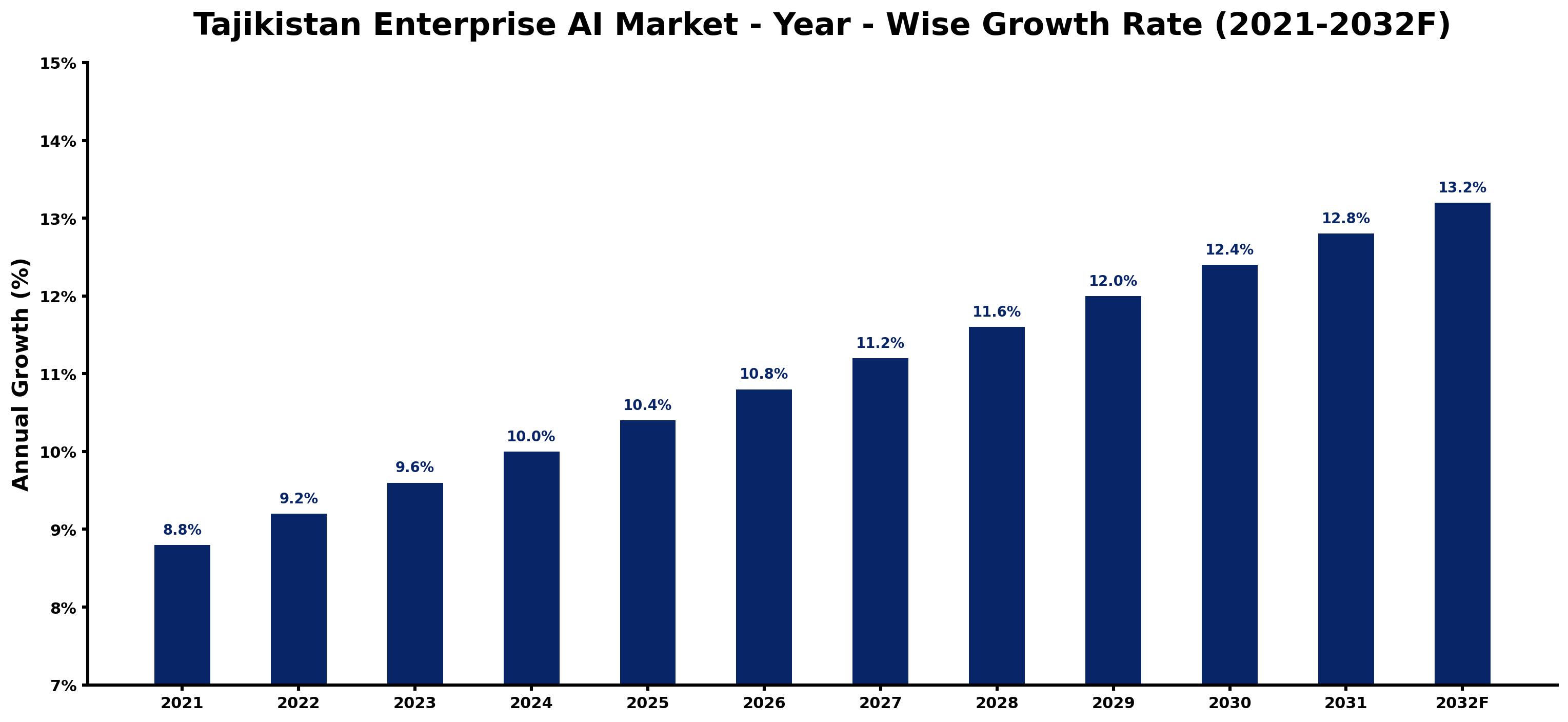
The table below presents the year‑wise growth rates along with the key drivers influencing the market
| Year | Growth Rate | Major Drivers |
| 2021 | 8.8% | Digital Silk Road initiative enhancing tech investments |
| 2022 | 9.2% | Increased demand for automation in local agricultural sectors |
| 2023 | 9.6% | Government backing of AI adoption in public services |
| 2024 | 10.0% | Local startups leveraging AI for healthcare solutions |
| 2025 | 10.4% | Tajikistan's youth skilled in computer science disciplines |
| 2026 | 10.8% | Emergence of AI training programs at universities |
| 2027 | 11.2% | Growing interest in AI-driven financial technologies |
| 2028 | 11.6% | Government partnerships with tech firms for AI projects |
| 2029 | 12.0% | Rising mobile internet accessibility boosting AI applications |
| 2030 | 12.4% | Investment in AI for water resource management initiatives |
| 2031 | 12.8% | AI integration in local translation services expanding demand |
| 2032 | 13.2% | Regulatory frameworks supporting AI innovations in business |
Note: Market size estimations and growth projections presented in this report are based on 6Wresearch's proprietary forecasting methodology, utilizing the latest available industry data, government publications, and primary research inputs.
Tajikistan Enterprise AI Market Key Takeaways
Below are some of the specific key takeaways from the market, including:
- The demand for AI solutions is driven by the need for automation, data analysis, and enhanced customer experiences.
- Challenges like limited technical expertise and data privacy concerns hinder market growth.
- The government's emphasis on digital transformation is boosting the adoption of AI technologies.
- Emerging startups and tech firms are creating opportunities for collaboration in AI innovation.
- Healthcare, finance, and telecommunications are the primary sectors leading AI adoption.
Evaluation of Restraints in Tajikistan Enterprise AI Market
The Tajikistan Enterprise AI market faces several critical constraints that limit its growth potential. A significant barrier is the lack of skilled professionals, which hampers the implementation and maintenance of AI systems. Many organizations struggle to find employees with the necessary expertise to operate advanced AI technologies effectively. on top of that, inadequate infrastructure and resources pose additional challenges for enterprises looking to adopt AI solutions.
Data privacy and security concerns are also at the forefront of obstacles faced by businesses. Compliance with regulations is essential, yet many companies lack the frameworks to protect sensitive information adequately. The relatively small market size and low awareness of AI's benefits among local businesses further contribute to a cautious approach toward adoption. Addressing these issues requires strategic investments in education, infrastructure, and regulatory compliance.
Tajikistan Enterprise AI Market Trends
A few key trends are emerging in the Tajikistan Enterprise AI market. The rising demand for AI-powered solutions is evident, particularly in enhancing operational efficiency and customer service. Companies are increasingly focused on integrating AI into their business processes to gain competitive advantages and drive innovation. The government's commitment to digital transformation is also accelerating the adoption of AI technologies across various sectors.
Another trend is the proliferation of startups in the AI space, which fosters collaboration opportunities for established enterprises. These new players often bring fresh ideas and innovative solutions that can complement existing technologies, further driving AI adoption in Tajikistan. As awareness grows, businesses are likely to invest more in AI capabilities to meet evolving customer demands.
Tajikistan Enterprise AI Market Opportunities
There are numerous opportunities for growth within the Tajikistan Enterprise AI market. The increasing demand for automation in sectors such as healthcare and finance presents a ripe environment for AI solution providers. Companies looking to enhance operational efficiency can significantly benefit from tailored AI applications that address their unique challenges.
The government's focus on fostering digital innovation offers additional avenues for investment and development. As foreign interest in the market grows, local enterprises can collaborate with international players to access cutting-edge technologies. This synergy could lead to enhanced AI capabilities, further driving market expansion.
Government Initiatives in the Tajikistan Enterprise AI Market
Government policies are crucial in shaping the trajectory of the Tajikistan Enterprise AI market. The administration has launched several initiatives aimed at fostering a conducive environment for digital transformation and AI adoption. By prioritizing regulatory frameworks that support innovation, the government seeks to position Tajikistan as a competitive player in the AI sector.
- A national digital infrastructure upgrade programme launched in early 2025 aims to enhance connectivity and data processing capabilities across the country.
- Current efforts include ongoing initiatives to provide subsidies for businesses investing in AI technologies, aimed at reducing the financial burden of adoption.
- A planned public-private partnership expected to commence in late 2026 aims to create a regulatory body focused on data privacy and security in AI applications.
- Recently completed workshops and training sessions for local businesses in 2024 have increased awareness about the benefits of AI and encouraged its adoption.
- Future policies are expected to focus on creating an innovation hub for AI, attracting foreign investment and expertise into the Tajik market.
Future Insights of the Tajikistan Enterprise AI Market
Looking ahead, the Tajikistan Enterprise AI market is set for substantial growth between 2026 and 2032. The increasing adoption of AI technologies across various sectors will likely drive demand as businesses strive to enhance efficiency and customer engagement. The government's commitment to digital transformation will continue to be a significant catalyst, prompting more enterprises to invest in AI solutions.
As awareness of AI benefits expands, organizations are expected to prioritize investment in technologies that can deliver measurable results. However, addressing challenges such as data privacy concerns and the need for a skilled workforce will be essential for sustained growth. With strategic initiatives in place, Tajikistan's AI market holds promising potential for innovation and competitiveness.
Tajikistan Enterprise AI Market Latest Developments
Recent activities in the Tajikistan Enterprise AI market reflect a growing momentum towards digital transformation. Over the past year, various enterprises have begun integrating AI solutions into their operations, signaling a shift in how businesses approach technology. The increasing interest from both local and foreign stakeholders has intensified competition, fostering a more vibrant market environment.
- A major technology vendor announced a partnership in early 2025 with a local healthcare provider to implement AI-driven patient management systems, enhancing operational efficiencies.
- In Q1 2025, a leading regional operator launched a new AI analytics platform aimed at optimizing customer service operations for retail clients, which is currently receiving positive feedback.
- Plans for a nationwide AI training program were unveiled in mid-2025, designed to equip professionals with necessary skills for effective AI implementation.
- A pilot project began in late 2024, focusing on AI applications in agriculture to improve crop yield predictions, which is now set to expand to additional regions.
- A rollout expected to begin in late 2026 will focus on establishing AI research centers in collaboration with universities, enhancing local expertise and innovation capacity.
Tajikistan Enterprise AI Market - Key Attractiveness of the Report
- 10 Years of Market Numbers
- Historical Data Starting from 2022 to 2025
- Base Year: 2025
- Forecast Data until 2032
- Key Performance Indicators Impacting the Market
- Major Upcoming Developments and Projects
Key Highlights of the Report:
- Tajikistan Enterprise AI Market Outlook
- Market Size of Tajikistan Enterprise AI Market, 2025
- Forecast of Tajikistan Enterprise AI Market, 2032
- Historical Data and Forecast of Tajikistan Enterprise AI Revenues & Volume for the Period 2022-2032F
- Tajikistan Enterprise AI Market Trend Evolution
- Tajikistan Enterprise AI Market Drivers and Challenges
- Tajikistan Enterprise AI Price Trends
- Tajikistan Enterprise AI Porter's Five Forces
- Tajikistan Enterprise AI Industry Life Cycle
- Historical Data and Forecast of Tajikistan Enterprise AI Market Revenues & Volume By Component for the Period 2022-2032F
- Historical Data and Forecast of Tajikistan Enterprise AI Market Revenues & Volume By Solution for the Period 2022-2032F
- Historical Data and Forecast of Tajikistan Enterprise AI Market Revenues & Volume By Services for the Period 2022-2032F
- Historical Data and Forecast of Tajikistan Enterprise AI Market Revenues & Volume By Technology for the Period 2022-2032F
- Historical Data and Forecast of Tajikistan Enterprise AI Market Revenues & Volume By Machine learning and deep learning for the Period 2022-2032F
- Historical Data and Forecast of Tajikistan Enterprise AI Market Revenues & Volume By Natural Language Processing (NLP) for the Period 2022-2032F
- Historical Data and Forecast of Tajikistan Enterprise AI Market Revenues & Volume By Application Area for the Period 2022-2032F
- Historical Data and Forecast of Tajikistan Enterprise AI Market Revenues & Volume By Security and risk management for the Period 2022-2032F
- Historical Data and Forecast of Tajikistan Enterprise AI Market Revenues & Volume By Marketing management for the Period 2022-2032F
- Historical Data and Forecast of Tajikistan Enterprise AI Market Revenues & Volume By Customer support and experience for the Period 2022-2032F
- Historical Data and Forecast of Tajikistan Enterprise AI Market Revenues & Volume By Human resource and recruitment management for the Period 2022-2032F
- Historical Data and Forecast of Tajikistan Enterprise AI Market Revenues & Volume By Analytics application for the Period 2022-2032F
- Historical Data and Forecast of Tajikistan Enterprise AI Market Revenues & Volume By Process automation for the Period 2022-2032F
- Historical Data and Forecast of Tajikistan Enterprise AI Market Revenues & Volume By Deployment Type for the Period 2022-2032F
- Historical Data and Forecast of Tajikistan Enterprise AI Market Revenues & Volume By Cloud for the Period 2022-2032F
- Historical Data and Forecast of Tajikistan Enterprise AI Market Revenues & Volume By On-premises for the Period 2022-2032F
- Historical Data and Forecast of Tajikistan Enterprise AI Market Revenues & Volume By Organization Size for the Period 2022-2032F
- Historical Data and Forecast of Tajikistan Enterprise AI Market Revenues & Volume By Small and Medium-sized Businesses (SMBs) for the Period 2022-2032F
- Historical Data and Forecast of Tajikistan Enterprise AI Market Revenues & Volume By Large enterprises for the Period 2022-2032F
- Tajikistan Enterprise AI Import Export Trade Statistics
- Market Opportunity Assessment By Component
- Market Opportunity Assessment By Technology
- Market Opportunity Assessment By Application Area
- Market Opportunity Assessment By Deployment Type
- Market Opportunity Assessment By Organization Size
- Tajikistan Enterprise AI Top Companies Market Share
- Tajikistan Enterprise AI Competitive Benchmarking By Technical and Operational Parameters
- Tajikistan Enterprise AI Company Profiles
- Tajikistan Enterprise AI Key Strategic Recommendations






































