Tajikistan Enterprise Firewall Market Size & Growth Rate (2026-2032)
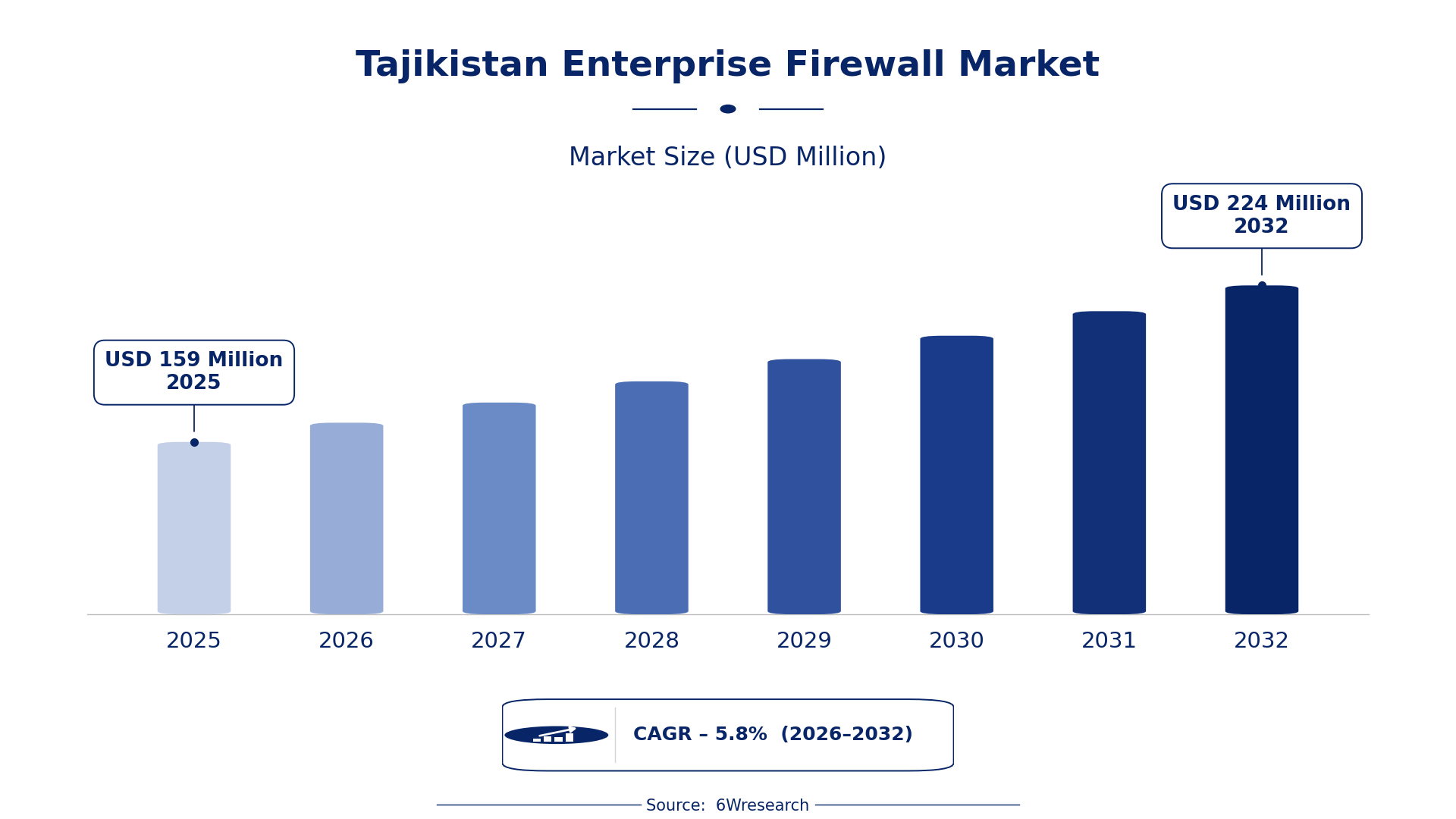
The Tajikistan Enterprise Firewall Market was estimated at USD 159 Million in 2025 and is projected to reach USD 224 Million by 2032, growing at a CAGR of 5.8% from 2026 to 2032.
Tajikistan Enterprise Firewall Market Synopsis
The Tajikistan Enterprise Firewall Market is currently experiencing momentum as businesses grow increasingly vigilant about cybersecurity threats. The shift towards digital operations is compelling organizations to invest in security measures that can protect sensitive data and infrastructure.
Looking ahead, the market is expected to witness sustained growth. The increasing complexity of cyber threats, coupled with rising regulatory demands, will drive demand for advanced firewall solutions. As businesses adapt to a more digital-centric approach, the need for effective cybersecurity measures will only intensify.
Tajikistan Enterprise Firewall Market Year-wise Growth Rate and Key Drivers
This graph illustrates the annual growth rates of the Tajikistan Enterprise Firewall Market from 2021 to 2032, highlighting a steady upward trajectory and projected expansion over the forecast period.

The table below presents the year‑wise growth rates along with the key drivers influencing the market
| Year | Growth Rate | Major Drivers |
| 2021 | 5.8% | Increasing cybersecurity threats from regional geopolitical tensions. |
| 2022 | 5.8% | Government incentives for small businesses to enhance digital security. |
| 2023 | 6.0% | Rise in digital banking services driving firewall demand. |
| 2024 | 5.7% | Regulatory requirements for data protection enhancing enterprise security. |
| 2025 | 6.1% | Growing adoption of remote work necessitating advanced firewalls. |
| 2026 | 6.2% | Investment in IT infrastructure by local telecommunications providers. |
| 2027 | 5.7% | Local tech startups requiring robust cybersecurity solutions. |
| 2028 | 6.1% | Increased focus on e-commerce security boosting firewall sales. |
| 2029 | 6.0% | Emerging trends in digital identity verification among enterprises. |
| 2030 | 5.6% | Regional cooperation in cybersecurity strategies elevating firewall investment. |
| 2031 | 6.0% | Surge in online learning resources increasing cybersecurity awareness. |
| 2032 | 5.8% | Enhanced government policies promoting technology resilience in businesses. |
Note: Market size estimations and growth projections presented in this report are based on 6Wresearch's proprietary forecasting methodology, utilizing the latest available industry data, government publications, and primary research inputs.
Tajikistan Enterprise Firewall Market Key Takeaways
Below are some of the specific key takeaways from the market, including:
- The increasing adoption of Next-Generation Firewalls (NGFW) is shaping the security posture of Tajikistan's enterprises.
- Government initiatives are catalyzing investments in cybersecurity infrastructure across various sectors.
- Cloud-based firewall solutions are gaining popularity due to their scalability and cost-effectiveness.
- There is a notable demand for tailored firewall solutions catering to small and medium-sized enterprises.
- Continuous updates and maintenance of firewall technologies are essential for addressing evolving cyber threats.
Evaluation of Restraints in Tajikistan Enterprise Firewall Market
Despite its growth prospects, the Tajikistan Enterprise Firewall Market faces significant hurdles. A fundamental issue is the limited awareness of cybersecurity's importance among businesses, hindering the widespread adoption of enterprise firewalls. Budget constraints, particularly for small and medium enterprises, further complicate investment in effective solutions. Additionally, a lack of skilled cybersecurity professionals exacerbates implementation challenges, making it difficult for businesses to manage their firewall systems effectively. As the threat landscape evolves, enterprises must prioritize education and training while pursuing cost-effective solutions tailored to their specific needs.
Tajikistan Enterprise Firewall Market Trends
A notable trend in the Tajikistan Enterprise Firewall Market is the growing demand for advanced security solutions. Businesses are increasingly turning to next-generation firewalls that provide sophisticated protection against diverse cyber threats. on top of that, as digitization accelerates, more organizations are adopting cloud-based solutions for their flexibility and cost advantages. This shift offers an opportunity for vendors to innovate and develop customizable firewall solutions that meet the specific requirements of various enterprises, particularly small and medium-sized businesses.
Tajikistan Enterprise Firewall Market Opportunities
The market offers several attractive opportunities for growth. As organizations face stringent regulatory requirements concerning data protection, the demand for compliance-focused firewall solutions is on the rise. Additionally, tailoring firewall products to address the unique needs of small and medium-sized enterprises presents a significant market niche. With ongoing education about cybersecurity threats, providers who can offer effective, scalable solutions will find ample opportunities to expand their presence in Tajikistan.
Government Initiatives in the Tajikistan Enterprise Firewall Market
Government policies in Tajikistan are increasingly focused on strengthening cybersecurity measures, which positively impacts the enterprise firewall market. The regulatory environment encourages businesses to adopt better security practices, ensuring the protection of critical infrastructure and sensitive data. This proactive governmental approach creates an advantageous climate for firewall vendors looking to penetrate the market.
- A national cybersecurity policy was introduced in 2025, emphasizing the need for comprehensive security measures across all sectors.
- Currently underway is a public-private initiative aimed at enhancing the cybersecurity capabilities of local enterprises through training and resources.
- A regulatory framework encouraging the adoption of international cybersecurity standards is expected to be rolled out by 2026.
- In early 2025, a national digital infrastructure upgrade program was launched, which includes provisions for improved cybersecurity measures.
Future Insights of the Tajikistan Enterprise Firewall Market
From 2026 to 2032, the Tajikistan Enterprise Firewall Market is set for steady growth, driven by increasing awareness of cybersecurity threats and the rising digitalization of businesses. Organizations will increasingly prioritize robust network security solutions to mitigate risks associated with cyberattacks. Regulatory demands will continue to evolve, further influencing the market dynamics as enterprises seek innovative solutions to comply with new standards and safeguard their operations.
Tajikistan Enterprise Firewall Market Latest Developments
Recent activity in the Tajikistan Enterprise Firewall Market reflects a concerted effort to enhance cybersecurity measures. Over the past year, there has been a noticeable uptick in investments in advanced firewall technologies as businesses respond to the growing threat landscape.
- In Q3 2025, a major technology vendor announced the rollout of a new unified threat management solution tailored specifically for the Tajik market.
- An initiative to train cybersecurity professionals began in early 2025 and remains ongoing, aiming to bridge the skills gap in the region.
- By mid-2026, a government-sponsored program focused on integrating AI and machine learning in firewall technologies is expected to launch, enhancing real-time threat detection capabilities.
- A collaborative effort among various stakeholders resulted in a cybersecurity awareness campaign completed in late 2025, aimed at educating businesses about cyber risks.
Tajikistan Enterprise Firewall Market - Key Attractiveness of the Report
- 10 Years of Market Numbers
- Historical Data Starting from 2022 to 2025
- Base Year: 2025
- Forecast Data until 2032
- Key Performance Indicators Impacting the Market
- Major Upcoming Developments and Projects
Key Highlights of the Report:
- Tajikistan Enterprise Firewall Market Outlook
- Market Size of Tajikistan Enterprise Firewall Market, 2025
- Forecast of Tajikistan Enterprise Firewall Market, 2032
- Historical Data and Forecast of Tajikistan Enterprise Firewall Revenues & Volume for the Period 2022-2032F
- Tajikistan Enterprise Firewall Market Trend Evolution
- Tajikistan Enterprise Firewall Market Drivers and Challenges
- Tajikistan Enterprise Firewall Price Trends
- Tajikistan Enterprise Firewall Porter's Five Forces
- Tajikistan Enterprise Firewall Industry Life Cycle
- Historical Data and Forecast of Tajikistan Enterprise Firewall Market Revenues & Volume By Types for the Period 2022-2032F
- Historical Data and Forecast of Tajikistan Enterprise Firewall Market Revenues & Volume By Next Generation for the Period 2022-2032F
- Historical Data and Forecast of Tajikistan Enterprise Firewall Market Revenues & Volume By Application for the Period 2022-2032F
- Historical Data and Forecast of Tajikistan Enterprise Firewall Market Revenues & Volume By Conventional for the Period 2022-2032F
- Historical Data and Forecast of Tajikistan Enterprise Firewall Market Revenues & Volume By Industry vertical for the Period 2022-2032F
- Historical Data and Forecast of Tajikistan Enterprise Firewall Market Revenues & Volume By Government & Public Utilities for the Period 2022-2032F
- Historical Data and Forecast of Tajikistan Enterprise Firewall Market Revenues & Volume By Healthcare for the Period 2022-2032F
- Historical Data and Forecast of Tajikistan Enterprise Firewall Market Revenues & Volume By Telecommunication for the Period 2022-2032F
- Historical Data and Forecast of Tajikistan Enterprise Firewall Market Revenues & Volume By Education for the Period 2022-2032F
- Historical Data and Forecast of Tajikistan Enterprise Firewall Market Revenues & Volume By Retail for the Period 2022-2032F
- Historical Data and Forecast of Tajikistan Enterprise Firewall Market Revenues & Volume By Entertainment & Media for the Period 2022-2032F
- Historical Data and Forecast of Tajikistan Enterprise Firewall Market Revenues & Volume By Manufacturing for the Period 2022-2032F
- Historical Data and Forecast of Tajikistan Enterprise Firewall Market Revenues & Volume By Education for the Period 2022-2032F
- Historical Data and Forecast of Tajikistan Enterprise Firewall Market Revenues & Volume By Organization Size for the Period 2022-2032F
- Historical Data and Forecast of Tajikistan Enterprise Firewall Market Revenues & Volume By Small and Medium Sized Enterprises (SMBs) for the Period 2022-2032F
- Historical Data and Forecast of Tajikistan Enterprise Firewall Market Revenues & Volume By Large Enterprises for the Period 2022-2032F
- Tajikistan Enterprise Firewall Import Export Trade Statistics
- Market Opportunity Assessment By Types
- Market Opportunity Assessment By Industry vertical
- Market Opportunity Assessment By Organization Size
- Tajikistan Enterprise Firewall Top Companies Market Share
- Tajikistan Enterprise Firewall Competitive Benchmarking By Technical and Operational Parameters
- Tajikistan Enterprise Firewall Company Profiles
- Tajikistan Enterprise Firewall Key Strategic Recommendations






































