Tajikistan Fencing Market Size, Share & Growth Rate
The Tajikistan Fencing Market was estimated at USD 271 Million in 2025 and is projected to reach USD 369 Million by 2032, growing at a CAGR of 4.5% from 2026 to 2032. This growth trajectory is largely driven by an upswing in construction activities and infrastructure development initiatives throughout the country. As urbanization accelerates, the demand for secure residential and commercial properties continues to rise, which further fuels the need for a diverse range of fencing solutions.
Tajikistan Fencing Market Year-wise Growth Rate and Key Drivers
This graph highlights how the Tajikistan Fencing Market has steadily grown over the years, supported by major growth factors.
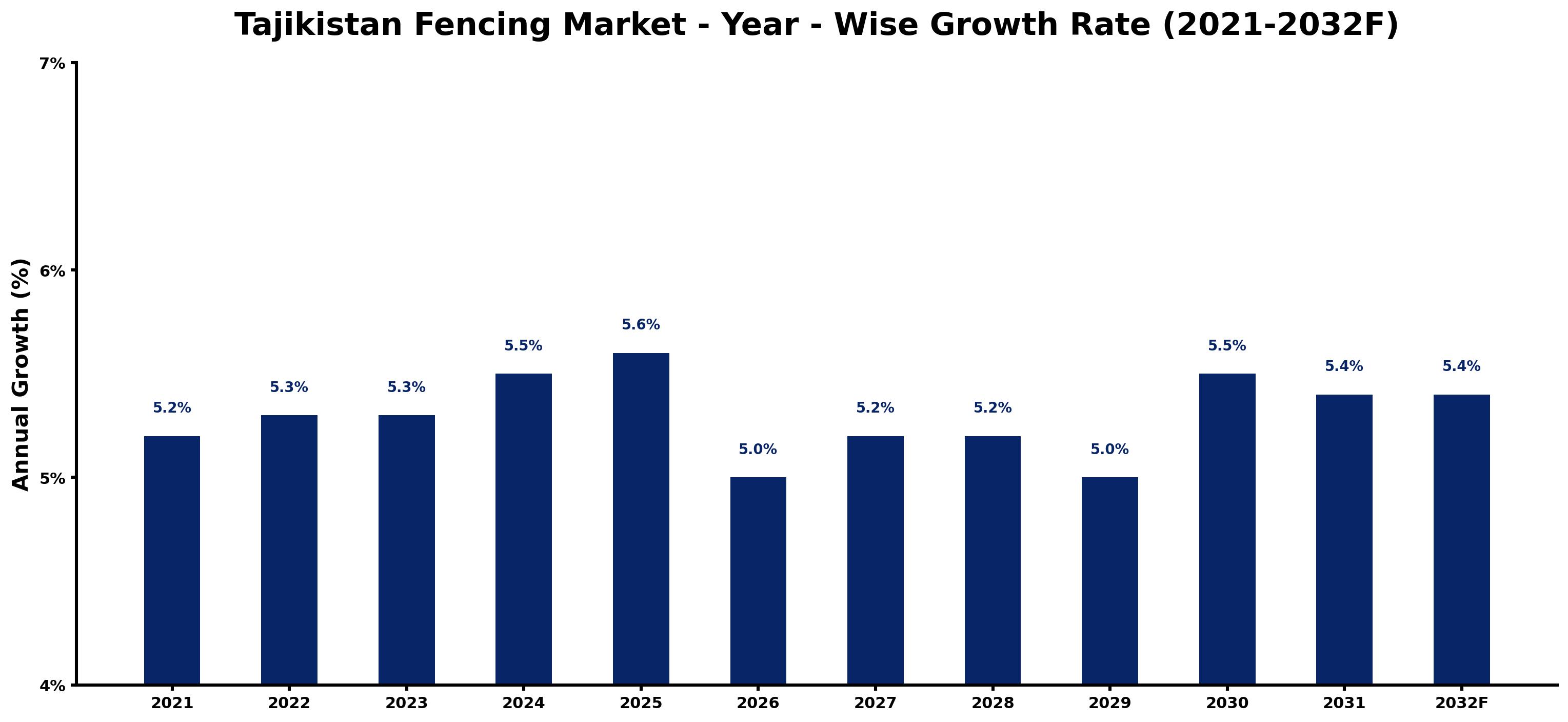
The table below presents the year‑wise growth rates along with the key drivers influencing the market
| Year | Growth Rate | Major Drivers |
| 2021 | 5.2% | Rapid growth in telecom and data center sectors |
| 2022 | 5.3% | Increasing adoption of advanced technologies |
| 2023 | 5.3% | Expansion of commercial construction activities |
| 2024 | 5.5% | Expansion of manufacturing activities |
| 2025 | 5.6% | Expansion of transportation and logistics networks |
| 2026 | 5.0% | Growing renewable energy integration projects |
| 2027 | 5.2% | Increasing smart city development projects |
| 2028 | 5.2% | Government infrastructure modernization initiatives |
| 2029 | 5.0% | Rising electricity demand across industries |
| 2030 | 5.5% | Increasing adoption of advanced technologies |
| 2031 | 5.4% | Expansion of transportation and logistics networks |
| 2032 | 5.4% | Rising electricity demand across industries |
Note - Market size estimations and growth projections presented in this report are based on 6Wresearch's advanced forecasting approach, validated with industry datasets as of June 2026.
Tajikistan Fencing Market Synopsis
The strongest force currently shaping the Tajikistan fencing market is the increasing emphasis on security and aesthetic appeal among property owners. As both residential and commercial sectors evolve, consumers are prioritizing durable and visually appealing fencing options that provide adequate protection while enhancing property value.
Moreover, government initiatives aimed at bolstering infrastructure development have resulted in a significant uptick in construction projects. These initiatives are creating opportunities for a variety of fencing solutions, ranging from traditional wooden fences to modern metal options, catering to the preferences of a growing customer base.
Tajikistan Fencing Market Key Takeaways
- Consumer preferences are shifting towards higher quality materials and customized designs, reflecting a desire for both security and aesthetics.
- The growth of urbanization and real estate development is propelling demand for diverse fencing solutions across various sectors.
- Local production is being supported through government policies, enhancing the competitiveness of domestic fencing manufacturers.
- Investment opportunities abound, particularly for eco-friendly and cost-effective fencing solutions tailored to modern needs.
- Challenges such as consumer awareness and the availability of skilled labor remain pertinent, but they present avenues for market education and development.
Evaluation of Restraints in Tajikistan Fencing Market
Despite its promising growth, the Tajikistan fencing market grapples with several constraints. A notable challenge is the lack of consumer awareness regarding the long-term benefits of investing in high-quality fencing materials. This often leads to a preference for cheaper, less durable options that can hinder market expansion. Additionally, the limited availability of skilled professionals for installation and maintenance can affect the overall quality of fencing solutions. Economic factors, such as fluctuating raw material costs, further complicate the landscape, impacting both suppliers and consumers.
Tajikistan Fencing Market Trends
The Tajikistan fencing market is currently experiencing a significant trend towards modern designs, with a growing preference for materials like aluminum and wrought iron due to their durability and aesthetic qualities. Consumers are increasingly seeking fencing options that not only provide security but also contribute to the overall appeal of their properties. Customization is another emerging trend, as more buyers desire unique designs that reflect their personal tastes. Additionally, the popularity of low-maintenance solutions, particularly powder-coated finishes resistant to rust and corrosion, is reshaping consumer expectations in the market.
Tajikistan Fencing Market Opportunities
The prospects for investment in the Tajikistan fencing market are robust. As urbanization accelerates, the demand for various fencing solutions—ranging from chain-link to concrete structures—grows. Investors have the opportunity to supply high-quality materials to meet this expanding demand, particularly in residential and commercial sectors. There is also a notable market for innovative eco-friendly fencing solutions, aligning with the increasing focus on sustainability. Collaborations with local construction firms and effective digital marketing strategies can further enhance market reach and profitability.
Government Initiatives in the Tajikistan Fencing Market
Government policies in Tajikistan are notably supportive of the local fencing industry, with a focus on boosting domestic production and maintaining quality standards. Import tariffs on foreign fencing products serve to protect local manufacturers, fostering a more competitive environment. Regulations are in place to ensure that fencing materials adhere to safety and quality benchmarks, which safeguards consumers. Furthermore, government incentives aimed at promoting the use of locally produced materials in construction projects align with broader economic growth objectives.
Future Insights of the Tajikistan Fencing Market
Looking ahead to the period from 2026 to 2032, the Tajikistan fencing market is positioned for steady growth. Factors such as ongoing urbanization, expanded infrastructure projects, and heightened security concerns among property owners will continue to drive demand. Additionally, as disposable incomes rise, consumers will increasingly opt for quality, aesthetically pleasing fencing options that enhance their properties. Overall, the market presents numerous opportunities for manufacturers and suppliers willing to adapt to evolving customer preferences.
Tajikistan Fencing Market Latest Developments (May 2025 - June 2026)
Recent developments in the Tajikistan fencing market indicate a shift towards more innovative and sustainable fencing solutions. There is a growing interest among manufacturers to incorporate advanced materials and eco-friendly practices into their product lines. Furthermore, local companies are beginning to explore partnerships with international firms to enhance their offerings and improve market reach. Government funding for infrastructure projects continues to stimulate demand for fencing solutions, ensuring a vibrant market environment.
Tajikistan Fencing Market - Key Attractiveness of the Report
- 10 Years of Market Numbers
- Historical Data Starting from 2022 to 2025
- Base Year: 2025
- Forecast Data until 2032
- Key Performance Indicators Impacting the Market
- Major Upcoming Developments and Projects
Key Highlights of the Report:
- Tajikistan Fencing Market Outlook
- Market Size of Tajikistan Fencing Market, 2025
- Forecast of Tajikistan Fencing Market, 2032
- Historical Data and Forecast of Tajikistan Fencing Revenues & Volume for the Period 2022-2032F
- Tajikistan Fencing Market Trend Evolution
- Tajikistan Fencing Market Drivers and Challenges
- Tajikistan Fencing Price Trends
- Tajikistan Fencing Porter's Five Forces
- Tajikistan Fencing Industry Life Cycle
- Historical Data and Forecast of Tajikistan Fencing Market Revenues & Volume By Material for the Period 2022-2032F
- Historical Data and Forecast of Tajikistan Fencing Market Revenues & Volume By Metal for the Period 2022-2032F
- Historical Data and Forecast of Tajikistan Fencing Market Revenues & Volume By Wood for the Period 2022-2032F
- Historical Data and Forecast of Tajikistan Fencing Market Revenues & Volume By Plastic & Composite for the Period 2022-2032F
- Historical Data and Forecast of Tajikistan Fencing Market Revenues & Volume By Concrete for the Period 2022-2032F
- Historical Data and Forecast of Tajikistan Fencing Market Revenues & Volume By Distribution Channel for the Period 2022-2032F
- Historical Data and Forecast of Tajikistan Fencing Market Revenues & Volume By Online for the Period 2022-2032F
- Historical Data and Forecast of Tajikistan Fencing Market Revenues & Volume By Retail for the Period 2022-2032F
- Historical Data and Forecast of Tajikistan Fencing Market Revenues & Volume By Installation for the Period 2022-2032F
- Historical Data and Forecast of Tajikistan Fencing Market Revenues & Volume By Do-It-Yourself for the Period 2022-2032F
- Historical Data and Forecast of Tajikistan Fencing Market Revenues & Volume By Contractor for the Period 2022-2032F
- Historical Data and Forecast of Tajikistan Fencing Market Revenues & Volume By Application for the Period 2022-2032F
- Historical Data and Forecast of Tajikistan Fencing Market Revenues & Volume By Residential for the Period 2022-2032F
- Historical Data and Forecast of Tajikistan Fencing Market Revenues & Volume By Agricultural for the Period 2022-2032F
- Historical Data and Forecast of Tajikistan Fencing Market Revenues & Volume By Industrial for the Period 2022-2032F
- Historical Data and Forecast of Tajikistan Fencing Market Revenues & Volume By End-users for the Period 2022-2032F
- Historical Data and Forecast of Tajikistan Fencing Market Revenues & Volume By Government for the Period 2022-2032F
- Historical Data and Forecast of Tajikistan Fencing Market Revenues & Volume By Petroleum & Chemicals for the Period 2022-2032F
- Historical Data and Forecast of Tajikistan Fencing Market Revenues & Volume By Military & Defense for the Period 2022-2032F
- Historical Data and Forecast of Tajikistan Fencing Market Revenues & Volume By Mining for the Period 2022-2032F
- Historical Data and Forecast of Tajikistan Fencing Market Revenues & Volume By Energy & Power for the Period 2022-2032F
- Historical Data and Forecast of Tajikistan Fencing Market Revenues & Volume By Transport for the Period 2022-2032F
- Historical Data and Forecast of Tajikistan Fencing Market Revenues & Volume By Others for the Period 2022-2032F
- Tajikistan Fencing Import Export Trade Statistics
- Market Opportunity Assessment By Material
- Market Opportunity Assessment By Distribution Channel
- Market Opportunity Assessment By Installation
- Market Opportunity Assessment By Application
- Market Opportunity Assessment By End-users
- Tajikistan Fencing Top Companies Market Share
- Tajikistan Fencing Competitive Benchmarking By Technical and Operational Parameters
- Tajikistan Fencing Company Profiles
- Tajikistan Fencing Key Strategic Recommendations






































