Tajikistan Food & Grocery Retail Market Size, Share & Growth Rate
The Tajikistan Food & Grocery Retail Market was estimated at USD 643 Million in 2025 and is projected to reach USD 1196 Million by 2032, growing at a CAGR of 9.3% from 2026 to 2032. This impressive growth trajectory is driven by a combination of rising disposable incomes, increasing urbanization, and a noticeable shift in consumer preferences toward modern retail formats. As more urban centers expand, the demand for accessible grocery options continues to escalate, offering a wealth of opportunities for investors.
Tajikistan Food & Grocery Retail Market Year-wise Growth Rate and Key Drivers
This graph highlights how the Tajikistan Food & Grocery Retail Market has steadily grown over the years, supported by major growth factors.
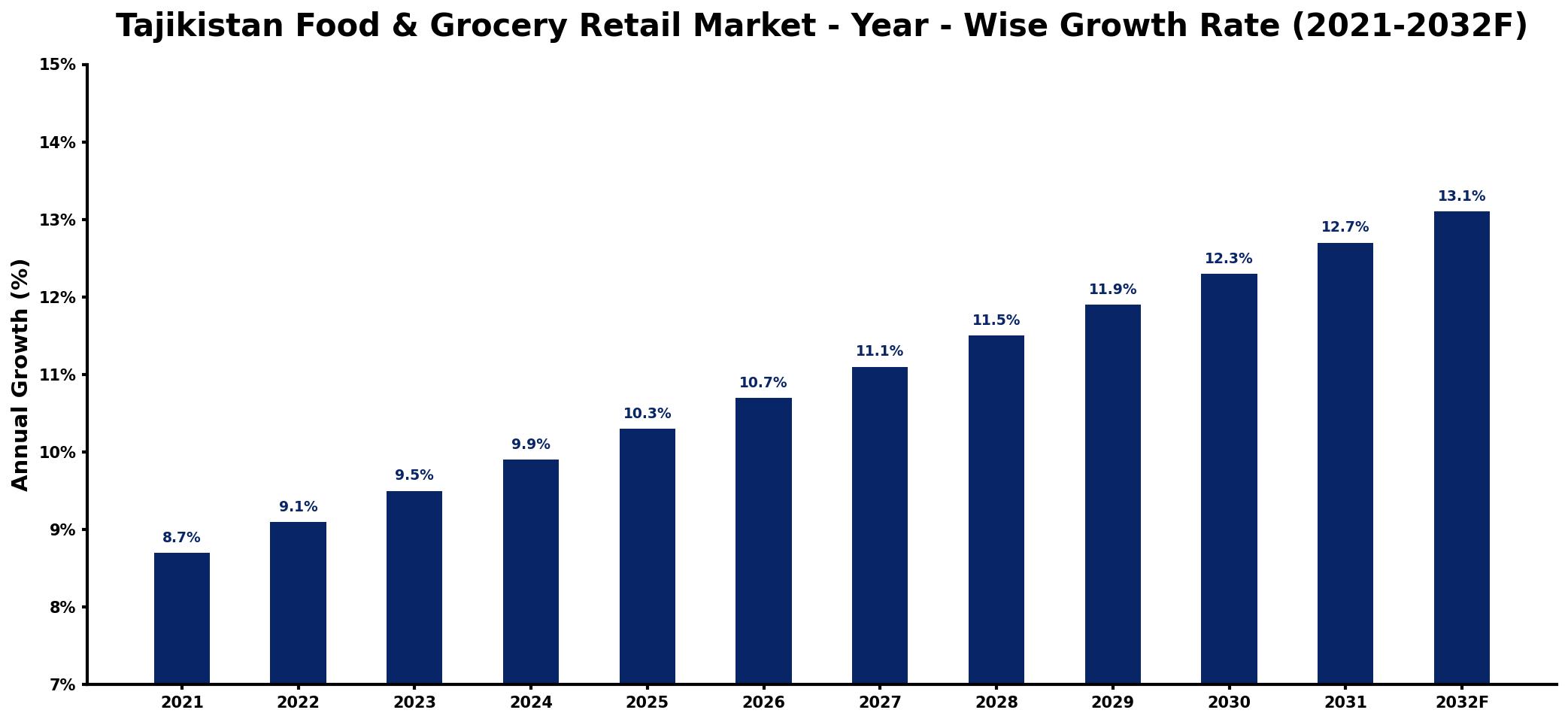
The table below presents the year‑wise growth rates along with the key drivers influencing the market
| Year | Growth Rate | Major Drivers |
| 2021 | 8.7% | Rising urban population demand |
| 2022 | 9.1% | Increased disposable income levels |
| 2023 | 9.5% | Expansion of delivery services |
| 2024 | 9.9% | Growth in e-commerce platforms |
| 2025 | 10.3% | Diversification of supplier networks |
| 2026 | 10.7% | Higher consumer health awareness |
| 2027 | 11.1% | Development of local brands |
| 2028 | 11.5% | Investment in cold chain logistics |
| 2029 | 11.9% | Increased foreign investment interest |
| 2030 | 12.3% | Emergence of organic product trends |
| 2031 | 12.7% | Technological advancements in distribution |
| 2032 | 13.1% | Rising popularity of convenience shopping |
Note: Market size estimations and growth projections presented in this report are based on 6Wresearch's proprietary forecasting methodology, utilizing the latest available industry data, government publications, and primary research inputs.
Tajikistan Food & Grocery Retail Market Synopsis
Recently, the Tajikistan Food & Grocery Retail Market has experienced a notable blend of traditional and modern retail dynamics. While traditional bazaars have long been the go-to for consumers, there is a swift transition towards contemporary supermarkets and online shopping platforms that cater to the evolving tastes of a younger demographic.
Looking ahead, this market is set to witness significant changes, underpinned by urban growth and a burgeoning middle class. The demand for convenience foods, along with a rising interest in health-oriented products, signifies a pivotal moment for retailers seeking to adapt and thrive in this transforming landscape.
- Rising urbanization is reshaping the retail landscape, driving demand for modern grocery formats.
- Changing consumer preferences are leading to increased interest in convenience and online shopping.
- Investment opportunities abound in establishing supermarkets and improving supply chains.
- The government is actively promoting domestic food production, impacting market growth.
- Health-conscious consumers are propelling the demand for organic and natural food options.
Despite the promising outlook, several factors are curtailing growth within the Tajikistan Food & Grocery Retail Market. Infrastructure remains a significant barrier, particularly in reaching remote regions where logistics can be complex. Furthermore, limited technological adoption in retail practices contributes to inefficiencies, hindering optimal customer engagement and inventory management. Price volatility, heavily influenced by currency fluctuations and dependence on imports, continues to pose risks to profitability and stability, necessitating strategic adjustments from retailers in the face of these challenges.
Several trends are shaping the Tajikistan Food & Grocery Retail Market, foremost among them being the growing inclination towards convenience foods. Busy lifestyles are compelling consumers to seek ready-to-eat and easily prepared food options. Concurrently, e-commerce is gaining traction, largely accelerated by the COVID-19 pandemic, leading to a rise in online grocery shopping. Additionally, an increasing awareness of health and wellness is prompting a shift towards organic and natural food products, indicating a demand for healthier choices in the marketplace.
The evolving landscape of the Tajikistan Food & Grocery Retail Market presents various investment opportunities. With a significant portion of the population still reliant on traditional bazaars, the modernization of retail formats holds promise. Expanding into supermarkets, convenience stores, and online grocery platforms aligns well with current consumer demands. Furthermore, the growth potential for local food production is significant, as consumers increasingly prefer fresh and locally sourced products. Retailers can capitalize on these trends to foster growth and enhance market presence.
The Tajik government has enacted various policies aimed at stabilizing the food and grocery retail market. Initiatives include setting price controls on essential items to keep them affordable for consumers and promoting domestic food production through financial incentives and support programs. Licensing requirements ensure that food retailers meet hygiene standards, thus protecting consumer health. Overall, these government policies aim to bolster local economies, enhance food security, and create a more structured retail environment.
Looking ahead to 2026-2032, the Tajikistan Food & Grocery Retail Market is positioned for substantial growth. With urbanization continuing to expand, alongside a rising middle-class demographic, the demand for diverse, quality products will only intensify. Retailers embracing modern formats and enhancing their online presence will likely find themselves well-placed in this evolving market. Although infrastructure challenges persist, the overall trend towards innovation and consumer-centric strategies will drive the market forward.
In recent months, the Tajikistan Food & Grocery Retail Market has seen a surge in investment aimed at enhancing distribution channels and expanding retail formats. Retailers are increasingly adopting technology to streamline operations and improve customer experience. Additionally, there has been a noticeable uptick in interest towards sustainability, with several players exploring eco-friendly packaging and sourcing practices. These developments reflect the market's adaptability and responsiveness to evolving consumer expectations.
- 10 Years of Market Numbers
- Historical Data Starting from 2022 to 2025
- Base Year: 2025
- Forecast Data until 2032
- Key Performance Indicators Impacting the Market
- Major Upcoming Developments and Projects
Key Highlights of the Report:
- Tajikistan Food & Grocery Retail Market Outlook
- Market Size of Tajikistan Food & Grocery Retail Market, 2025
- Forecast of Tajikistan Food & Grocery Retail Market, 2032
- Historical Data and Forecast of Tajikistan Food & Grocery Retail Revenues & Volume for the Period 2022-2032F
- Tajikistan Food & Grocery Retail Market Trend Evolution
- Tajikistan Food & Grocery Retail Market Drivers and Challenges
- Tajikistan Food & Grocery Retail Price Trends
- Tajikistan Food & Grocery Retail Porter's Five Forces
- Tajikistan Food & Grocery Retail Industry Life Cycle
- Historical Data and Forecast of Tajikistan Food & Grocery Retail Market Revenues & Volume By Product for the Period 2022-2032F
- Historical Data and Forecast of Tajikistan Food & Grocery Retail Market Revenues & Volume By Fresh Food for the Period 2022-2032F
- Historical Data and Forecast of Tajikistan Food & Grocery Retail Market Revenues & Volume By Frozen Food for the Period 2022-2032F
- Historical Data and Forecast of Tajikistan Food & Grocery Retail Market Revenues & Volume By Food Cupboard for the Period 2022-2032F
- Historical Data and Forecast of Tajikistan Food & Grocery Retail Market Revenues & Volume By Beverages for the Period 2022-2032F
- Historical Data and Forecast of Tajikistan Food & Grocery Retail Market Revenues & Volume By Cleaning & Household for the Period 2022-2032F
- Historical Data and Forecast of Tajikistan Food & Grocery Retail Market Revenues & Volume By Others for the Period 2022-2032F
- Historical Data and Forecast of Tajikistan Food & Grocery Retail Market Revenues & Volume By Distribution Channel for the Period 2022-2032F
- Historical Data and Forecast of Tajikistan Food & Grocery Retail Market Revenues & Volume By Supermarkets & Hypermarkets for the Period 2022-2032F
- Historical Data and Forecast of Tajikistan Food & Grocery Retail Market Revenues & Volume By Convenience Stores for the Period 2022-2032F
- Historical Data and Forecast of Tajikistan Food & Grocery Retail Market Revenues & Volume By Departmental Stores & Clubs for the Period 2022-2032F
- Historical Data and Forecast of Tajikistan Food & Grocery Retail Market Revenues & Volume By Online for the Period 2022-2032F
- Tajikistan Food & Grocery Retail Import Export Trade Statistics
- Market Opportunity Assessment By Product
- Market Opportunity Assessment By Distribution Channel
- Tajikistan Food & Grocery Retail Top Companies Market Share
- Tajikistan Food & Grocery Retail Competitive Benchmarking By Technical and Operational Parameters
- Tajikistan Food & Grocery Retail Company Profiles
- Tajikistan Food & Grocery Retail Key Strategic Recommendations






































