Tajikistan Fruit Pulp Market Size, Share & Growth Rate
The Tajikistan Fruit Pulp Market was estimated at USD 1476 Million in 2025 and is projected to reach USD 2152 Million by 2032, growing at a CAGR of 5.5% from 2026 to 2032. This growth trajectory is largely attributed to the increasing demand for healthy and convenient food options among consumers, reflecting a broader global trend. Additionally, the country's rich agricultural resources, particularly in fruits like apricots and pomegranates, provide a solid foundation for market expansion.
Tajikistan Fruit Pulp Market Year-wise Growth Rate and Key Drivers
This graph highlights how the Tajikistan Fruit Pulp Market has steadily grown over the years, supported by major growth factors.
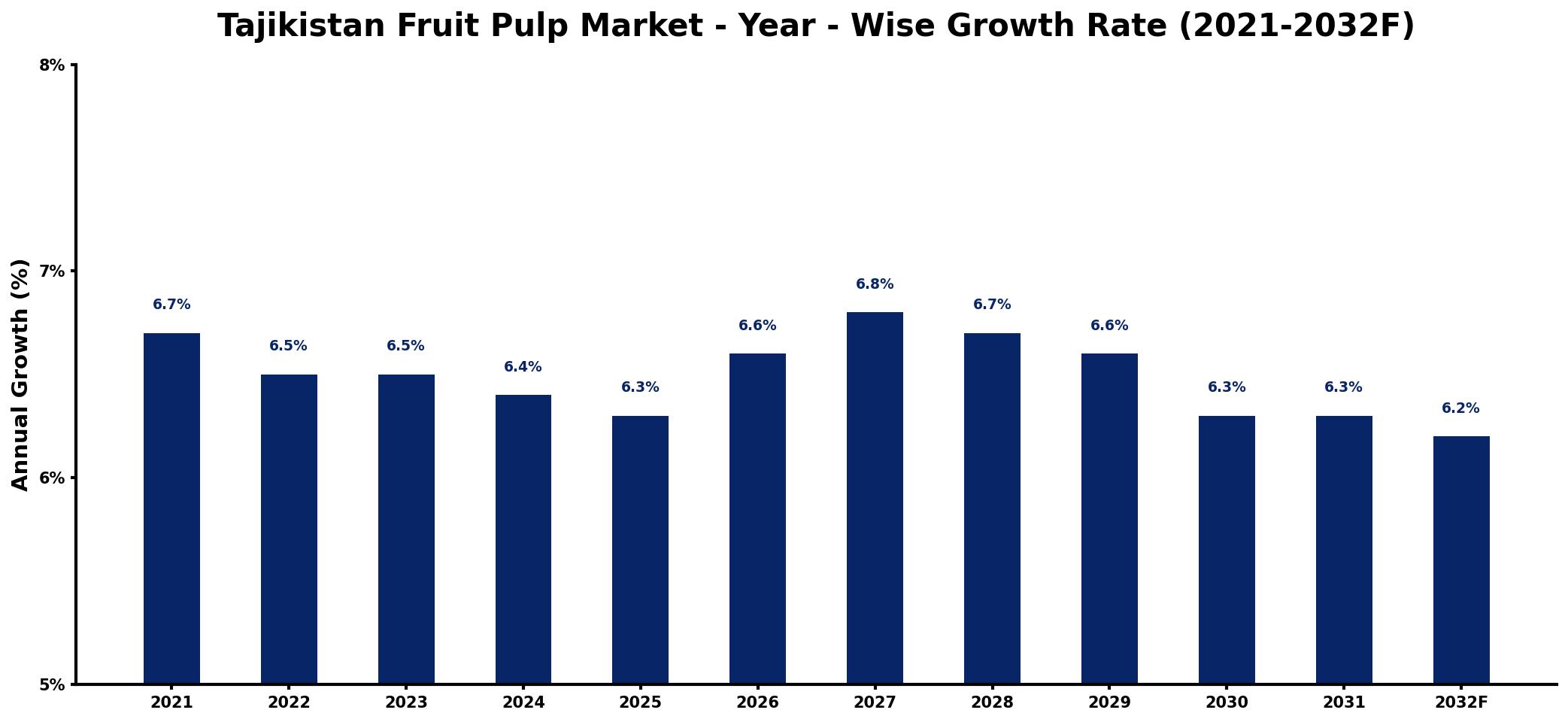
The table below presents the year‑wise growth rates along with the key drivers influencing the market
| Year | Growth Rate | Major Drivers |
| 2021 | 6.7% | Rising health consciousness among consumers |
| 2022 | 6.5% | Increasing demand for natural ingredients |
| 2023 | 6.5% | Growth in beverage industry applications |
| 2024 | 6.4% | Expansion of retail distribution channels |
| 2025 | 6.3% | Investments in processing technology |
| 2026 | 6.6% | Surge in online shopping platforms |
| 2027 | 6.8% | Emergence of new flavor trends |
| 2028 | 6.7% | Growing popularity of organic products |
| 2029 | 6.6% | Increase in export opportunities |
| 2030 | 6.3% | Development of sustainable sourcing practices |
| 2031 | 6.3% | Rising preference for convenience foods |
| 2032 | 6.2% | Enhanced consumer awareness on nutrition |
Note: Market size estimations and growth projections presented in this report are based on 6Wresearch's proprietary forecasting methodology, utilizing the latest available industry data, government publications, and primary research inputs.
Tajikistan Fruit Pulp Market Synopsis
The Tajikistan Fruit Pulp Market is characterized by a notable rise in the popularity of fruit-based products, driven by an evolving consumer base that prioritizes health and nutrition. As local production meets increased demand for natural ingredients, the market reflects the unique agricultural identity of Tajikistan.
Recent years have seen an uptick in innovative processing techniques that enhance product quality, appealing to both domestic and international markets. The commitment to sustainability and eco-friendly practices is also reshaping consumer expectations, further influencing market dynamics in this region.
Tajikistan Fruit Pulp Market Key Takeaways
- The market is projected to grow significantly due to rising health consciousness among consumers.
- Innovative processing methods are enhancing the quality and shelf-life of fruit pulp products.
- Investment opportunities abound in establishing processing facilities and sourcing raw materials locally.
- Government initiatives are focusing on improving agricultural output and market access.
- Sustainable practices are becoming integral to consumer preferences and market strategies.
Evaluation of Restraints in Tajikistan Fruit Pulp Market
Despite the promising outlook, the Tajikistan Fruit Pulp Market faces notable restraints. Limited infrastructure for transportation and storage hampers the efficient distribution of products, affecting market reach. Fluctuating raw material prices, exacerbated by climate change, challenge producers in maintaining quality and affordability. Furthermore, the presence of imported fruit pulp products intensifies competition, urging local businesses to enhance their processes and marketing strategies.
Tajikistan Fruit Pulp Market Trends
Current trends within the Tajikistan Fruit Pulp Market indicate a shift towards more diverse fruit flavors and blends, reflecting evolving consumer preferences. The rising demand for products perceived as natural and nutritious is driving manufacturers to innovate continuously. Additionally, the emphasis on sustainability is prompting businesses to adopt eco-friendly packaging solutions and practices, aligning with global market trends that value environmental responsibility.
Tajikistan Fruit Pulp Market Opportunities
Investment opportunities in the Tajikistan Fruit Pulp Market are increasingly appealing due to the nations abundant agricultural resources. Establishing processing facilities can enhance value addition and ensure a steady supply of high-quality fruit pulp. Collaborations with local farmers present a significant opportunity for investors, ensuring a reliable source of raw materials. Moreover, Tajikistan's strategic geographic location provides a unique advantage for exporting products to regional and international markets.
Government Initiatives in the Tajikistan Fruit Pulp Market
The Tajikistan government has recognized the importance of the fruit pulp sector and has implemented various supportive policies. These include subsidies for fruit producers, investments in transportation infrastructure, and the establishment of quality control measures to meet international standards. Such initiatives are designed to boost agricultural productivity, enhance market access, and promote economic growth, ultimately benefiting the local fruit pulp industry.
Future Insights of the Tajikistan Fruit Pulp Market
Looking ahead to the period from 2026 to 2032, the Tajikistan Fruit Pulp Market is set to thrive as consumer preferences shift further towards natural and healthy food options. Factors such as rising disposable incomes, urbanization, and an increasing awareness of health benefits associated with fruit pulp are expected to drive this growth. Industry players will likely continue focusing on innovation, product diversification, and strategic partnerships to capitalize on emerging market opportunities.
Tajikistan Fruit Pulp Market Latest Developments (2025 - 2026)
Recent industry developments indicate a robust direction for the Tajikistan Fruit Pulp Market, with several new processing facilities being established. Efforts to enhance distribution channels are underway, aiming to improve the accessibility of fruit pulp products across various regions. Furthermore, growing collaborations between local producers and international companies are facilitating knowledge transfer and fostering innovation in processing techniques.
Tajikistan Fruit Pulp Market - Key Attractiveness of the Report
- 10 Years of Market Numbers
- Historical Data Starting from 2022 to 2025
- Base Year: 2025
- Forecast Data until 2032
- Key Performance Indicators Impacting the Market
- Major Upcoming Developments and Projects
Key Highlights of the Report:
- Tajikistan Fruit Pulp Market Outlook
- Market Size of Tajikistan Fruit Pulp Market, 2025
- Forecast of Tajikistan Fruit Pulp Market, 2032
- Historical Data and Forecast of Tajikistan Fruit Pulp Revenues & Volume for the Period 2022-2032F
- Tajikistan Fruit Pulp Market Trend Evolution
- Tajikistan Fruit Pulp Market Drivers and Challenges
- Tajikistan Fruit Pulp Price Trends
- Tajikistan Fruit Pulp Porter's Five Forces
- Tajikistan Fruit Pulp Industry Life Cycle
- Historical Data and Forecast of Tajikistan Fruit Pulp Market Revenues & Volume By Fruit Type for the Period 2022-2032F
- Historical Data and Forecast of Tajikistan Fruit Pulp Market Revenues & Volume By Mango for the Period 2022-2032F
- Historical Data and Forecast of Tajikistan Fruit Pulp Market Revenues & Volume By Strawberry for the Period 2022-2032F
- Historical Data and Forecast of Tajikistan Fruit Pulp Market Revenues & Volume By Apple for the Period 2022-2032F
- Historical Data and Forecast of Tajikistan Fruit Pulp Market Revenues & Volume By Guava for the Period 2022-2032F
- Historical Data and Forecast of Tajikistan Fruit Pulp Market Revenues & Volume By Berries for the Period 2022-2032F
- Historical Data and Forecast of Tajikistan Fruit Pulp Market Revenues & Volume By Citrus Fruits for the Period 2022-2032F
- Historical Data and Forecast of Tajikistan Fruit Pulp Market Revenues & Volume By Others for the Period 2022-2032F
- Historical Data and Forecast of Tajikistan Fruit Pulp Market Revenues & Volume By Form for the Period 2022-2032F
- Historical Data and Forecast of Tajikistan Fruit Pulp Market Revenues & Volume By Liquid for the Period 2022-2032F
- Historical Data and Forecast of Tajikistan Fruit Pulp Market Revenues & Volume By Powder for the Period 2022-2032F
- Historical Data and Forecast of Tajikistan Fruit Pulp Market Revenues & Volume By Application for the Period 2022-2032F
- Historical Data and Forecast of Tajikistan Fruit Pulp Market Revenues & Volume By Food and Beverages for the Period 2022-2032F
- Historical Data and Forecast of Tajikistan Fruit Pulp Market Revenues & Volume By Distribution for the Period 2022-2032F
- Historical Data and Forecast of Tajikistan Fruit Pulp Market Revenues & Volume By E-Commerce for the Period 2022-2032F
- Historical Data and Forecast of Tajikistan Fruit Pulp Market Revenues & Volume By Convenience Stores for the Period 2022-2032F
- Historical Data and Forecast of Tajikistan Fruit Pulp Market Revenues & Volume By Supermarkets/Hypermarkets for the Period 2022-2032F
- Historical Data and Forecast of Tajikistan Fruit Pulp Market Revenues & Volume By Specialty Stores for the Period 2022-2032F
- Historical Data and Forecast of Tajikistan Fruit Pulp Market Revenues & Volume By Others for the Period 2022-2032F
- Tajikistan Fruit Pulp Import Export Trade Statistics
- Market Opportunity Assessment By Fruit Type
- Market Opportunity Assessment By Form
- Market Opportunity Assessment By Application
- Market Opportunity Assessment By Distribution
- Tajikistan Fruit Pulp Top Companies Market Share
- Tajikistan Fruit Pulp Competitive Benchmarking By Technical and Operational Parameters
- Tajikistan Fruit Pulp Company Profiles
- Tajikistan Fruit Pulp Key Strategic Recommendations






































