Tajikistan Fruit Sorting Machinery Market Size, Share & Growth Rate
The Tajikistan Fruit Sorting Machinery Market was estimated at USD 161 Million in 2025 and is projected to reach USD 219 Million by 2032, growing at a CAGR of 4.5% from 2026 to 2032. This growth trajectory is propelled by the need for enhanced productivity and quality within the agricultural sector, particularly as Tajikistan aims to improve its post-harvest processes. The increasing focus on modernizing farming practices and government support initiatives is likely to further fuel demand for sophisticated sorting solutions.
Tajikistan Fruit Sorting Machinery Market Year-wise Growth Rate and Key Drivers
This graph highlights how the Tajikistan Fruit Sorting Machinery Market has steadily grown over the years, supported by major growth factors.
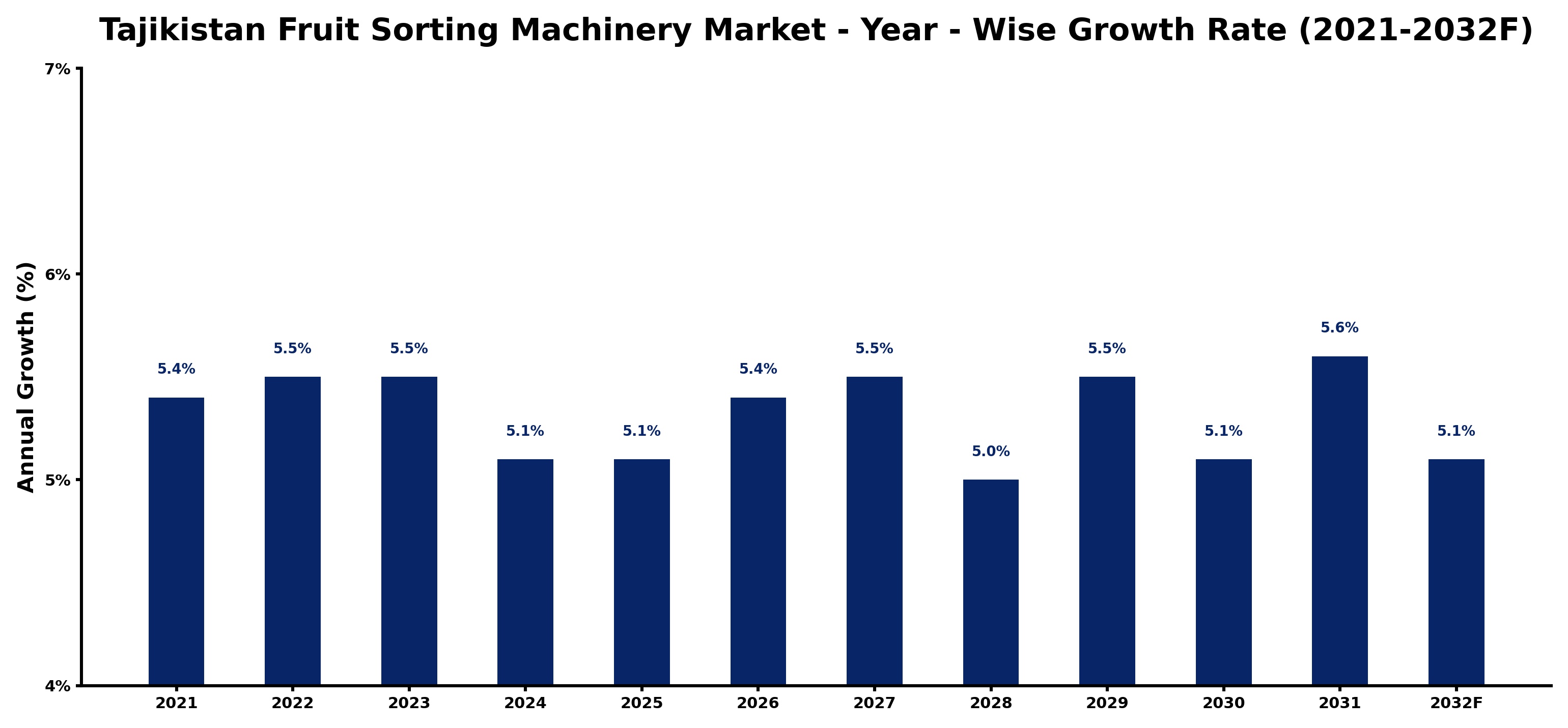
The table below presents the year‑wise growth rates along with the key drivers influencing the market
| Year | Growth Rate | Major Drivers |
| 2021 | 5.4% | Increasing adoption of advanced technologies |
| 2022 | 5.5% | Increasing industrial automation investments |
| 2023 | 5.5% | Government infrastructure modernization initiatives |
| 2024 | 5.1% | Growing renewable energy integration projects |
| 2025 | 5.1% | Expansion of manufacturing activities |
| 2026 | 5.4% | Increasing smart city development projects |
| 2027 | 5.5% | Expansion of commercial construction activities |
| 2028 | 5.0% | Expansion of manufacturing activities |
| 2029 | 5.5% | Growing urbanization and commercial development |
| 2030 | 5.1% | Expansion of manufacturing activities |
| 2031 | 5.6% | Growing urbanization and commercial development |
| 2032 | 5.1% | Increasing smart city development projects |
Note - Market size estimations and growth projections presented in this report are based on 6Wresearch’s advanced forecasting approach, validated with industry datasets as of June 2026.
Tajikistan Fruit Sorting Machinery Market Synopsis
Tajikistan's agricultural landscape is characterized by a diversity of fruits, including apricots and pomegranates, that require efficient sorting methods to meet both local and international market standards. As the market matures, fruit producers are recognizing the importance of adopting advanced sorting technologies to optimize yield and reduce waste, which has led to a surge in the demand for automated machinery.
The current emphasis on quality improvement and standardization in fruit processing aligns with global trends, where exporters are increasingly required to adhere to stringent quality controls. Consequently, manufacturers of fruit sorting machinery are focusing on developing solutions that not only enhance the sorting accuracy but also integrate seamlessly with existing agricultural practices in Tajikistan.
Tajikistan Fruit Sorting Machinery Market Key Takeaways
- The market is fueled by increasing demand for automation and advanced sorting technologies among fruit producers.
- Government initiatives aimed at modernizing the agricultural sector significantly influence market dynamics.
- Investment opportunities exist in developing tailored sorting solutions for Tajikistan's unique fruit varieties.
- Rising awareness about efficiency and quality standards is driving the adoption of sorting machinery.
- Challenges related to initial investment costs and limited technical infrastructure must be addressed to unlock full market potential.
Evaluation of Restraints in Tajikistan Fruit Sorting Machinery Market
Despite the promising outlook, several constraints impede the growth of the Tajikistan Fruit Sorting Machinery Market. A significant hurdle is the high initial investment required for advanced sorting machinery, which can deter small and medium-sized enterprises from upgrading their operations. Furthermore, the current technological infrastructure is not fully equipped to support widespread adoption of advanced sorting technologies, resulting in a reliance on traditional methods. Limited access to financing and a workforce lacking the necessary skills to operate sophisticated machinery further exacerbate these challenges, highlighting a need for targeted solutions and educational initiatives.
Tajikistan Fruit Sorting Machinery Market Trends
A key trend shaping the Tajikistan Fruit Sorting Machinery Market is the integration of automation and advanced data analytics into sorting processes. Producers are increasingly adopting machinery with optical sensors and artificial intelligence capabilities, allowing for precise classification based on quality and size. This shift not only boosts operational efficiency but also aligns with international quality standards, enabling Tajikistan's fruit exports to remain competitive on a global scale. The market is also witnessing a gradual cultural shift towards technology-driven methods, as producers recognize the long-term benefits of modern machinery.
Tajikistan Fruit Sorting Machinery Market Opportunities
Investment opportunities abound in the Tajikistan Fruit Sorting Machinery Market, particularly as the demand for modern sorting technologies continues to rise. By focusing on developing machinery tailored to the specific characteristics of local fruit varieties, investors can tap into a niche market that supports Tajikistan's agricultural exports. Moreover, partnerships with local producers to establish financing solutions or offer leasing arrangements for sorting equipment can further stimulate growth. The ongoing efforts to modernize the agricultural sector present a unique window for innovation in sorting technologies, signaling a ripe opportunity for stakeholders.
Government Initiatives in the Tajikistan Fruit Sorting Machinery Market
The Tajikistan government is actively promoting the fruit sorting machinery market through various initiatives aimed at modernizing the agricultural sector. These initiatives include providing financial incentives for producers to adopt advanced sorting technologies, improving credit accessibility for small and medium-sized enterprises, and promoting research and development in the field of fruit processing. By focusing on enhancing agricultural infrastructure and logistics, the government is working to bolster competitiveness within the market, which ultimately supports both domestic and export-oriented fruit production.
Future Insights of the Tajikistan Fruit Sorting Machinery Market
Looking ahead to the period from 2026 to 2032, the Tajikistan Fruit Sorting Machinery Market is poised for steady growth. Increased investments in the agriculture sector, along with a continued push for automation and efficiency, will drive demand for sophisticated sorting solutions. While challenges related to high costs and technological awareness persist, the market's trajectory indicates a growing acceptance of advanced machinery among producers. As the sector evolves, stakeholders who prioritize innovation and education will be best positioned to capitalize on the burgeoning opportunities within this promising market.
Tajikistan Fruit Sorting Machinery Market Latest Developments (May 2025 - June 2026)
Recent developments in the Tajikistan Fruit Sorting Machinery Market reflect a proactive approach towards modernization. There has been a noticeable increase in public and private sector collaborations aimed at enhancing the technological framework needed for effective fruit sorting. Additionally, various training programs focused on improving the skill set of the agricultural workforce have been initiated, enabling smoother transitions towards automated sorting processes. The market is also witnessing heightened interest from international technology providers looking to engage with local producers, underscoring the evolving landscape.
Tajikistan Fruit Sorting Machinery Market - Key Attractiveness of the Report
- 10 Years of Market Numbers
- Historical Data Starting from 2022 to 2025
- Base Year: 2025
- Forecast Data until 2032
- Key Performance Indicators Impacting the Market
- Major Upcoming Developments and Projects
Key Highlights of the Report:
- Tajikistan Fruit Sorting Machinery Market Outlook
- Market Size of Tajikistan Fruit Sorting Machinery Market, 2025
- Forecast of Tajikistan Fruit Sorting Machinery Market, 2032
- Historical Data and Forecast of Tajikistan Fruit Sorting Machinery Revenues & Volume for the Period 2022-2032F
- Tajikistan Fruit Sorting Machinery Market Trend Evolution
- Tajikistan Fruit Sorting Machinery Market Drivers and Challenges
- Tajikistan Fruit Sorting Machinery Price Trends
- Tajikistan Fruit Sorting Machinery Porter's Five Forces
- Tajikistan Fruit Sorting Machinery Industry Life Cycle
- Historical Data and Forecast of Tajikistan Fruit Sorting Machinery Market Revenues & Volume By Product for the Period 2022-2032F
- Historical Data and Forecast of Tajikistan Fruit Sorting Machinery Market Revenues & Volume By Automated fruit sorting machinery for the Period 2022-2032F
- Historical Data and Forecast of Tajikistan Fruit Sorting Machinery Market Revenues & Volume By Mechanical fruit sorting machinery for the Period 2022-2032F
- Historical Data and Forecast of Tajikistan Fruit Sorting Machinery Market Revenues & Volume By Application for the Period 2022-2032F
- Historical Data and Forecast of Tajikistan Fruit Sorting Machinery Market Revenues & Volume By Orchard for the Period 2022-2032F
- Historical Data and Forecast of Tajikistan Fruit Sorting Machinery Market Revenues & Volume By Mall for the Period 2022-2032F
- Historical Data and Forecast of Tajikistan Fruit Sorting Machinery Market Revenues & Volume By Other for the Period 2022-2032F
- Tajikistan Fruit Sorting Machinery Import Export Trade Statistics
- Market Opportunity Assessment By Product
- Market Opportunity Assessment By Application
- Tajikistan Fruit Sorting Machinery Top Companies Market Share
- Tajikistan Fruit Sorting Machinery Competitive Benchmarking By Technical and Operational Parameters
- Tajikistan Fruit Sorting Machinery Company Profiles
- Tajikistan Fruit Sorting Machinery Key Strategic Recommendations






































