Tajikistan Gambling Market Summary
The tajikistan gambling market was estimated at USD 993 Million in 2025 and is projected to reach USD 1409 Million by 2032, growing at a CAGR of 5.7% from 2026 to 2032.
Tajikistan Gambling Market Year-wise Growth Rate and Key Drivers
This graph highlights how the Tajikistan Gambling Market has steadily grown over the past five years, supported by major growth factors.
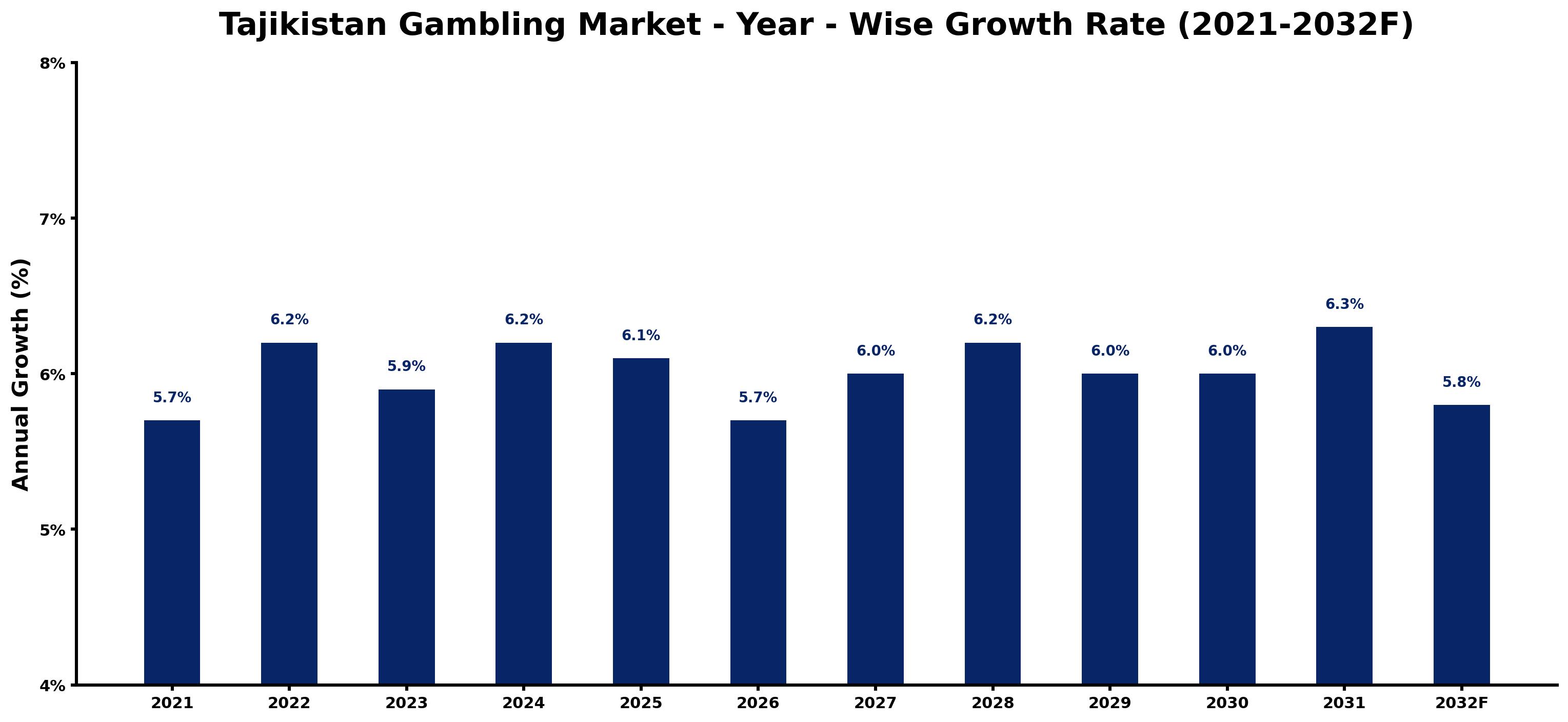
The table below presents the year wise growth rates along with the key drivers influencing the market
| Year | Growth Rate | Major Drivers |
| 2021 | 5.7% | Economic recovery post-pandemic has stimulated interest in leisure activities, including gambling. |
| 2022 | 6.2% | Emerging online platforms have attracted younger demographics, changing gambling participation patterns. |
| 2023 | 5.9% | Increased disposable income levels have allowed more citizens to explore gambling options. |
| 2024 | 6.2% | Local entrepreneurs are investing in brick-and-mortar casinos and entertainment complexes. |
| 2025 | 6.1% | Tourism revival leads to foreign interest in Tajikistan's unique gambling offerings. |
| 2026 | 5.7% | Technological integration enhances user experiences, making gambling more accessible and engaging. |
| 2027 | 6.0% | Shifts in consumer preferences towards online gambling options spotlight the digital market's growth. |
| 2028 | 6.2% | Collaboration with international gaming companies fosters innovation and competition in the market. |
| 2029 | 6.0% | Regulatory frameworks are evolving, creating a more structured and secure gambling environment. |
| 2030 | 6.0% | Market consolidation is evident as larger players acquire smaller operators for expansion. |
| 2031 | 6.3% | Increased marketing efforts target diverse consumer segments, expanding the market reach significantly. |
| 2032 | 5.8% | Integration of cryptocurrency in gambling transactions attracts tech-savvy players, boosting participation. |
Note - Market size estimations and growth projections presented in this report are based on 6Wresearch's advanced forecasting approach, validated with industry datasets as of June 2026.
Tajikistan Gambling Market Synopsis
The Tajikistan Gambling Market is projected to reach 5.7% and witness significant growth during the forecast period (2026-2032). In its current state, gambling remains illegal within the country, and there are no official indications from the government suggesting a shift towards legalisation. Despite this, there are reports indicating the presence of online gambling platforms operating from foreign jurisdictions, which serve Tajik players. These platforms typically offer a diverse array of betting options that include sports betting, casino games, and lotteries.
Tajikistan Gambling Market Economic Impact
The potential legalisation of the Tajikistan Gambling Market holds substantial implications for the national economy. By attracting both local and international tourists seeking leisure activities, a regulated gambling sector could contribute significantly to economic growth. The reallocation of funds through taxation on winnings or stakes placed by players could lead to increased government revenues, which might be reinvested into public services and infrastructure.
- Legalising gambling could enhance tourism revenues, stimulating local markets and generating employment opportunities in related sectors.
- The establishment of a legal framework for gambling could lead to better regulation, ensuring consumer protection and promoting fair play.
- Revenue generated from taxes on gambling could be redirected to critical areas such as education, healthcare, and infrastructure development.
- The growth of online gambling options could foster technological advancements and digitalisation within the region, aligning with global trends.
- Enhanced economic activity from a legal gambling industry could draw foreign investments, contributing to overall economic stability.
Tajikistan Gambling Market Government Investment and Initiatives
While gambling is currently prohibited in Tajikistan, the government has not been inactive regarding the potential for future developments in the sector. There have been ongoing discussions regarding possible regulatory frameworks that could pave the way for a controlled gambling environment. Investing in the appropriate legislation and infrastructure will be essential if the government decides to pursue this course.
- Government initiatives focused on tourism development could include the creation of specific zones where gambling could be permissible, potentially boosting visitor numbers.
- Public sector investments in technology and security measures would be necessary to create a safe online betting environment if legalisation occurs.
- The government may consider collaborating with international organisations to develop a regulatory framework that ensures responsible gambling practices.
- Public awareness campaigns could be initiated to educate citizens about the benefits and risks associated with gambling, preparing them for a potential market opening.
- Incentives for local businesses to engage in the tourism sector, which may include gambling, could be part of broader economic development strategies.
Tajikistan Gambling Market Latest Developments (May 2025 - June 2026)
During the period from May 2025 to June 2026, the environment surrounding the Tajikistan Gambling Market has seen several noteworthy developments. There has been an increasing dialogue around the implications of legalising certain forms of gambling as a means to diversify the economy and enhance tourism. Policymakers and stakeholders have been examining international best practices to better understand the potential benefits of a regulated market.
- Industry experts have begun to advocate for the establishment of a regulatory authority that would oversee a legal gambling framework, ensuring compliance with both local and international laws.
- Discussions have taken place regarding possible international partnerships aimed at facilitating technology transfer for secure online gambling platforms.
- The government has expressed interest in studying the experiences of other nations that have successfully implemented legal gambling markets, focusing on economic benefits and social implications.
- Increased digital literacy initiatives in the region could help prepare the local populace for an eventual transition to online gambling options.
- Stakeholder consultations have highlighted the importance of involving local communities in discussions about the potential impacts of gambling legalisation.
Tajikistan Gambling Market - Key Attractiveness of the Report
- 10 Years of Market Numbers
- Historical Data Starting from 2022 to 2025
- Base Year: 2025
- Forecast Data until 2032
- Key Performance Indicators Impacting the Market
- Major Upcoming Developments and Projects
Key Highlights of the Report:
- Tajikistan Gambling Market Outlook
- Market Size of Tajikistan Gambling Market, 2025
- Forecast of Tajikistan Gambling Market, 2032F
- Historical Data and Forecast of Tajikistan Gambling Revenues & Volume for the Period 2022-2032F
- Tajikistan Gambling Market Trend Evolution
- Tajikistan Gambling Market Drivers and Challenges
- Tajikistan Gambling Price Trends
- Tajikistan Gambling Porter's Five Forces
- Tajikistan Gambling Industry Life Cycle
- Historical Data and Forecast of Tajikistan Gambling Market Revenues & Volume By Product Type for the Period 2022-2032F
- Historical Data and Forecast of Tajikistan Gambling Market Revenues & Volume By Betting for the Period 2022-2032F
- Historical Data and Forecast of Tajikistan Gambling Market Revenues & Volume By Casino for the Period 2022-2032F
- Historical Data and Forecast of Tajikistan Gambling Market Revenues & Volume By Lottery for the Period 2022-2032F
- Historical Data and Forecast of Tajikistan Gambling Market Revenues & Volume By Others for the Period 2022-2032F
- Historical Data and Forecast of Tajikistan Gambling Market Revenues & Volume By Channel Type for the Period 2022-2032F
- Historical Data and Forecast of Tajikistan Gambling Market Revenues & Volume By Offline for the Period 2022-2032F
- Historical Data and Forecast of Tajikistan Gambling Market Revenues & Volume By Online for the Period 2022-2032F
- Historical Data and Forecast of Tajikistan Gambling Market Revenues & Volume By Virtual Reality VR for the Period 2022-2032F
- Historical Data and Forecast of Tajikistan Gambling Market Revenues & Volume By Platform for the Period 2022-2032F
- Historical Data and Forecast of Tajikistan Gambling Market Revenues & Volume By Land-Based for the Period 2022-2032F
- Historical Data and Forecast of Tajikistan Gambling Market Revenues & Volume By Online for the Period 2022-2032F
- Tajikistan Gambling Import Export Trade Statistics
- Market Opportunity Assessment By Product Type
- Market Opportunity Assessment By Channel Type
- Market Opportunity Assessment By Platform
- Tajikistan Gambling Top Companies Market Share
- Tajikistan Gambling Competitive Benchmarking By Technical and Operational Parameters
- Tajikistan Gambling Company Profiles
- Tajikistan Gambling Key Strategic Recommendations






































