Tajikistan Ghee Market Size, Share & Growth Rate
The Tajikistan Ghee Market was estimated at USD 408 Million in 2025 and is projected to reach USD 556 Million by 2032, growing at a CAGR of 4.5% from 2026 to 2032. This positive trajectory is primarily driven by the increasing consumer awareness of the health benefits associated with ghee, coupled with a cultural preference for traditional cooking practices. Additionally, rising disposable incomes among the middle class are enhancing purchasing power, leading to a greater demand for premium ghee products.
Tajikistan Ghee Market Year-wise Growth Rate and Key Drivers
This graph highlights how the Tajikistan Ghee Market has steadily grown over the years, supported by major growth factors.
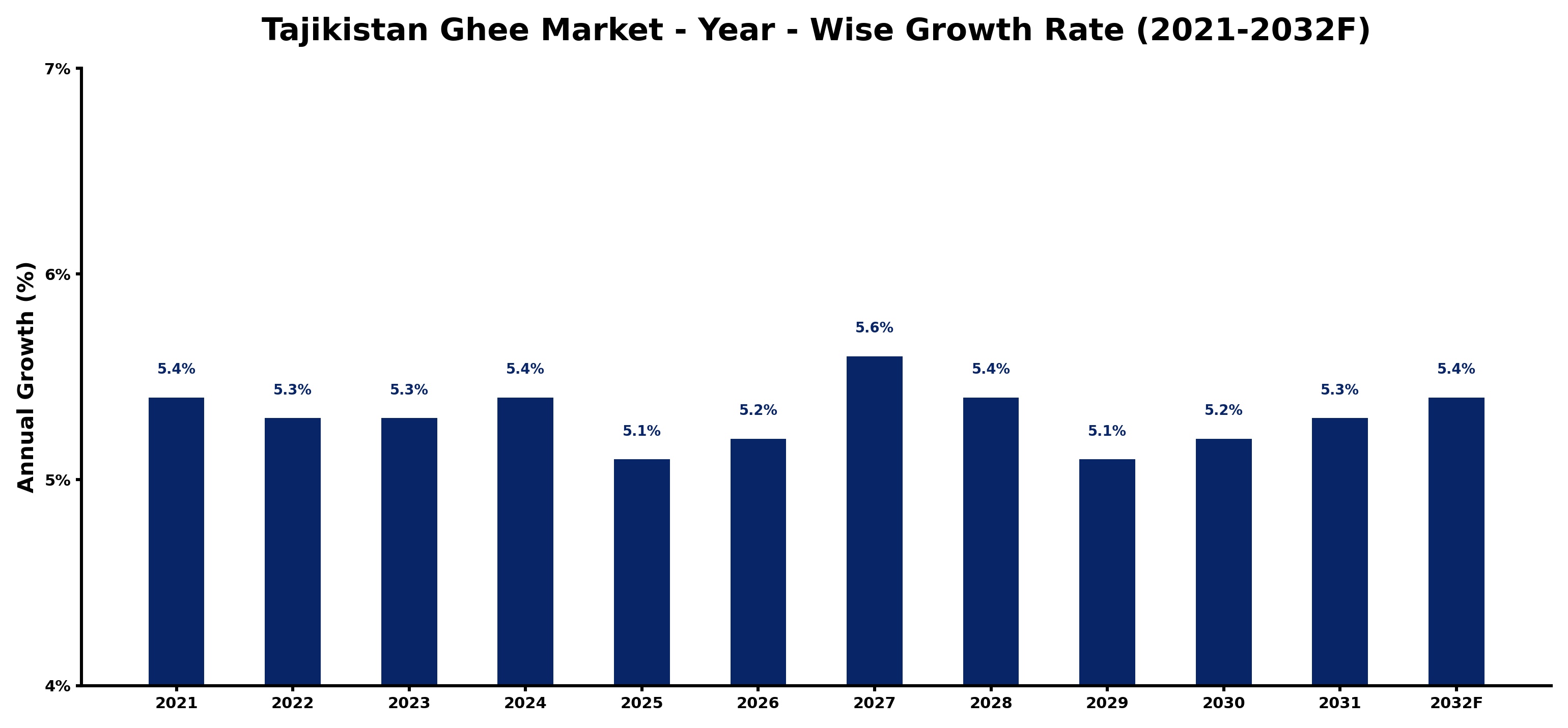
The table below presents the year‑wise growth rates along with the key drivers influencing the market
| Year | Growth Rate | Major Drivers |
| 2021 | 5.4% | Rising health consciousness among consumers |
| 2022 | 5.3% | Increased demand for natural products |
| 2023 | 5.3% | Culinary trends favoring traditional ghee |
| 2024 | 5.4% | Growing popularity of ethnic cuisines |
| 2025 | 5.1% | Expansion of local dairy farms |
| 2026 | 5.2% | Increased marketing of ghee benefits |
| 2027 | 5.6% | Rising disposable income among households |
| 2028 | 5.4% | Health benefits of ghee promoted |
| 2029 | 5.1% | Consumer preference for organic options |
| 2030 | 5.2% | Innovative packaging attracting buyers |
| 2031 | 5.3% | Online sales channels expanding rapidly |
| 2032 | 5.4% | Cultural festivals boosting ghee consumption |
Note - Market size estimations and growth projections presented in this report are based on 6Wresearch’s advanced forecasting approach, validated with industry datasets as of June 2026.
Tajikistan Ghee Market Synopsis
In Tajikistan, ghee is an integral component of traditional dishes, underscoring its cultural significance. As consumers become more health-conscious, ghee is increasingly seen as a healthier alternative to other cooking oils, creating robust demand for high-quality products.
The market landscape is also evolving with innovation, as manufacturers explore flavored variants of ghee to appeal to diverse taste preferences. The combination of traditional usage and modern marketing strategies is poised to sustain market growth, attracting both local and international players.
Tajikistan Ghee Market Key Takeaways
- The market is experiencing a shift towards organic and premium ghee products in response to health trends.
- Increased disposable income is allowing consumers to explore higher-quality ghee options.
- Innovative flavors and product variations are emerging as key drivers of consumer interest.
- Competition between local and international producers is intensifying, pushing for improved quality and branding.
- The government is implementing policies to support domestic production and ensure fair market practices.
Evaluation of Restraints in Tajikistan Ghee Market
Despite its growth potential, the Tajikistan Ghee Market faces several significant restraints. Limited access to modern production technology results in lower product quality compared to international standards, hindering competitive advantage. Additionally, fluctuations in the prices of raw materials such as dairy create uncertainty in cost management for ghee producers. The country's inadequate infrastructure impacts distribution capabilities, especially in remote areas, further complicating market access for local brands. Lastly, competition from imported brands often challenges local producers, necessitating a focus on quality enhancement and effective marketing strategies.
Tajikistan Ghee Market Trends
Key trends are shaping the Tajikistan ghee market landscape. A notable movement towards organic and health-focused products is evident, as consumers increasingly prioritize natural ingredients in their cooking. Concurrently, the rise of urbanization is driving a demand for convenience, leading to a broader acceptance of packaged ghee products. Additionally, health campaigns promoting the benefits of ghee are amplifying consumer interest, further cementing its position as a staple cooking fat in Tajik cuisine.
Tajikistan Ghee Market Opportunities
The Tajikistan ghee market is ripe with investment opportunities, particularly in establishing new production facilities to meet growing local demand. There is significant potential for exporting ghee to neighboring countries, capitalizing on Tajikistan's geographical position. Moreover, the introduction of premium and flavored ghee options can cater to health-conscious consumers seeking gourmet alternatives. This market offers a unique landscape for investors looking to innovate within the traditional food sector.
Government Initiatives in the Tajikistan Ghee Market
The Tajik government has enacted various initiatives to regulate and support the ghee market. These include implementing quality control measures aimed at ensuring consumer safety and compliance with established standards. Furthermore, the government provides subsidies to local producers to foster domestic manufacturing and reduce dependency on imports. Regulations governing pricing practices are also in place to maintain affordability for consumers, creating a balanced market environment.
Future Insights of the Tajikistan Ghee Market
Looking ahead to 2026-2032, the Tajikistan Ghee Market is expected to witness sustained growth, driven by a heightened awareness of the health benefits of ghee and increasing disposable income levels. Evolving dietary preferences are likely to further fuel demand for traditional and natural food products. Continued support from government initiatives to enhance local production capabilities may also play a crucial role in reducing import reliance. However, challenges such as price volatility and competition from alternative cooking oils must be navigated to harness the full market potential.
Tajikistan Ghee Market Latest Developments (May 2025 - June 2026)
Recent developments in the Tajikistan ghee market indicate a growing focus on product innovation and quality improvement among local manufacturers. Efforts to introduce new flavors and organic options are gaining traction, reflecting consumer demands. Additionally, partnerships and collaborations between producers and distributors are emerging, aiming to enhance supply chain efficiency and reach a broader customer base. The market is also witnessing a gradual shift towards online sales channels, making ghee products more accessible to urban consumers.
Tajikistan Ghee Market - Key Attractiveness of the Report
- 10 Years of Market Numbers
- Historical Data Starting from 2022 to 2025
- Base Year: 2025
- Forecast Data until 2032
- Key Performance Indicators Impacting the Market
- Major Upcoming Developments and Projects
Key Highlights of the Report:
- Tajikistan Ghee Market Outlook
- Market Size of Tajikistan Ghee Market, 2025
- Forecast of Tajikistan Ghee Market, 2032
- Historical Data and Forecast of Tajikistan Ghee Revenues & Volume for the Period 2022-2032F
- Tajikistan Ghee Market Trend Evolution
- Tajikistan Ghee Market Drivers and Challenges
- Tajikistan Ghee Price Trends
- Tajikistan Ghee Porter's Five Forces
- Tajikistan Ghee Industry Life Cycle
- Historical Data and Forecast of Tajikistan Ghee Market Revenues & Volume By Source for the Period 2022-2032F
- Historical Data and Forecast of Tajikistan Ghee Market Revenues & Volume By Cow for the Period 2022-2032F
- Historical Data and Forecast of Tajikistan Ghee Market Revenues & Volume By Buffalo for the Period 2022-2032F
- Historical Data and Forecast of Tajikistan Ghee Market Revenues & Volume By Mixed for the Period 2022-2032F
- Historical Data and Forecast of Tajikistan Ghee Market Revenues & Volume By End-use for the Period 2022-2032F
- Historical Data and Forecast of Tajikistan Ghee Market Revenues & Volume By Retail for the Period 2022-2032F
- Historical Data and Forecast of Tajikistan Ghee Market Revenues & Volume By Institutional for the Period 2022-2032F
- Historical Data and Forecast of Tajikistan Ghee Market Revenues & Volume By Distribution Channel for the Period 2022-2032F
- Historical Data and Forecast of Tajikistan Ghee Market Revenues & Volume By Supermarkets/Hypermarkets for the Period 2022-2032F
- Historical Data and Forecast of Tajikistan Ghee Market Revenues & Volume By Convenience Stores for the Period 2022-2032F
- Historical Data and Forecast of Tajikistan Ghee Market Revenues & Volume By Specialty Stores for the Period 2022-2032F
- Historical Data and Forecast of Tajikistan Ghee Market Revenues & Volume By Online for the Period 2022-2032F
- Historical Data and Forecast of Tajikistan Ghee Market Revenues & Volume By Others for the Period 2022-2032F
- Tajikistan Ghee Import Export Trade Statistics
- Market Opportunity Assessment By Source
- Market Opportunity Assessment By End-use
- Market Opportunity Assessment By Distribution Channel
- Tajikistan Ghee Top Companies Market Share
- Tajikistan Ghee Competitive Benchmarking By Technical and Operational Parameters
- Tajikistan Ghee Company Profiles
- Tajikistan Ghee Key Strategic Recommendations






































