Tajikistan Greenhouse Horticulture Market Size, Share & Growth Rate
The Tajikistan Greenhouse Horticulture Market was estimated at USD 205 Million in 2025 and is projected to reach USD 225 Million by 2032, growing at a CAGR of 1.3% from 2026 to 2032. This upward trajectory is fueled by an increasing consumer preference for high-quality, locally produced fruits and vegetables, combined with government initiatives aimed at modernizing agricultural practices. The sector is also benefitting from favorable climatic conditions, which support greenhouse operations throughout the year.
Tajikistan Greenhouse Horticulture Market Year-wise Growth Rate and Key Drivers
This graph highlights how the Tajikistan Greenhouse Horticulture Market has steadily grown over the years, supported by major growth factors.
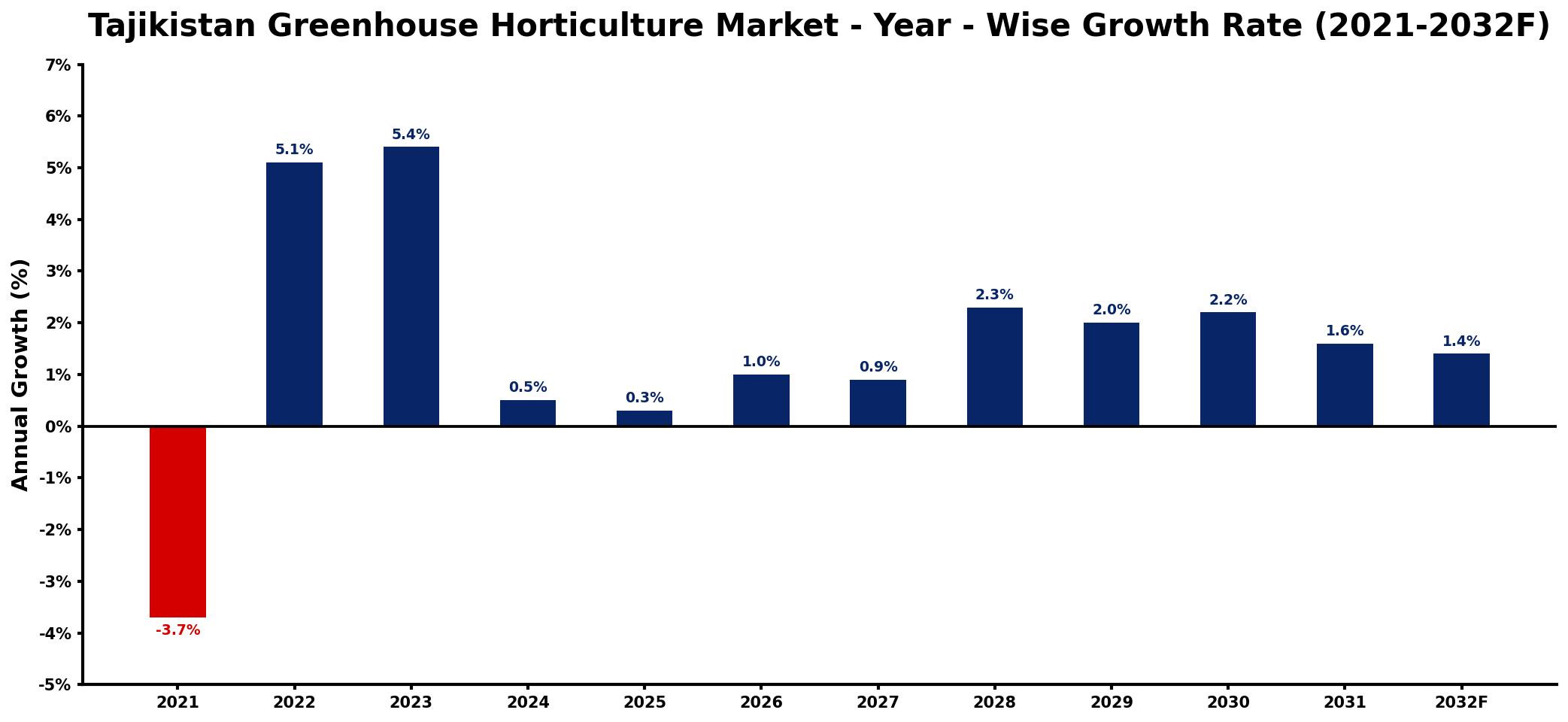
The table below presents the year‑wise growth rates along with the key drivers influencing the market
| Year | Growth Rate | Major Drivers |
| 2021 | -3.7% | decreased consumer spending on produce |
| 2022 | 5.1% | rising demand for fresh vegetables |
| 2023 | 5.4% | increased investment in local farms |
| 2024 | 0.5% | growing popularity of organic options |
| 2025 | 0.3% | expansion of distribution networks |
| 2026 | 1.0% | increased focus on sustainable practices |
| 2027 | 0.9% | enhanced technology adoption in farming |
| 2028 | 2.3% | strengthened export opportunities for produce |
| 2029 | 2.0% | growing urban population driving consumption |
| 2030 | 2.2% | rising awareness of healthy eating |
| 2031 | 1.6% | increased government support programs |
| 2032 | 1.4% | growing interest in local sourcing |
Note: Market size estimations and growth projections presented in this report are based on 6Wresearch's proprietary forecasting methodology, utilizing the latest available industry data, government publications, and primary research inputs.
Tajikistan Greenhouse Horticulture Market Synopsis
Recent years have seen momentum in Tajikistan's greenhouse horticulture sector, primarily driven by a surge in demand for fresh produce. The outlook for the market indicates robust growth, as advancements in technology and farming techniques continue to improve crop yields and quality. Stakeholders are increasingly recognizing the potential of greenhouse horticulture in meeting both domestic and regional food requirements.
Despite the current growth trajectory, challenges such as limited access to advanced agricultural technologies and investment in infrastructure remain significant hurdles. However, the ongoing commitment to enhance local production capabilities suggests a promising path forward for the market.
Tajikistan Greenhouse Horticulture Market Key Takeaways
- The market is heavily reliant on small-scale farmers who are modernizing their facilities.
- Demand for high-value crops like tomatoes and peppers is on the rise.
- Government policies are increasingly supportive of greenhouse agricultural practices.
- Technological advancements in climate control and irrigation are gaining traction.
- Opportunities for foreign investment are growing due to regional export potential.
Evaluation of Restraints in Tajikistan Greenhouse Horticulture Market
The growth of the Tajikistan Greenhouse Horticulture Market faces several constraints that must be addressed for sustained development. Key among these are the limited access to state-of-the-art technology, which hampers efficiency, and the inadequate infrastructure that restricts expansion capabilities. Farmers often struggle with outdated irrigation methods, leading to suboptimal water usage and crop yield. Furthermore, the impact of fluctuating weather conditions poses additional risks, creating an environment where operational consistency is difficult to maintain. With fierce competition from imported goods, domestic producers are under significant pressure to enhance their offerings to retain market share. Addressing these constraints through targeted investments and policy reforms will be crucial for the market's future success.
Tajikistan Greenhouse Horticulture Market Trends
Several trends are shaping the Tajikistan Greenhouse Horticulture Market. The adoption of advanced greenhouse technologies, such as automated climate control systems, is becoming more prevalent, allowing for optimized growing conditions. Alongside this, efficient irrigation practices and a transition towards organic farming techniques are on the rise, reflecting a broader consumer preference for sustainable produce. Moreover, as the demand for fresh produce continues to surge, an increasing number of farmers are pivoting towards high-value crops that promise better returns.
Tajikistan Greenhouse Horticulture Market Opportunities
Investment opportunities within the Tajikistan Greenhouse Horticulture Market are abundant, especially given the ongoing demand for high-quality vegetables and fruits. Key areas of interest for investors include modernizing greenhouse technologies, introducing new crop varieties, and enhancing irrigation systems. With government support and growing regional markets, the potential for exporting greenhouse-grown produce is significant, particularly to neighboring countries with limited domestic agricultural capacity.
Government Initiatives in the Tajikistan Greenhouse Horticulture Market
The government of Tajikistan has launched several initiatives to bolster the greenhouse horticulture sector. These include subsidies and financial incentives aimed at encouraging investment in greenhouse farming. Additionally, there are training programs designed to enhance the technical expertise of farmers and facilitate access to modern agricultural technologies. Policies promoting sustainable practices further support the sector's growth, emphasizing the need for energy and water conservation in greenhouse operations.
Future Insights of the Tajikistan Greenhouse Horticulture Market
Looking ahead, the Tajikistan Greenhouse Horticulture Market is anticipated to expand significantly as demand for locally sourced produce intensifies. The integration of innovative technologies and sustainable farming practices is likely to drive productivity enhancements. Additionally, with food security becoming a priority, there will be an increasing push for greenhouse cultivation to minimize reliance on imports. Overall, stakeholders are poised to capitalize on these trends, positioning the market for sustained growth through 2032.
Tajikistan Greenhouse Horticulture Market Latest Developments (2025 - 2026)
Recent developments in the Tajikistan Greenhouse Horticulture Market highlight a heightened focus on technological innovation and sustainability. Farmers are increasingly exploring partnerships that leverage modern agricultural practices to boost productivity. Training programs aimed at skill development are gaining popularity, promoting the adoption of best practices in greenhouse management. As domestic demand continues to rise, the sector is preparing for substantial expansions that could reshape the landscape of agricultural production in the coming years.
Tajikistan Greenhouse Horticulture Market - Key Attractiveness of the Report
- 10 Years of Market Numbers
- Historical Data Starting from 2022 to 2025
- Base Year: 2025
- Forecast Data until 2032
- Key Performance Indicators Impacting the Market
- Major Upcoming Developments and Projects
Key Highlights of the Report:
- Tajikistan Greenhouse Horticulture Market Outlook
- Market Size of Tajikistan Greenhouse Horticulture Market, 2025
- Forecast of Tajikistan Greenhouse Horticulture Market, 2032
- Historical Data and Forecast of Tajikistan Greenhouse Horticulture Revenues & Volume for the Period 2022-2032F
- Tajikistan Greenhouse Horticulture Market Trend Evolution
- Tajikistan Greenhouse Horticulture Market Drivers and Challenges
- Tajikistan Greenhouse Horticulture Price Trends
- Tajikistan Greenhouse Horticulture Porter's Five Forces
- Tajikistan Greenhouse Horticulture Industry Life Cycle
- Historical Data and Forecast of Tajikistan Greenhouse Horticulture Market Revenues & Volume By Material Type for the Period 2022-2032F
- Historical Data and Forecast of Tajikistan Greenhouse Horticulture Market Revenues & Volume By Glass for the Period 2022-2032F
- Historical Data and Forecast of Tajikistan Greenhouse Horticulture Market Revenues & Volume By Plastic for the Period 2022-2032F
- Historical Data and Forecast of Tajikistan Greenhouse Horticulture Market Revenues & Volume By Crop Type for the Period 2022-2032F
- Historical Data and Forecast of Tajikistan Greenhouse Horticulture Market Revenues & Volume By Fruits and Vegetables for the Period 2022-2032F
- Historical Data and Forecast of Tajikistan Greenhouse Horticulture Market Revenues & Volume By Flowers and Ornamentals for the Period 2022-2032F
- Historical Data and Forecast of Tajikistan Greenhouse Horticulture Market Revenues & Volume By Nursery Crops for the Period 2022-2032F
- Historical Data and Forecast of Tajikistan Greenhouse Horticulture Market Revenues & Volume By Others for the Period 2022-2032F
- Historical Data and Forecast of Tajikistan Greenhouse Horticulture Market Revenues & Volume By Technology for the Period 2022-2032F
- Historical Data and Forecast of Tajikistan Greenhouse Horticulture Market Revenues & Volume By Heating System for the Period 2022-2032F
- Historical Data and Forecast of Tajikistan Greenhouse Horticulture Market Revenues & Volume By Cooling System for the Period 2022-2032F
- Tajikistan Greenhouse Horticulture Import Export Trade Statistics
- Market Opportunity Assessment By Material Type
- Market Opportunity Assessment By Crop Type
- Market Opportunity Assessment By Technology
- Tajikistan Greenhouse Horticulture Top Companies Market Share
- Tajikistan Greenhouse Horticulture Competitive Benchmarking By Technical and Operational Parameters
- Tajikistan Greenhouse Horticulture Company Profiles
- Tajikistan Greenhouse Horticulture Key Strategic Recommendations






































