Tajikistan Helicopter Market Size, Share & Growth Rate
The Tajikistan Helicopter Market was estimated at USD 319 Million in 2025 and is projected to reach USD 425 Million by 2032, growing at a CAGR of 4.2% from 2026 to 2032. This growth is primarily fueled by the urgent need for accessible air transportation in remote mountainous regions, where traditional road infrastructure is insufficient. The government's emphasis on enhancing emergency services and expanding the tourism sector further supports the increasing demand for helicopter services.
Tajikistan Helicopter Market Year-wise Growth Rate and Key Drivers
This graph highlights how the Tajikistan Helicopter Market has steadily grown over the years, supported by major growth factors.
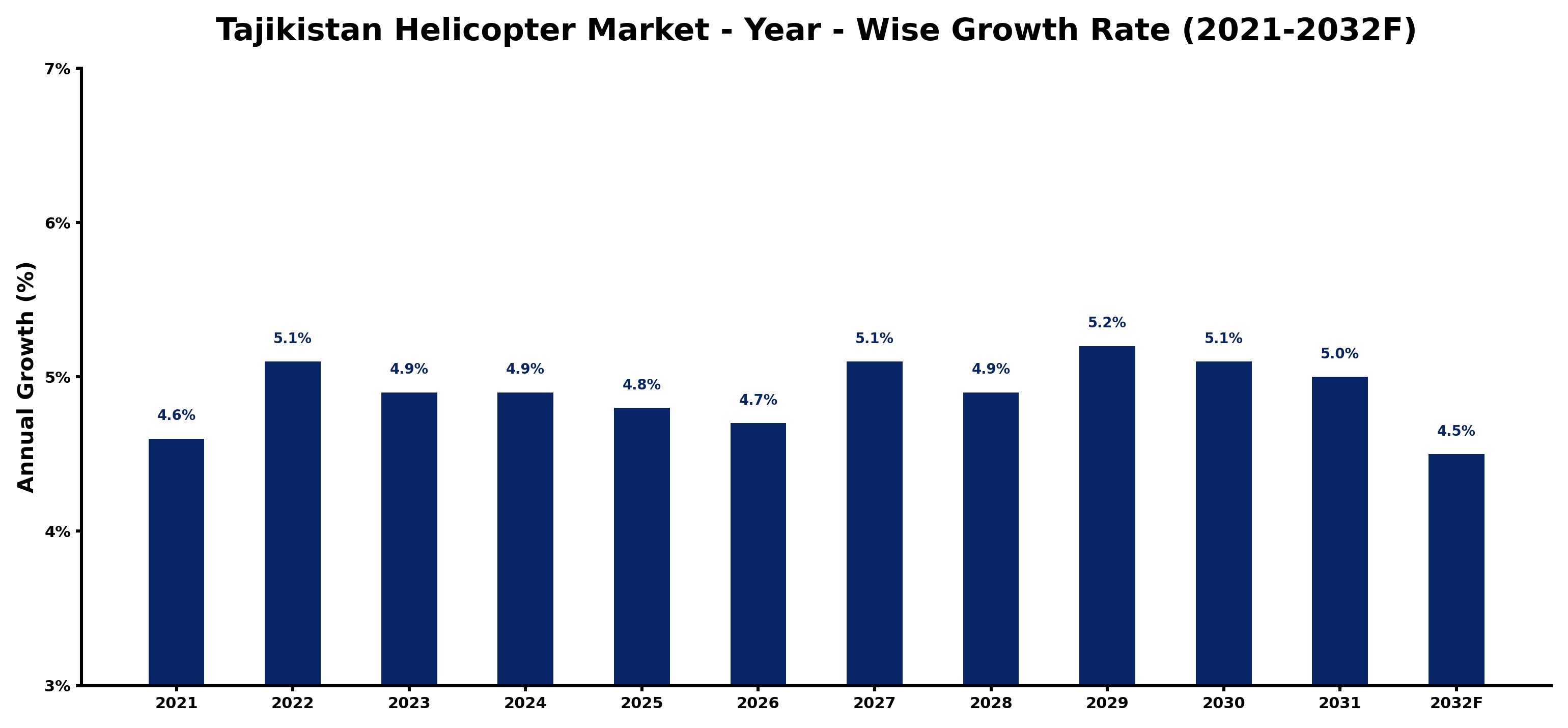
The table below presents the year‑wise growth rates along with the key drivers influencing the market
| Year | Growth Rate | Major Drivers |
| 2021 | 4.6% | Technological upgrades in fleet management boost helicopter operational efficiency |
| 2022 | 5.1% | Production capacity upgrades bolstered local helicopter assembly operations |
| 2023 | 4.9% | Increased helicopter maintenance services boost domestic component manufacturing demand |
| 2024 | 4.9% | Helicopter service contracts boost local maintenance and repair capabilities |
| 2025 | 4.8% | New infrastructure projects boosted helicopter component manufacturing demand |
| 2026 | 4.7% | Improved local assembly facilities boosted helicopter component manufacturing capacity |
| 2027 | 5.1% | Infrastructure projects drive local demand for utility helicopters' procurement |
| 2028 | 4.9% | Helicopter component localization initiatives boosted Tajikistan's manufacturing capabilities |
| 2029 | 5.2% | Helicopter assembly plant establishment boosts local manufacturing capabilities |
| 2030 | 5.1% | Regional helicopter component manufacturing bolstered local supply chain resilience |
| 2031 | 5.0% | Modern avionics adoption boosts helicopter maintenance and operational safety |
| 2032 | 4.5% | Local assembly operations bolstered helicopter manufacturing capacity and efficiency |
Note - Market size estimations and growth projections presented in this report are based on 6Wresearch's advanced forecasting approach, validated with industry datasets as of June 2026.
Tajikistan Helicopter Market Synopsis
The demand for helicopters in Tajikistan is underscored by its challenging geographical landscape, which necessitates alternative transportation solutions for reaching isolated communities. Helicopters are vital for operations like medical evacuations and search and rescue missions, making them indispensable assets in the region.
On the supply side, the market is primarily served by a limited number of providers, offering various helicopter models tailored for distinct applications. While this concentration allows for specialized services, it also highlights the need for increased competition and infrastructure development to better serve the diverse needs of the market.
Tajikistan Helicopter Market Key Takeaways
- The helicopter market is critical for emergency services and tourism, driven by challenging terrain.
- Government initiatives aim to enhance aviation safety standards and support market growth.
- There is a notable shift toward modern helicopters equipped with advanced technology.
- Investment opportunities are emerging in maintenance, training, and tourism-related services.
- Infrastructure improvements are crucial for market expansion and operational efficiency.
Evaluation of Restraints in Tajikistan Helicopter Market
The Tajikistan Helicopter Market faces significant restraints, chiefly due to limited operational infrastructure. The combination of regulatory hurdles and a relatively small customer base poses challenges for potential operators. Strict import regulations and bureaucratic processes often impede entry and expansion within the market. Moreover, the high costs associated with helicopter acquisition and maintenance can deter investment and reduce the appeal for potential operators in a market that is still developing.
Tajikistan Helicopter Market Trends
Current trends in the Tajikistan helicopter market reveal a growing preference for technologically advanced helicopters that enhance safety and operational efficiency. There is an increasing inclination among governmental and private sectors to utilize helicopters for a broader range of applications, including tourism and natural resource exploration. The rise of leisure and business travel is also contributing to the demand for helicopter services, as more individuals seek convenient access to remote destinations.
Tajikistan Helicopter Market Opportunities
The helicopter market in Tajikistan presents significant investment opportunities. Strategic partnerships with local operators can facilitate fleet expansion, while helicopter maintenance and repair services are essential for sustaining operations. The burgeoning tourism sector offers avenues for helicopter tour services, catering to both local and international tourists. Furthermore, investment in training programs for helicopter pilots is increasingly critical, given the rising demand for skilled personnel in the aviation sector.
Government Initiatives in the Tajikistan Helicopter Market
The Tajikistan government has instituted various policies aimed at regulating and promoting the helicopter market. These initiatives include stringent safety guidelines for helicopter operations and licensing frameworks for pilots and operators. The government is also focusing on partnerships with international aviation organizations to enhance the industry's overall safety standards. By providing investment incentives and fostering regulatory compliance, the government aims to create a competitive and sustainable helicopter market.
Future Insights of the Tajikistan Helicopter Market
Looking ahead to 2026-2032, the Tajikistan Helicopter Market is poised for steady growth. The continuous demand for helicopter services in sectors such as tourism, emergency response, and natural resource exploration highlights the market's potential. Ongoing government investments in infrastructure development are expected to catalyze further demand. However, addressing regulatory hurdles and operational challenges will be crucial to unlocking the market's full potential, paving the way for enhanced air mobility across the region.
Tajikistan Helicopter Market Latest Developments (May 2025 - June 2026)
Recent developments in the Tajikistan helicopter market have indicated a positive direction, with an increase in government focus on improving aviation infrastructure and safety protocols. Various initiatives aimed at enhancing pilot training and maintenance capabilities have gained momentum. Furthermore, local operators are actively seeking collaborations with international helicopter manufacturers to diversify their fleets and modernize their operational practices. These developments are paving the way for a more robust helicopter ecosystem in Tajikistan.
Tajikistan Helicopter Market - Key Attractiveness of the Report
- 10 Years of Market Numbers
- Historical Data Starting from 2022 to 2025
- Base Year: 2025
- Forecast Data until 2032
- Key Performance Indicators Impacting the Market
- Major Upcoming Developments and Projects
Key Highlights of the Report:
- Tajikistan Helicopter Market Outlook
- Market Size of Tajikistan Helicopter Market, 2025
- Forecast of Tajikistan Helicopter Market, 2032
- Historical Data and Forecast of Tajikistan Helicopter Revenues & Volume for the Period 2022-2032F
- Tajikistan Helicopter Market Trend Evolution
- Tajikistan Helicopter Market Drivers and Challenges
- Tajikistan Helicopter Price Trends
- Tajikistan Helicopter Porter's Five Forces
- Tajikistan Helicopter Industry Life Cycle
- Historical Data and Forecast of Tajikistan Helicopter Market Revenues & Volume By End-users for the Period 2022-2032F
- Historical Data and Forecast of Tajikistan Helicopter Market Revenues & Volume By Commercial for the Period 2022-2032F
- Historical Data and Forecast of Tajikistan Helicopter Market Revenues & Volume By Military for the Period 2022-2032F
- Historical Data and Forecast of Tajikistan Helicopter Market Revenues & Volume By Component for the Period 2022-2032F
- Historical Data and Forecast of Tajikistan Helicopter Market Revenues & Volume By Aerostructures/Airframes for the Period 2022-2032F
- Historical Data and Forecast of Tajikistan Helicopter Market Revenues & Volume By Rotary System for the Period 2022-2032F
- Historical Data and Forecast of Tajikistan Helicopter Market Revenues & Volume By Engine for the Period 2022-2032F
- Historical Data and Forecast of Tajikistan Helicopter Market Revenues & Volume By Undercarriage for the Period 2022-2032F
- Historical Data and Forecast of Tajikistan Helicopter Market Revenues & Volume By Avionics for the Period 2022-2032F
- Historical Data and Forecast of Tajikistan Helicopter Market Revenues & Volume By Cabin Interiors for the Period 2022-2032F
- Historical Data and Forecast of Tajikistan Helicopter Market Revenues & Volume By Environmental Control System for the Period 2022-2032F
- Historical Data and Forecast of Tajikistan Helicopter Market Revenues & Volume By Sales Channels for the Period 2022-2032F
- Historical Data and Forecast of Tajikistan Helicopter Market Revenues & Volume By OEM for the Period 2022-2032F
- Historical Data and Forecast of Tajikistan Helicopter Market Revenues & Volume By Maintenance for the Period 2022-2032F
- Historical Data and Forecast of Tajikistan Helicopter Market Revenues & Volume By Repair for the Period 2022-2032F
- Historical Data and Forecast of Tajikistan Helicopter Market Revenues & Volume By Overhaul for the Period 2022-2032F
- Tajikistan Helicopter Import Export Trade Statistics
- Market Opportunity Assessment By End-users
- Market Opportunity Assessment By Component
- Market Opportunity Assessment By Sales Channels
- Tajikistan Helicopter Top Companies Market Share
- Tajikistan Helicopter Competitive Benchmarking By Technical and Operational Parameters
- Tajikistan Helicopter Company Profiles
- Tajikistan Helicopter Key Strategic Recommendations






































