Tajikistan Hiking Gear & Equipment Market Size, Share & Growth Rate
The Tajikistan Hiking Gear & Equipment Market was estimated at USD 235 Million in 2025 and is projected to reach USD 323 Million by 2032, growing at a CAGR of 4.6% from 2026 to 2032. This growth trajectory is being fueled by an increasing interest in outdoor activities, the establishment of more hiking trails, and a significant uptick in adventure tourism, which is drawing both local and international hikers to Tajikistan's stunning natural landscapes.
Tajikistan Hiking Gear & Equipment Market Year-wise Growth Rate and Key Drivers
This graph highlights how the Tajikistan Hiking Gear & Equipment Market has steadily grown over the years, supported by major growth factors.
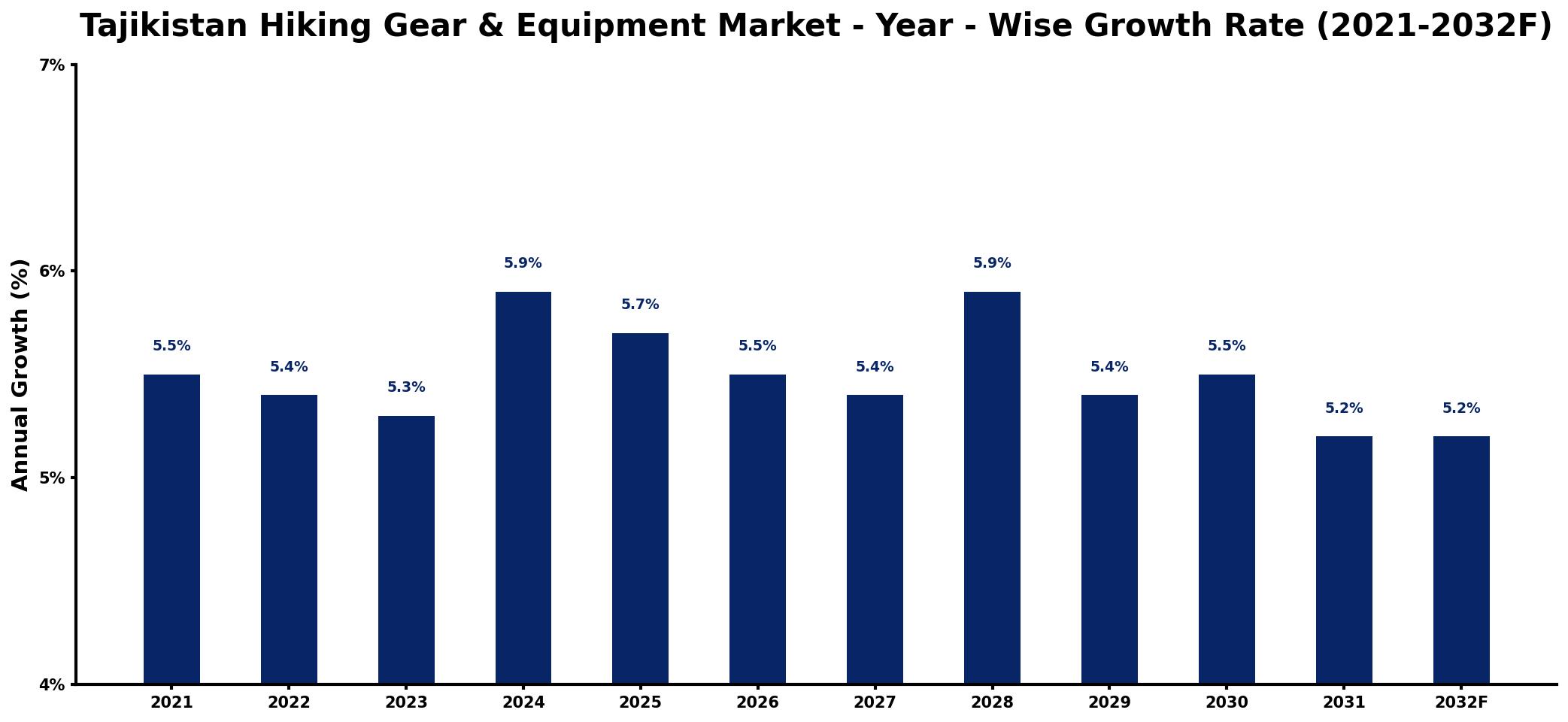
The table below presents the year‑wise growth rates along with the key drivers influencing the market
| Year | Growth Rate | Major Drivers |
| 2021 | 5.5% | Rising outdoor tourism interest |
| 2022 | 5.4% | Increased local manufacturing capabilities |
| 2023 | 5.3% | Growing health and wellness awareness |
| 2024 | 5.9% | Expansion of adventure travel offerings |
| 2025 | 5.7% | Improved transportation infrastructure development |
| 2026 | 5.5% | Increased disposable income levels |
| 2027 | 5.4% | Growth in eco-friendly initiatives |
| 2028 | 5.9% | Enhanced marketing strategies adoption |
| 2029 | 5.4% | Rising youth engagement in outdoors |
| 2030 | 5.5% | Development of new recreational areas |
| 2031 | 5.2% | Strengthened community outdoor programs |
| 2032 | 5.2% | Surge in social media influence |
Note: Market size estimations and growth projections presented in this report are based on 6Wresearch's proprietary forecasting methodology, utilizing the latest available industry data, government publications, and primary research inputs.
Tajikistan Hiking Gear & Equipment Market Synopsis
In recent years, Tajikistan has become an attractive destination for hiking enthusiasts, thanks to its breathtaking mountain ranges and diverse ecosystems. As adventure tourism continues to gain traction, the demand for specialized hiking gear and equipment is on the rise, reflecting the countrys potential to become a leading outdoor destination in Central Asia.
Consumers are becoming increasingly discerning, seeking high-quality and durable products that can withstand Tajikistan's rugged terrain. This growing consumer awareness, coupled with the expansion of eco-tourism initiatives, is shaping the market landscape, compelling businesses to innovate and cater to the needs of today's hikers.
- The market is witnessing a robust growth driven by rising disposable incomes and a burgeoning interest in outdoor activities.
- There is a noticeable shift towards eco-friendly and sustainable hiking products among consumers.
- Investment opportunities are abundant in both local manufacturing and online retail of hiking gear tailored for the regional climate.
- Challenges such as limited infrastructure and high import costs persist, impacting market dynamics.
- Government initiatives aimed at promoting tourism could play a vital role in market expansion.
Despite its growth potential, the Tajikistan hiking gear market faces substantial constraints that could impede progress. One primary challenge is the limited availability of high-quality, specialized hiking equipment due to the nations remote location and insufficient infrastructure. Importation processes can be slow and costly, resulting in higher prices for consumers. Additionally, a lack of widespread awareness and enthusiasm for outdoor activities among the local populace hinders the generation of robust demand for hiking gear. Seasonal weather fluctuations and the challenging terrain further complicate the logistics for retailers and manufacturers.
As the market evolves, several notable trends are shaping the demand for hiking gear in Tajikistan. Consumers increasingly prefer lightweight and compact equipment designed for optimal performance, such as versatile footwear and waterproof backpacks. Moreover, the rise of social media and influencer culture in the region has sparked greater awareness and interest in hiking, as individuals share their adventures and outdoor experiences online. This shift is fostering innovation in product design and sustainability, aligning with consumers growing preference for eco-conscious products.
The hiking gear market in Tajikistan presents numerous investment opportunities, particularly due to the increasing interest in outdoor activities and eco-tourism. The picturesque landscapes and challenging terrains create a strong demand for high-quality hiking gear. Opportunities abound in the production and distribution of essential hiking equipment, such as backpacks, trekking poles, and outdoor clothing tailored to the local environment. Collaborating with local tour operators and adventure travel companies can also provide unique avenues for market penetration and growth.
While there are currently no specific government policies directly aimed at the hiking gear and equipment sector, broader trade regulations and customs duties apply to imports in this industry. Companies entering the market should remain vigilant about any changes in these regulations, as well as potential incentives aimed at boosting the outdoor recreation sector. Awareness of government efforts to promote tourism and infrastructure development could be crucial for businesses aiming to thrive in this market.
Looking ahead, the Tajikistan Hiking Gear & Equipment Market is set for steady growth, driven by the continued rise in outdoor adventure tourism and the governments push for improved infrastructure in rural areas. As more individuals look to explore Tajikistan's stunning landscapes, there will be an increasing demand for high-quality, innovative hiking gear. The anticipated growth of online shopping platforms and advances in product sustainability are expected to further catalyze market expansion, offering both challenges and opportunities for industry participants.
Recent developments in the Tajikistan hiking gear and equipment market indicate a noticeable shift toward online retail, with several platforms emerging that specialize in outdoor gear. These digital marketplaces are facilitating access for consumers seeking quality hiking equipment. Additionally, increased collaboration between local manufacturers and international brands is fostering innovation and improving the product offerings available in the market. Efforts to enhance hiking trail networks and eco-tourism initiatives are also being prioritized to bolster the attractiveness of the region as an outdoor destination.
- 10 Years of Market Numbers
- Historical Data Starting from 2022 to 2025
- Base Year: 2025
- Forecast Data until 2032
- Key Performance Indicators Impacting the Market
- Major Upcoming Developments and Projects
Key Highlights of the Report:
- Tajikistan Hiking Gear & Equipment Market Outlook
- Market Size of Tajikistan Hiking Gear & Equipment Market, 2025
- Forecast of Tajikistan Hiking Gear & Equipment Market, 2032
- Historical Data and Forecast of Tajikistan Hiking Gear & Equipment Revenues & Volume for the Period 2022-2032F
- Tajikistan Hiking Gear & Equipment Market Trend Evolution
- Tajikistan Hiking Gear & Equipment Market Drivers and Challenges
- Tajikistan Hiking Gear & Equipment Price Trends
- Tajikistan Hiking Gear & Equipment Porter's Five Forces
- Tajikistan Hiking Gear & Equipment Industry Life Cycle
- Historical Data and Forecast of Tajikistan Hiking Gear & Equipment Market Revenues & Volume By Product for the Period 2022-2032F
- Historical Data and Forecast of Tajikistan Hiking Gear & Equipment Market Revenues & Volume By Clothes for the Period 2022-2032F
- Historical Data and Forecast of Tajikistan Hiking Gear & Equipment Market Revenues & Volume By Footwear for the Period 2022-2032F
- Historical Data and Forecast of Tajikistan Hiking Gear & Equipment Market Revenues & Volume By Backpack for the Period 2022-2032F
- Historical Data and Forecast of Tajikistan Hiking Gear & Equipment Market Revenues & Volume By Equipment for the Period 2022-2032F
- Historical Data and Forecast of Tajikistan Hiking Gear & Equipment Market Revenues & Volume By Others for the Period 2022-2032F
- Historical Data and Forecast of Tajikistan Hiking Gear & Equipment Market Revenues & Volume By Distribution Channel for the Period 2022-2032F
- Historical Data and Forecast of Tajikistan Hiking Gear & Equipment Market Revenues & Volume By Specialty stores for the Period 2022-2032F
- Historical Data and Forecast of Tajikistan Hiking Gear & Equipment Market Revenues & Volume By Retail stores for the Period 2022-2032F
- Historical Data and Forecast of Tajikistan Hiking Gear & Equipment Market Revenues & Volume By Online for the Period 2022-2032F
- Tajikistan Hiking Gear & Equipment Import Export Trade Statistics
- Market Opportunity Assessment By Product
- Market Opportunity Assessment By Distribution Channel
- Tajikistan Hiking Gear & Equipment Top Companies Market Share
- Tajikistan Hiking Gear & Equipment Competitive Benchmarking By Technical and Operational Parameters
- Tajikistan Hiking Gear & Equipment Company Profiles
- Tajikistan Hiking Gear & Equipment Key Strategic Recommendations






































