Tajikistan Holster Market Size, Share & Growth Rate
The Tajikistan Holster Market was estimated at USD 202 Million in 2025 and is projected to reach USD 279 Million by 2032, growing at a CAGR of 4.7% from 2026 to 2032. This growth trajectory is fueled by a rising awareness of personal safety among civilians, as well as an increasing interest in shooting sports. The combination of economic development and improved access to firearms and accessories is further driving the demand for quality holsters in the region.
Tajikistan Holster Market Year-wise Growth Rate and Key Drivers
This graph highlights how the Tajikistan Holster Market has steadily grown over the years, supported by major growth factors.
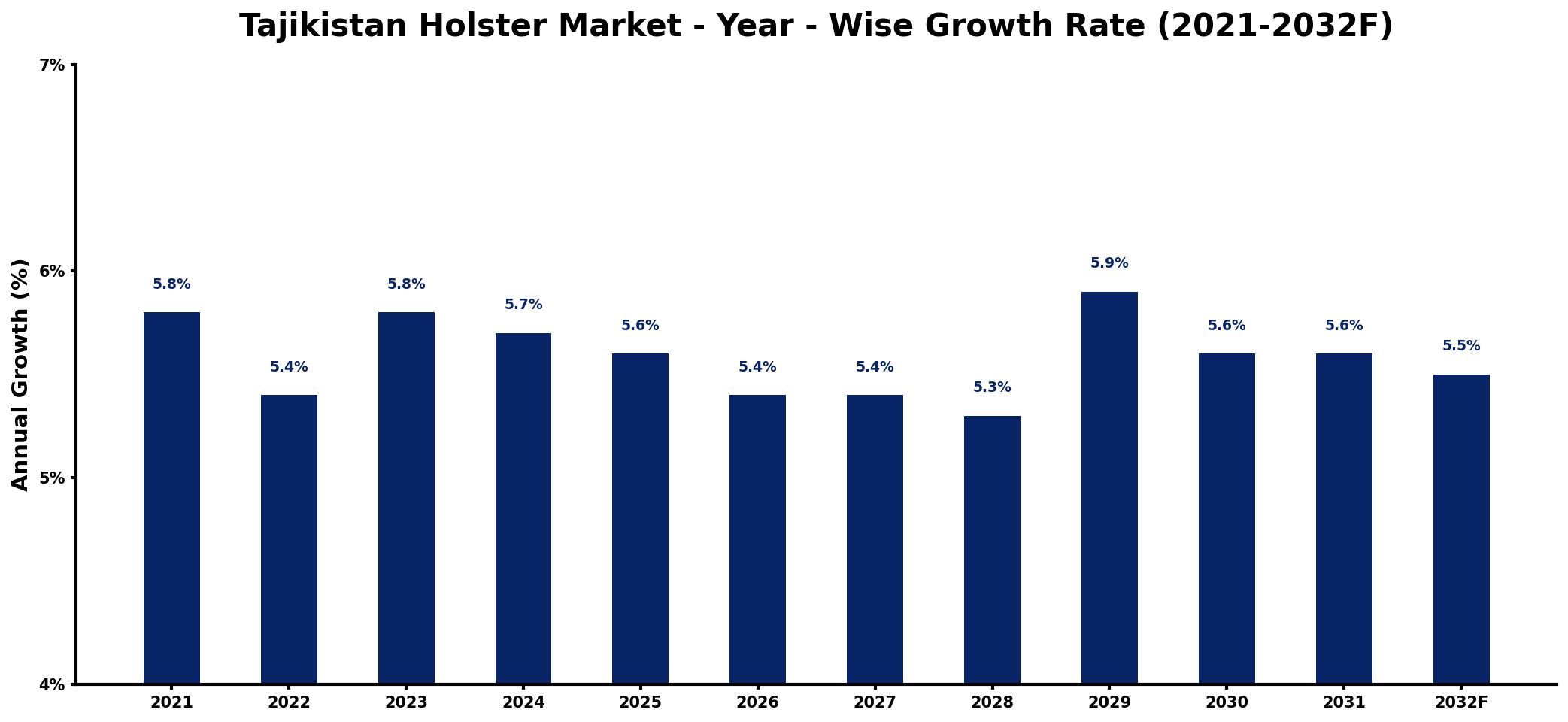
The table below presents the year‑wise growth rates along with the key drivers influencing the market
| Year | Growth Rate | Major Drivers |
| 2021 | 5.8% | Rising security sector investments |
| 2022 | 5.4% | Increased outdoor recreational activities |
| 2023 | 5.8% | Growing interest in personal safety |
| 2024 | 5.7% | growing commercial sector adoption |
| 2025 | 5.6% | rising infrastructure development spending |
| 2026 | 5.4% | Enhanced military procurement programs |
| 2027 | 5.4% | Development of training facilities |
| 2028 | 5.3% | Boost in local manufacturing capabilities |
| 2029 | 5.9% | Emergence of new retail channels |
| 2030 | 5.6% | rising export shipment volumes |
| 2031 | 5.6% | Increased awareness of self-defense |
| 2032 | 5.5% | Rising popularity of tactical gear |
Note: Market size estimations and growth projections presented in this report are based on 6Wresearch's proprietary forecasting methodology, utilizing the latest available industry data, government publications, and primary research inputs.
Tajikistan Holster Market Synopsis
Currently, the most significant force shaping the Tajikistan Holster Market is the growing emphasis on personal security. As the population becomes more aware of the benefits of responsible firearm ownership, the demand for reliable holster solutions is rising, catering to a diverse consumer base.
Another influential factor is the increasing popularity of shooting sports, which promotes the need for high-quality, versatile holster options. Consumers are not only looking for functional holsters, but also those that provide comfort and security, which is leading to innovation and expansion of product offerings in the market.
Tajikistan Holster Market Key Takeaways
- Growing demand for high-quality, customizable holsters tailored to individual preferences.
- Increased awareness of personal safety driving civil demand for firearm accessories.
- Urbanization and rising disposable income levels contributing to market expansion.
- Innovative materials and designs enhancing holster functionality and user experience.
- Government regulations shaping the landscape of manufacturing and distribution.
Evaluation of Restraints in Tajikistan Holster Market
Despite its growth potential, the Tajikistan Holster Market faces significant restraints. A key challenge is the limited awareness and understanding among the general population regarding the importance of utilizing holsters for firearm safety. This has resulted in relatively low demand, hindering market growth. Additionally, the scarcity of diverse product offerings and limited access to high-quality holsters restrict consumer choices, making it difficult for manufacturers to meet evolving preferences. The presence of counterfeit products also threatens genuine manufacturers, impacting their sales and brand integrity.
Tajikistan Holster Market Trends
The market is witnessing several trends, notably the increasing demand for durable and versatile holster options. Consumers are gravitating towards holsters compatible with a variety of firearms, such as pistols and revolvers. There is a strong inclination towards customization, allowing users to adjust retention levels and carry positions to enhance user experience. Furthermore, materials like Kydex and premium leather are gaining traction, as they provide superior durability and protection, aligning with the growing consumer desire for quality.
Tajikistan Holster Market Opportunities
Investors have a promising landscape to explore within the Tajikistan Holster Market. The rising focus on personal security and increased gun ownership creates a demand for quality holster solutions. Engaging in the production and distribution of locally tailored holsters presents lucrative opportunities. Moreover, utilizing e-commerce platforms can expand reach and accessibility, while partnerships with local retailers can solidify market presence. Customization offerings can further capitalize on consumer demand for personalized products.
Government Initiatives in the Tajikistan Holster Market
The Tajikistan government has enacted various policies to regulate the holster market, including licensing requirements for manufacturers and importers, as well as quality control standards. These initiatives aim to uphold public safety by overseeing the production and distribution of holsters. Strict regulations also govern the export of holsters, ensuring that unauthorized transfers are prevented and maintaining control over the market.
Future Insights of the Tajikistan Holster Market
Looking ahead to 2026-2032, the Tajikistan Holster Market is positioned for sustained growth. With urbanization and rising disposable incomes, the demand for holsters, especially for concealed carry and tactical use, is expected to escalate. The tourism sectors expansion may also contribute as visitors seek protective gear for outdoor activities. Manufacturers are likely to leverage technological advancements to introduce innovative and customizable holster solutions, further catering to evolving consumer needs.
Tajikistan Holster Market Latest Developments (2025 - 2026)
In recent months, the Tajikistan Holster Market has seen a shift towards greater consumer engagement through digital platforms. Manufacturers are increasingly leveraging social media and e-commerce to educate potential buyers on the importance of holsters, resulting in heightened awareness. Furthermore, collaborations among local brands are emerging, aiming to enhance the quality and diversity of product offerings to better meet the evolving market demands.
Tajikistan Holster Market - Key Attractiveness of the Report
- 10 Years of Market Numbers
- Historical Data Starting from 2022 to 2025
- Base Year: 2025
- Forecast Data until 2032
- Key Performance Indicators Impacting the Market
- Major Upcoming Developments and Projects
Key Highlights of the Report:
- Tajikistan Holster Market Outlook
- Market Size of Tajikistan Holster Market, 2025
- Forecast of Tajikistan Holster Market, 2032
- Historical Data and Forecast of Tajikistan Holster Revenues & Volume for the Period 2022-2032F
- Tajikistan Holster Market Trend Evolution
- Tajikistan Holster Market Drivers and Challenges
- Tajikistan Holster Price Trends
- Tajikistan Holster Porter's Five Forces
- Tajikistan Holster Industry Life Cycle
- Historical Data and Forecast of Tajikistan Holster Market Revenues & Volume By Type for the Period 2022-2032F
- Historical Data and Forecast of Tajikistan Holster Market Revenues & Volume By Leather for the Period 2022-2032F
- Historical Data and Forecast of Tajikistan Holster Market Revenues & Volume By Nylon for the Period 2022-2032F
- Historical Data and Forecast of Tajikistan Holster Market Revenues & Volume By Plastic for the Period 2022-2032F
- Historical Data and Forecast of Tajikistan Holster Market Revenues & Volume By Other for the Period 2022-2032F
- Historical Data and Forecast of Tajikistan Holster Market Revenues & Volume By Application for the Period 2022-2032F
- Historical Data and Forecast of Tajikistan Holster Market Revenues & Volume By Civil for the Period 2022-2032F
- Historical Data and Forecast of Tajikistan Holster Market Revenues & Volume By Armed Forces for the Period 2022-2032F
- Historical Data and Forecast of Tajikistan Holster Market Revenues & Volume By others for the Period 2022-2032F
- Tajikistan Holster Import Export Trade Statistics
- Market Opportunity Assessment By Type
- Market Opportunity Assessment By Application
- Tajikistan Holster Top Companies Market Share
- Tajikistan Holster Competitive Benchmarking By Technical and Operational Parameters
- Tajikistan Holster Company Profiles
- Tajikistan Holster Key Strategic Recommendations






































