Tajikistan Home Appliances Market Summary
The tajikistan home appliances market was estimated at USD 1088 Million in 2025 and is projected to reach USD 1558 Million by 2032, growing at a CAGR of 6.3% from 2026 to 2032.
Tajikistan Home Appliances Market Year-wise Growth Rate and Key Drivers
This graph highlights how the Tajikistan Home Appliances Market has steadily grown over the past five years, supported by major growth factors.
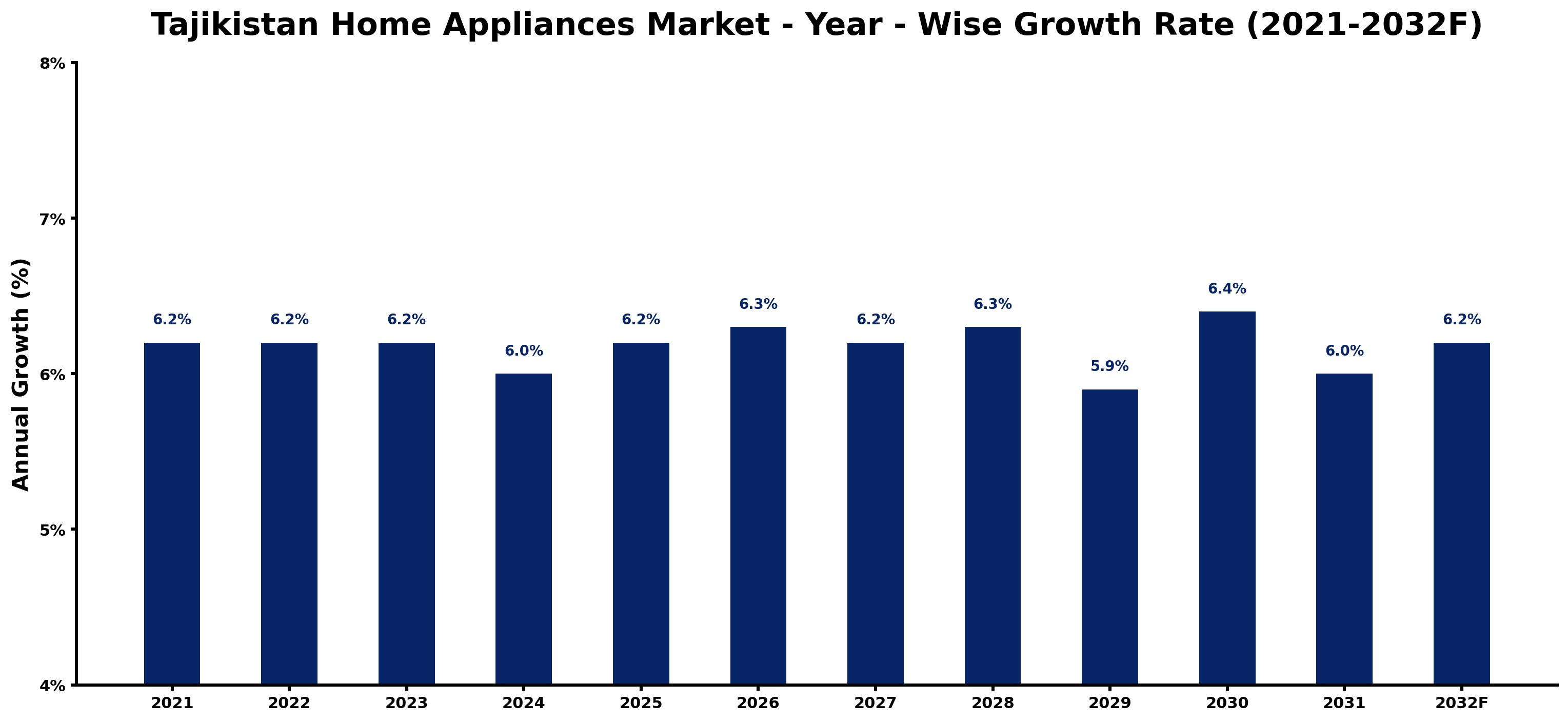
The table below presents the year wise growth rates along with the key drivers influencing the market
| Year | Growth Rate | Major Drivers |
| 2021 | 6.2% | Market recovery began as pandemic restrictions eased, boosting consumer confidence and spending. |
| 2022 | 6.2% | Increased foreign investments targeted energy-efficient home appliances for sustainable living standards. |
| 2023 | 6.2% | Manufacturers adapted to local preferences, enhancing product offerings tailored to Tajikistan's climate. |
| 2024 | 6.0% | Urbanization trends encouraged households to upgrade appliances, improving overall living conditions. |
| 2025 | 6.2% | Emerging middle-class demographics demand modern home solutions, emphasizing quality and innovation. |
| 2026 | 6.3% | E-commerce platforms expanded, facilitating easier access to various home appliance brands. |
| 2027 | 6.2% | Economic stability led to increased disposable incomes, driving higher appliance purchases per household. |
| 2028 | 6.3% | Local manufacturers invested in technology, reducing reliance on imports and improving pricing competitiveness. |
| 2029 | 5.9% | Consumer awareness campaigns highlighted energy efficiency, influencing purchasing decisions towards eco-friendly options. |
| 2030 | 6.4% | Smart home technology integration gained traction, attracting tech-savvy younger consumers. |
| 2031 | 6.0% | After-sales service improvements emerged, increasing customer loyalty and repeat purchases within the market. |
| 2032 | 6.2% | Sustainability regulations prompted manufacturers to innovate, aligning products with environmental standards. |
Note - Market size estimations and growth projections presented in this report are based on 6Wresearch's advanced forecasting approach, validated with industry datasets as of June 2026.
Tajikistan Home Appliances Market Synopsis
The Tajikistan Home Appliances Market is projected to reach 6.3% and witness significant growth during the forecast period (2026-2032). This growth is driven by several key factors, including increasing urbanization, rising disposable incomes, and an expanding middle-class demographic. As consumers strive to enhance their living standards, the demand for essential appliances such as refrigerators, washing machines, and televisions continues to rise. The market landscape encompasses a blend of local enterprises and international brands, all vying to present innovative solutions at competitive price points.
Tajikistan Home Appliances Market Growth Drivers
An array of growth drivers is propelling the Tajikistan Home Appliances Market forward. Firstly, urbanization is a crucial factor; as more individuals migrate to urban centers, the need for functional home appliances rises significantly. Secondly, rising disposable income levels enable consumers to allocate funds towards purchasing modern appliances. Thirdly, the increasing prevalence of the middle class is shifting consumer preferences towards higher-quality, technologically advanced products. Fourthly, heightened awareness around energy efficiency is pushing consumers to seek appliances that are both environmentally friendly and economically beneficial. Finally, government initiatives aimed at industrial development are creating a conducive environment for market expansion.
Tajikistan Home Appliances Market Trends and Opportunities
The current landscape of the Tajikistan Home Appliances Market reveals significant trends that present numerous opportunities for growth. There is a notable increase in demand for energy-efficient appliances, as consumers become more environmentally conscious. Additionally, the trend towards smart appliances that provide enhanced convenience, including features like IoT connectivity and remote control capabilities, is rapidly gaining traction. The rising standard of living encourages investment in high-quality products, particularly in segments such as refrigerators, air conditioners, and kitchen gadgets. The expansion of e-commerce platforms further underscores an emerging trend, with consumers gravitating towards online channels for appliance purchases, driven by the convenience and variety they offer.
Tajikistan Home Appliances Market Challenges and Restraints
While the Tajikistan Home Appliances Market is on an upward trajectory, it encounters several challenges that could hinder its growth. One significant issue is the limited purchasing power among the population, impeded by low average incomes, which restricts the adoption of higher-end appliances. Additionally, poor infrastructure, including inconsistent electricity supply and inadequate retail outlets, complicates sales and distribution efforts. Import tariffs and taxes on home appliances further inflate prices, making them less accessible for consumers. The fragmented nature of the market, characterized by a multitude of local and foreign competitors, adds another layer of complexity that businesses must navigate. Addressing these challenges will require strategic pricing, effective distribution networks, and targeted marketing approaches.
Tajikistan Home Appliances Market Investment Opportunities
The prospects for investment in the Tajikistan Home Appliances Market are promising, particularly for companies looking to leverage the growing consumer demand for modern home products. The rise of the middle class and increasing disposable incomes signal a shift towards premium and technologically advanced appliances, creating numerous opportunities in this sector. Notable areas with high investment potential include energy-efficient refrigerators, air conditioning units, washing machines, and small kitchen appliances. There is also a burgeoning interest in smart home technologies that enhance user convenience and connectivity. Companies that deliver innovative, competitively priced products with reliable after-sales support are likely to capture a significant share of this emerging market.
Tajikistan Home Appliances Market Government Investment and Initiatives
The Tajikistan government has introduced a series of policies aimed at bolstering the home appliances market, focusing on consumer protection and market fairness. Key initiatives include establishing stringent regulations on product quality and safety standards to ensure that appliances meet consumer expectations. Energy efficiency ratings have also been mandated, encouraging companies to prioritize environmentally sustainable designs. Furthermore, the government has instituted import tariffs on select home appliances to stimulate domestic manufacturing, thereby enhancing local production capabilities. This policy framework is designed to safeguard consumer interests while fostering a competitive and resilient home appliances sector within the country.
Tajikistan Home Appliances Market Latest Developments (May 2025 - June 2026)
Recent developments in the Tajikistan Home Appliances Market, spanning from May 2025 to June 2026, highlight a dynamic shift in industry direction. One prominent trend is the increasing emphasis on sustainability, with manufacturers focusing on energy-efficient and eco-friendly appliance options. The market is also witnessing a surge in online sales, as consumers are increasingly turning to digital platforms for purchasing appliances. Innovative product launches featuring advanced smart technologies have been notable as companies respond to evolving consumer preferences. Additionally, public and private partnerships are being explored to enhance distribution networks and address infrastructure deficiencies, thereby improving access to modern appliances across various segments of the population.
Tajikistan Home Appliances Market - Key Attractiveness of the Report
- 10 Years of Market Numbers
- Historical Data Starting from 2022 to 2025
- Base Year: 2025
- Forecast Data until 2032
- Key Performance Indicators Impacting the Market
- Major Upcoming Developments and Projects
Key Highlights of the Report:
- Tajikistan Home Appliances Market Outlook
- Market Size of Tajikistan Home Appliances Market, 2025
- Forecast of Tajikistan Home Appliances Market, 2032F
- Historical Data and Forecast of Tajikistan Home Appliances Revenues & Volume for the Period 2022-2032F
- Tajikistan Home Appliances Market Trend Evolution
- Tajikistan Home Appliances Market Drivers and Challenges
- Tajikistan Home Appliances Price Trends
- Tajikistan Home Appliances Porter's Five Forces
- Tajikistan Home Appliances Industry Life Cycle
- Historical Data and Forecast of Tajikistan Home Appliances Market Revenues & Volume By Product Types for the Period 2022-2032F
- Historical Data and Forecast of Tajikistan Home Appliances Market Revenues & Volume By Kitchen Appliances for the Period 2022-2032F
- Historical Data and Forecast of Tajikistan Home Appliances Market Revenues & Volume By Washing Appliances for the Period 2022-2032F
- Historical Data and Forecast of Tajikistan Home Appliances Market Revenues & Volume By Entertainment Appliances for the Period 2022-2032F
- Historical Data and Forecast of Tajikistan Home Appliances Market Revenues & Volume By Air Conditioner for the Period 2022-2032F
- Historical Data and Forecast of Tajikistan Home Appliances Market Revenues & Volume By Others for the Period 2022-2032F
- Historical Data and Forecast of Tajikistan Home Appliances Market Revenues & Volume By Technology for the Period 2022-2032F
- Historical Data and Forecast of Tajikistan Home Appliances Market Revenues & Volume By Wi-Fi for the Period 2022-2032F
- Historical Data and Forecast of Tajikistan Home Appliances Market Revenues & Volume By Bluetooth for the Period 2022-2032F
- Historical Data and Forecast of Tajikistan Home Appliances Market Revenues & Volume By ZigBee for the Period 2022-2032F
- Historical Data and Forecast of Tajikistan Home Appliances Market Revenues & Volume By Radio Frequency Identification for the Period 2022-2032F
- Historical Data and Forecast of Tajikistan Home Appliances Market Revenues & Volume By Cellular Technology for the Period 2022-2032F
- Historical Data and Forecast of Tajikistan Home Appliances Market Revenues & Volume By IoT for the Period 2022-2032F
- Historical Data and Forecast of Tajikistan Home Appliances Market Revenues & Volume By Distribution Channel for the Period 2022-2032F
- Historical Data and Forecast of Tajikistan Home Appliances Market Revenues & Volume By Retail for the Period 2022-2032F
- Historical Data and Forecast of Tajikistan Home Appliances Market Revenues & Volume By E-commerce for the Period 2022-2032F
- Historical Data and Forecast of Tajikistan Home Appliances Market Revenues & Volume By Others for the Period 2022-2032F
- Tajikistan Home Appliances Import Export Trade Statistics
- Market Opportunity Assessment By Product Types
- Market Opportunity Assessment By Technology
- Market Opportunity Assessment By Distribution Channel
- Tajikistan Home Appliances Top Companies Market Share
- Tajikistan Home Appliances Competitive Benchmarking By Technical and Operational Parameters
- Tajikistan Home Appliances Company Profiles
- Tajikistan Home Appliances Key Strategic Recommendations






































