Tajikistan HVAC System Market Size Growth Rate
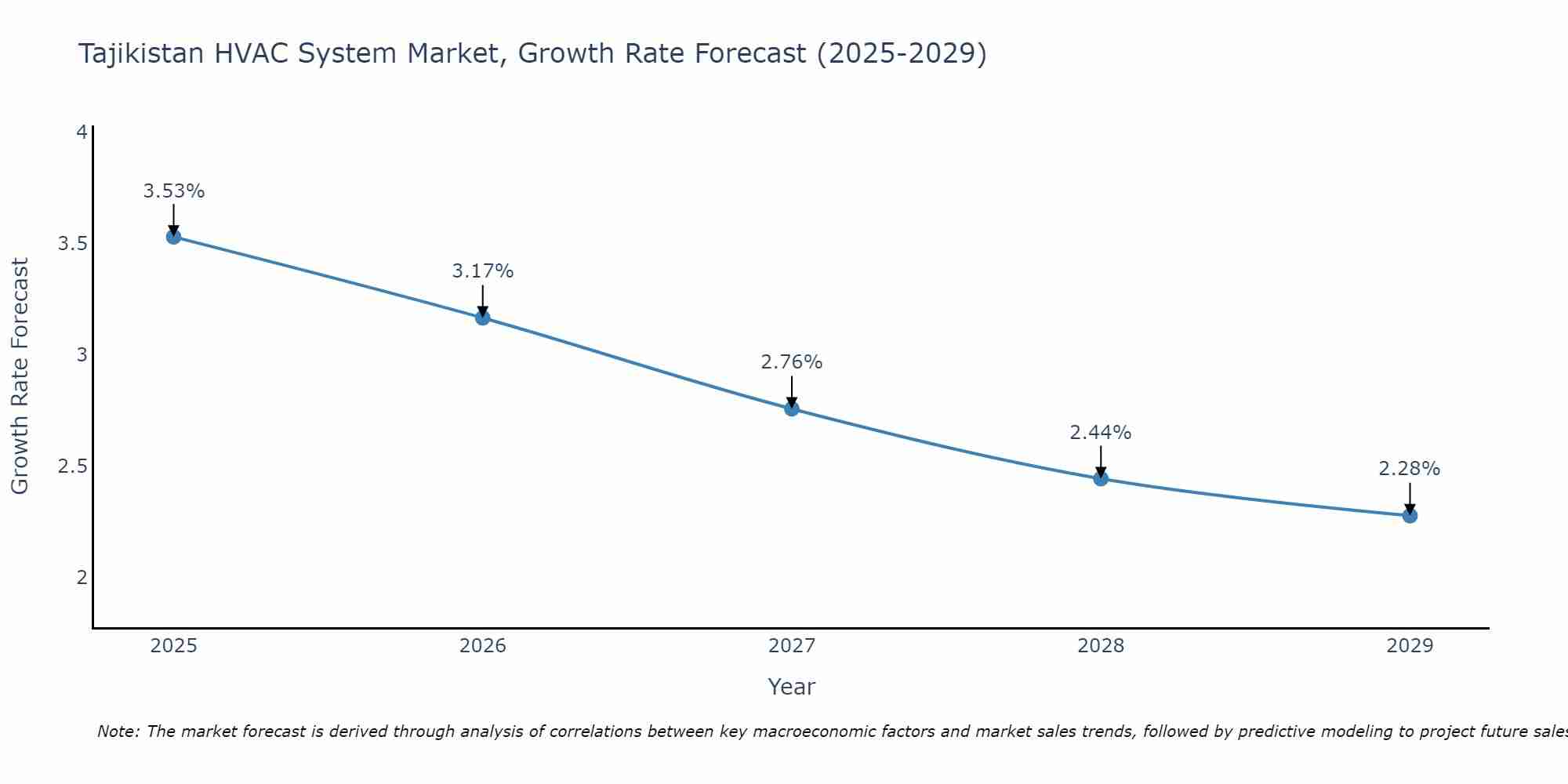
The Tajikistan HVAC System Market may undergo a gradual slowdown in growth rates between 2025 and 2029. Although the growth rate starts strong at 3.53% in 2025, it steadily loses momentum, ending at 2.28% by 2029.
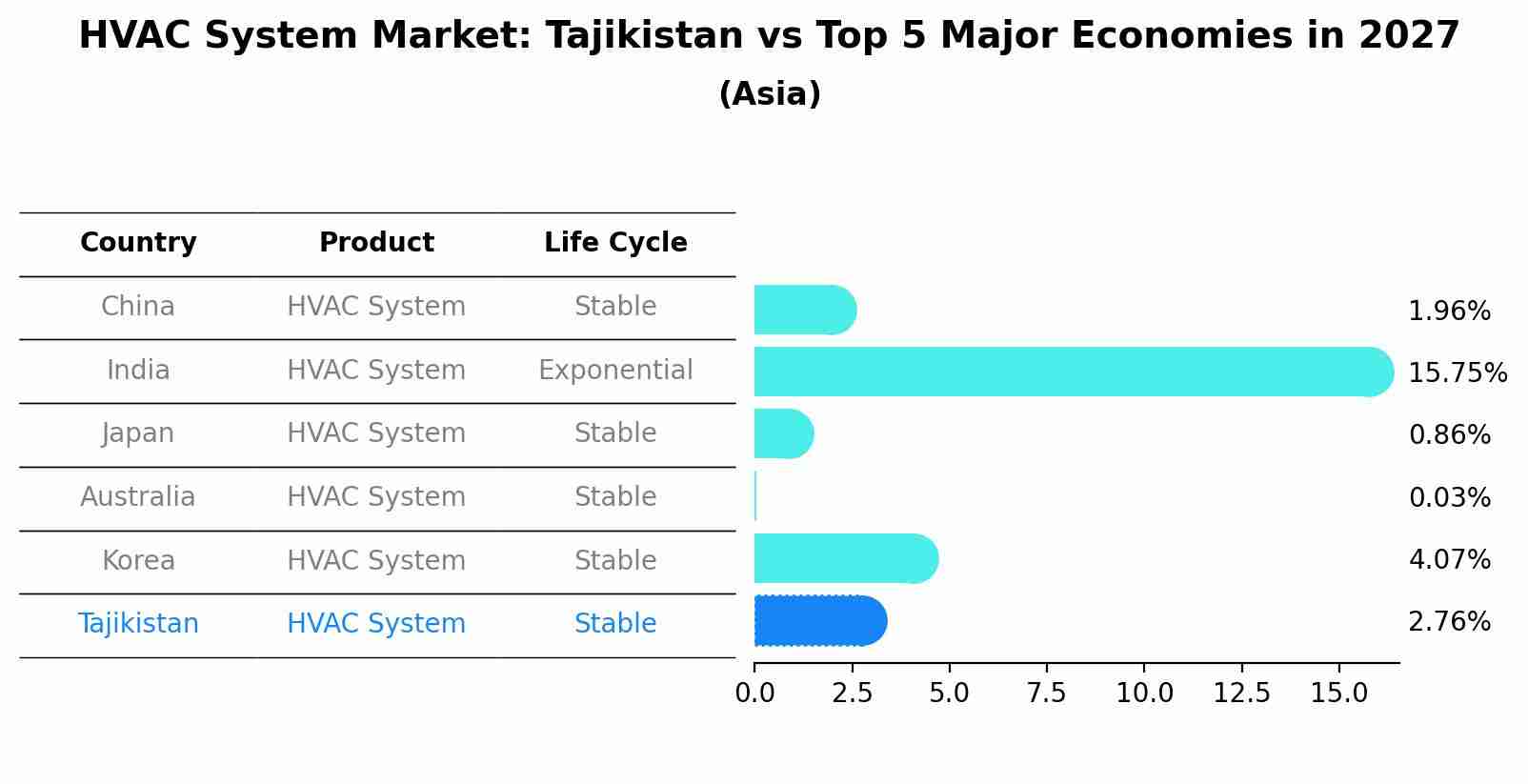
HVAC System Market: Tajikistan vs Top 5 Major Economies in 2027 (Asia)
The HVAC System market in Tajikistan is projected to grow at a stable growth rate of 2.76% by 2027, within the Asia region led by China, along with other countries like India, Japan, Australia and South Korea, collectively shaping a dynamic and evolving market environment driven by innovation and increasing adoption of emerging technologies.
Tajikistan Hvac System Market Synopsis
The HVAC market in Tajikistan is still in its infancy and there are no reliable statistics available. However, it is estimated that the demand for air-conditioning systems has been growing steadily over the past few years due to increasing urbanization as well as rising incomes. Additionally, with international organizations investing heavily in infrastructure projects, they have also increased their spending on cooling equipment such as chillers and air conditioners
Currently, most of the HVAC installations are done by local contractors who lack both technical expertise and experience working with modern equipment. As a result, many buildings suffer from poorly maintained or inefficient systems which results in higher energy bills and an overall decrease of comfort levels within their premises. To tackle this issue there has been some effort from international organizations to promote best practices through training programs however these initiatives have so far had limited impact on improving existing standards across all sectors
Key Highlights of the Report:
- Tajikistan HVAC System Market Outlook
- Market Size of Tajikistan HVAC System Market, 2019
- Forecast of Tajikistan HVAC System Market, 2026
- Historical Data and Forecast of Tajikistan HVAC System Revenues & Volume for the Period 2016 - 2026
- Tajikistan HVAC System Market Trend Evolution
- Tajikistan HVAC System Market Drivers and Challenges
- Tajikistan HVAC System Price Trends
- Tajikistan HVAC System Porter's Five Forces
- Tajikistan HVAC System Industry Life Cycle
- Historical Data and Forecast of Tajikistan HVAC System Market Revenues & Volume By Product Type for the Period 2016 - 2026
- Historical Data and Forecast of Tajikistan HVAC System Market Revenues & Volume By Heating for the Period 2016 - 2026
- Historical Data and Forecast of Tajikistan HVAC System Market Revenues & Volume By Cooling for the Period 2016 - 2026
- Historical Data and Forecast of Tajikistan HVAC System Market Revenues & Volume By Ventilation for the Period 2016 - 2026
- Historical Data and Forecast of Tajikistan HVAC System Market Revenues & Volume By End-User for the Period 2016 - 2026
- Historical Data and Forecast of Tajikistan HVAC System Market Revenues & Volume By Residential for the Period 2016 - 2026
- Historical Data and Forecast of Tajikistan HVAC System Market Revenues & Volume By Commercial for the Period 2016 - 2026
- Historical Data and Forecast of Tajikistan HVAC System Market Revenues & Volume By Industrial for the Period 2016 - 2026
- Tajikistan HVAC System Import Export Trade Statistics
- Market Opportunity Assessment By Product Type
- Market Opportunity Assessment By End-User
- Tajikistan HVAC System Top Companies Market Share
- Tajikistan HVAC System Competitive Benchmarking By Technical and Operational Parameters
- Tajikistan HVAC System Company Profiles
- Tajikistan HVAC System Key Strategic Recommendations






































