Tajikistan Industrial Burner Market Size, Share & Growth Rate
The Tajikistan Industrial Burner Market was estimated at USD 161 Million in 2025 and is projected to reach USD 176 Million by 2032, growing at a CAGR of 1.3% from 2026 to 2032. This growth trajectory is significantly influenced by the nation's ongoing industrialization efforts, particularly in manufacturing and energy sectors. The increasing need for efficient and environmentally friendly heating solutions is prompting businesses to adopt advanced burner technologies, which aligns with the government's commitment to sustainability.
Tajikistan Industrial Burner Market Year-wise Growth Rate and Key Drivers
This graph highlights how the Tajikistan Industrial Burner Market has steadily grown over the years, supported by major growth factors.
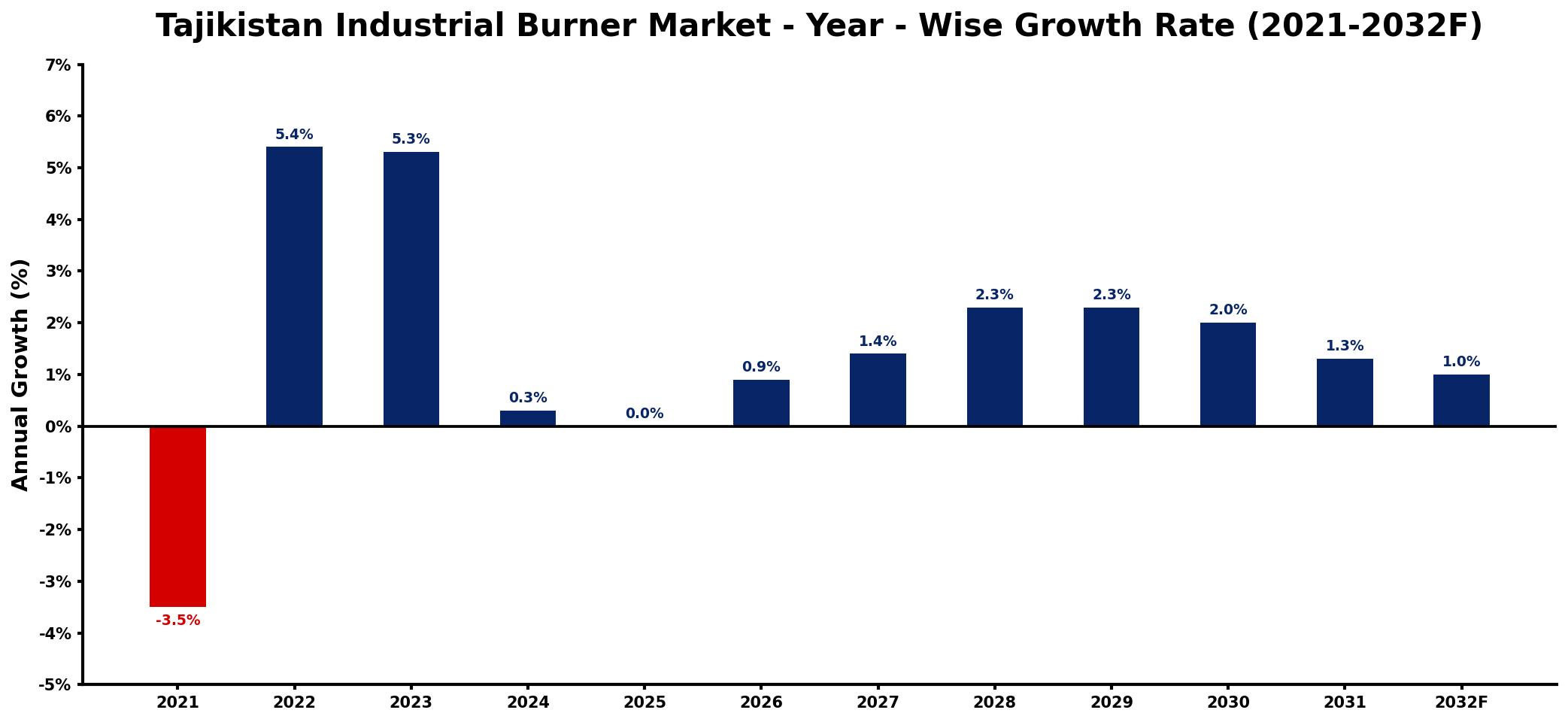
The table below presents the year‑wise growth rates along with the key drivers influencing the market
| Year | Growth Rate | Major Drivers |
| 2021 | -3.5% | decreased energy sector investments |
| 2022 | 5.4% | increased manufacturing sector demand |
| 2023 | 5.3% | growing construction project requirements |
| 2024 | 0.3% | expanding renewable energy initiatives |
| 2025 | 0.0% | rising export market opportunities |
| 2026 | 0.9% | enhanced energy efficiency regulations |
| 2027 | 1.4% | increased infrastructure development projects |
| 2028 | 2.3% | expanding manufacturing base activity |
| 2029 | 2.3% | expansion of local production facilities |
| 2030 | 2.0% | increased foreign direct investments |
| 2031 | 1.3% | growing demand for energy solutions |
| 2032 | 1.0% | rising focus on sustainability practices |
Note: Market size estimations and growth projections presented in this report are based on 6Wresearch's proprietary forecasting methodology, utilizing the latest available industry data, government publications, and primary research inputs.
Tajikistan Industrial Burner Market Synopsis
Currently, Tajikistan's industrial burner market is in a phase of notable transformation, driven by the demand for energy-efficient solutions amid rising environmental concerns. The push for modernization across various sectors is fostering an environment ripe for technological innovation in industrial burners.
The transition towards greener alternatives is evident as industries increasingly seek to minimize fuel consumption and emissions. This market is characterized by a strong shift towards automation and digitalization, enhancing monitoring and control in burner operations.
Tajikistan Industrial Burner Market Key Takeaways
- The market is influenced by increasing industrialization and a shift toward energy efficiency.
- Government policies are favoring the adoption of sustainable burner technologies.
- Automation and digital technology are emerging as key trends in industrial burner systems.
- Investment opportunities are available in sectors like manufacturing, power generation, and oil & gas.
- There is a growing need for skilled technicians to support advanced burner technologies.
Evaluation of Restraints in Tajikistan Industrial Burner Market
Despite the promising growth prospects, the Tajikistan Industrial Burner Market faces several challenges. Access to advanced burner technologies remains limited, which can hinder productivity. Moreover, inadequate infrastructure for installation and maintenance, alongside high import tariffs, poses significant barriers to market entry. The lack of skilled technicians further complicates the efficient operation of burner systems, creating an urgent need for workforce development and technology transfer initiatives.
Tajikistan Industrial Burner Market Trends
The market is currently witnessing a pronounced shift toward energy-efficient and environmentally friendly industrial burners. Theres an increasing emphasis on reducing carbon footprints, which is driving demand for burners that minimize emissions. Additionally, the integration of digital technologies into burner systems is enhancing operational efficiency, allowing for improved monitoring and control. This trend toward smarter solutions aligns well with the global move towards sustainability.
Tajikistan Industrial Burner Market Opportunities
Investment opportunities in the Tajikistan Industrial Burner Market are significant, particularly as the country emphasizes industrial modernization. Sectors such as manufacturing, energy, and chemical processing are ripe for introducing advanced burner technologies. The government's focus on promoting foreign investment and clean energy initiatives creates an inviting environment for stakeholders looking to capitalize on emerging market trends.
Government Initiatives in the Tajikistan Industrial Burner Market
The Tajik government has actively pursued policies aimed at fostering the Industrial Burner Market's growth. These include providing incentives for companies that invest in energy-efficient burner technologies and promoting the use of renewable energy sources in industrial applications. Additionally, regulations ensuring compliance with environmental standards are being enforced to support the transition toward cleaner industrial processes, thus enhancing overall market viability.
Future Insights of the Tajikistan Industrial Burner Market
Looking ahead to 2026-2032, the Tajikistan Industrial Burner Market is expected to continue its upward trajectory. The industrial sector's persistent push for modernization will drive demand for more efficient and sustainable burner solutions. Furthermore, ongoing infrastructural investments in key areas such as oil and gas, coupled with governmental support for cleaner energy initiatives, will position the market for significant growth. However, monitoring raw material price fluctuations and addressing labor shortages will be crucial for sustaining this positive outlook.
Tajikistan Industrial Burner Market Latest Developments (2025 - 2026)
Recent developments within the Tajikistan Industrial Burner Market indicate a heightened focus on technological innovation. There has been a surge in pilot projects aimed at testing advanced burner technologies, reflecting the industry's commitment to sustainable practices. Additionally, collaboration between local and foreign entities is becoming more prevalent as stakeholders seek to leverage each other's strengths to drive growth in the sector.
Tajikistan Industrial Burner Market - Key Attractiveness of the Report
- 10 Years of Market Numbers
- Historical Data Starting from 2022 to 2025
- Base Year: 2025
- Forecast Data until 2032
- Key Performance Indicators Impacting the Market
- Major Upcoming Developments and Projects
Key Highlights of the Report:
- Tajikistan Industrial Burner Market Outlook
- Market Size of Tajikistan Industrial Burner Market, 2025
- Forecast of Tajikistan Industrial Burner Market, 2032
- Historical Data and Forecast of Tajikistan Industrial Burner Revenues & Volume for the Period 2022-2032F
- Tajikistan Industrial Burner Market Trend Evolution
- Tajikistan Industrial Burner Market Drivers and Challenges
- Tajikistan Industrial Burner Price Trends
- Tajikistan Industrial Burner Porter's Five Forces
- Tajikistan Industrial Burner Industry Life Cycle
- Historical Data and Forecast of Tajikistan Industrial Burner Market Revenues & Volume By Type for the Period 2022-2032F
- Historical Data and Forecast of Tajikistan Industrial Burner Market Revenues & Volume By Cold Chamber Die Casting Machine for the Period 2022-2032F
- Historical Data and Forecast of Tajikistan Industrial Burner Market Revenues & Volume By Hot Chamber Die Casting Machine for the Period 2022-2032F
- Historical Data and Forecast of Tajikistan Industrial Burner Market Revenues & Volume By Gravity Die Casting Machine for the Period 2022-2032F
- Historical Data and Forecast of Tajikistan Industrial Burner Market Revenues & Volume By Material for the Period 2022-2032F
- Historical Data and Forecast of Tajikistan Industrial Burner Market Revenues & Volume By Aluminum for the Period 2022-2032F
- Historical Data and Forecast of Tajikistan Industrial Burner Market Revenues & Volume By Zinc for the Period 2022-2032F
- Historical Data and Forecast of Tajikistan Industrial Burner Market Revenues & Volume By Magnesium for the Period 2022-2032F
- Historical Data and Forecast of Tajikistan Industrial Burner Market Revenues & Volume By End User for the Period 2022-2032F
- Historical Data and Forecast of Tajikistan Industrial Burner Market Revenues & Volume By Transportation for the Period 2022-2032F
- Historical Data and Forecast of Tajikistan Industrial Burner Market Revenues & Volume By Mechanical & Manufacturing Equipment for the Period 2022-2032F
- Historical Data and Forecast of Tajikistan Industrial Burner Market Revenues & Volume By Building & Construction for the Period 2022-2032F
- Tajikistan Industrial Burner Import Export Trade Statistics
- Market Opportunity Assessment By Type
- Market Opportunity Assessment By Material
- Market Opportunity Assessment By End User
- Tajikistan Industrial Burner Top Companies Market Share
- Tajikistan Industrial Burner Competitive Benchmarking By Technical and Operational Parameters
- Tajikistan Industrial Burner Company Profiles
- Tajikistan Industrial Burner Key Strategic Recommendations






































