Tajikistan Industrial Rubber Products Market Size, Share & Growth Rate
The Tajikistan Industrial Rubber Products Market was estimated at USD 141 Million in 2025 and is projected to reach USD 154 Million by 2032, growing at a CAGR of 1.3% from 2026 to 2032. This growth trajectory is primarily driven by heightened industrial activities and substantial infrastructure projects throughout the country. The demand for rubber products is particularly rising in the automotive, construction, and manufacturing sectors, reflecting a broader trend toward modernization and economic development in Tajikistan.
Tajikistan Industrial Rubber Products Market Year-wise Growth Rate and Key Drivers
This graph highlights how the Tajikistan Industrial Rubber Products Market has steadily grown over the years, supported by major growth factors.
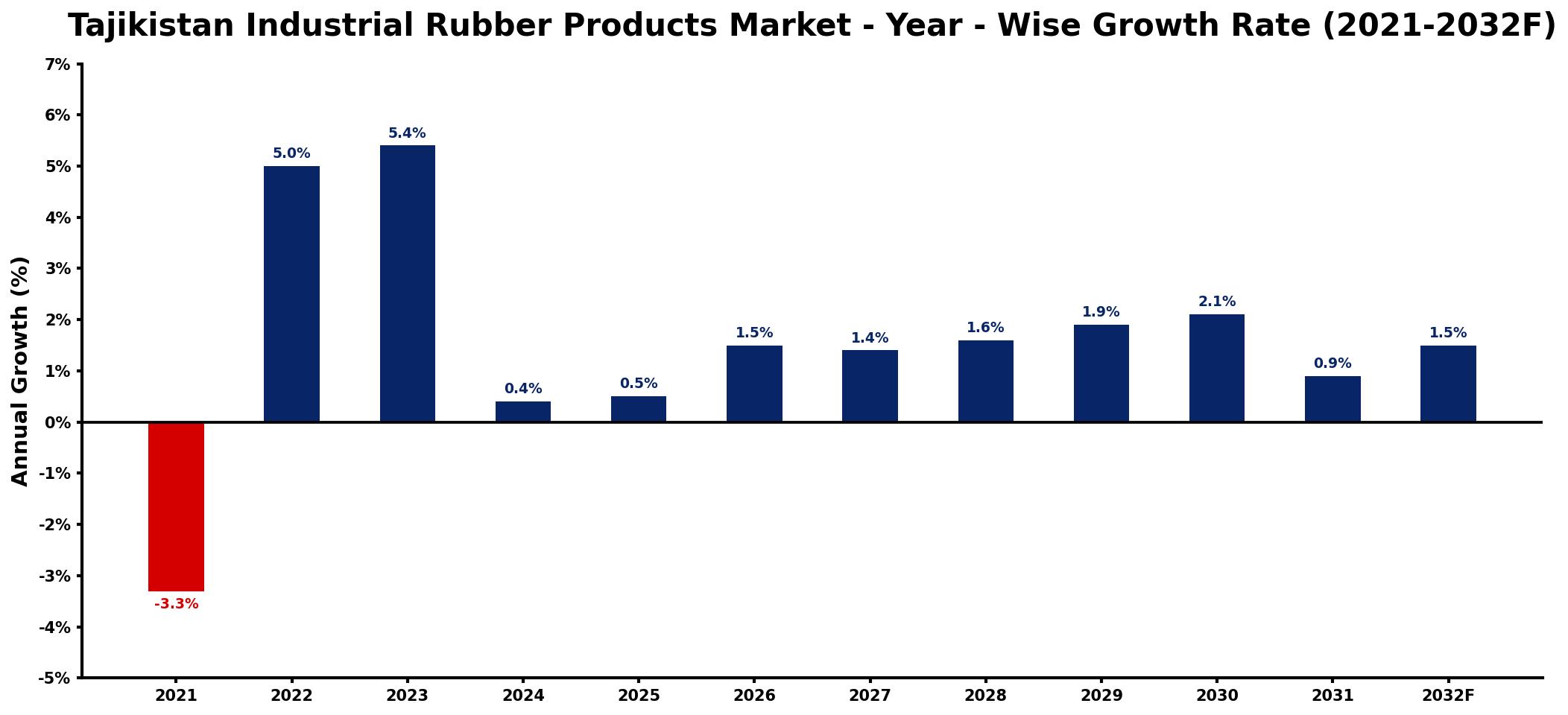
The table below presents the year‑wise growth rates along with the key drivers influencing the market
| Year | Growth Rate | Major Drivers |
| 2021 | -3.3% | decreased construction sector activity |
| 2022 | 5.0% | rising demand from automotive sector |
| 2023 | 5.4% | increased infrastructure development projects |
| 2024 | 0.4% | expansion in manufacturing capabilities |
| 2025 | 0.5% | growing agricultural machinery requirements |
| 2026 | 1.5% | boost in transportation industry investments |
| 2027 | 1.4% | enhanced supply chain efficiencies |
| 2028 | 1.6% | surge in export opportunities |
| 2029 | 1.9% | growing focus on sustainability initiatives |
| 2030 | 2.1% | increased technological advancements adoption |
| 2031 | 0.9% | expansion of local manufacturing base |
| 2032 | 1.5% | rising consumer awareness initiatives |
Note: Market size estimations and growth projections presented in this report are based on 6Wresearch's proprietary forecasting methodology, utilizing the latest available industry data, government publications, and primary research inputs.
Tajikistan Industrial Rubber Products Market Synopsis
In recent years, the Tajikistan Industrial Rubber Products Market has experienced a steady uptick, fueled by governmental initiatives and foreign investments. As industries expand, the need for reliable rubber products like hoses, belts, gaskets, and seals is growing, further bolstering market dynamics. However, while the current growth momentum is promising, the market must navigate challenges posed by price volatility and competition from lower-cost producers.
Looking ahead, the market is set for significant transformation, driven by investments in technology and innovative materials aimed at enhancing product quality and sustainability. As manufacturers adapt to evolving demands, the transition toward more environmentally friendly rubber products will likely shape the future landscape of the Tajikistan Industrial Rubber Products Market.
Tajikistan Industrial Rubber Products Market Key Takeaways
- The market is projected to grow from USD 141 Million in 2025 to USD 154 Million by 2032.
- Key sectors driving demand include automotive, construction, and manufacturing.
- Investments in R&D are increasing to develop advanced rubber solutions tailored to industry needs.
- Government initiatives support local manufacturing, bolstering the domestic rubber products industry.
- Challenges such as fluctuating raw material prices and competition from neighboring countries need to be addressed.
Evaluation of Restraints in Tajikistan Industrial Rubber Products Market
Despite the promising outlook, the Tajikistan Industrial Rubber Products Market faces several restraints. Limited technological advancements often result in lower product quality when compared to international standards, presenting a challenge for local manufacturers striving for competitiveness. Additionally, inadequate infrastructure constrains distribution networks, making it difficult to reach end-users efficiently. The fluctuation of raw material prices can significantly impact production costs, which complicates pricing strategies. Lastly, the industry experiences vulnerabilities to global economic shifts and regional geopolitical tensions, which can disrupt supply chains and demand patterns.
Tajikistan Industrial Rubber Products Market Trends
Current trends in the Tajikistan Industrial Rubber Products Market include a shift towards sustainable and environmentally friendly rubber solutions. This trend is manifesting in increased adoption of innovative materials and technologies aimed at enhancing product performance and longevity. Moreover, a greater emphasis on safety and quality standards is compelling manufacturers to refine their production processes, ensuring compliance with both local and international requirements.
Tajikistan Industrial Rubber Products Market Opportunities
The market presents numerous investment opportunities, particularly in response to growing demands from the automotive and construction sectors. Investors may find potential in establishing local manufacturing facilities or partnering with domestic suppliers. Additionally, there are avenues for introducing new technologies in rubber production and supplying high-quality raw materials, which could align well with the government's industrial growth initiatives.
Government Initiatives in the Tajikistan Industrial Rubber Products Market
The Tajikistan government has rolled out a series of policies designed to bolster the Industrial Rubber Products Market. These policies often include incentives such as tax breaks and subsidies for businesses that invest in local rubber manufacturing. Additionally, there is an emphasis on fostering research and development to improve product standards and global competitiveness. The government is also focused on ensuring environmental sustainability and worker safety in the rubber industry, contributing to a more robust and responsible manufacturing environment.
Future Insights of the Tajikistan Industrial Rubber Products Market
The future of the Tajikistan Industrial Rubber Products Market appears optimistic, with expectations of continued growth bolstered by expanding industrialization and infrastructure development. As investment pours into key sectors, the demand for quality rubber products is likely to increase. Innovations in production techniques and materials will further enhance market offerings, driving competitive advantage. Nevertheless, businesses will need to remain vigilant about fluctuating material costs and international market dynamics to successfully navigate the evolving landscape.
Tajikistan Industrial Rubber Products Market Latest Developments (2025 - 2026)
Recent developments within the Tajikistan Industrial Rubber Products Market have highlighted a growing focus on sustainability, as several local manufacturers explore eco-friendly rubber materials. Additionally, there has been a noticeable uptick in partnerships between local firms and international players, aimed at enhancing product quality and expanding distribution networks. Government initiatives continue to provide a supportive framework, facilitating investments aimed at modernizing production facilities across the sector.
Tajikistan Industrial Rubber Products Market - Key Attractiveness of the Report
- 10 Years of Market Numbers
- Historical Data Starting from 2022 to 2025
- Base Year: 2025
- Forecast Data until 2032
- Key Performance Indicators Impacting the Market
- Major Upcoming Developments and Projects
Key Highlights of the Report:
- Tajikistan Industrial Rubber Products Market Outlook
- Market Size of Tajikistan Industrial Rubber Products Market, 2025
- Forecast of Tajikistan Industrial Rubber Products Market, 2032
- Historical Data and Forecast of Tajikistan Industrial Rubber Products Revenues & Volume for the Period 2022-2032F
- Tajikistan Industrial Rubber Products Market Trend Evolution
- Tajikistan Industrial Rubber Products Market Drivers and Challenges
- Tajikistan Industrial Rubber Products Price Trends
- Tajikistan Industrial Rubber Products Porter's Five Forces
- Tajikistan Industrial Rubber Products Industry Life Cycle
- Historical Data and Forecast of Tajikistan Industrial Rubber Products Market Revenues & Volume By Rubber Type for the Period 2022-2032F
- Historical Data and Forecast of Tajikistan Industrial Rubber Products Market Revenues & Volume By Natural Rubber for the Period 2022-2032F
- Historical Data and Forecast of Tajikistan Industrial Rubber Products Market Revenues & Volume By Styrene Butadiene Rubber for the Period 2022-2032F
- Historical Data and Forecast of Tajikistan Industrial Rubber Products Market Revenues & Volume By Polybutadiene for the Period 2022-2032F
- Historical Data and Forecast of Tajikistan Industrial Rubber Products Market Revenues & Volume By Ethylene-propylene for the Period 2022-2032F
- Historical Data and Forecast of Tajikistan Industrial Rubber Products Market Revenues & Volume By Nitrile Butadiene Rubber for the Period 2022-2032F
- Historical Data and Forecast of Tajikistan Industrial Rubber Products Market Revenues & Volume By Others for the Period 2022-2032F
- Historical Data and Forecast of Tajikistan Industrial Rubber Products Market Revenues & Volume By Process for the Period 2022-2032F
- Historical Data and Forecast of Tajikistan Industrial Rubber Products Market Revenues & Volume By Molded for the Period 2022-2032F
- Historical Data and Forecast of Tajikistan Industrial Rubber Products Market Revenues & Volume By Extruded for the Period 2022-2032F
- Historical Data and Forecast of Tajikistan Industrial Rubber Products Market Revenues & Volume By Fabricated for the Period 2022-2032F
- Historical Data and Forecast of Tajikistan Industrial Rubber Products Market Revenues & Volume By Latex-Based for the Period 2022-2032F
- Historical Data and Forecast of Tajikistan Industrial Rubber Products Market Revenues & Volume By Others for the Period 2022-2032F
- Historical Data and Forecast of Tajikistan Industrial Rubber Products Market Revenues & Volume By Product for the Period 2022-2032F
- Historical Data and Forecast of Tajikistan Industrial Rubber Products Market Revenues & Volume By Mechanical Rubber Products for the Period 2022-2032F
- Historical Data and Forecast of Tajikistan Industrial Rubber Products Market Revenues & Volume By Rubber Hoses for the Period 2022-2032F
- Historical Data and Forecast of Tajikistan Industrial Rubber Products Market Revenues & Volume By Rubber Belts for the Period 2022-2032F
- Historical Data and Forecast of Tajikistan Industrial Rubber Products Market Revenues & Volume By Rubber Roofing for the Period 2022-2032F
- Historical Data and Forecast of Tajikistan Industrial Rubber Products Market Revenues & Volume By Others for the Period 2022-2032F
- Historical Data and Forecast of Tajikistan Industrial Rubber Products Market Revenues & Volume By End-use for the Period 2022-2032F
- Historical Data and Forecast of Tajikistan Industrial Rubber Products Market Revenues & Volume By Construction & Infrastructure for the Period 2022-2032F
- Historical Data and Forecast of Tajikistan Industrial Rubber Products Market Revenues & Volume By Automotive for the Period 2022-2032F
- Historical Data and Forecast of Tajikistan Industrial Rubber Products Market Revenues & Volume By Aerospace for the Period 2022-2032F
- Historical Data and Forecast of Tajikistan Industrial Rubber Products Market Revenues & Volume By Energy for the Period 2022-2032F
- Historical Data and Forecast of Tajikistan Industrial Rubber Products Market Revenues & Volume By Others for the Period 2022-2032F
- Tajikistan Industrial Rubber Products Import Export Trade Statistics
- Market Opportunity Assessment By Rubber Type
- Market Opportunity Assessment By Process
- Market Opportunity Assessment By Product
- Market Opportunity Assessment By End-use
- Tajikistan Industrial Rubber Products Top Companies Market Share
- Tajikistan Industrial Rubber Products Competitive Benchmarking By Technical and Operational Parameters
- Tajikistan Industrial Rubber Products Company Profiles
- Tajikistan Industrial Rubber Products Key Strategic Recommendations






































