Tajikistan IoT Market Size & Growth Rate (2026-2032)
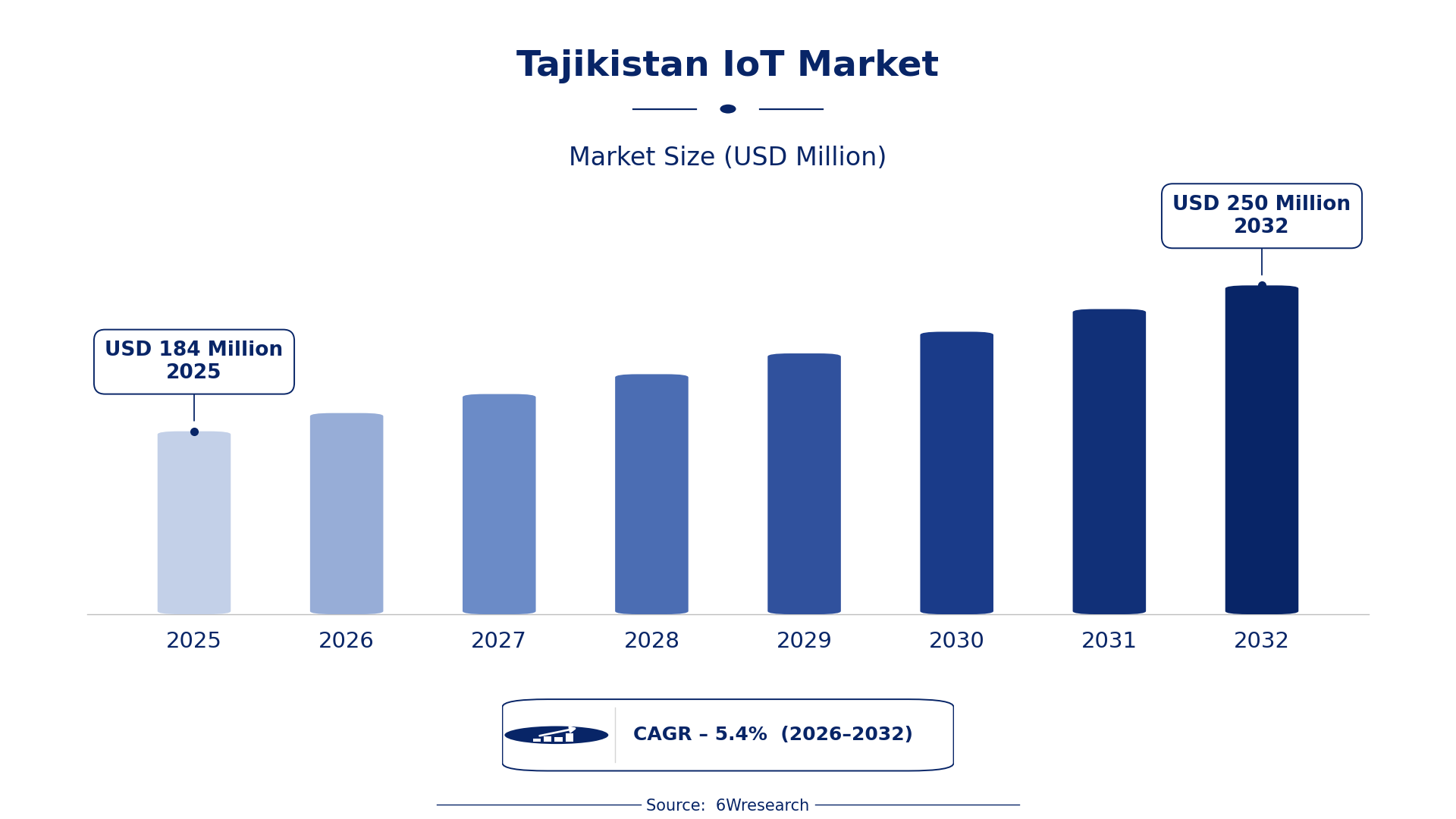
The Tajikistan IoT Market was estimated at USD 184 Million in 2025 and is projected to reach USD 250 Million by 2032, growing at a CAGR of 5.4% from 2026 to 2032.
Tajikistan IoT Market Synopsis
The Tajikistan IoT market is on an upward trajectory, fueled by the government’s push for digital transformation and infrastructure enhancement. In recent years, sectors such as agriculture, manufacturing, and transportation have begun to embrace IoT technologies, setting the stage for further expansion.
As local enterprises and international investors increasingly recognize the potential of IoT applications, the market is expected to evolve significantly. This momentum, coupled with growing awareness of smart technologies, suggests that the coming years will see an intensified focus on innovative solutions tailored to Tajikistan's unique needs.
Tajikistan IoT Market Year-wise Growth Rate and Key Drivers
This graph illustrates the annual growth rates of the Tajikistan IoT Market from 2021 to 2032, highlighting a steady upward trajectory and projected expansion over the forecast period.
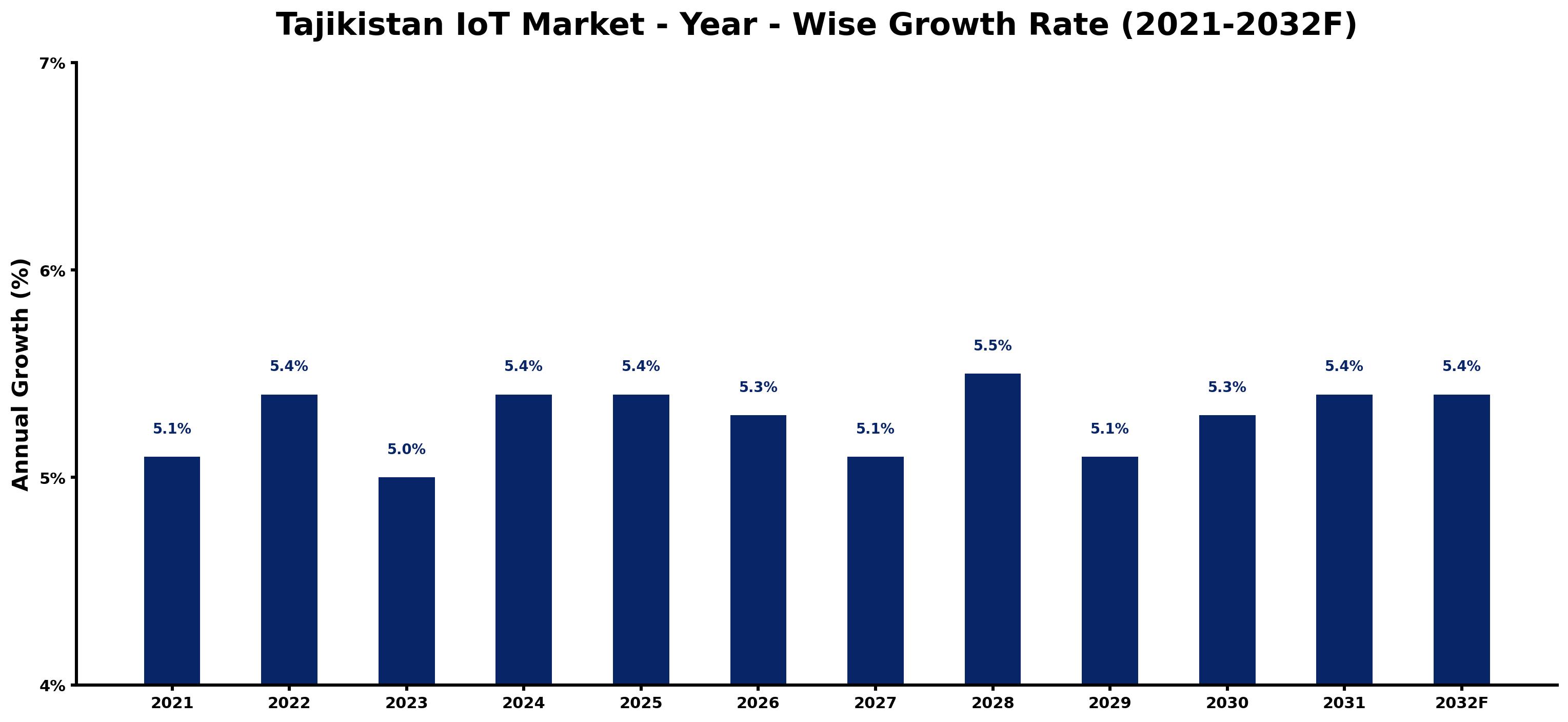
The table below presents the year‑wise growth rates along with the key drivers influencing the market
| Year | Growth Rate | Major Drivers |
| 2021 | 5.1% | Government initiative to enhance rural connectivity programs. |
| 2022 | 5.4% | Emergence of local startups focusing on smart city solutions. |
| 2023 | 5.0% | Growing interest in agricultural IoT from regional farmers. |
| 2024 | 5.4% | Upgraded regulatory framework supporting IoT deployment rapidity. |
| 2025 | 5.4% | Increasing public-private partnerships for digital infrastructure projects. |
| 2026 | 5.3% | Boost in broadband connectivity improving IoT device accessibility. |
| 2027 | 5.1% | Young population driving demand for connected lifestyle products. |
| 2028 | 5.5% | National strategy promoting digital transformation in key services. |
| 2029 | 5.1% | Investment in educational programs about IoT technologies. |
| 2030 | 5.3% | Local government incentives for tech-driven small businesses. |
| 2031 | 5.4% | Rising tech workforce enhancing IoT project implementations. |
| 2032 | 5.4% | Increased integration of IoT in public service management. |
Note: Market size estimations and growth projections presented in this report are based on 6Wresearch's proprietary forecasting methodology, utilizing the latest available industry data, government publications, and primary research inputs.
Tajikistan IoT Market Key Takeaways
Below are some of the specific key takeaways from the market, including:
- The government's commitment to digital transformation is a primary driver of IoT adoption.
- Investment in smart agriculture solutions is gaining traction to enhance crop yields.
- Smart city initiatives are emerging as a key focus area for urban development.
- Industrial IoT solutions are being adopted to boost operational efficiency across various sectors.
- Challenges such as connectivity and skill gaps need to be addressed to unlock full market potential.
Evaluation of Restraints in Tajikistan IoT Market
Several factors are currently restraining the growth of the Tajikistan IoT market. Limited internet infrastructure hampers the deployment of IoT solutions, particularly in rural and remote areas. Additionally, there is a notable lack of technical expertise among the local workforce, which stifles innovation and implementation. Businesses often struggle with a general lack of understanding regarding IoT technologies, leading to hesitation in investment. on top of that, concerns surrounding data security and privacy issues further complicate the market's advancement. Addressing these challenges requires a concerted effort from both the government and the private sector to improve infrastructure, invest in education, and create a conducive regulatory environment.
Tajikistan IoT Market Trends
A few notable trends are emerging in the Tajikistan IoT market. The integration of IoT with artificial intelligence and cloud computing is enhancing data processing capabilities, allowing for more efficient operations across sectors. Smart agriculture is becoming increasingly popular, with farmers adopting IoT solutions for real-time monitoring of crops and livestock. Additionally, the concept of smart cities is gaining momentum, with local governments exploring IoT technologies to improve urban living. These trends indicate a shift toward a more connected and automated future for Tajikistan.
Tajikistan IoT Market Opportunities
The potential for growth in the Tajikistan IoT market is substantial. There is a clear opportunity for businesses to develop smart city initiatives that can streamline urban services and improve the quality of life for residents. on top of that, innovations in smart agriculture and IoT-enabled monitoring systems present a pathway for enhancing productivity and efficiency in the agricultural sector. The increasing focus on connectivity solutions will also drive demand for IoT devices and services, making it an attractive arena for investment.
Government Initiatives in the Tajikistan IoT Market
The Tajikistan government is actively shaping the IoT market through a variety of initiatives aimed at boosting infrastructure and encouraging investment. By fostering a regulatory environment conducive to innovation, the government is signaling its commitment to harnessing the potential of IoT technologies for national development.
- A national digital infrastructure upgrade programme launched in late 2023 aims to improve internet access across rural areas.
- Ongoing efforts focus on creating a regulatory framework that supports the deployment of IoT solutions, including incentives for local companies.
- A public-private partnership initiative currently underway seeks to expand IoT applications in agriculture, promoting smart farming practices.
- Plans for a comprehensive smart city pilot project are expected to be rolled out by 2026, showcasing IoT integration in urban management.
- The government is working on educational reforms to enhance technical skills relevant to IoT technologies among the workforce.
Future Insights of the Tajikistan IoT Market
Looking ahead to 2026-2032, the Tajikistan IoT market is set for a phase of steady growth driven by increased investment and technological adoption. As the government continues to prioritize digital transformation, the demand for IoT solutions will likely escalate across various industries. While challenges like data security and the need for skilled professionals may persist, the overall trend points towards a more connected, efficient, and innovative economy.
Tajikistan IoT Market Latest Developments
In the past year, the Tajikistan IoT market has seen a surge in activity, with both local and international stakeholders recognizing the potential of IoT technologies. The focus has been on enhancing infrastructure and developing tailored solutions to meet the specific needs of the region.
- A leading regional operator successfully launched a new IoT platform in Q2 2024, enabling businesses to better manage their operations through real-time data analytics.
- An initiative that began in early 2024 and remains underway aims to deploy IoT-enabled smart irrigation systems in key agricultural regions.
- A major technology vendor initiated a collaboration with local universities in late 2023 to enhance IoT education and research capabilities.
- A rollout expected to begin in mid-2026 will expand the existing telecommunications infrastructure to support more IoT applications across urban areas.
Tajikistan IoT Market - Key Attractiveness of the Report
- 10 Years of Market Numbers
- Historical Data Starting from 2022 to 2025
- Base Year: 2025
- Forecast Data until 2032
- Key Performance Indicators Impacting the Market
- Major Upcoming Developments and Projects
Key Highlights of the Report:
- Tajikistan IoT Market Outlook
- Market Size of Tajikistan IoT Market, 2025
- Forecast of Tajikistan IoT Market, 2032
- Historical Data and Forecast of Tajikistan IoT Revenues & Volume for the Period 2022-2032F
- Tajikistan IoT Market Trend Evolution
- Tajikistan IoT Market Drivers and Challenges
- Tajikistan IoT Price Trends
- Tajikistan IoT Porter's Five Forces
- Tajikistan IoT Industry Life Cycle
- Historical Data and Forecast of Tajikistan IoT Market Revenues & Volume By Component for the Period 2022-2032F
- Historical Data and Forecast of Tajikistan IoT Market Revenues & Volume By Platform for the Period 2022-2032F
- Historical Data and Forecast of Tajikistan IoT Market Revenues & Volume By Service for the Period 2022-2032F
- Historical Data and Forecast of Tajikistan IoT Market Revenues & Volume By Software Solution for the Period 2022-2032F
- Historical Data and Forecast of Tajikistan IoT Market Revenues & Volume By Application for the Period 2022-2032F
- Historical Data and Forecast of Tajikistan IoT Market Revenues & Volume By Building & Home Automation for the Period 2022-2032F
- Historical Data and Forecast of Tajikistan IoT Market Revenues & Volume By Smart Energy for the Period 2022-2032F
- Historical Data and Forecast of Tajikistan IoT Market Revenues & Volume By Smart Manufacturing for the Period 2022-2032F
- Historical Data and Forecast of Tajikistan IoT Market Revenues & Volume By Connected Logistics for the Period 2022-2032F
- Historical Data and Forecast of Tajikistan IoT Market Revenues & Volume By Connected Health for the Period 2022-2032F
- Historical Data and Forecast of Tajikistan IoT Market Revenues & Volume By Smart Retail for the Period 2022-2032F
- Historical Data and Forecast of Tajikistan IoT Market Revenues & Volume By Smart Mobility & Transportation for the Period 2022-2032F
- Historical Data and Forecast of Tajikistan IoT Market Revenues & Volume By Security & Emergencies for the Period 2022-2032F
- Historical Data and Forecast of Tajikistan IoT Market Revenues & Volume By Platform for the Period 2022-2032F
- Historical Data and Forecast of Tajikistan IoT Market Revenues & Volume By Device Management Platform for the Period 2022-2032F
- Historical Data and Forecast of Tajikistan IoT Market Revenues & Volume By Application Management Software for the Period 2022-2032F
- Historical Data and Forecast of Tajikistan IoT Market Revenues & Volume By Network Management Software for the Period 2022-2032F
- Historical Data and Forecast of Tajikistan IoT Market Revenues & Volume By Software Solution for the Period 2022-2032F
- Historical Data and Forecast of Tajikistan IoT Market Revenues & Volume By Real-time Stream Analytics for the Period 2022-2032F
- Historical Data and Forecast of Tajikistan IoT Market Revenues & Volume By Security Solution for the Period 2022-2032F
- Historical Data and Forecast of Tajikistan IoT Market Revenues & Volume By Data Management for the Period 2022-2032F
- Historical Data and Forecast of Tajikistan IoT Market Revenues & Volume By Remote Monitoring System for the Period 2022-2032F
- Historical Data and Forecast of Tajikistan IoT Market Revenues & Volume By Network Bandwidth Management for the Period 2022-2032F
- Historical Data and Forecast of Tajikistan IoT Market Revenues & Volume By Service for the Period 2022-2032F
- Historical Data and Forecast of Tajikistan IoT Market Revenues & Volume By Professional Services for the Period 2022-2032F
- Historical Data and Forecast of Tajikistan IoT Market Revenues & Volume By Managed Services for the Period 2022-2032F
- Tajikistan IoT Import Export Trade Statistics
- Market Opportunity Assessment By Component
- Market Opportunity Assessment By Application
- Market Opportunity Assessment By Platform
- Market Opportunity Assessment By Software Solution
- Market Opportunity Assessment By Service
- Tajikistan IoT Top Companies Market Share
- Tajikistan IoT Competitive Benchmarking By Technical and Operational Parameters
- Tajikistan IoT Company Profiles
- Tajikistan IoT Key Strategic Recommendations






































