Tajikistan Lavender oil Market Size, Share & Growth Rate
The Tajikistan Lavender oil Market was estimated at USD 487 Million in 2025 and is projected to reach USD 704 Million by 2032, growing at a CAGR of 5.4% from 2026 to 2032. This growth trajectory is largely attributed to the burgeoning demand for natural and organic products within the beauty and wellness sectors. As consumers increasingly prioritize the therapeutic benefits of lavender oil—such as stress reduction and relaxation—the industry is poised to thrive, particularly in export markets across Europe and Asia.
Tajikistan Lavender oil Market Year-wise Growth Rate and Key Drivers
This graph highlights how the Tajikistan Lavender oil Market has steadily grown over the years, supported by major growth factors.
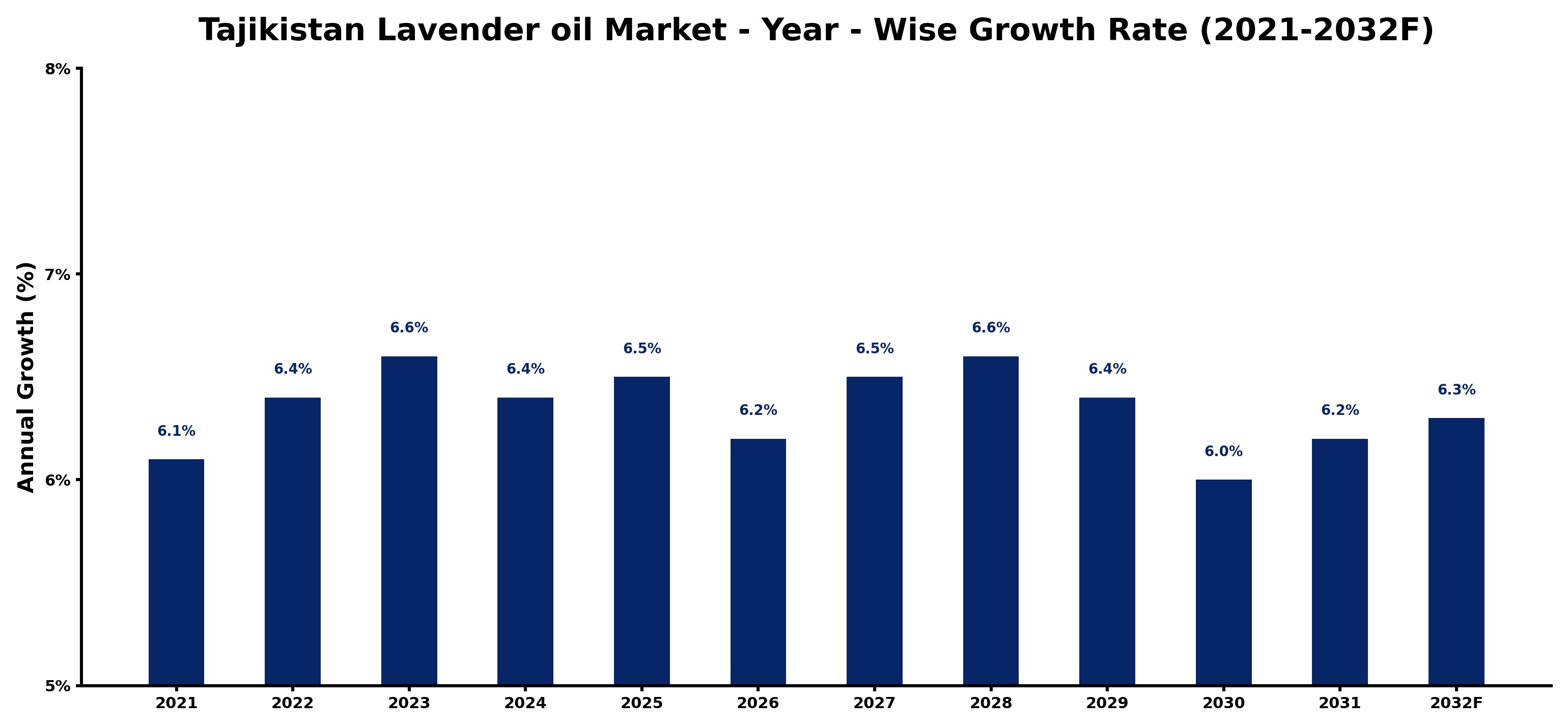
The table below presents the year‑wise growth rates along with the key drivers influencing the market
| Year | Growth Rate | Major Drivers |
| 2021 | 6.1% | Rising electricity demand across industries |
| 2022 | 6.4% | Rapid growth in telecom and data center sectors |
| 2023 | 6.6% | Growing urbanization and commercial development |
| 2024 | 6.4% | Rising electricity demand across industries |
| 2025 | 6.5% | Expansion of commercial construction activities |
| 2026 | 6.2% | Increasing smart city development projects |
| 2027 | 6.5% | Expansion of manufacturing activities |
| 2028 | 6.6% | Expansion of commercial construction activities |
| 2029 | 6.4% | Growing renewable energy integration projects |
| 2030 | 6.0% | Increasing industrial automation investments |
| 2031 | 6.2% | Rising electricity demand across industries |
| 2032 | 6.3% | Expansion of commercial construction activities |
Note - Market size estimations and growth projections presented in this report are based on 6Wresearch's advanced forecasting approach, validated with industry datasets as of June 2026.
Tajikistan Lavender oil Market Synopsis
Recently, the Tajikistan lavender oil market has shown significant momentum, buoyed by the global shift towards natural and organic ingredients in personal care. However, this flourishing market is transitioning towards a more competitive landscape, with an emphasis on quality and sustainability becoming paramount for producers. As the market matures, there is an increasing focus on positioning Tajikistan's lavender oil as a premium offering internationally.
Tajikistan's favorable growing conditions have historically contributed to high-quality lavender oil production. Nevertheless, the market is at a critical juncture where strategic investments in infrastructure, farmer education, and quality control will determine its future trajectory. Strengthening these areas will ensure that local producers can effectively meet the growing international demand.
Tajikistan Lavender oil Market Key Takeaways
- Steady growth driven by the increasing global demand for natural and organic beauty products.
- The therapeutic benefits of lavender oil are enhancing its popularity in aromatherapy and personal care.
- Tajikistan's favorable climate and soil conditions support high-quality lavender oil production.
- Investment in sustainable farming and processing is crucial for market competitiveness.
- Government policies aim to foster growth in the lavender oil sector, providing subsidies and support.
Evaluation of Restraints in Tajikistan Lavender oil Market
Despite the market's potential, several constraints are hindering growth. Limited infrastructure for lavender cultivation and processing remains a significant barrier, reducing efficiency and output. Additionally, fluctuations in weather patterns pose a risk to consistent yields, while a lack of awareness among local farmers regarding best practices can lead to suboptimal production quality. These challenges are further compounded by the regional political and economic instability, which can create uncertainties for businesses seeking to expand and access international markets.
Tajikistan Lavender oil Market Trends
Key trends influencing the Tajikistan lavender oil market include an increasing consumer preference for aromatherapy and wellness products, which is driving demand across multiple sectors. Additionally, the rise of sustainable and ethically sourced ingredients is pushing producers to adopt eco-friendly practices, enhancing product appeal. Innovative extraction methods and advancements in processing technology are also emerging, allowing for the production of higher-quality oil that meets international standards.
Tajikistan Lavender oil Market Opportunities
The Tajikistan lavender oil market is ripe with opportunities for investment and growth. The ongoing global demand for natural essential oils presents a unique chance for stakeholders to invest in lavender cultivation and advanced processing facilities. Developing partnerships with local farmers can create a competitive sourcing model while investing in research and development can enhance product quality and yield. Furthermore, establishing diversified export channels can significantly mitigate risks associated with market fluctuations.
Government Initiatives in the Tajikistan Lavender oil Market
The Tajikistan government recognizes the potential of the lavender oil sector for economic growth and export diversification. Policies aimed at supporting farmers include subsidies for agricultural technology and training programs designed to improve cultivation practices. Regulatory frameworks ensure the quality of lavender oil produced, enhancing its reputation in international markets. Moreover, tax incentives and initiatives promoting sustainable production methods reflect the government's commitment to nurturing this burgeoning industry.
Future Insights of the Tajikistan Lavender oil Market
Looking ahead to 2026-2032, the Tajikistan lavender oil market is positioned for robust growth, largely propelled by the increasing global emphasis on natural and organic beauty products. Enhanced agricultural practices and investments in production capabilities will likely strengthen the industry's position in global markets. Additionally, growing consumer awareness of the health benefits associated with lavender oil is expected to sustain demand, further solidifying Tajikistan's role in the international lavender oil market.
Tajikistan Lavender oil Market Latest Developments (May 2025 - June 2026)
Recent developments in the Tajikistan lavender oil market include collaborative efforts between local farmers and international agricultural organizations aimed at improving cultivation techniques. Training workshops have been initiated to educate farmers on sustainable farming practices and processing methods. Furthermore, ongoing negotiations with foreign buyers highlight the growing interest in Tajikistan's lavender oil, suggesting an upward trajectory in export potential.
Tajikistan Lavender oil Market - Key Attractiveness of the Report
- 10 Years of Market Numbers
- Historical Data Starting from 2022 to 2025
- Base Year: 2025
- Forecast Data until 2032
- Key Performance Indicators Impacting the Market
- Major Upcoming Developments and Projects
Key Highlights of the Report:
- Tajikistan Lavender oil Market Outlook
- Market Size of Tajikistan Lavender oil Market, 2025
- Forecast of Tajikistan Lavender oil Market, 2032
- Historical Data and Forecast of Tajikistan Lavender oil Revenues & Volume for the Period 2022-2032F
- Tajikistan Lavender oil Market Trend Evolution
- Tajikistan Lavender oil Market Drivers and Challenges
- Tajikistan Lavender oil Price Trends
- Tajikistan Lavender oil Porter's Five Forces
- Tajikistan Lavender oil Industry Life Cycle
- Historical Data and Forecast of Tajikistan Lavender oil Market Revenues & Volume By Application for the Period 2022-2032F
- Historical Data and Forecast of Tajikistan Lavender oil Market Revenues & Volume By Food and Beverage for the Period 2022-2032F
- Historical Data and Forecast of Tajikistan Lavender oil Market Revenues & Volume By Cosmetic for the Period 2022-2032F
- Historical Data and Forecast of Tajikistan Lavender oil Market Revenues & Volume By Pharmaceutical for the Period 2022-2032F
- Historical Data and Forecast of Tajikistan Lavender oil Market Revenues & Volume By Distribution Channel for the Period 2022-2032F
- Historical Data and Forecast of Tajikistan Lavender oil Market Revenues & Volume By Pharmacy and Drug Stores for the Period 2022-2032F
- Historical Data and Forecast of Tajikistan Lavender oil Market Revenues & Volume By Health and Beauty Stores for the Period 2022-2032F
- Historical Data and Forecast of Tajikistan Lavender oil Market Revenues & Volume By Online Retailing for the Period 2022-2032F
- Historical Data and Forecast of Tajikistan Lavender oil Market Revenues & Volume By Others for the Period 2022-2032F
- Tajikistan Lavender oil Import Export Trade Statistics
- Market Opportunity Assessment By Application
- Market Opportunity Assessment By Distribution Channel
- Tajikistan Lavender oil Top Companies Market Share
- Tajikistan Lavender oil Competitive Benchmarking By Technical and Operational Parameters
- Tajikistan Lavender oil Company Profiles
- Tajikistan Lavender oil Key Strategic Recommendations






































