Tajikistan Letterpress Printing Machinery Market Size, Share & Growth Rate
The Tajikistan Letterpress Printing Machinery Market was estimated at USD 454 Million in 2025 and is projected to reach USD 600 Million by 2032, growing at a CAGR of 4.1% from 2026 to 2032. This positive growth trajectory is largely driven by an escalating demand for high-quality printed materials, spurred by the rising activities in commercial printing, particularly within the packaging and advertising sectors. As local printing enterprises upgrade their equipment, the market is poised for further expansion, reflecting Tajikistans developing economy.
Tajikistan Letterpress Printing Machinery Market Year-wise Growth Rate and Key Drivers
This graph highlights how the Tajikistan Letterpress Printing Machinery Market has steadily grown over the years, supported by major growth factors.
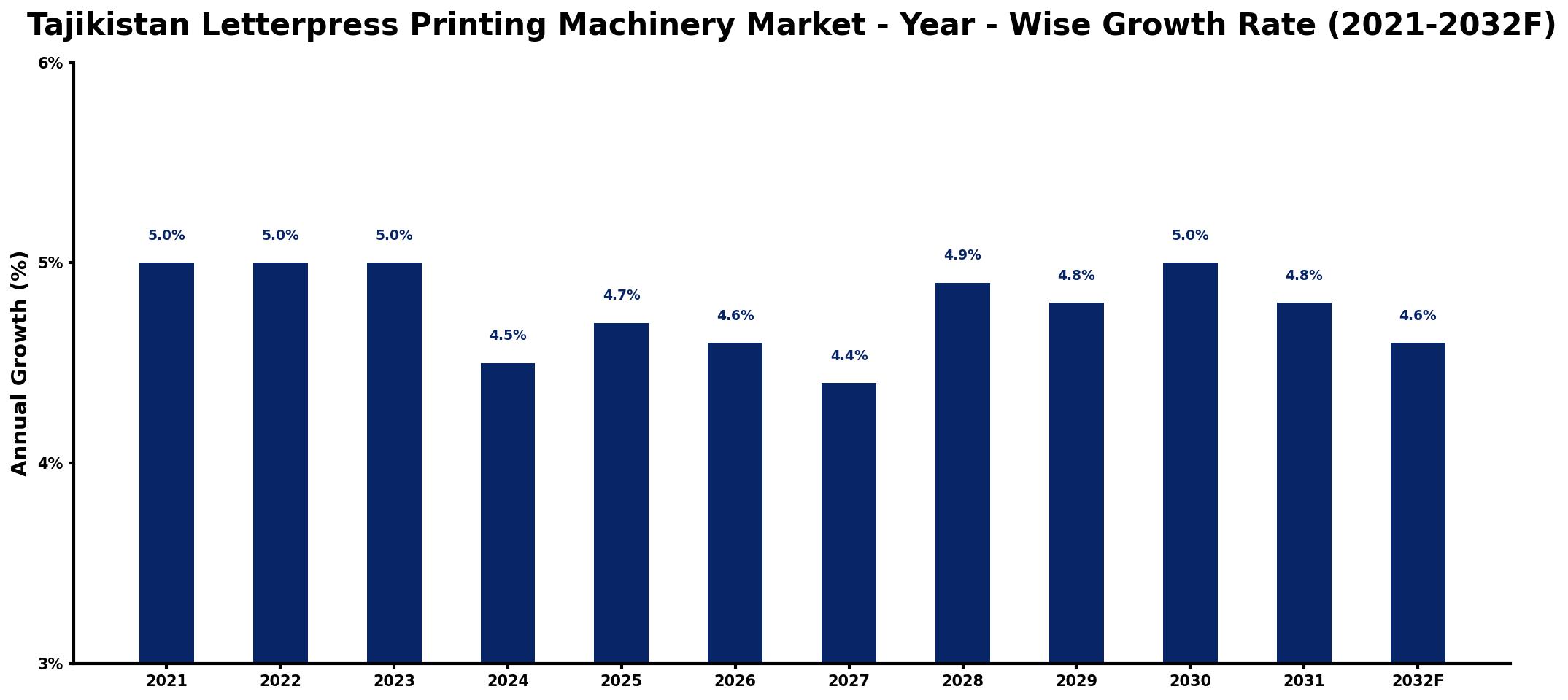
The table below presents the year‑wise growth rates along with the key drivers influencing the market
| Year | Growth Rate | Major Drivers |
| 2021 | 5.0% | Rising demand for packaging solutions |
| 2022 | 5.0% | increased pharmaceutical industry usage |
| 2023 | 5.0% | Increased investment in technology |
| 2024 | 4.5% | Growing interest in sustainable practices |
| 2025 | 4.7% | Strengthening of regional trade agreements |
| 2026 | 4.6% | Emergence of new market players |
| 2027 | 4.4% | Increase in educational initiatives |
| 2028 | 4.9% | Boost in e-commerce activities |
| 2029 | 4.8% | Greater focus on customization options |
| 2030 | 5.0% | Surge in advertising expenditures |
| 2031 | 4.8% | Development of creative design services |
| 2032 | 4.6% | Enhanced supply chain efficiency |
Note: Market size estimations and growth projections presented in this report are based on 6Wresearch's proprietary forecasting methodology, utilizing the latest available industry data, government publications, and primary research inputs.
Tajikistan Letterpress Printing Machinery Market Synopsis
A notable shift is occurring in the Tajikistan letterpress printing landscape, with local businesses increasingly seeking modern machinery to enhance production efficiency. This trend is particularly evident in the burgeoning packaging industry, where the demand for versatile and high-quality print options continues to grow.
The move toward automation and the integration of digital solutions are reshaping traditional practices. While letterpress remains valuable for specific applications, the industry is gradually transitioning toward more sophisticated technology to meet evolving customer expectations.
Tajikistan Letterpress Printing Machinery Market Key Takeaways
- The market is witnessing a consistent growth trend, with increasing demand for quality printing services.
- Investments in modern letterpress technology are essential for local printing firms to remain competitive.
- Environmental sustainability practices are becoming integral, with a rising adoption of eco-friendly materials.
- Government initiatives are fostering a supportive environment for domestic manufacturing of printing machinery.
- Emerging digital printing technologies are reshaping production processes, enhancing efficiency and quality.
Evaluation of Restraints in Tajikistan Letterpress Printing Machinery Market
Despite its growth, the Tajikistan Letterpress Printing Machinery Market grapples with significant challenges. Limited technological advancements hinder the sector's ability to compete internationally, while high import costs for machinery and spare parts impede local manufacturers. Infrastructure deficiencies complicate logistics and maintenance, slowing down market responsiveness. Furthermore, a shortage of skilled technicians severely affects operational efficiency, leading to production delays and diminished service quality.
Tajikistan Letterpress Printing Machinery Market Trends
The market is currently experiencing a dynamic shift toward embracing modern digital printing technologies. Companies are increasingly prioritizing faster turnaround times and improved print quality, which is driving the demand for sophisticated equipment. In parallel, the growing commitment to environmentally friendly practices is influencing the choice of materials, with more firms opting for sustainable inks and papers, aligning with global trends in eco-conscious printing.
Tajikistan Letterpress Printing Machinery Market Opportunities
There are significant growth opportunities within the Tajikistan Letterpress Printing Machinery Market, particularly for investors focused on high-quality print solutions. As the advertising and packaging sectors continue to expand, the demand for efficient and modern printing technologies will rise. Moreover, the government's focus on promoting small and medium enterprises creates a fertile ground for investment, presenting a unique chance for manufacturers and suppliers to establish their presence in a developing market.
Government Initiatives in the Tajikistan Letterpress Printing Machinery Market
The Tajik government is actively fostering a conducive environment for the letterpress printing sector through various initiatives aimed at boosting local manufacturing capabilities. Programs offering financial incentives, tax benefits, and technical assistance are designed to reduce dependency on imports. Quality standards and environmental regulations further enhance the market's integrity, supporting domestic producers in their pursuit of innovation and sustainability.
Future Insights of the Tajikistan Letterpress Printing Machinery Market
Looking ahead to the period between 2026 and 2032, the Tajikistan Letterpress Printing Machinery Market is expected to flourish, driven by the escalating demand for diverse printed materials, including labels and promotional items. Technological innovations will play a crucial role in increasing production efficiency and enhancing product quality. Coupled with ongoing investments in infrastructure and supportive government policies, the market is set to witness steady growth as businesses adapt to an evolving print landscape.
Tajikistan Letterpress Printing Machinery Market Latest Developments (2025 - 2026)
Recent developments in the Tajikistan letterpress printing industry indicate a clear shift toward modernization and efficiency. Many local printing firms are actively exploring new technologies, including automation and advanced software solutions, to enhance their service delivery. Additionally, increased participation in international trade fairs is facilitating knowledge exchange, helping local businesses remain competitive amid rapid technological advancements.
Tajikistan Letterpress Printing Machinery Market - Key Attractiveness of the Report
- 10 Years of Market Numbers
- Historical Data Starting from 2022 to 2025
- Base Year: 2025
- Forecast Data until 2032
- Key Performance Indicators Impacting the Market
- Major Upcoming Developments and Projects
Key Highlights of the Report:
- Tajikistan Letterpress Printing Machinery Market Outlook
- Market Size of Tajikistan Letterpress Printing Machinery Market, 2025
- Forecast of Tajikistan Letterpress Printing Machinery Market, 2032
- Historical Data and Forecast of Tajikistan Letterpress Printing Machinery Revenues & Volume for the Period 2022-2032F
- Tajikistan Letterpress Printing Machinery Market Trend Evolution
- Tajikistan Letterpress Printing Machinery Market Drivers and Challenges
- Tajikistan Letterpress Printing Machinery Price Trends
- Tajikistan Letterpress Printing Machinery Porter's Five Forces
- Tajikistan Letterpress Printing Machinery Industry Life Cycle
- Historical Data and Forecast of Tajikistan Letterpress Printing Machinery Market Revenues & Volume By Type for the Period 2022-2032F
- Historical Data and Forecast of Tajikistan Letterpress Printing Machinery Market Revenues & Volume By Rotary Letterpress Machine for the Period 2022-2032F
- Historical Data and Forecast of Tajikistan Letterpress Printing Machinery Market Revenues & Volume By Other for the Period 2022-2032F
- Historical Data and Forecast of Tajikistan Letterpress Printing Machinery Market Revenues & Volume By Application for the Period 2022-2032F
- Historical Data and Forecast of Tajikistan Letterpress Printing Machinery Market Revenues & Volume By Securities for the Period 2022-2032F
- Historical Data and Forecast of Tajikistan Letterpress Printing Machinery Market Revenues & Volume By Invitation Card for the Period 2022-2032F
- Historical Data and Forecast of Tajikistan Letterpress Printing Machinery Market Revenues & Volume By Other for the Period 2022-2032F
- Tajikistan Letterpress Printing Machinery Import Export Trade Statistics
- Market Opportunity Assessment By Type
- Market Opportunity Assessment By Application
- Tajikistan Letterpress Printing Machinery Top Companies Market Share
- Tajikistan Letterpress Printing Machinery Competitive Benchmarking By Technical and Operational Parameters
- Tajikistan Letterpress Printing Machinery Company Profiles
- Tajikistan Letterpress Printing Machinery Key Strategic Recommendations






































