Tajikistan LTE IoT Market Size & Growth Rate (2026-2032)
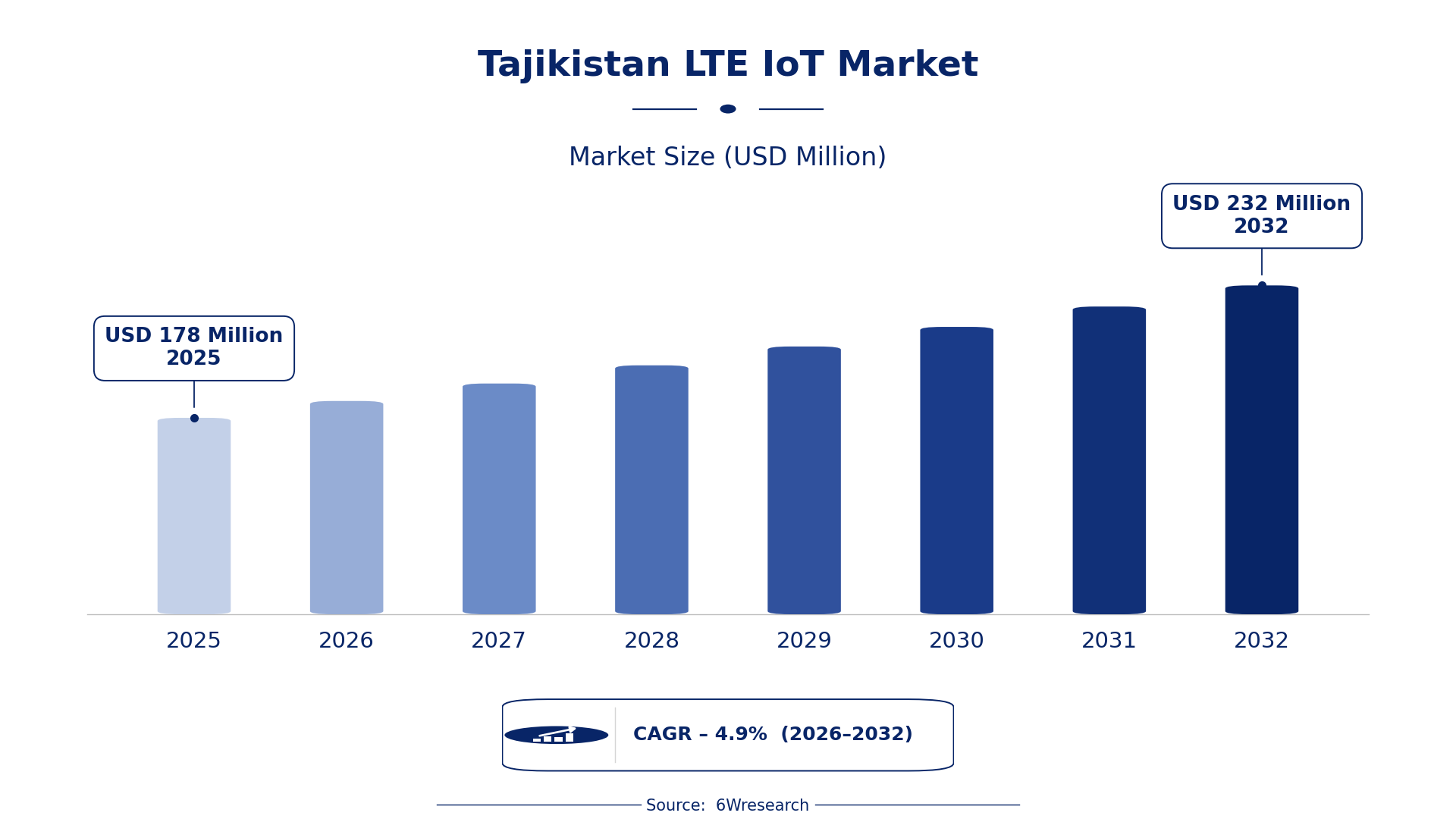
The Tajikistan LTE IoT Market was estimated at USD 178 Million in 2025 and is projected to reach USD 232 Million by 2032, growing at a CAGR of 4.9% from 2026 to 2032.
Tajikistan LTE IoT Market Synopsis
The Tajikistan LTE IoT market is currently gaining traction, fueled by increasing investments in digital infrastructure and IoT adoption across sectors like agriculture and manufacturing. However, this momentum is set against a backdrop of structural challenges that could impact the speed of this growth.
As urban areas ramp up LTE network deployment, businesses are beginning to experience enhanced connectivity for their IoT devices, translating to better operational efficiency and cost reduction. The government’s focus on promoting digital transformation aligns closely with market needs, potentially unlocking new avenues for expansion.
Tajikistan LTE IoT Market Year-wise Growth Rate and Key Drivers
This graph illustrates the annual growth rates of the Tajikistan LTE IoT Market from 2021 to 2032, highlighting a steady upward trajectory and projected expansion over the forecast period.
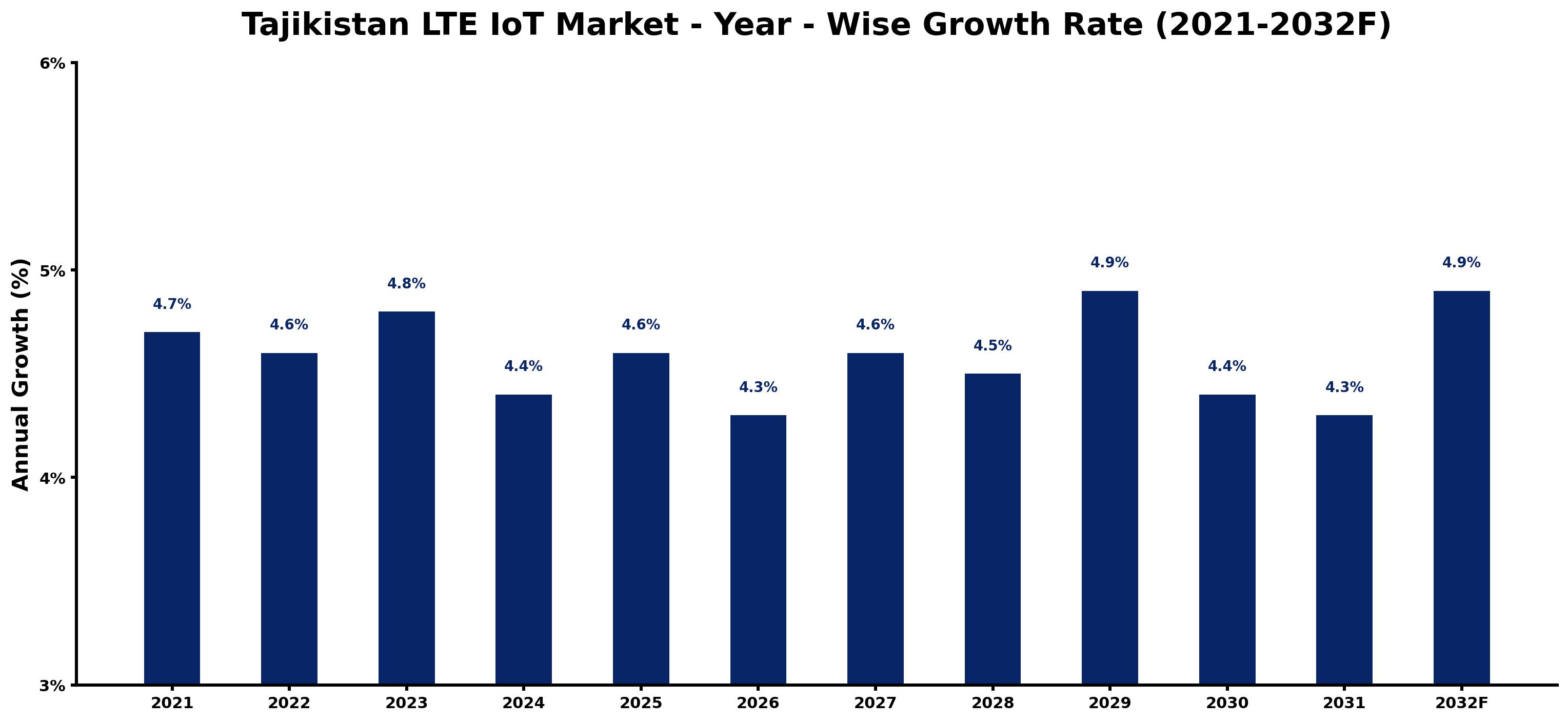
The table below presents the year‑wise growth rates along with the key drivers influencing the market
| Year | Growth Rate | Major Drivers |
| 2021 | 4.7% | Launch of National IoT Development Strategy by government. |
| 2022 | 4.6% | Increased cellular coverage expansion by Tcell and Beeline. |
| 2023 | 4.8% | Growing agricultural IoT initiatives from Tajikistan's Ministry of Agriculture. |
| 2024 | 4.4% | Investment in smart city projects by Dushanbe municipality. |
| 2025 | 4.6% | Enhancements in connectivity infrastructure by Tajiktelecom. |
| 2026 | 4.3% | Regulatory support for broadband expansion in rural areas. |
| 2027 | 4.6% | Rising popularity of smart meter implementations for utilities. |
| 2028 | 4.5% | Collaboration with international tech firms for IoT training. |
| 2029 | 4.9% | Increased local production of IoT devices and solutions. |
| 2030 | 4.4% | Support from Asian Development Bank for digital infrastructure. |
| 2031 | 4.3% | Growth in fintech solutions utilizing IoT for transactions. |
| 2032 | 4.9% | Government focus on disaster management technologies via IoT. |
Note: Market size estimations and growth projections presented in this report are based on 6Wresearch's proprietary forecasting methodology, utilizing the latest available industry data, government publications, and primary research inputs.
Tajikistan LTE IoT Market Key Takeaways
Below are some of the specific key takeaways from the market, including:
- The market is projected to grow from USD 178 Million in 2025 to USD 232 Million by 2032, indicating a promising growth trajectory.
- Widespread adoption of IoT technologies is being driven by sectors such as agriculture, manufacturing, and utilities.
- Government initiatives aimed at digital transformation are creating an environment conducive to LTE IoT advancements.
- Investment in LTE-M and NB-IoT networks is expanding coverage and improving connectivity for IoT applications.
- Challenges related to infrastructure and costs remain significant but are being addressed through collaborative efforts.
Evaluation of Restraints in Tajikistan LTE IoT Market
Despite its potential, the Tajikistan LTE IoT market is facing hurdles that can hamper its overall growth. Infrastructure limitations, particularly in rural regions, restrict the reach of LTE connectivity, making it difficult for businesses in these areas to adopt IoT solutions. Furthermore, the high cost associated with IoT devices continues to be a barrier for many potential users.
The lack of skilled workforce to install and maintain IoT systems exacerbates the situation, leaving businesses in a lurch as they try to implement these technologies. Regulatory concerns, especially regarding data privacy and security, also create hesitance among potential adopters, which could delay the broader market maturation.
Tajikistan LTE IoT Market Trends
Several key trends are currently influencing the Tajikistan LTE IoT market. The rise of LTE-M and NB-IoT networks highlights a shift towards more efficient connectivity options tailored for IoT applications. These networks not only provide improved coverage but also enhance power efficiency, making them more suitable for devices requiring long battery life.
In industries like agriculture and transportation, businesses are increasingly utilizing LTE IoT solutions for purposes such as asset tracking and remote monitoring. The ongoing push towards smart city initiatives is further stimulating the demand for advanced IoT systems, positioning the market for continued innovation.
Tajikistan LTE IoT Market Opportunities
The investment landscape within the Tajikistan LTE IoT market reveals significant opportunities. As the government emphasizes infrastructure development, there is an increasing need for efficient IoT services, particularly in sectors like agriculture, healthcare, and manufacturing. Investors can capitalize on this demand by providing tailored IoT devices and network solutions.
Collaboration with local telecom companies and government bodies can aid in overcoming regulatory challenges, thus establishing a strong foothold in the market. Furthermore, the emergence of smart city projects presents a fertile ground for deploying cutting-edge LTE IoT solutions, fostering long-term growth.
Government Initiatives in the Tajikistan LTE IoT Market
The Tajik government has recognized the vital role that IoT technologies play in modernizing the economy and is actively pursuing policies to bolster the LTE IoT market. By focusing on infrastructure improvements and regulatory reforms, the government is creating a supportive environment for industry growth. These initiatives are critical for attracting both local and foreign investments.
- A national digital infrastructure upgrade programme launched in early 2023 aims to expand telecommunications access across rural and urban areas.
- The government has introduced incentives for private sector participation in IoT initiatives, encouraging innovation and investment.
- A regulatory framework established in late 2022 is designed to enhance data security and privacy, building trust in IoT solutions.
- Current efforts are underway to facilitate public-private partnerships that will expand LTE network coverage by 2025.
- Future plans include a nationwide awareness campaign aimed at educating businesses about the benefits of adopting IoT technologies, expected to launch in mid-2024.
Future Insights of the Tajikistan LTE IoT Market
Looking ahead to 2026-2032, the Tajikistan LTE IoT market is expected to experience significant growth. Increasing adoption across multiple sectors will drive demand, fueled by government initiatives and expanding digital infrastructure. The anticipated rollout of 5G networks will further enhance capabilities, allowing for new applications and services that leverage IoT technology.
As businesses increasingly embrace connectivity and automation, the market will provide numerous opportunities for innovation and investment. Stakeholders who adapt quickly to these evolving trends will find themselves well-positioned to capture a share of this burgeoning market.
Tajikistan LTE IoT Market Latest Developments
Recent months have witnessed a series of developments in the Tajikistan LTE IoT market, indicating a growing commitment from both public and private sectors to advance IoT technology. Investment in LTE infrastructure is ramping up, with various projects aimed at enhancing service availability. This trend is critical as businesses increasingly recognize the value of IoT solutions for operational efficiency and competitive advantage.
- In early 2023, a leading regional operator completed the expansion of its LTE network to cover several previously underserved areas, enhancing connectivity for businesses.
- An ongoing project initiated in mid-2023 aims to deploy IoT-enabled smart meters across urban centers, improving resource management.
- A technology vendor is expected to launch a new line of affordable IoT devices tailored for the local market by late 2024.
- Partnerships among telecom providers and agricultural firms are currently being established to pilot IoT solutions for precision farming, set to begin in Q3 2025.
- A public-private initiative focused on developing IoT applications for smart city projects is planned to commence in 2026.
Tajikistan LTE IoT Market - Key Attractiveness of the Report
- 10 Years of Market Numbers
- Historical Data Starting from 2022 to 2025
- Base Year: 2025
- Forecast Data until 2032
- Key Performance Indicators Impacting the Market
- Major Upcoming Developments and Projects
Key Highlights of the Report:
- Tajikistan LTE IoT Market Outlook
- Market Size of Tajikistan LTE IoT Market, 2025
- Forecast of Tajikistan LTE IoT Market, 2032
- Historical Data and Forecast of Tajikistan LTE IoT Revenues & Volume for the Period 2022-2032F
- Tajikistan LTE IoT Market Trend Evolution
- Tajikistan LTE IoT Market Drivers and Challenges
- Tajikistan LTE IoT Price Trends
- Tajikistan LTE IoT Porter's Five Forces
- Tajikistan LTE IoT Industry Life Cycle
- Historical Data and Forecast of Tajikistan LTE IoT Market Revenues & Volume By Technology for the Period 2022-2032F
- Historical Data and Forecast of Tajikistan LTE IoT Market Revenues & Volume By NB-IoT for the Period 2022-2032F
- Historical Data and Forecast of Tajikistan LTE IoT Market Revenues & Volume By LTE-M for the Period 2022-2032F
- Historical Data and Forecast of Tajikistan LTE IoT Market Revenues & Volume By Service for the Period 2022-2032F
- Historical Data and Forecast of Tajikistan LTE IoT Market Revenues & Volume By Professional Services for the Period 2022-2032F
- Historical Data and Forecast of Tajikistan LTE IoT Market Revenues & Volume By Managed Services for the Period 2022-2032F
- Historical Data and Forecast of Tajikistan LTE IoT Market Revenues & Volume By Industry for the Period 2022-2032F
- Historical Data and Forecast of Tajikistan LTE IoT Market Revenues & Volume By Manufacturing for the Period 2022-2032F
- Historical Data and Forecast of Tajikistan LTE IoT Market Revenues & Volume By Energy and utilities for the Period 2022-2032F
- Historical Data and Forecast of Tajikistan LTE IoT Market Revenues & Volume By Transportation and logistics for the Period 2022-2032F
- Historical Data and Forecast of Tajikistan LTE IoT Market Revenues & Volume By Healthcare for the Period 2022-2032F
- Historical Data and Forecast of Tajikistan LTE IoT Market Revenues & Volume By Agriculture for the Period 2022-2032F
- Tajikistan LTE IoT Import Export Trade Statistics
- Market Opportunity Assessment By Technology
- Market Opportunity Assessment By Service
- Market Opportunity Assessment By Industry
- Tajikistan LTE IoT Top Companies Market Share
- Tajikistan LTE IoT Competitive Benchmarking By Technical and Operational Parameters
- Tajikistan LTE IoT Company Profiles
- Tajikistan LTE IoT Key Strategic Recommendations






































